July 16, 2026
HSE Disciplinary Procedure: A Guide for Irish Hospitality
Navigate the HSE disciplinary procedure with confidence. Our guide for Irish hospitality covers steps, common mistakes, and how to build a WRC-compliant policy.

It's half an hour after service. A supervisor has just told you the same bartender ignored cash-handling rules again. Last week it was lateness. Before that, it was a row with a colleague on the floor. You know the standards are slipping. You also know one rash decision can leave you defending an unfair process instead of fixing the problem.
That's where many hospitality managers freeze. They're not unsure that something went wrong. They're unsure what they can prove, what they should say next, and whether the next step will protect the business or create a bigger problem.
In hotels, restaurants, and bars, discipline often gets treated as a last resort. That's a mistake. A good disciplinary process isn't just about sanctions. It's a management system. It sets expectations, records problems properly, gives employees a fair chance to improve, and puts structure around difficult decisions before tempers or operational pressure take over.
The hse disciplinary procedure matters here for one simple reason. It shows what a mature Irish disciplinary framework looks like when an employer has had to formalise fairness, consistency, and management accountability at scale. Private hospitality businesses don't copy it word for word. They adapt its logic. Done properly, that gives you a policy that's far more likely to stand up when your decisions are questioned.
The Moment Every Manager Dreads
A recurring staff issue rarely arrives at a convenient time. It lands in the middle of a wedding weekend, during a breakfast rush, or on the same day two people call in sick. The pressure in hospitality pushes managers towards speed. The legal risk pushes them towards caution. That tension is exactly why so many disciplinary situations go wrong.
Operational frustration versus fair procedure
Take a common scenario. A chef has been warned informally about turning up late for prep. Then a senior team member says he's also been ignoring temperature recording procedures. The General Manager is angry, the Head Chef wants him gone, and payroll is due the next morning. In that moment, it's tempting to treat the latest incident as the final straw and move straight to a severe sanction.
That instinct is understandable. It's also where weak cases start.
The problem usually isn't that the employee's conduct was acceptable. The problem is that the employer can't show a fair path from issue to outcome. There's no dated note of the first conversation. No clear record of what standard was explained. No proper investigation into the safety allegation. No letter inviting the employee to a meeting. No real distinction between frustration, suspicion, and proven misconduct.
Practical rule: If your process only exists in managers' memories and WhatsApp messages, it won't protect you.
Hospitality businesses are especially exposed because standards are enforced in real time. A floor manager corrects behaviour on the spot. A duty manager tells someone to go home after a row with a guest. A Head Chef loses patience and says, “If this happens again, you're done.” That may feel decisive, but without structure it often produces inconsistent treatment and poor documentation.
Why this matters more than managers think
Discipline is often spoken about as if it's separate from operations. It isn't. Attendance, food safety, guest interaction, till accuracy, stock control, and team conduct all sit inside operational discipline. If managers don't deal with those issues promptly and fairly, standards drift. If they overreact without process, they create a different problem.
A sound disciplinary framework helps you do three things at once:
- Protect standards: Staff know what's required and what happens if they fall short.
- Protect fairness: Employees get a chance to respond, improve, and challenge decisions.
- Protect the business: Managers create a record that explains why action was taken.
That's why the right question isn't “Can I discipline this person?” It's “Can I show that I managed this issue fairly, consistently, and with evidence?” Once you start there, the hse disciplinary procedure stops looking like public-sector bureaucracy and starts looking like what it really is for private employers. A model of control.
Why the HSE Procedure is Your Gold Standard
The phrase hse disciplinary procedure can sound irrelevant to a hotel or restaurant operator. It isn't. It's one of the clearest Irish examples of a disciplinary system built around fairness, documented standards, and managerial responsibility.

What makes it such a useful benchmark
The current HSE employee disciplinary procedure was last reviewed in January 2007, and a new review was expected to be completed by the end of 2025, making it the first full review in over 18 years. That review was said to consider legislative changes, employment case law developments, organisational changes within the HSE since 2007, and updated HR best practice, as reported by the Medical Independent's coverage of the HSE disciplinary procedure review.
For a private employer, the point isn't to admire its age. The point is stability. A framework that has operated across a large Irish employer for that length of time reflects a serious attempt to balance standards with procedural fairness. That makes it a strong reference point when you're designing your own internal policy.
The principles private hospitality should borrow
The HSE model is useful because it forces managers to separate process from emotion. In hospitality, that's half the battle.
A solid policy adapted from that framework should include:
- Clear standards: Attendance, conduct, safety, guest treatment, cash procedures, and reporting lines must be set out before you try to enforce them.
- Graduated response: Not every issue belongs at the same level. Some matters need coaching. Some need formal warnings. Some may justify stronger action after proper investigation.
- A real right to respond: Managers need to hear the employee's version before deciding outcome.
- Documented consistency: Similar cases should be handled in a similar way unless there's a recorded reason for the difference.
- An appeal route: A decision should never look final without a chance for review.
The strongest disciplinary policies don't just tell staff what can go wrong. They tell managers exactly how to respond when it does.
Your Step-by-Step Disciplinary Process Map
A workable disciplinary system needs a sequence. Managers get into trouble when they skip steps, merge investigation with decision-making, or treat a formal meeting as a dressing-down. The safest route is a staged process that starts with facts and only then moves to outcome.
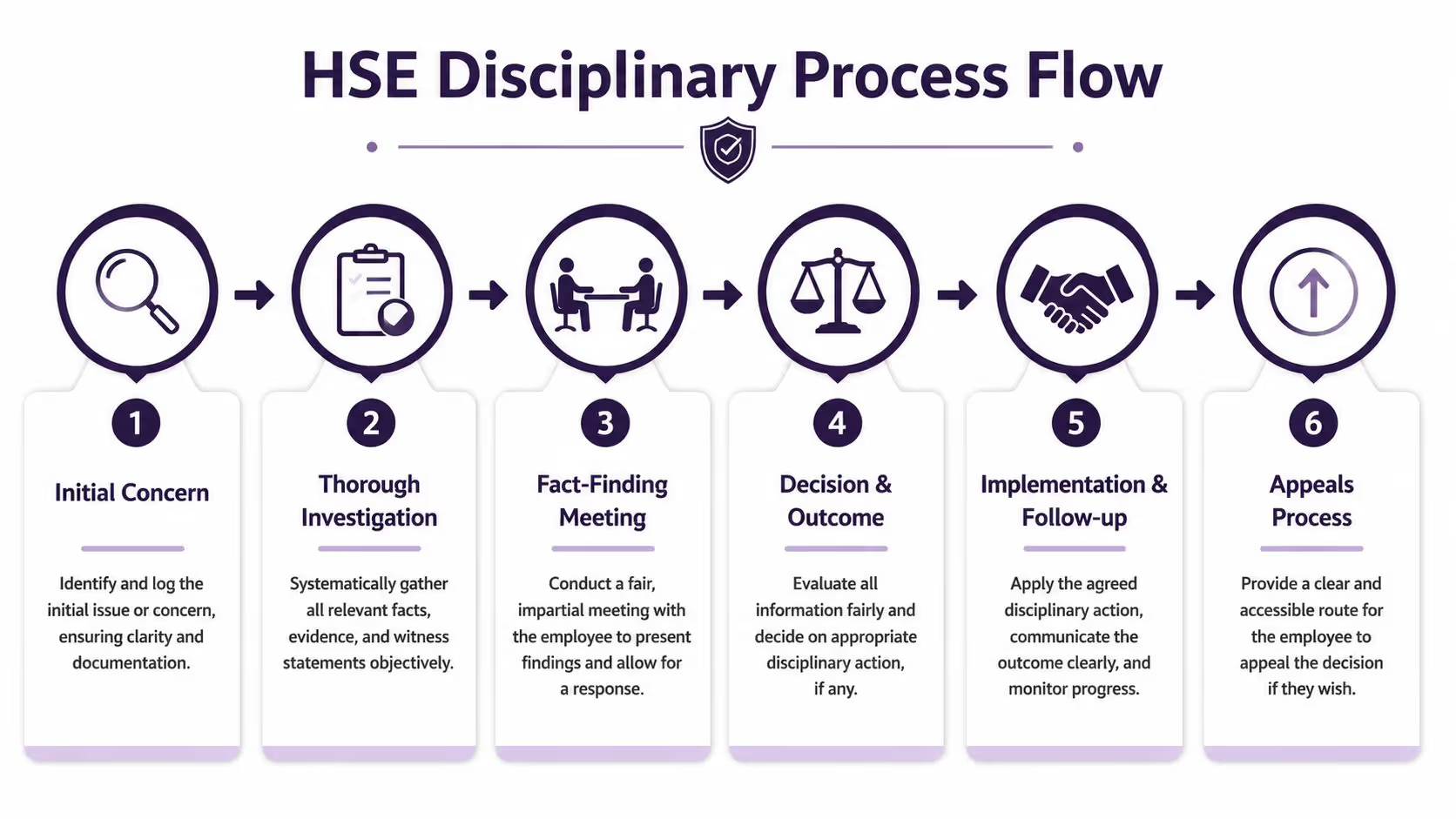
The HSE's own procedure states that its key objective is to help the employee maintain required standards, rather than to punish, according to the HSE disciplinary procedure for employees. That corrective purpose should shape every stage below.
Stage one with the issue before it becomes a case
Not every problem starts formally. A one-off lapse, minor lateness, or first complaint about attitude may justify an informal management conversation first. The goal is clarity. Tell the employee what standard wasn't met, why it matters, and what must change.
Keep a brief manager note even at this stage. Informal doesn't mean invisible.
If the problem improves, that may be the end of it. If it continues, the note becomes part of the timeline showing early intervention rather than ambush.
Stage two investigate before you accuse
Once the issue may lead to formal action, slow down. Investigate first.
That means gathering rosters, CCTV where appropriate, till reports, temperature logs, witness accounts, guest complaints, or manager notes. If the allegation is interpersonal, speak to everyone involved separately. If it concerns safety, identify the rule, when it was communicated, and what evidence shows a breach.
A proper investigation asks one question: What happened? It doesn't ask, “How do we justify the warning we've already decided to give?”
A disciplinary hearing is not the place to discover basic facts for the first time.
Stage three hold a fair fact-finding or disciplinary meeting
When the matter is moving formally, invite the employee in writing. Set out the allegations or concerns clearly enough that they can answer them. Give them reasonable notice. Tell them who will attend and whether they may be accompanied in line with your policy.
At the meeting:
- State the issue clearly: Avoid loaded language and stick to facts.
- Walk through the evidence: Dates, incidents, records, and witness information.
- Let the employee respond fully: Don't cut them off because you think you already know the answer.
- Ask follow-up questions: Clarify contradictions, context, mitigation, and whether training or instruction was missing.
The chair should stay measured. A disciplinary meeting is not a performance of authority. It is part of a fair process.
Stage four decide outcome by reference to the evidence
After the meeting, assess the material and decide proportionately. Not every proven issue requires a warning. Not every repeated issue should remain informal.
Common outcomes include:
- No formal action: Evidence is weak, the allegation isn't made out, or the matter is best dealt with through coaching.
- Informal guidance with review: Suitable where there's concern but formal sanction would be premature.
- Formal warning: Appropriate where the issue is substantiated and improvement is required.
- Final warning or stronger sanction: Considered where there's repetition, serious impact, or prior live warnings.
- Dismissal: Reserved for cases where the facts and the process justify it.
The outcome letter matters as much as the meeting. It should record the issue, findings, sanction if any, improvement required, review period if your policy uses one, and the right of appeal.
Stage five monitor and follow through
A warning without follow-up is poor management. If you've told an employee attendance must improve, someone needs to review attendance. If the issue involved food safety, a manager should check logs and behaviours. If the problem was conduct, line management needs to observe whether standards are being maintained.
Many policies fail at this point. They describe sanctions but say nothing about what happens after. A good process closes the loop.
Stage six separate the appeal from the original decision
An appeal should be heard by someone not involved in the original decision wherever possible. The point isn't to rubber-stamp the first outcome. It's to test whether the decision was reasonable and whether the process was fair.
Mastering the Evidence the WRC Demands
Most disciplinary cases don't collapse because the employer had no issue to address. They collapse because the employer can't prove how the issue was handled. Evidence is what turns a manager's account into a defensible process.

What good evidence looks like
Good documentation is boring in the best possible way. It is dated, specific, legible, relevant, and stored where it can be retrieved quickly. It doesn't contain emotional commentary, insults, or lazy shorthand.
For managers, that means writing notes like this:
- Specific incident: Date, time, location, who was present, and what happened.
- Clear standard: Which policy, instruction, roster requirement, or safety rule was involved.
- Employee response: What the employee said when asked.
- Management action: Informal coaching, investigation step, meeting invite, warning, or no action.
- Next step: Review date, expected improvement, or appeal route.
What doesn't help is “attitude problem,” “always late,” or “bad with customers.” Those are conclusions. They aren't evidence.
The core records every hospitality employer should keep
If you ever need to explain your process, you should be able to produce a clean file. In practical terms, that file usually needs:
- Informal file note: Shows early intervention and that the standard was explained.
- Investigation notes: Details who was interviewed and what records were checked.
- Meeting invitation: Outlines what the employee was told before the meeting.
- Meeting minutes: Captures what was discussed and how the employee responded.
- Outcome letter: Documents the findings, sanction, expectations, and the appeal route.
- Appeal record: Logs the grounds of appeal and the final decision.
A strong record also shows chronology. That matters. An employer who can show concern, inquiry, meeting, decision, and follow-up in order looks organised. An employer who produces scattered emails and memory-based explanations looks reactive.
Keep one central incident log. If managers in different departments each hold their own unofficial notes, consistency disappears.
Evidence in hospitality cases is often operational evidence
Hospitality businesses usually already hold the records that matter. They just don't connect them to HR decisions properly.
Operational evidence can include rota history, clock-in records, stock variances, guest complaint logs, CCTV, HACCP records, cleaning schedules, training sign-off sheets, or manager shift reports. Used properly, those records give context. Used badly, they create confusion because nobody explains what they prove.
That's why managers need a basic discipline-and-records mindset, not just HR support after the fact. If you want a practical overview of how disputes are handled, the Beacon guide to the Workplace Relations Commission is a useful starting point.
The standard for written warnings
A written warning should answer five questions without forcing anyone to guess:
- What was the allegation or concern?
- What facts were found?
- Why was this considered misconduct or underperformance?
- What improvement is required?
- What happens if the issue continues?
If your warning letter is just a template filled with vague language, it won't carry much weight. The best warning letters read like careful management records, not threats drafted in anger.
Common Disciplinary Mistakes in Hospitality
Hospitality creates its own disciplinary traps. The pace is fast, complaints are immediate, and managers often supervise while firefighting. That environment doesn't remove the need for fairness. It makes fairness harder to deliver consistently.

Guidance from health and safety bodies also treats discipline as part of operational control. The UK HSE's workplace transport guidance states that management must enforce compliance through supervision and a penalty system, and that repeated breaches after documented warnings and clear instruction on the safe alternative can become grounds for termination, as set out in the HSE guidance on procedures for non-compliance. That logic applies neatly to hospitality safety rules too.
Mistake one picking favourites without realising it
A classic example is lateness. One employee gets a formal warning because they're already on a manager's radar. Another drifts in late regularly and gets jokes instead of action because they're popular or hard to replace. The inconsistency becomes the story.
Managers often tell themselves the cases are
different. Sometimes they are. Often the difference was never documented.
Mistake two treating guest complaints as automatic proof
A bad online review names a server. A wedding organiser complains about a supervisor's tone. A regular customer says a bartender was rude. Those issues may justify investigation, but they do not justify instant findings.
Guest complaints are evidence of an allegation, not evidence that the allegation is true. You still need to check rota details, speak to the employee, review any contemporaneous notes, and test whether there were witnesses or context.
A customer can trigger a process. A customer should not decide the outcome.
Mistake three skipping investigation in staff-on-staff allegations
This happens constantly in bars, kitchens, and accommodation teams. Someone reports bullying, aggressive language, or inappropriate comments. Management calls both people into the office together and tries to “sort it out” in one sitting.
That approach usually fails. It contaminates evidence, pressures the reporting employee, and leaves no proper investigative record. Separate accounts first. Review messages if relevant and lawful. Identify witnesses. Then decide whether the matter belongs in informal resolution, a formal disciplinary route, or a more serious process.
Mistake four treating safety breaches as ordinary performance issues
In hospitality, many serious disciplinary matters sit inside health and safety. Ignoring a cleaning chemical procedure, bypassing food safety checks, refusing manual handling instructions, or disregarding a safe system of work can't be brushed off as “not ideal”.
The right response isn't automatic dismissal. It's controlled escalation. Explain the safe alternative clearly. Record the breach. Warn appropriately where justified. If breaches continue after forewarning and instruction, the employer is in a much stronger position to take serious action. If your issue falls into a severe category, the Beacon explainer on gross misconduct gives useful context on where employers often go wrong.
Mistake five allowing angry managers to become sole decision-makers
One of the weakest setups is this: the same manager witnesses the problem, investigates it, chairs the hearing, decides the sanction, and rejects the appeal. That may happen in smaller businesses through necessity, but where possible you should split roles.
A useful internal check is simple:
- Who saw the incident
- Who investigated
- Who chaired the meeting
- Who approved the outcome
- Who heard the appeal
If all five answers are the same person, the process needs more control.
What works better in real operations
The strongest hospitality employers do a few practical things well:
- They train line managers on note-taking: Not legal theory. Just how to record facts.
- They keep one live warning register: So managers know what stage an employee is at.
- They write standards into handbooks and induction: Especially around attendance, guest conduct, cash, and safety.
- They pause before deciding: Even when the incident feels obvious.
That pause is where good decisions are made.
Build Your Bulletproof Policy with Beacon
Most hospitality businesses don't struggle because they've never heard of a disciplinary process. They struggle because the policy on file doesn't match what managers do on a Saturday night, in a staff accommodation issue, or during a food safety problem in the middle of service.
That gap is where risk lives.
A policy worth having must do more than define misconduct. It must fit your operation, your reporting lines, your documents, and your management capability. It should tell a duty manager how to log an issue, tell a senior manager how to investigate, and tell the business how to separate warnings, hearings, and appeals. It should also sit cleanly beside contracts, handbook standards, onboarding records, and manager training.
That's why implementation matters more than templates. A technically correct policy can still fail if nobody knows when to suspend, how to invite someone to a meeting, what to put in an outcome letter, or when a safety issue becomes a disciplinary one.
For hospitality operators who need that system built properly, Beacon's HR consulting support is designed around operational reality. That includes staff handbooks, employment documentation, policy drafting, people audits, and practical support for managers who need to run fair processes under pressure. The value isn't in adding paperwork. It's in building one consistent way of managing people that protects standards and holds up when challenged.
A good disciplinary framework doesn't make difficult conversations disappear. It makes them manageable, fair, and defensible.
If your hotel, restaurant, or hospitality group needs a disciplinary policy that works in real operations, Beacon Recruitment can help you build it properly. Our team supports Irish hospitality businesses with practical HR systems, compliant handbooks, contracts, and manager guidance that turn process into protection.
Is Your Disciplinary Policy Putting You at Risk?
Don’t wait for a WRC claim to test your processes. Book a Free Consultation with Beacon today to build a bulletproof HR framework that protects your hospitality business.