July 16, 2026
A 2026 Guide to TUPE Regulations Ireland for Employers
A practical guide to TUPE regulations Ireland for hospitality owners. Learn your obligations, follow our checklist, and avoid pitfalls in a business transfer.

You've agreed the sale. Or the lease assignment is nearly done. Or you're taking over a café, bar, hotel, or catering operation that already has a team on site. The first instinct is usually operational. Who's on the rota next week, who holds the keys, who knows the booking system, who can open breakfast service without drama.
Then the harder question lands. What happens to the staff?
In hospitality, that question is never theoretical. A venue can look ready on paper and still fall apart in the first week if payroll is wrong, managers don't know who reports to whom, holiday balances are unclear, or long-serving staff feel they've been treated like disposable stock. That's where tupe regulations matter. They are the rulebook for business transfers, and they affect far more than contracts in a filing cabinet.
The practical pressure is real. You want continuity for guests, stability for managers, and no nasty surprise sitting in your inbox from the WRC a few weeks later. You also don't want to spend the handover buried in legal language while service standards slide on the floor.
That's why the right approach isn't to treat TUPE as a legal side issue. It has to sit inside your transition plan from the start, alongside payroll, stock, supplier accounts, licensing, accommodation arrangements, and team communications. If you need support translating transfer law into day-to-day HR actions, hospitality HR consulting support is often the difference between a controlled handover and a messy one.
Introduction When Your New Venture Comes with an Old Team
A new venue rarely arrives empty.
You inherit habits, personalities, unwritten rules, key staff, weak managers, strong supervisors, and often one or two people who carry more operational knowledge than anyone realised during due diligence. In hospitality, the team is part of the asset. If that team panics, feels ignored, or receives mixed messages, the damage shows up fast in service, standards, and retention.
That's why employers need to think about TUPE early, not after contracts are signed. A transfer isn't just about whether people move across. It's about how to move them across without breaking continuity, trust, or compliance.
The real issue is continuity
Most owners I speak with don't object to protecting staff. What catches them out is the operational detail. They assume the legal side can be dealt with by a few notices and a payroll instruction. It can't.
A hospitality transfer usually raises questions like these:
- Shift continuity: Who works the first weekend under the new operator, and who approves rota changes?
- Management authority: Which existing supervisors still have decision-making authority on day one?
- People records: Are contracts, warnings, absences, and holiday balances up to date?
- Employee confidence: What have staff been told, by whom, and when?
Staff don't judge a transfer by the sale agreement. They judge it by whether their wages arrive, their shifts make sense, and someone answers questions honestly.
Why this matters more in hospitality
A law firm can absorb confusion for a few days. A restaurant, hotel, or pub can't. Hospitality runs on visible people processes. If there's uncertainty around hours, reporting lines, tips, uniforms, live-in arrangements, or who is staying, everyone feels it immediately.
That's why a practical TUPE plan matters. Not because the legislation is abstractly important, but because business continuity depends on it.
What TUPE Actually Means for Your Hospitality Business
At its simplest, TUPE means the business transfer may carry employees with it, not as a fresh recruitment exercise, but as existing employees with history attached.
The transfer process is comparable to taking over a vehicle with its full logbook, service record, and ownership trail. You do not receive the benefit of the asset and then decide the history no longer counts. In a transfer, the employment relationship may move with the business activity.

The legal foundation in Ireland
Ireland's TUPE framework is grounded in the European Communities (Protection of Employees on Transfer of Undertakings) Regulations 2003, and under those rules an employee's accrued service with the original employer is deemed to transfer to the new employer, preserving continuity of employment rather than resetting service on completion of the transfer, as set out by the Workplace Relations Commission guidance on transfer of undertakings.
That point matters in practice. Length of service doesn't disappear because the signage changes over the door. If someone has years of service behind them, you should approach the transfer on the basis that this history comes across too.
What counts in hospitality
The phrase tupe regulations ireland often gets discussed as if it only applies to large corporate deals. In hospitality, it can arise in much more ordinary trading situations.
Examples include:
- A venue sale: A restaurant, pub, or hotel changes hands and continues operating.
- Part of a business moving: A catering function, banqueting arm, or specific operation moves to another employer.
- A lease-based change: One operator exits and another takes over the premises and business activity.
- A merger-style arrangement: Two operations combine and one employer becomes responsible for the relevant team.
The broad principle from the WRC is that the regulations apply to any transfer of an undertaking, business, or part of a business from one employer to another by legal transfer, including assignment or forfeiture of a lease, or merger.
Who is affected on the ground
Hospitality teams are rarely neat. You may have full-time chefs, part-time floor staff, seasonal workers, reception staff, duty managers, kitchen porters, accommodation assistants, and people whose contract paperwork hasn't kept pace with reality.
That's why employers should avoid simplistic assumptions such as “only permanent staff transfer” or “only the people we want to keep matter”. They don't hold up well once the facts are examined.
Practical rule: If a role is part of the transferring operation, treat the people impact as a live TUPE issue early. Don't wait until the final week to work out who sits where.
Your Legal Obligations Under Irish TUPE Regulations
The central employer duty is not just to know a transfer is happening. It is to inform and consult properly.
That obligation catches operators out because they focus on the commercial deal first and leave employee communications until very late. In hospitality, late communication is especially risky. Staff hear rumours from suppliers, guests, and social media before they hear a formal explanation from management.
The consultation timing that matters
A major Ireland-specific compliance milestone is the consultation timing requirement. Parties must provide transfer information to employees' representatives, where reasonably practicable, not later than 30 days before the transfer date and in any event in good time before the transfer occurs. Unlike in some other jurisdictions, this obligation applies to all undertakings, regardless of employee numbers, as noted in DAC Beachcroft's comparison of TUPE legislation in ROI and GB.
That has two practical consequences for hospitality employers.
- Small operator doesn't mean exempt: A single-site business can still be inside the obligation.
- Late deal activity creates pressure: If legal completion is moving quickly, HR work still has to be done in time.
What employers should communicate
The legal requirement is often described in broad terms, but the operational version is clearer. Representatives need enough information to understand what's happening and what it means for affected employees.
Your communication process should cover:
- Transfer timing: The expected date, or proposed date, and whether anything could shift.
- Reason for the transfer: A concise explanation that makes commercial sense to staff.
- Implications for employees: Legal, social, and economic implications should be explained in plain language.
- Proposed measures: Any operational changes being considered by the current or incoming employer.
If your employee communication reads like a solicitor's note rather than a management briefing, expect confusion.
Documentation is not optional
Good employers document every stage. Bad employers rely on verbal reassurance and memory.
Keep a written record of:
- who the representatives are
- what information was issued
- when meetings happened
- what questions were raised
- what answers were given
- any follow-up actions
This protects the business and helps managers stay consistent.
For operators worried about complaints or inspection risk, it helps to understand the role of the Workplace Relations Commission in Irish employment disputes.
Consultation isn't a ceremony. It's a process. If staff can show they were told too late, told too little, or told through rumour, the business starts from a weak position.
What doesn't work
Some habits nearly always create trouble:
- Last-minute announcements: Staff hear the news when the deal is effectively done and feel ambushed.
- Manager improvisation: Different supervisors give different answers about pay, jobs, and reporting lines.
- Incomplete handover files: The incoming employer gets partial information and discovers issues after transfer.
- Silence on practical implications: People aren't told what happens to shifts, holiday bookings, or line management.
A transfer can be commercially smooth and still be an employment mess if this part is handled poorly.
A Step-by-Step TUPE Compliance Checklist for Operators
Most online material stops at employee protection. That's useful, but it doesn't help much when you're trying to hand over a busy venue without payroll errors, rota chaos, or avoidable grievances. Irish employers need a practical readiness pack that answers hospitality-specific questions around due diligence, consultation timing, rosters, tips and service charges, holiday balances, probation clauses, and the documents needed so payroll and HR continuity are not broken on day one, as highlighted in Collier Broderick's overview of transfer of undertakings.
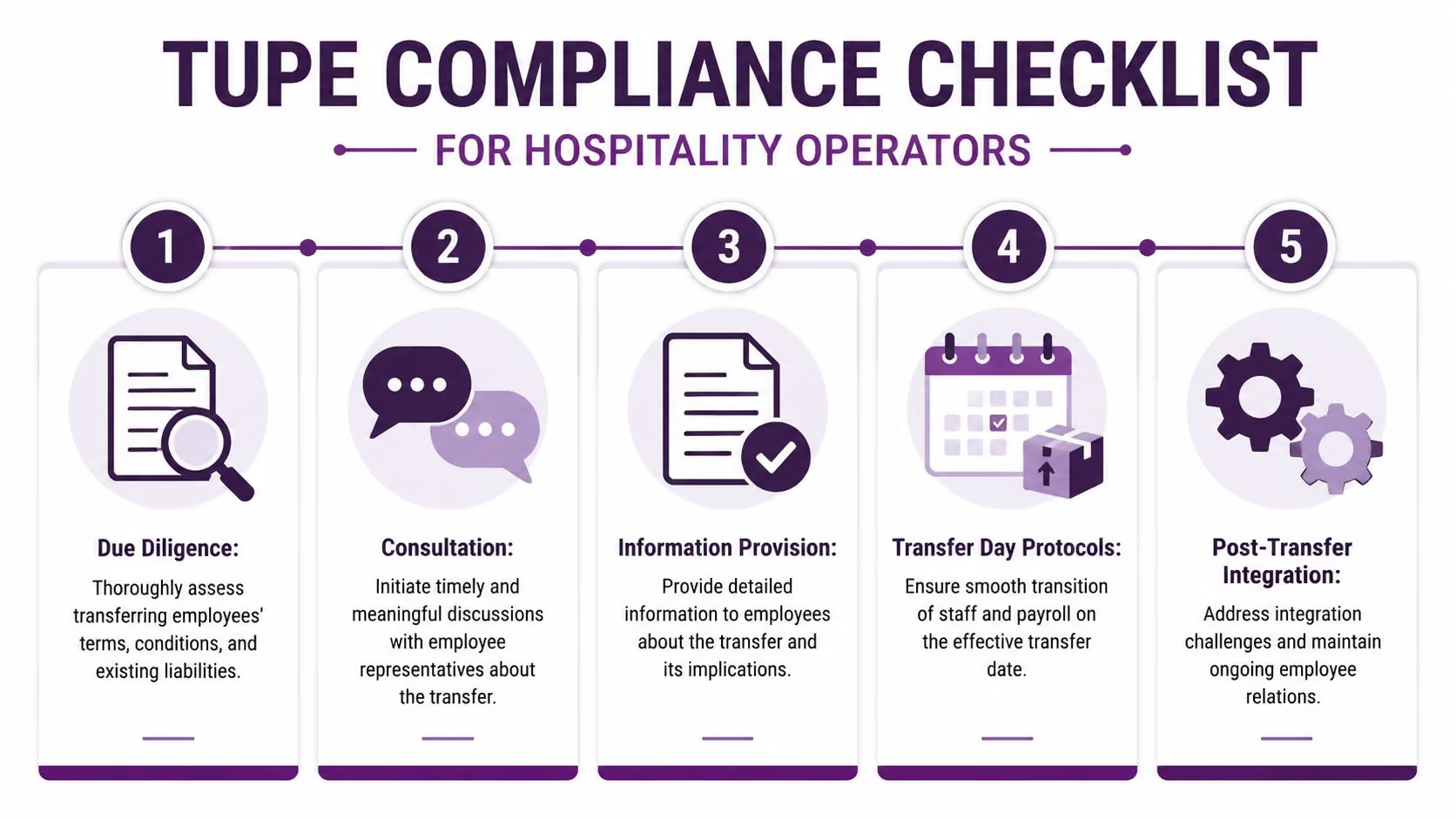
Phase one before signatures are dry
Start with people due diligence, not just commercial due diligence.
Ask for the core employment pack early:
- Contracts and amendments: You need current contracts, not old templates that no longer match practice.
- Organisation chart: Even a simple reporting map helps expose informal structures.
- Payroll data: Names, roles, rates, allowances, and normal working patterns should match reality.
- Leave and absence records: Outstanding annual leave, family leave, sick leave patterns, and approved future leave matter.
- Active issues: Ongoing grievances, disciplinary matters, or disputed terms shouldn't be discovered after completion.
This is also the point to map the hospitality-specific items that often sit outside standard HR files.
Look at:
- Rosters and working patterns
- Tips or service charge arrangements
- Accommodation linked to employment
- Uniform deductions or deposits
- Probation clauses that may still be active on paper
- Custom and practice issues such as staff meals or transport support
Phase two build the information and consultation process
Once you know who is affected, sort the communication route.
If there are existing representatives, work through them properly. If there aren't, don't ignore that gap and hope a general staff meeting will do the job. The process needs structure.
A solid consultation pack usually includes:
- the proposed transfer date
- the commercial reason for the transfer
- the likely employee impact
- any measures being considered
- a channel for questions and follow-up
Keep the wording plain. Hospitality teams don't need dense legal drafting. They need clear answers.
A good consultation meeting is calm, factual, and specific. A bad one is vague, rushed, and full of promises nobody has authority to make.
Phase three prepare for transfer day
Transfer day fails when administration is treated as back-office detail. It isn't. It is the engine room.
Before the effective date, confirm:
- Payroll setup: Bank details, tax records, pay dates, and payslip process need to align.
- Clocking and attendance systems: Staff must know where to clock in and who checks exceptions.
- Line management: Every transferred employee should know who they report to.
- Site access: Keys, alarm codes, lockers, staff entrances, and system logins should be settled.
- Scheduled work: The first set of rotas should be agreed in advance, not written in a panic.
Where records are patchy, use a controlled verification exercise. Don't ask employees to “sort it out later” themselves.
Phase four stabilise the first weeks
Many employers think the legal risk ends on the transfer date. In reality, the first weeks are when tensions surface.
Use a short integration checklist:
- Issue welcome communications: Confirm reporting lines, payroll contact, and immediate operational expectations.
- Review local policies: Staff need to know which policies already apply and which are being reviewed.
- Train managers: Incoming line managers need briefing on inherited terms, not assumptions.
- Set a question channel: Give employees one clear route for pay, leave, rota, and people concerns.
- Track flashpoints: Watch for confusion around old practices that may still be expected.
If staff raise concerns formally, the business should follow a clear and documented workplace grievance procedure.
Phase five control change carefully
A transfer is not a free reset button.
Operators often want quick consistency across sites. That's understandable. But trying to standardise contracts, hours, or reward structures too fast usually creates more risk than it removes. First stabilise. Then assess. Then take advice on any proposed changes.
What works is disciplined sequencing. Gather the records. Consult properly. Land payroll and rota continuity. Brief managers. Resolve early confusion fast. That's what keeps service moving while the legal obligations are being respected.
Handling Unique Hospitality Challenges in a Transfer
A hotel transfer is not the same as moving a small office team. Hospitality has awkward edges. That's where tupe regulations ireland become real for operators, because the pressure points are usually practical rather than theoretical.

Tips and service charges
Take a restaurant where front-of-house staff receive a regular share through a service charge system. The incoming owner may want to redesign the model straight away to align with another site. That's where caution matters.
If a payment arrangement is embedded in how people are rewarded, treat it as a live employment issue and review it before making any change. Don't assume that because the wording is loose, the practice is optional. In hospitality, custom and practice often matters just as much as the neat contract clause.
Rotas and flexible hours
Consider a café team with mixed arrangements. A supervisor works broadly full-time but with changing weekly hours. Two staff members are casual workers. Another has a contract that says one thing and a stable pattern that says another.
The practical answer is to map the real working pattern before transfer. Managers should compare contracts, payroll, and rota history. If those three don't match, the business needs to know that before day one.
Live-in and accommodation-linked roles
A country hotel can have kitchen, bar, or housekeeping staff whose accommodation is tied closely to the job. That creates an extra layer of sensitivity.
Questions to settle early include:
- Occupation arrangements: Is accommodation contractual, licensed, or informal?
- Charges and deductions: Are any deductions operating, and how are they recorded?
- Operational dependency: Can the role function without the accommodation element?
- Communication risk: Has anyone explained clearly whether anything is changing?
These issues shouldn't be left to the property team alone. HR and operations both need visibility.
In hospitality transfers, the hidden risk is often the unwritten arrangement. The roster everyone follows. The tip split everyone expects. The room allocation everyone assumes will continue.
Holiday balances, warnings, and probation
A pub takeover often reveals dusty HR records. Someone is still “on probation” on paper despite working there much longer. A disciplinary warning exists but the file is incomplete. Holiday records sit partly on payroll and partly in a manager's notebook.
The right move is not to ignore the mess. It's to verify and regularise it carefully. Build a transfer file that separates confirmed facts from unclear items. Then assign responsibility for resolving each issue after transfer with proper documentation and communication.
That approach is slower than guessing, but it avoids the worst mistake of all. Acting confidently on records nobody has tested.
Common TUPE Mistakes That Can Cost You Dearly
The expensive mistakes aren't usually dramatic. They're often ordinary decisions made too quickly.

Mistake one changing terms on day one
A new operator takes over and immediately cuts paid breaks, changes shift lengths, or rewrites overtime rules to match another site. That may feel efficient. It usually isn't.
What works better is a holding position. Keep things stable first. Review later with proper advice and a business case.
Mistake two assuming silence equals agreement
Some employers issue a short announcement and think that's enough because nobody complained in the meeting. In practice, staff often go quiet when they're uncertain, not when they agree.
A better approach is to create a written question route, hold follow-up conversations, and keep records of responses.
Mistake three buying the venue but not auditing the people risk
A buyer can inspect equipment, stock, and supplier contracts carefully, then spend almost no time on payroll history, leave records, or unresolved people issues. That's backwards.
The corrective action is simple. Treat employment due diligence as operational due diligence. If the people file is weak, the transfer plan is weak.
Mistake four leaving managers unbriefed
Line managers are often the first people employees ask. If those managers don't know what to say, they improvise. That's where confusion spreads.
Brief them on what is known, what is not yet confirmed, and which questions must be escalated.
The fastest way to lose trust in a transfer is inconsistent answers from different managers on the same shift.
Mistake five treating TUPE as a legal memo instead of a live project
A transfer isn't complete because the solicitor has circulated documents. If payroll, rostering, employee communication, and site leadership aren't aligned, the project isn't ready.
The businesses that handle this well usually appoint one person to own the people workstream and chase actions across HR, payroll, finance, and operations.
Next Steps for a Smooth and Compliant Business Transfer
A TUPE transfer doesn't have to become a crisis. But it does need structure.
The operators who manage this well tend to do a few things consistently. They start early, they gather the right records before assumptions harden, and they treat staff communication as part of operational planning rather than an afterthought. They also resist the urge to “tidy everything up” immediately after transfer.
Keep the next steps straightforward:
- Build your timeline now: Work backwards from the proposed transfer date and include consultation, payroll setup, and manager briefings.
- Create a proper due diligence pack: Contracts, leave balances, rota patterns, active issues, and local practices all belong in it.
- Document every communication: Notes, letters, meeting records, and follow-up actions matter.
- Assign ownership: One person should drive the HR transfer checklist across departments.
- Stabilise before changing anything: Continuity first. Integration second.
If the facts are messy, if the site has legacy practices nobody can fully explain, or if employee relations are already tense, get specialist support before the transfer date rather than after a complaint lands.
If you're navigating a venue sale, lease assignment, outsourcing change, or hospitality handover, Beacon Recruitment can support the HR and compliance side of the transfer with practical, venue-focused guidance that keeps your business organised, your records aligned, and your team transition manageable.
Is Your Venue Takeover Hiding HR Risks?
Don’t let a messy TUPE transfer lead to WRC claims or operational chaos. Book a Free Consultation with Beacon today to ensure your handover is fully compliant and legally protected.