July 16, 2026
What is a HACCP Plan and Why Does Every Irish Food Business Need One?
Is your food safety binder collecting dust? Understand your legal obligations under I.S. 340:2007 and why a generic, off-the-shelf HACCP folder won't pass an audit.
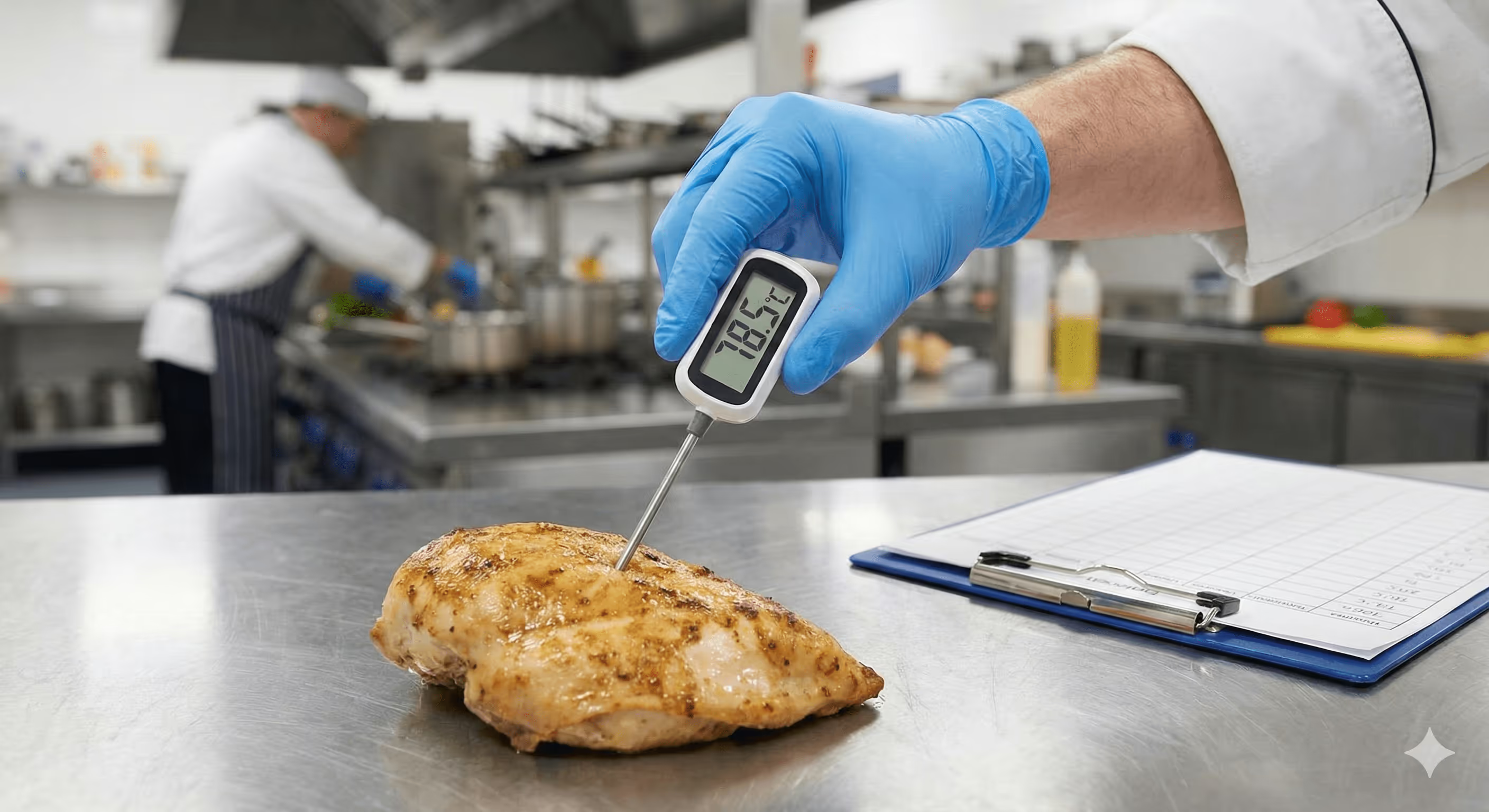
If you work in the Irish hospitality sector, "HACCP" is a word you probably hear daily. Ideally, it’s a living system that runs smoothly in the background, keeping your customers safe and your business efficient.
Realistically? For many businesses, it’s a dusty, grease-stained folder on a shelf that gets panic-filled 10 minutes before an inspection.
But HACCP (Hazard Analysis and Critical Control Point) is more than just a paperwork exercise to annoy you. It is the global standard for food safety, and in Ireland, it is backed by strict legislation: Regulation (EC) 852/2004.
If you are confused about what actually needs to be in your plan, or why your last "off-the-shelf" folder didn't impress the EHO, you are in the right place. Let’s break down what a compliant system looks like under the Irish Standard (I.S. 340:2007).
It Starts with the "Hazards"
The whole point of HACCP is to be proactive, not reactive. It is about spotting things that could go wrong before they make someone sick. In a professional kitchen, hazards generally fall into four main buckets (yes, there is a fourth one now!):
- Microbiological: The invisible killers. Bacteria like Salmonella, E. coli, or Campylobacter growing on raw chicken or poorly reheated rice.
- Chemical: Cleaning spray getting into the soup, or residue from the dishwasher not being rinsed off.
- Physical: Glass from a broken jar, a screw from a loose pot handle, or even a plaster falling off a chef's finger.
- Allergens: Since recent legislative changes, this is now a critical hazard. Peanuts, gluten, or shellfish contaminating a dish that is supposed to be "Free From."
Your plan simply needs to identify where these could happen in your specific kitchen and prove you have a step (a "Control Point") to stop them.
The Difference Between "Prerequisites" and "CCPs"
This is where most people get lost. Think of your food safety system like a house.
1. The Foundation (Prerequisites): Before you even cook a single meal, you must have your "Prerequisites" in place. These are the general hygiene rules that apply to the whole building. An EHO will look at these before they even look at your food.
- Supplier Approval: Are you buying meat from a reputable source with a traceability number?
- Pest Control: Do you have a contractor checking for mice/rats 8 times a year?
- Cleaning Schedules: Who cleans the meat slicer? How do they do it? What chemical do they use? And crucially - did they sign off on it?
- Staff Training: Does everyone have their Level 1 or Level 2 certs?
2. The Pillars (Critical Control Points - CCPs): A "CCP" is a specific step in the process where you must apply a control to prevent a hazard. If you lose control here, food becomes unsafe.
- Example: Storing raw chicken in the fridge is a CCP. If the fridge breaks and the chicken hits 15°C, bacteria grow.
- Example: Cooking a burger. If you don't hit 75°C, the bacteria aren't killed.
The "Critical" Temperatures (The Irish Standard)
One of the most common reasons businesses fail audits is temperature abuse. In Ireland, the rules are specific. Your HACCP plan must prove you are hitting these targets:
- Cooking: You must cook food to a core temperature of 75°C. (You can use equivalent time/temp combinations, like 70°C for 2 minutes, but 75°C is the gold standard instant reading).
- Hot Holding: Keeping soup or carvery warm? It must stay above 63°C. Anything lower, and bacteria start to multiply.
- Reheating: Reheating yesterday's stew? It is not enough to just "warm it up." It needs to go back up to 70°C at the core.
- Cooling: This is a major failure point. You must cool high-risk food from cooking temperature to fridge temperature within 90 minutes. If you leave a giant pot of stew out on the counter overnight to cool, you are breeding bacteria.
- The "Danger Zone": The fridge is your best friend. Legally, food should be stored below 8°C, but we highly recommend targeting 0°C–5°C to be safe.
Top Tip: If your fridge log just says "OK" every day instead of the actual temperature (e.g., "3.4°C"), that is a compliance fail. "OK" is an opinion; "3.4°C" is a fact.
The "Corrective Action" Column
This is the secret weapon of a good HACCP plan. EHOs know that things go wrong. Fridges break. Deliveries arrive warm. What matters is what you did about it.
Your records should have a column for "Corrective Action."
- Bad Record: Fridge was 12°C. Chef wrote "12°C" and went home.
- Good Record: Fridge was 12°C. Chef wrote "12°C." Corrective Action: "Moved food to walk-in freezer. Called repair technician. Discarded milk."
If an EHO sees a "Corrective Action" filled out correctly, they trust you. It shows you are managing the system, not just ticking boxes.
Why "Off-the-Shelf" Plans Fail
We often see business owners buy a generic HACCP folder online for €50. They put it on the shelf and think they are covered. The problem? It doesn't describe your business.
- If your folder has a section on "Sous Vide" cooking or "Sushi Rice acidification," but you run a simple sandwich deli, the EHO will know you haven't read it.
- If your plan says "We check fridge temps three times a day" (because that's what the template said), but you only check them once a day, you are technically non-compliant with your own plan.
A HACCP plan must be bespoke. It needs to match your menu, your equipment, your flow, and your staffing levels.
Need a Plan That Actually Works?
At Beacon, we believe HACCP should make your life easier, not harder. A good system streamlines your kitchen, reduces food waste, and makes training new staff a breeze.
We build custom Food Safety Management Systems tailored to your specific operation - whether you're a high-volume gastropub or a mobile food truck. We strip out the jargon, design logs that take seconds to fill out, and give you a system your staff can actually follow.
Is your HACCP plan collecting dust? Let us review and update your Food Safety Management System to ensure it meets I.S. 340:2007 standards and protects your business.
Is your HACCP plan collecting dust?
Let us review and update your Food Safety Management System to ensure it meets I.S. 340:2007 standards.