May 22, 2026
Probation Period Ireland Employer Guide
As a probation period Ireland employer, ensure compliance. Learn about the 6-month limit, compliant contracts, reviews, and dismissals here.
You've hired a new head chef, or maybe three front-of-house staff before a busy spell. The contracts are signed, the rota is live, and everyone says the same thing: “We'll see how they get on over probation.” That sounds straightforward until performance slips, attendance becomes patchy, or a manager decides after a few weeks that the person “just isn't the right fit”.
That's where many hospitality employers in Ireland get caught. The issue usually isn't the decision itself. The issue is the lack of a compliant probation clause, the absence of written reviews, or an outdated contract that still refers to a probation period that no longer fits the law.
For any probation period Ireland employer query, the practical answer is this. Probation is still useful, but it now has to be tightly structured, clearly documented, and managed like a real process. In hospitality, where turnover is high and managers are busy, that discipline matters more than ever if you want to avoid trouble at the WRC.
The New Rules for Probation Periods in Ireland
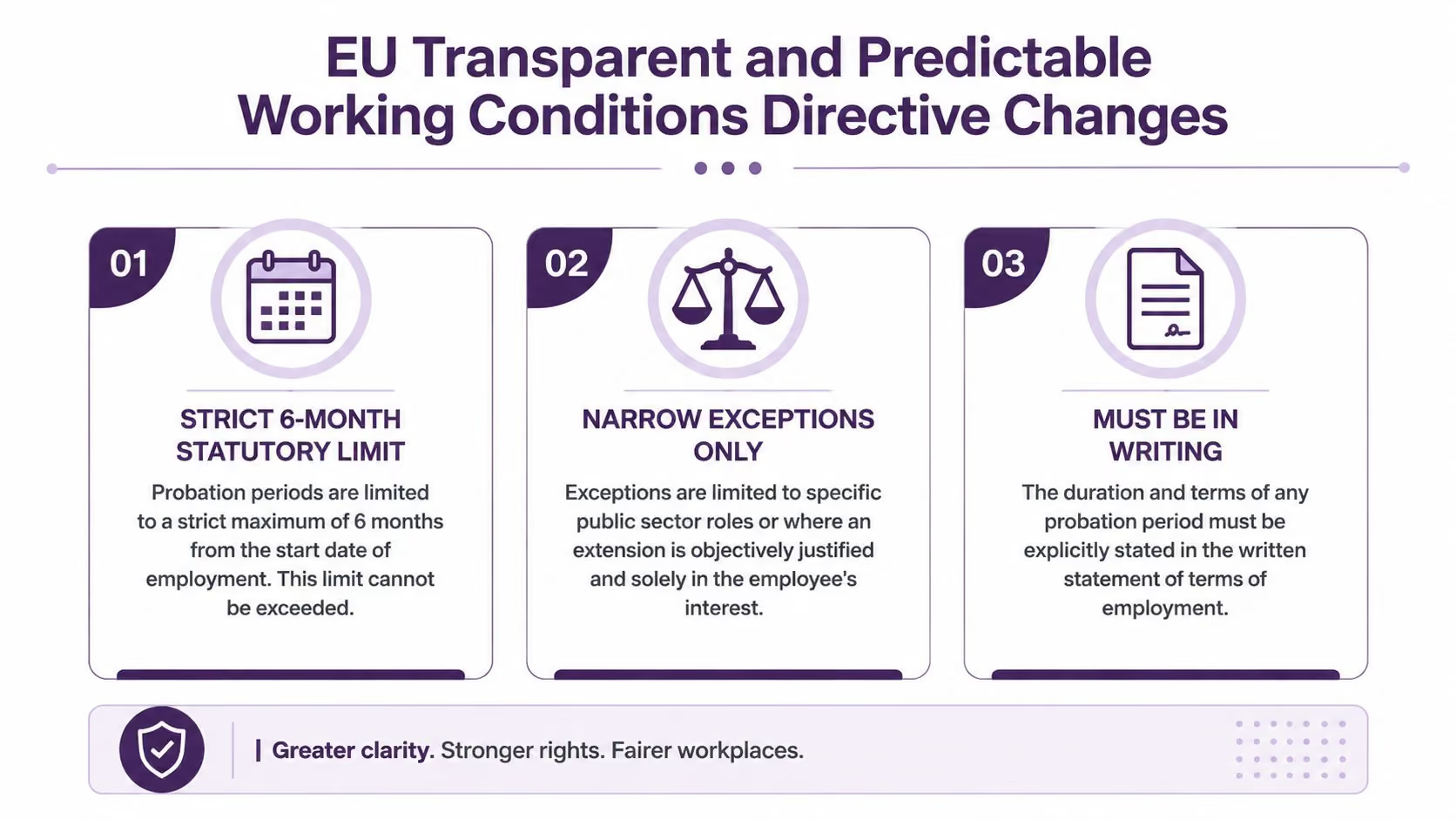
A hotel hires a head chef in May, gives them a 12 month probation clause from an old contract template, and plans to review performance after the summer. That approach creates risk now. Since 1 August 2022, Irish employers have had to treat probation as a defined, legally limited assessment period, not an open-ended trial.
For most private-sector hospitality roles, probation should be set to finish within six months. If your contracts for chefs, servers, bartenders, accommodation staff, or supervisors still refer to 9 or 12 months as standard, the wording needs attention.
Working rule: Build your probation process to conclude within six months unless you have a clear, lawful reason to do something different.
What changed in practice
The main change for hospitality employers is practical. Managers now need enough structure to assess the employee properly inside the permitted window. In a busy kitchen or front-of-house team, six months passes quickly, especially if the first few weeks are spent on induction, shadowing, and rota gaps rather than formal review meetings.
Extensions are not a fallback for poor planning. They are only appropriate in limited cases and need to be justified carefully, typically where the employee could not be fairly assessed during the original period and the extension is in the employee's interest. A delayed decision, a distracted manager, or a chaotic summer season will not fix that problem.
That is why old templates cause trouble. Many hospitality businesses still issue contracts that no longer match the current rules, then discover the problem only when they need to act on poor attendance, weak service standards, or repeated conduct issues. If you have not reviewed your documents recently, compare them against current Irish employment updates, including this note on SI No. 656 of 2024.
Fixed-term contracts need extra care
Seasonal hiring needs a tighter approach again.
For fixed-term roles, probation has to be proportionate to the length of the contract and the nature of the job. In hospitality, that matters for summer hires, Christmas staff, event teams, and temporary cover. A long probation period inside a short contract can look poorly considered and may be hard to defend.
The trade-off is obvious. Employers want enough time to test punctuality, customer handling, pace of service, hygiene standards, teamwork, and ability to cope under pressure. But the shorter the contract, the faster your review cycle has to run.
Use these rules on the ground:
- Permanent hires: Set reviews early enough to reach a decision within six months.
- Fixed-term hires: Keep probation proportionate to the contract length and the role.
- Any extension: Record the reason in writing, explain why it benefits the employee, and avoid using it as a holding position.
What this means for hospitality operators
Probation now works best as a risk-control process. In high-turnover settings, the legal limit matters, but the true compliance issue is whether the business can show a fair, organised review process before any decision is made.
I see the same failures repeatedly in hospitality businesses that end up exposed at the WRC. Managers assume they have longer than they do. Review meetings are missed because the operation is busy. Contracts stay in circulation long after the law has changed. Then a dismissal decision is made with no paper trail behind it.
That is the post-2022 reality. If you want probation to protect the business, the contract wording, review timetable, and manager actions all need to match from the employee's first day.
How to Draft a Compliant Probation Clause
A probation clause should do three jobs. It should state the period clearly, explain how performance will be assessed, and preserve the employer's right to act if standards aren't met. If any of those parts are missing, the clause becomes less useful when a problem arises.
In hospitality, vague wording causes trouble fast. “Subject to probation” is not enough on its own. A proper clause needs to tell the employee what the probation period is, what will be reviewed, and how decisions will be made.
What the clause should cover
At minimum, your contract wording should deal with these points:
- Length of probation: State the exact duration and keep it compliant with current Irish rules.
- Assessment criteria: Refer to performance, conduct, attendance, capability, and suitability for the role.
- Review process: Confirm that review meetings may take place during probation.
- Possible outcomes: Confirm that employment may be confirmed, concerns may be addressed through review, or employment may be terminated if standards are not met.
- Notice position: Make clear that notice obligations still apply in line with the contract and the law.
Here is a practical example of contract wording:
The first six months of your employment will be a probationary period. During this time, your performance, conduct, attendance, capability, and overall suitability for the role will be reviewed. Review meetings may be held during this period. Subject to applicable law and the terms of this contract, your employment may be confirmed, or your employment may be terminated if the required standards are not met.
That is plain, readable, and usable. It doesn't overcomplicate the point.
What works and what doesn't
What works is direct language tied to real management steps. What doesn't work is legal-sounding padding that nobody follows in practice.
Use wording that managers can apply:
- Good phrase: “Your performance, conduct, attendance, and suitability for the role will be reviewed.”
- Good phrase: “You will receive feedback during the probationary period.”
- Weak phrase: “The company may at its sole discretion assess general compatibility.”
That sounds broad, but it gives managers nothing concrete to work with.
The contract should also match the handbook. If the contract says there will be probation reviews, the handbook should explain how those reviews happen. If the handbook promises a detailed review process, managers need to follow it. Misalignment between documents is one of the easiest ways to undermine your own position.
Keep the paperwork aligned
For hospitality employers, the safest setup is:
- Contract with a clear probation clause.
- Handbook with the review procedure and standards.
- Manager template for recording meetings, concerns, and agreed actions.
If you need support putting those documents into a usable format, Beacon Recruitment's HR consulting service is one option for hospitality employers looking to align contracts, handbooks, and review processes.
A strong probation clause isn't the one with the most legal wording. It's the one your managers can follow consistently on a busy week.
A Practical Guide to Managing Probation Reviews
Most probation problems don't start with the contract. They start when no one manages the period. A supervisor has a few verbal chats, a general manager means to “catch up next week”, and by the time a decision is needed there's no written record worth relying on.
That's why I favour a simple review rhythm for hospitality roles. Not a heavy corporate process. Just a repeatable structure that busy managers can stick to.

Use a 30 90 150 day schedule
For most kitchen, bar, restaurant floor, and accommodation roles, a 30, 90, and 150 day pattern works well. It fits inside a compliant six-month probation window and gives enough points to correct issues before they become termination decisions.
Day 30
This is not the meeting for sweeping conclusions. It's an early settling-in check.
Cover points like:
- Attendance and punctuality: Are they showing up reliably and following reporting procedures?
- Basic role execution: Can they handle the core tasks expected at this stage?
- Training absorption: Are they taking on feedback and applying instruction?
- Team fit in practical terms: Are they communicating properly with the kitchen pass, reception desk, floor team, or supervisors?
Document specific examples. “Good attitude” is weak. “Handled breakfast service setup independently after training and followed close-down checklist correctly” is useful.
Day 90
By this point, you should be assessing consistent performance, not first impressions.
Record:
- Role-specific competence: Service standards, prep accuracy, station management, cash handling, booking procedures, guest interaction, or hygiene compliance.
- Behaviour under pressure: How they perform during busy periods matters in hospitality.
- Responsiveness to feedback: Did earlier issues improve, stay the same, or worsen?
If there is a concern, write it plainly. Don't soften it into something meaningless. A fair review can still be direct.
Day 150
This is the decision stage. If someone is going to pass probation, extend only in the rare circumstances already discussed earlier, or leave the business, the record should already show why.
At this meeting, the notes should answer three questions:
- What standard was expected?
- What happened?
- What decision follows from that evidence?
What managers must write down
A review process only helps if managers document it properly. The note does not need to be long. It needs to be clear.
Use a short record after each meeting:
- Date and attendees
- Issues discussed
- Examples of performance or conduct
- Employee response
- Actions agreed
- Next review date
If a termination decision can't be traced back to dated notes, examples, and prior feedback, the business is relying on memory rather than evidence.
There's another reason to keep this process disciplined. Ireland's labour-market picture includes vulnerable groups who can struggle to maintain stable employment. For example, CSO-linked figures show the employment index for people on probation orders rose by only 3% from January 2019 to December 2023, while the overall employee index rose by 17%, according to the CSO analysis of employment levels linked to justice sanctions. Those figures are about court-ordered probation, not employment probation clauses, but they still underline why fair, documented processes matter in Irish workplaces.
Tailor the content to the role
Don't use one generic probation form for every hire.
For example:
- Front-of-house staff: Focus on guest interaction, accuracy, pace, complaints handling, upselling behaviour if relevant, and shift readiness.
- Kitchen staff: Focus on prep discipline, food safety behaviour, station organisation, pace, teamwork, and ability to follow spec.
- Supervisors: Add delegation, shift control, communication, and record-keeping.
That is what makes the process credible. It shows you assessed the actual job, not a vague idea of whether someone felt right.
Common Probation Period Mistakes and How to Avoid Them
The mistakes that lead to WRC trouble are rarely dramatic. They're usually ordinary management habits that went unchallenged for too long. Hospitality is full of them because the day moves fast, managers are stretched, and paperwork gets pushed down the list.

The informal extension
A manager says, “We'll give it another few months and see.” Nothing is issued in writing. No reason is recorded. No one checks whether an extension is even permitted on the facts.
That approach fails because an informal extension has no proper compliance footing. If probation is going to continue beyond what the contract and the law allow, the employer needs a lawful basis and written justification. In practice, many hospitality employers should avoid extensions altogether unless the facts support one.
The safer alternative is simple. Make the decision inside the original review window wherever possible.
No review meetings before dismissal
This is common in busy venues. Performance concerns build informally. Everyone in management talks about them. The employee is then called in and told it isn't working out.
The problem is obvious once you step back. If concerns were serious enough to end employment, why were they never put to the employee in a structured way? Verbal frustration is not the same as a review process.
A better approach is:
- Raise concerns early: Don't leave first mention of an issue until the exit meeting.
- Use examples: Point to incidents, standards, and expectations.
- Give a chance to respond: Even during probation, fairness still matters.
Letting bias creep into the decision
Sometimes a manager decides someone is “not a fit”, but the underlying issue is less clear. It may involve personality conflict, assumptions about health, family status, nationality, age, or another protected ground. That is where risk rises quickly.
The compliant alternative is to anchor every decision to work-related evidence. Focus on conduct, performance, attendance, capability, and documented standards. If the written notes don't support the reason, the decision needs to be reconsidered before action is taken.
Using probation to solve the wrong problem
Probation is for assessing the employee in the role. It is not a workaround for unrelated business issues.
Examples include:
- Role no longer needed: That points toward a redundancy analysis, not “failed probation”.
- Poor onboarding: If the business never trained the employee properly, the problem may sit with management, not the hire.
- Manager inconsistency: One supervisor signs off poor work, another suddenly treats it as a probation failure.
Poor probation management usually isn't one big legal error. It's a chain of small undocumented decisions that look unreasonable when someone reads them back later.
The fix in each case is the same. Slow down, classify the issue correctly, and document the actual reason before you act.
Safely Terminating Employment During Probation
A lot of employers assume probation means they can end employment with almost no process. That's the most expensive misunderstanding in this area. While dismissal flexibility is greater during probation, employers still can't terminate for discriminatory reasons, and notice obligations still apply under the contract and statutory minimum notice rules, as outlined in the RecruitIreland guide to probation periods in Ireland.
The decision should already be supported
If the first proper record of poor performance appears in the termination letter, you're late. The paper trail should already exist from the review stage.
Before scheduling the meeting, check that you have:
- A valid contract and probation clause
- Review notes showing concerns
- Examples tied to the role
- Evidence that the employee received feedback
- Clarity on notice and final pay
If any of those are missing, pause and review the file.
How to run the meeting
Keep the meeting short, calm, and evidence-based. Don't turn it into an argument about personality or fit.
A sensible structure looks like this:
- State the decision clearly
Confirm that employment is being terminated during probation. - Give the reason in work terms
Refer to capability, conduct, attendance, or performance concerns already discussed. - Refer back to the documented process
Mention the review meetings or prior feedback that led to the decision. - Explain notice and final arrangements
Confirm whether notice will be worked or paid, and explain final wages and return of company property. - Follow with a written letter
The letter should reflect the same reason and terms given in the meeting.
What to avoid
Some errors make a weak situation worse very quickly:
- Adding new allegations in the meeting: If it was never raised before, don't rely on it now.
- Using loose language: “You're not really the type for this place” is far riskier than a documented performance rationale.
- Arguing about personal traits: Stay with role requirements and evidence.
- Ignoring notice: Even where service is short, this still needs checking carefully.
If you need a clearer view of the wider dismissal risk framework, this unfair dismissal guide for Irish employers is a useful reference point.
Documentation is the real control point
For hospitality operators, the compliance bottleneck is usually not the manager's instinct. It's the lack of written support behind the instinct. If the venue can show that the decision followed documented concerns about service quality, attendance, kitchen discipline, guest handling, or conduct, the position is far easier to defend.
The safest probation termination is never a surprise decision. It is the final step in a short, documented process the employee has already been part of.
That is the practical standard to aim for.
From Probation to Performance Retaining Your Best Staff
Probation shouldn't be treated as a six-month trapdoor. The strongest operators use it as the first stage of retention. That sounds softer than a compliance discussion, but it's ultimately more commercial.
When employees know what good performance looks like, when they get timely feedback, and when managers deal with issues directly, two things happen. Weak hires are identified earlier, and strong hires settle faster. Both outcomes reduce operational drag.
Hospitality businesses often lose good people for avoidable reasons. Expectations were never made clear. Feedback only appeared when something went wrong. One manager praised the employee, another criticised them, and no one joined the dots. A structured probation process solves more of that than people realise.
What a good probation process builds
A well-run process creates habits that should continue after confirmation:
- Clear standards: Staff know what matters in the role.
- Manager consistency: Supervisors learn to document and communicate properly.
- Trust: Employees can see that decisions are based on evidence, not mood.
- Better retention foundations: Good people are more likely to stay where expectations are organised and fair.
That matters in every hospitality setting, from independent restaurants to hotel groups. The businesses with the least people drama are rarely the ones with no issues. They're the ones with usable systems.
Don't stop at confirmation
Once probation is passed, carry the same structure into normal performance management. Keep regular one-to-ones. Keep notes. Keep standards role-specific. The handover from probation to ongoing management should feel smooth and continuous, not like the process disappears the minute the employee is confirmed.
For a probation period Ireland employer, that is the actual goal. Compliance protects the business. Good probation management improves the workforce.
If your contracts, handbook, or manager review process still reflect old probation habits, Beacon Recruitment works with Irish hospitality employers on HR compliance, documentation, and operational systems that make probation easier to manage in practice.
Are Your Probation Clauses Out of Date?
The rules have changed, and informal extensions leave your business exposed. Book a Free Consultation with Beacon today to ensure your probation policies are fully compliant and WRC-ready.