July 16, 2026
Contract of Employment: A Guide for Irish Hospitality
Craft a WRC-compliant contract of employment for your Irish hospitality business. Our guide covers mandatory clauses, pay, notice, and drafting best practices.
A supervisor changes next week's rota. A team member objects, says those hours were never agreed, then raises holiday pay and notice at the same time. By Friday, what looked like a normal scheduling issue has turned into a formal complaint, a payroll check, and a lot of management time you didn't budget for.
That's how contract problems usually show up in hospitality. Not as a dramatic legal event on day one, but as a messy operational problem when the business is busy and patience is thin. In hotels, restaurants, bars, and multi-site groups, people move quickly, shifts change, and verbal understandings get tested hard. If the contract of employment is vague, outdated, or missing key terms, management ends up arguing from memory instead of documents.
A good contract of employment doesn't just satisfy a legal requirement. It gives managers a practical script for hours, pay, duties, leave, probation, and exit. That matters most in hospitality, where the same employee might work breakfast one week, late service the next, and cover another site when someone calls in sick.
Why Your Contract of Employment Is Your Most Important Tool
Most hospitality disputes don't begin with bad intent. They begin with assumptions. The manager assumes flexibility is obvious because “that's how hospitality works”. The employee assumes a pattern has become a right because “that's what I've been doing for months”. The gap between those two assumptions is where complaints grow.
That's why the contract of employment is your most useful management document. It's the first place to set expectations before a disagreement starts. If it clearly states the role, hours framework, pay method, place of work, and notice rules, you're not trying to reconstruct an arrangement after the fact.
Why verbal agreements fail in hospitality
Irish hospitality uses a lot of non-standard working arrangements. The scale matters. The Central Statistics Office reported that in the fourth quarter of 2023, there were 862,000 workers provided by contract firms in Ireland, as noted in this labour market reference. In practical terms, that means contingent and alternative working arrangements are a real part of the labour market, not an edge case.
For hospitality operators, that creates a simple lesson. If the wider labour market contains that much contingent work, you can't run your business on handshake terms and hope everyone remembers the same version later.
Practical rule: If a term matters to scheduling, payroll, supervision, or termination, it belongs in writing.
What a strong contract actually does
A strong contract of employment helps with daily operations in ways managers feel immediately:
- It supports rostering: Staff know the basic structure of their hours and what flexibility does and doesn't mean.
- It protects payroll: Pay intervals, rates, and methods are less likely to become disputed after the roster is worked.
- It reduces role confusion: A food and beverage assistant, accommodation assistant, or duty manager can be asked to perform related duties if the contract is drafted properly.
- It makes exits cleaner: Notice and termination mechanics are easier to apply when they were set out at the start.
The businesses that struggle most with contract issues are usually not reckless. They're busy. They reuse an old template, issue an offer by text, or postpone paperwork until the employee has “settled in”. That approach works until the first disagreement. Then the missing contract stops being admin and starts becoming risk.
Understanding Your Legal Obligations in Ireland
In Ireland, a contract of employment is tied directly to written statement obligations. The key point for employers is timing. You don't have the luxury of waiting until “the paperwork catches up”.
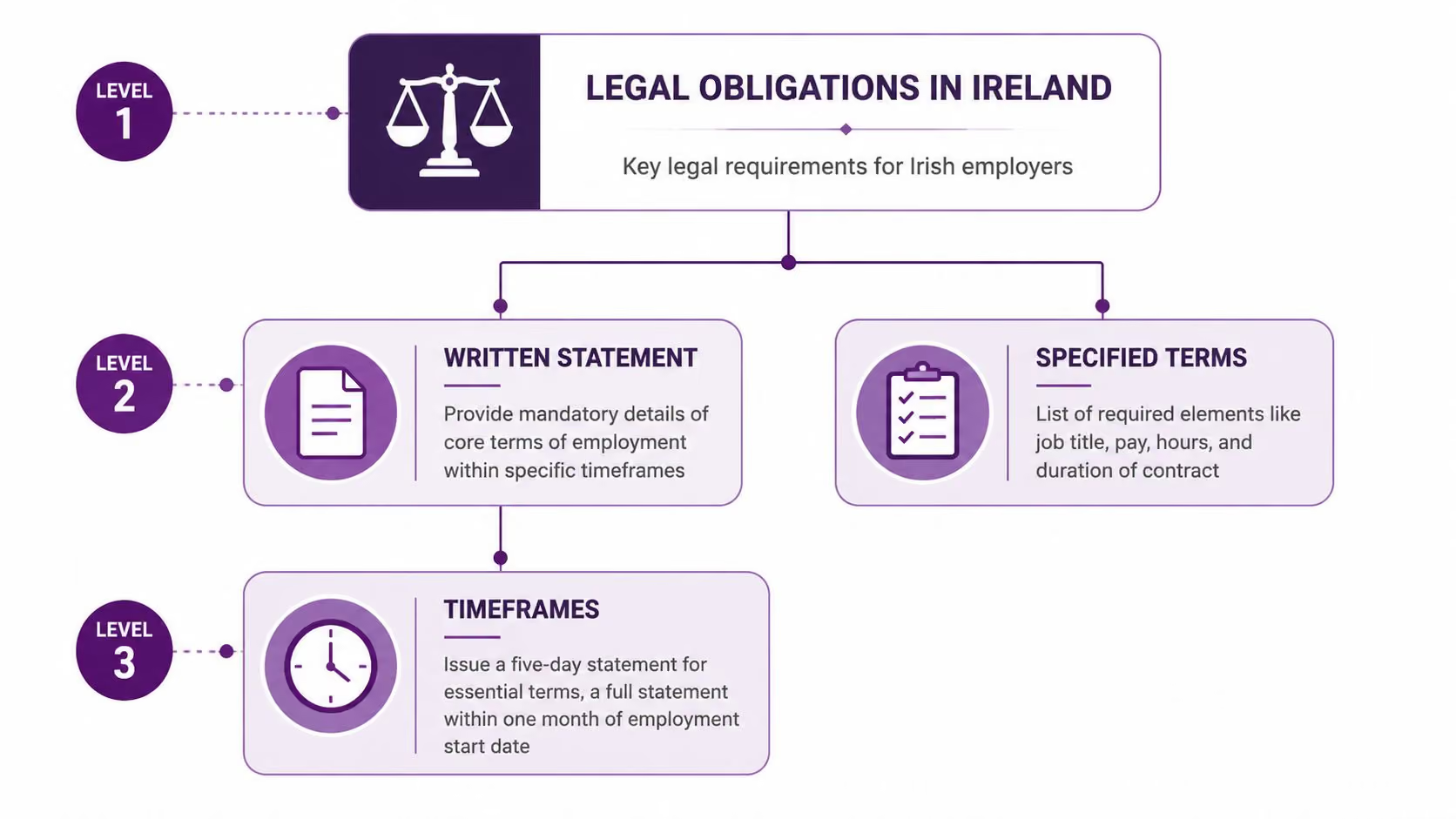
Under the Terms of Employment (Information) Act 1994, updated by later legislation, employers must provide a written statement of core terms quickly after employment starts. The practical position is set out in this overview of Irish employment contract requirements, which notes that employers must provide five core terms within 5 days of starting work, and a fuller written statement of prescribed terms within 1 month.
The Day 5 obligation
The first deadline is the one hospitality businesses most often underestimate. By day 5, the employee must already have key terms in writing. That's especially important where someone starts mid-week, joins during a busy period, or is recruited quickly to fill a service gap.
If you leave this until the end of the month, you've already missed the point. The purpose of the early written statement is to stop uncertainty at the start of employment, when confusion about hours, pay, and job scope tends to be highest.
The 1 month statement
The fuller statement expands the employment terms into a proper compliance document. In hospitality, loose arrangements usually need to be tightened up at this stage. A role that felt clear in an interview can become very unclear once split shifts, overtime, weekend work, uniform standards, and reporting lines come into play.
The prescribed terms include points such as:
- Who the parties are: The full names of employer and employee.
- Where the work is done: The place of work, which matters a lot for businesses operating across more than one venue.
- What the job is: The title or nature of the work.
- How long it lasts: If it's temporary, the expected duration.
- How pay works: The rate or method of pay and the pay intervals.
- What time means in the role: Normal working hours.
- Leave and ending employment: Annual leave entitlement and notice provisions.
Early contract administration is not a back-office detail. It's part of opening the employment relationship properly.
For managers, the fundamental discipline is simple. Issue the core terms immediately. Finalise the full statement without drift. If contracts are only produced after a problem starts, they've already failed as an operational tool.
Building the Core of Your WRC-Compliant Contract
A compliant contract starts with the basics done properly. That sounds obvious, but many hospitality contracts fail because they're copied from another venue, patched together over time, or drafted for a different type of workforce. The result is a document that looks formal but leaves practical gaps everywhere.
The Employment (Miscellaneous Provisions) Act 2018 sharpened the urgency around early written terms. As explained in this hospitality employment law discussion, employers must give new employees core terms in writing within 5 days, a requirement that directly addresses uncertainty around initial hours and pay arrangements.
The clauses that must be right
Use the contract as your foundation document, not as a summary of good intentions. At minimum, make sure these points are clear.
- Employer and employee names
This sounds elementary, but legal identity matters. If the trading name on the payslip, the entity on the contract, and the entity operating the venue don't line up, you create avoidable confusion before any dispute even begins. - Job title and job description
Keep the title accurate, but don't make the description so narrow that normal hospitality flexibility becomes impossible. “Chef de Partie” or “Food and Beverage Assistant” is fine. The duties section should allow for related operational tasks within reason. - Place of work
If someone may work across a hotel, sister property, event space, or more than one restaurant within a group, say so. If the contract lists only one site and management later treats movement between venues as automatic, that can become a flashpoint. - Start date and duration
Permanent, fixed-term, and specific-purpose arrangements should be identified cleanly. If it's temporary, say what the expected duration is and why the arrangement exists. - Pay details
Spell out the hourly rate or salary, the payment method, and the pay interval. Don't leave staff to infer how overtime, premium shifts, or service-related payments are handled. - Working hours
This clause needs more than a token weekly figure. If hours vary, say they vary. If the role requires weekend, evening, or public holiday work, include that framework. - Annual leave
State the entitlement and how leave should be requested. In hospitality, leave disputes often come from process failures, not just entitlement failures. - Notice provisions
Put the rules in writing from the start. Notice is one of the first areas reviewed when a relationship breaks down.
What works better than a generic template
A solid contract is detailed in the places where operational friction usually appears. It doesn't need legal theatre. It needs clarity.
Useful drafting support should also line up with the separate statement requirements. Beacon's Section 3 statement guidance is a good example of the practical distinction employers need to keep straight when issuing early written terms.
The best contract wording is usually the least dramatic. Clear, ordinary language survives scrutiny better than grand wording nobody can apply on shift.
A weak contract tends to fail in predictable ways. It uses a broad title but no real duty wording. It promises flexibility without defining any limits. It refers vaguely to “company policy” without identifying what exists, who applies it, or how staff receive it. Those are exactly the gaps that create trouble when a complaint reaches the WRC stage.
Clauses Tailored for Hospitality Operations
The legal minimum won't carry a hospitality business very far. It keeps you from missing the basics, but it doesn't solve the everyday pressures of split shifts, seasonal peaks, tips, cross-cover, and probation management. For that, the contract has to reflect how the venue runs.

Clauses that save arguments later
A hospitality contract should deal with the issues managers face every week, not just the ones lawyers discuss after something goes wrong.
- Probationary period wording Set out the length of probation, the review process, and the fact that performance, conduct, attendance, and suitability will be assessed. If extensions may be used, say when and why. Generic probation wording causes problems because managers assume flexibility that the contract never gives them. Practical support on this point is covered in Beacon's probationary period guide.
- Rostering and shift flexibility If hours depend on business demand, events, occupancy, or trading patterns, say that plainly. That doesn't mean you can promise unlimited unpredictability. It means the contract should describe the actual operating model transparently.
- Split shifts and break structures
If split shifts are part of the role, include them. If break arrangements are linked to service needs, make sure the wording reflects lawful practice and operational reality. Don't leave employees to discover that structure only after they start. - Tips and gratuities
If the business operates a system for tips, gratuities, or service distribution, reference the policy clearly. Staff disputes around tips often come from assumptions and inconsistent explanations between managers.
Fixed-term and seasonal roles need objective grounds
Seasonality creates one of the biggest contract mistakes in Irish hospitality. Employers often focus on whether a fixed-term or flexible arrangement feels commercially useful. That's not enough. What matters is whether the reason for the arrangement is clear, real, and documented.
As noted in this analysis of hospitality labour issues, the key for seasonal demand is not just choosing a fixed-term or flexible contract, but documenting the objective grounds for that choice, because the WRC scrutinises arrangements that appear to unfairly limit worker security.
That should change how managers draft.
If a role is seasonal, state the business reason. If a role is linked to a project, event cycle, or temporary increase in demand, say that directly. Vague wording rarely helps later.
Simple examples of better wording
You don't need over-engineered clauses. You need practical ones.
- On flexibility of duties
“The employee may be required to perform duties reasonably associated with the role and the operational needs of the business.” - On variable hours
“Working hours will be rostered according to business requirements and may include evenings, weekends, and public holidays.” - On seasonal fixed term rationale
“This fixed-term arrangement is linked to a seasonal increase in trading demand.”
Those short clauses won't solve everything by themselves. But they do far more than a generic template that says nothing about how hospitality work is organised.
Managing Pay Leave and Notice Periods Correctly
Pay, leave, and notice are where contract wording meets payroll reality. If the contract is sloppy here, the problem won't stay theoretical. It will show up in queries from staff, corrections from payroll, and disagreements at the point someone resigns or is dismissed.
Pay needs precision, not assumptions
State clearly how the employee is paid, when they are paid, and what the stated rate covers. In hospitality, confusion often comes from variable hours, overtime expectations, or additional payments that managers discuss casually but never define properly in writing.
Keep the contract and payroll process aligned. If the contract says one thing and the rota, payslip, or local management practice says another, staff will trust the version that affects their wages that week.
- Pay rate or salary should be explicit.
- Pay intervals should be stated clearly.
- Any separate treatment of overtime or premium hours should be explained where relevant.
- Any gratuity or service-distribution reference should match the venue's actual practice and policy.
Leave and variable-hour staff
Annual leave causes trouble when managers apply a full-time mindset to a mixed workforce. Part-time and variable-hour staff still need clear treatment. The contract should explain the entitlement framework and the leave request process, but managers must also make sure the calculation method used in practice matches the employee's actual pattern of work.
Hospitality businesses often falter at this stage. They issue a reasonable contract, then operate leave informally on the rota. Once leave is tracked casually, disputes become much harder to resolve.
Manager's check: If a staff member asked today how their leave, pay, or notice is worked out, could you answer from the contract and the payroll records without improvising?
Notice works best when it is boring
Notice clauses should be calm and specific. If the business expects a certain amount of notice from employees, put that in the contract. If the employer will apply statutory minimums or enhanced contractual notice, state that clearly too.
Avoid writing notice clauses in a way that sounds tough but is hard to apply. In practice, the best notice clause is one a line manager can understand, HR can administer, and payroll can action without debate.
The same principle applies to leave on termination, outstanding pay, and final deductions where lawful. The contract should support an orderly ending to employment, not introduce new ambiguity at the point of exit.
Navigating Termination and Post-Employment Rules
Termination is where a weak contract gets exposed. When employment ends, every vague clause starts to matter. Duties, notice, disciplinary procedure, suspension language, and policy references all come under pressure at once.

The contract is only part of the process
A contract of employment should support fair procedure. It should not pretend to replace it. If there is a disciplinary or grievance route, the contract should refer to it properly and the business should follow it.
That matters whether the issue is conduct, capability, attendance, or a wider operational change. Managers sometimes rely on broad contractual wording and assume that gives them complete freedom. It doesn't. Poor process can undermine a decision even where the underlying concern was legitimate.
For a practical overview of the risk area, Beacon's unfair dismissal resource is useful reading for anyone managing exits in hospitality.
Different reasons for termination need different handling
Not every termination is the same, and the contract should reflect that reality.
- Conduct cases require clear rules, fair investigation, and consistent procedure.
- Capacity or performance cases need documented concerns, support, and review rather than sudden decisions.
- Redundancy situations should never be disguised as misconduct or “not a good fit”.
A contract helps by setting the framework, but management still has to use that framework properly. A good document with poor process is still risky.
Be careful with restrictive covenants
Post-employment restrictions are often overused in standard hospitality contracts. For most roles, broad non-compete clauses are more noise than protection. Irish employers should be cautious about inserting sweeping restrictions into ordinary venue contracts and assuming they will hold up.
What usually makes more sense is targeted confidentiality wording and, where justified, narrower protections for senior roles with genuine access to strategic information, commercial plans, or key relationships.
A clause isn't useful because it sounds strict. It's useful if it reflects a real business interest and can be defended if challenged.
Your Irish Contract of Employment Questions Answered
What if an employee refuses to sign?
Don't ignore it, and don't panic. First, check whether the issue is substance or paperwork. Some employees object because a manager promised one thing verbally and the contract says another. Fixing that early is better than forcing a signature on a disputed version.
If the contract accurately reflects the agreed terms, record that it was issued, explain the terms clearly, and give the employee a fair chance to raise questions. An unsigned contract is still a warning sign. It tells you there may already be a mismatch between what the business thinks it offered and what the employee thinks they accepted.
Can you change terms after someone starts?
Yes, but not casually. If you want to change hours frameworks, duties, place of work, or other material terms, treat it as a formal process. Explain the reason, consult with the employee, document the change, and issue updated terms where needed.
Unilateral changes are where manageable employment relationships often start to unravel.
Are zero-hours style arrangements safe?
Treat this area with care. The practical question isn't whether flexibility is commercially attractive. It's whether the wording is clear, fair, and consistent with how the role operates. If the business needs seasonal or variable arrangements, the contract should explain the structure clearly and avoid promises that are vague or impossible to apply fairly.
A short drafting checklist
A useful final test is this:
- Can a line manager explain the contract without guessing?
- Does the document reflect the actual rota and pay setup?
- Are temporary or seasonal terms justified clearly?
- Do probation, leave, and notice clauses work in practice?
- Would the contract reduce ambiguity if a complaint was made tomorrow?
As noted in this practical legal guide to employment contracts, a well-drafted contract of employment acts as a primary compliance document that reduces ambiguity, particularly where work patterns vary.
If your contracts don't match how your venue operates, that gap will eventually cost you time, money, and management focus. Beacon Recruitment helps Irish hospitality businesses put the right structure behind their people operations, with practical contract drafting, HR compliance support, and operational advice built for the realities of hotels, restaurants, and multi-site groups.
Are Your Employment Contracts WRC-Ready?
Don’t rely on handshake deals or outdated templates. Book a Free Consultation with Beacon today to ensure your hospitality contracts are fully compliant and protect your business from day one.