July 16, 2026
Workers Rights in Ireland: A Guide for Employers
A clear guide for Irish employers on workers rights in Ireland. Understand contracts, pay, leave, dismissal, and WRC rules to ensure compliance.
Friday evening service is building. A chef calls in sick. Two floor staff want to swap shifts. A junior manager has rostered someone for a late close followed by an early breakfast shift. Payroll is due, one employee says their contract doesn't match the hours they work, and a former team member has emailed about taking a complaint further.
That's the point where workers rights in ireland stop being a legal topic and become an operations problem.
Most hotel and restaurant owners already know the broad principle. Pay people properly, treat them fairly, give breaks, and document what matters. The difficulty is that hospitality rarely runs on standard patterns. You deal with split shifts, last-minute demand, seasonal peaks, probation issues, and teams made up of full-time, part-time, and variable-hours staff. The legal rules don't disappear because the dining room is full.
The cost of getting this wrong isn't limited to a formal claim. It also shows up in manager time, poor morale, avoidable turnover, inconsistent payroll, and the reputation that follows when staff decide your venue is chaotic or unfair. In practice, the businesses that stay out of trouble are not always the ones with the longest manuals. They're the ones with contracts that reflect reality, rosters that are checked properly, and managers who understand what they can and can't do on a busy week.
Your Essential Guide to Workers Rights in Ireland
In hospitality, employment issues rarely arrive as tidy legal questions. They arrive disguised as operational friction. Someone says they never got their full terms. A supervisor assumes probation means they can let a person go without any real process. A kitchen porter regularly works one pattern on paper and another in reality. Then the problem lands all at once.
That's why workers rights in ireland matter to owners and general managers as a live management issue, not a document you glance at once a year. If your venue depends on flexible labour, long opening hours, and managers making quick calls under pressure, your systems need to be stronger than your intentions.
A compliant workplace in this sector rests on a few basics being done consistently:
- Pay is correct: Minimum wage, payroll calculations, and any age-related rates are checked before the payslip goes out.
- Hours are controlled: Managers don't just fill shifts. They monitor rest, breaks, and patterns over time.
- Terms are documented: Contracts and written statements match what the employee does.
- Problems are escalated properly: Grievances, conduct concerns, and performance issues don't get handled casually in the corridor.
Good employers in hospitality don't avoid disputes by being informal and friendly. They avoid disputes by making fairness repeatable, even on the worst week of the month.
The Irish framework gives employees rights on pay, time, equality, and dismissal. For employers, the practical question is simpler. Can you prove that your day-to-day operation matches those rights when someone asks for records, challenges a decision, or compares the contract to the roster? If the answer is uncertain, that's where risk sits.
Understanding Core Statutory Entitlements
A breakfast supervisor agrees to stay late to cover a no-show. A junior waiter swaps onto a split shift. A night porter takes calls during what was meant to be a break. None of that feels unusual in a hotel or restaurant. It can still create legal exposure if pay, rest, leave, or treatment are handled casually.
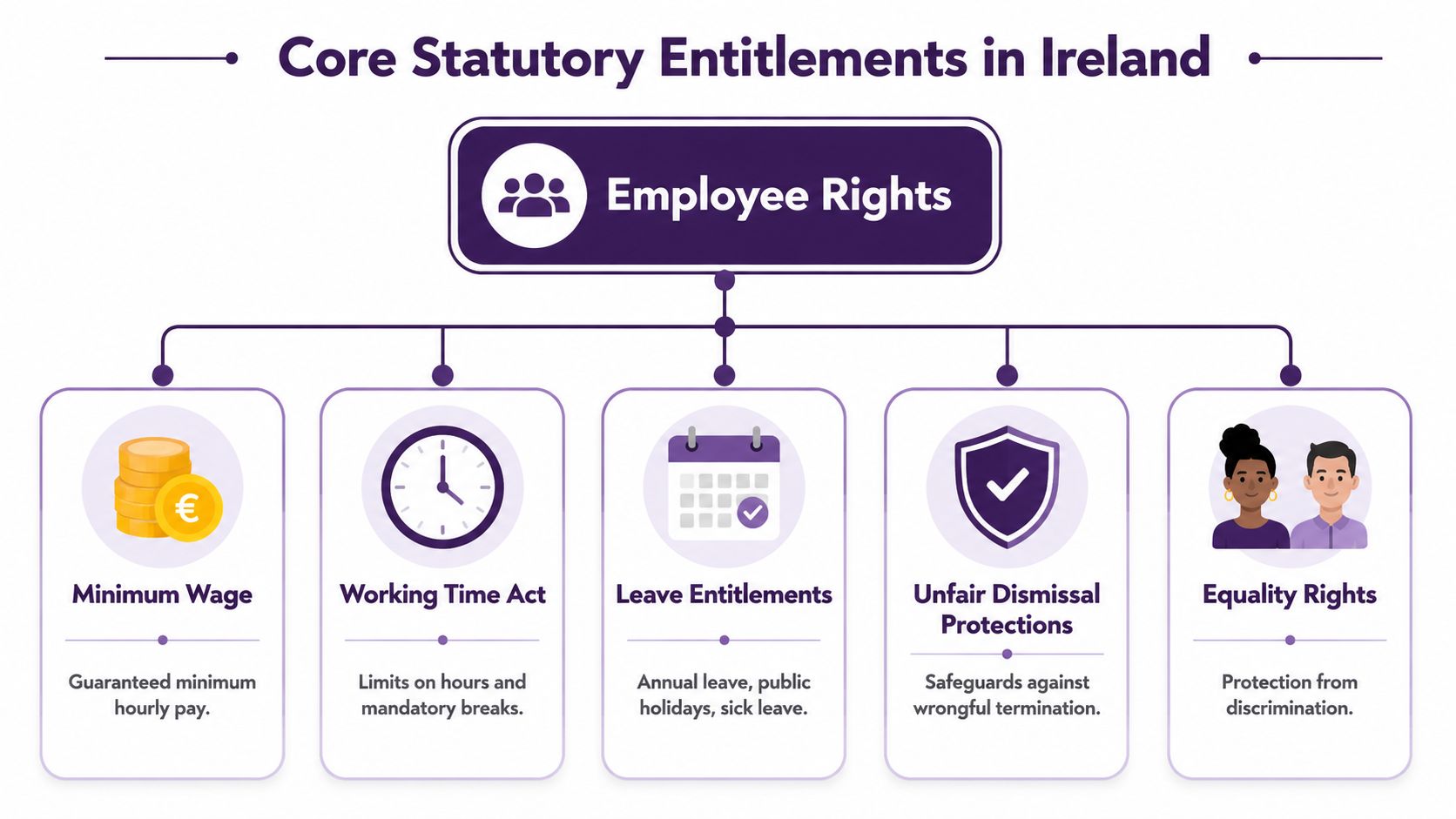
Core workers rights in ireland set the minimum standard every hospitality employer has to meet, even where the business relies on flexibility. In practice, the statutory floor matters most in the areas managers touch every day: hourly pay, working time, annual leave, public holidays, equality, and how employment ends.
Ireland's framework is shaped by the National Minimum Wage Act 2000, the Organisation of Working Time Act 1997, the Employment Equality Acts 1998–2015, and the Unfair Dismissals Acts 1977–2015, as outlined in this guide to employment law in Ireland for employers, managers and HR professionals.
Pay rights you must get right
Minimum wage errors in hospitality rarely start in payroll. They usually start on the floor, with poor time records, unpaid trial shifts, missed training hours, or managers rounding time in the employer's favour.
Current minimum wage rates from 1 January 2026: €14.15 per hour for adults, €9.91 for under 18s, €11.32 for 18-year-olds, and €12.74 for 19-year-olds, as set out in the same employment law guide.
For a restaurant or hotel, those rates affect more than basic pay. They shape how you cost rosters, whether younger team members are used appropriately, and how quickly a seemingly small underpayment issue spreads across a department. If a supervisor edits hours after the shift, or a department head expects staff to attend briefings unpaid, the risk sits with the employer.
The practical control point is to check pay rights at three stages:
- Before the start date: confirm the offered rate matches the worker's age category and role.
- During scheduling: make sure the roster reflects the hours you expect the person to work, including opening, closing, handover, and mandatory training time.
- Before payroll sign-off: reconcile clockings, approved amendments, and payslip calculations. Do not rely on assumption or verbal explanations.
Tips and service charges need separate attention. They do not excuse underpayment of statutory wages, and informal distribution practices can create arguments fast if nobody can explain how money is allocated.
Time, leave, and equality need operational control
The biggest mistake I see is treating working time, holidays, and equality as policy topics rather than shift-management topics. In hospitality, they sit inside the roster.
A venue with weak scheduling discipline often has the same weakness elsewhere. Breaks are missed but not recorded. Annual leave balances are unclear. Public holiday entitlements are handled differently from one manager to another. Favoured employees get the better shifts, while others say they were overlooked because of age, gender, nationality, family status, or another protected ground.
Those problems are connected. If your records are patchy, it becomes harder to defend the business when an employee says the pattern was unfair or unlawful.
A sensible baseline review covers:
- Working time records: whether start times, finish times, breaks, split shifts, and last-minute extensions are recorded accurately.
- Annual leave and public holidays: whether entitlements are tracked consistently for full-time, part-time, and variable-hours staff.
- Equality in day-to-day decisions: whether recruitment, promotion, training access, discipline, and shift allocation are applied consistently.
- End of employment decisions: whether managers understand that frustration, poor fit, or a busy season ending do not remove the need for fair process.
What this means in real hospitality operations
The law sets the minimum. Daily management decides whether you meet it.
That means line managers need clear rules on break coverage, clocking changes, overtime approval, and who can alter a rota after it is published. It also means owners should test whether written records match what happens on the ground. A contract may say 39 hours, but if the employee regularly works a different pattern, the paper alone will not protect the business.
Good compliance in this sector is practical. Keep accurate time records. Pay for all hours worked. Track leave properly. Apply standards consistently across departments. Train managers before a problem starts, not after an employee raises a complaint.
A busy service does not excuse weak controls. It exposes them.
Crafting Compliant Employment Contracts and Terms
The contract is where many hospitality employers either protect themselves or create future trouble. A weak contract doesn't just look untidy. It creates room for disputes about hours, duties, overtime, notice, and where the employee can be asked to work.
Irish rules create a two-stage obligation for written terms. Employees must receive core terms within 5 days of starting, and further written terms must follow within one month, according to this guide to employee rights in Ireland.
What has to be issued and when
The early statement matters because it sets the practical ground rules from day one. The first set of core terms must include items such as the employer and employee names, employer address, contract duration if temporary, pay period, and the normal length of the working day and week.
The fuller written statement then needs to cover the remaining terms, including place of work, job title, salary in euros, start date, overtime and days-in-lieu rules, leave entitlements, sick pay, pension details, and notice period.
That timetable catches out businesses that move fast on hiring and slow on administration. In hospitality, the common excuse is that the person had to start immediately because the venue was short-staffed. That won't help much if the paperwork never followed.
The contract must match reality
The biggest practical mistake is using a compliant-looking contract for a non-compliant working arrangement. A document may say “normal working week”, “occasional overtime”, or “varied duties”, but if the employee is working a regular variable-hours pattern that isn't reflected in writing, the contract becomes weaker when tested.
Three areas need particular care in hotels and restaurants:
- Job duties: Roles in hospitality often flex. That's normal. But “any duties as required” shouldn't become a licence for confusion. A chef shouldn't be left unclear about reporting lines, and a supervisor shouldn't discover too late that they are expected to carry management responsibility without the wording to support it.
- Place of work: Multi-site operators need this drafted carefully. If staff may rotate between venues, the contract should say so in clear terms.
- Overtime and time off in lieu: If your practice is inconsistent, your paperwork will not save you. Define the rule and then operate it that way.
Practical rule: If a contract doesn't describe how the person actually works, it won't help much when a dispute starts.
Why this matters for variable-hours staff
Hospitality relies heavily on atypical arrangements. That's where vague drafting causes the most friction. If someone's regular pattern drifts away from what the contract says, they may challenge the mismatch and seek alignment with the hours they work.
What works is a living contract process:
- Issue the Day 5 terms on time.
- Complete the full written statement within the month.
- Review the actual roster pattern after the employee settles in.
- Update terms when the role changes in practice.
What doesn't work is treating the signed contract as the end of the process. In a busy venue, it's the start of the evidence trail.
Managing Working Hours and Breaks in Hospitality
Most working-time breaches in hospitality don't come from one outrageous shift. They come from patterns. A late bar finish, an early breakfast cover, a double on Saturday, a short-turnaround call on Sunday. Each one can look manageable on its own. Together, they create risk.
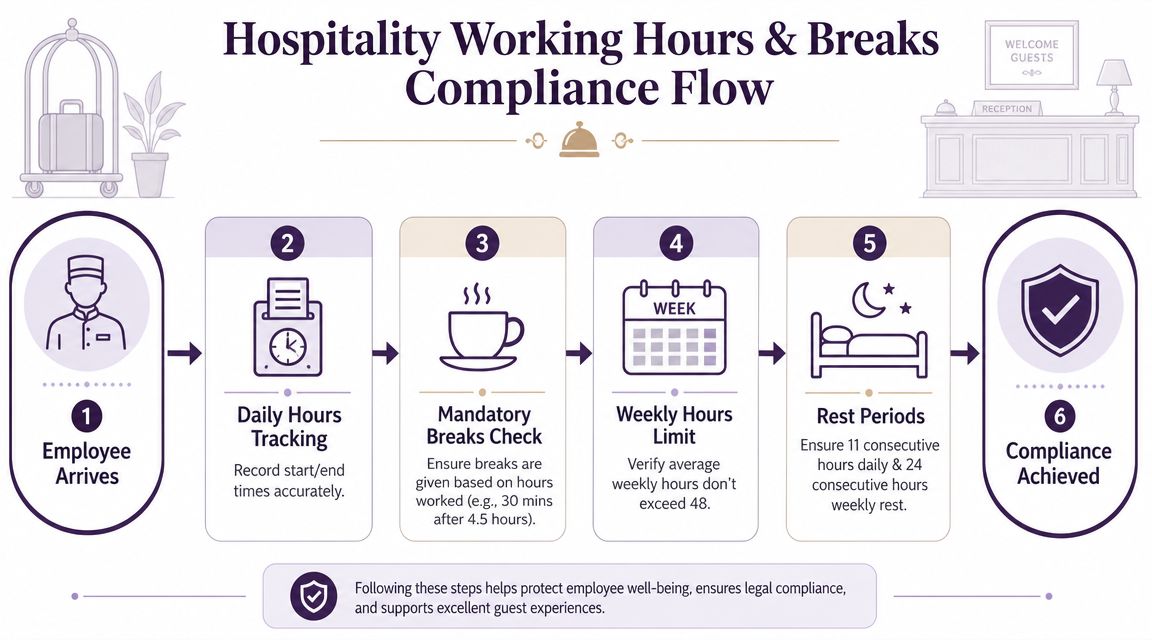
Under the Organisation of Working Time Act 1997, the average working week must not exceed 48 hours, measured over a standard 4-month reference period, which can extend to 6 months in seasonal or surge sectors. The same rules require 11 consecutive hours of daily rest, 24 consecutive hours of weekly rest, a 15-minute break after more than 4.5 hours worked, and a 30-minute break after more than 6 hours worked, as set out by the Workplace Relations Commission guidance on working hours.
Think of rostering as a rolling budget
The easiest way to explain the reference period is to compare it to a rolling budget. You can overspend on one line in one week and still recover later, but only if you are actively tracking the full period. If nobody checks the rolling position, the business doesn't notice the problem until the month-end. Working time works much the same way.
A single busy week won't necessarily tell you whether you're compliant. A pattern across months will.
This is why hospitality employers need more than a whiteboard rota and a manager's memory. You need records that show:
- Actual start and finish times
- Breaks taken, not just breaks planned
- Rest gaps between shifts
- Average hours across the reference period
If you want a more detailed legal breakdown, Beacon's knowledge base on the Organisation of Working Time Act 1997 is a useful operational reference.
Where operators usually get caught
The trouble spots are familiar.
- Split shifts: These can work operationally, but they need careful tracking so total hours and rest aren't distorted.
- Close then open patterns: Managers often underestimate how easily daily rest is breached.
- “Quick cover” requests: An employee agreeing to help doesn't remove the employer's duty to manage lawful hours.
- Break assumptions: If your records show a break happened because the rota allowed for it, but service pressure meant it never really happened, the record is weak.
If you can't show when a person worked and when they rested, you're relying on recollection. Recollection is a poor defence.
Atypical work makes the risk sharper
Hospitality uses part-time, seasonal, and variable-hours arrangements constantly. That flexibility can be legitimate, but it also creates disputes when the roster changes each week and the contract doesn't keep up. Complaints bodies have noted recurring issues around the manipulation of averaging in working-hours calculations and issues affecting workers with fewer than 12 months' service in this Citizens Information Board paper on employment rights for all.
For employers, the lesson is straightforward. Don't use averaging as a vague explanation for irregular scheduling. Use it as a controlled calculation backed by proper records. That means time-and-attendance systems, manager sign-off, and a routine review of staff whose actual pattern has drifted.
What works is discipline. What doesn't work is trying to reconstruct months of shifts after a complaint has already started.
Navigating Probation and Fair Termination Procedures
Probation causes more bad employment decisions in hospitality than almost any other label. Managers hear “probation” and assume flexibility. The law hears “employment relationship” and asks whether the employer acted fairly.
That distinction matters. A probation clause can give you a structured period to assess suitability, training progress, conduct, attendance, and cultural fit. It does not give you a free pass to skip process. In practice, many WRC problems begin when a venue decides someone “isn't working out” and moves too quickly, too casually, or without records.
Probation should be active, not passive
A proper probation period has to be managed. If concerns exist, they should be raised early and clearly. If performance is weak, the employee should know what standard is expected, what support was offered, and what happens if improvement doesn't follow.
A sound probation file usually contains:
- Clear objectives: What the person is meant to achieve in the role.
- Review notes: Short records of check-ins, not vague impressions.
- Examples of concern: Missed standards, attendance problems, or conduct issues described specifically.
- Opportunity to respond: The employee gets a chance to explain and improve.
Many employers do none of this. They let a probation drift, then dismiss at the end based on accumulated frustration. That's the sort of decision that often looks obvious internally and poorly handled externally.
Process is your insurance
Owners sometimes view disciplinary procedure as bureaucracy. In reality, it's insurance. The process forces the manager to slow down, identify the core issue, separate conduct from capability, and create a record that can be defended.
That applies outside probation too. If you are considering dismissal, the central questions are practical:
- What is the reason? Conduct, capability, or another legitimate basis.
- What evidence do you have? Notes, witness accounts, rota records, prior warnings.
- Was the employee told the issue clearly?
- Did they have a chance to respond?
- Did the manager follow the written procedure?
The Beacon guide on the probationary period is useful for managers who need to tighten this area operationally.
The meeting where you decide to dismiss someone is not the process. It is the end of the process.
What fails under pressure
What fails is informality dressed up as common sense. Telling someone to hand over keys after a difficult shift. Using WhatsApp to communicate serious disciplinary outcomes. Allowing a line manager to act on irritation rather than evidence. Ignoring your own handbook because service was busy.
Hospitality employers also need to be careful with staff who have short service. Some managers assume that fewer than 12 months means no risk. That is not a safe operating assumption. Even where certain claims may be affected by service length, poor process can still create wider exposure, internal conflict, and reputational damage.
The businesses that handle termination well are not always softer. They are more organised. They make decisions earlier, document them better, and follow a process that shows fairness rather than impulse.
The WRC Process and Collective Employee Rights
When an employee escalates a complaint, many employers panic because they don't understand the route the issue can take. That fear usually makes things worse. Some go defensive and stop engaging. Others scramble to create documents after the fact. Neither response is strong.
A better approach is to treat the WRC as the external test of whether your internal systems were credible. If your contract was accurate, your records were clean, and your procedures were followed, your position is usually clearer from the start.
What the process means for employers
At operational level, a WRC complaint often forces an employer to gather the basics fast:
- Employment documents
- Payroll records
- Rosters and time records
- Policies and procedures
- Correspondence with the employee
- Notes of meetings or warnings
That's why prevention and response are closely linked. Businesses that keep proper records from the outset don't have to rebuild the story later. Those that don't often discover too late that the manager “knows what happened” but can't prove it.
Beacon has a practical explainer on the WRC and Workplace Relations Commission process for employers who need to understand how a complaint progresses.
Employee voice matters even in non-union settings
Collective rights in Ireland often surprise hospitality employers. The Constitution recognises freedom of association, including the right to join a trade union, but trade unions do not have a legislative right to be recognised in the workplace for collective bargaining. Trade union membership was 26% in the IHREC report on decent work, which you can read in the Irish Human Rights and Equality Commission publication.
In practice, that means many hospitality venues are non-union workplaces. It does not mean employee voice can be ignored.
Where formal collective bargaining is less common, the burden shifts back onto management to provide credible internal routes for concerns. If staff don't trust the grievance process, don't understand who to raise issues with, or think complaints will affect shifts, they are more likely to go straight outside the business.
In non-union hospitality workplaces, the grievance procedure often does the work that formal representation would otherwise support.
What smart operators do differently
They don't wait for a formal complaint to create order. They put communication channels in place early. They train managers not to dismiss concerns as “just drama”. They escalate payroll queries and schedule disputes before they turn personal. And they understand that a fair internal process isn't separate from workers rights in ireland. It is how those rights are experienced day to day.
A Practical Compliance Checklist for Hospitality Employers
A busy Saturday can expose more compliance risk than any policy review. A supervisor asks a new server to stay late after a split shift, someone skips a break because a coach party arrives early, and payroll later pays the rostered hours instead of the hours worked. None of that feels unusual in a hotel or restaurant. It is still where claims start.
The employers who keep out of trouble usually do the same few things well. They review records regularly, compare what was planned with what happened on shift, and fix small gaps before they turn into WRC complaints. In hospitality, that means checking rosters, time records, pay practice, contract terms, and manager behaviour together rather than treating them as separate issues.
Recurring complaints often involve average working time, rest breaks, payroll mismatches, and procedural mistakes with shorter-service employees. Irregular hours, seasonality, last-minute cover, and multiple pay elements make those risks more common in hospitality. A checklist gives managers something concrete to review each month.
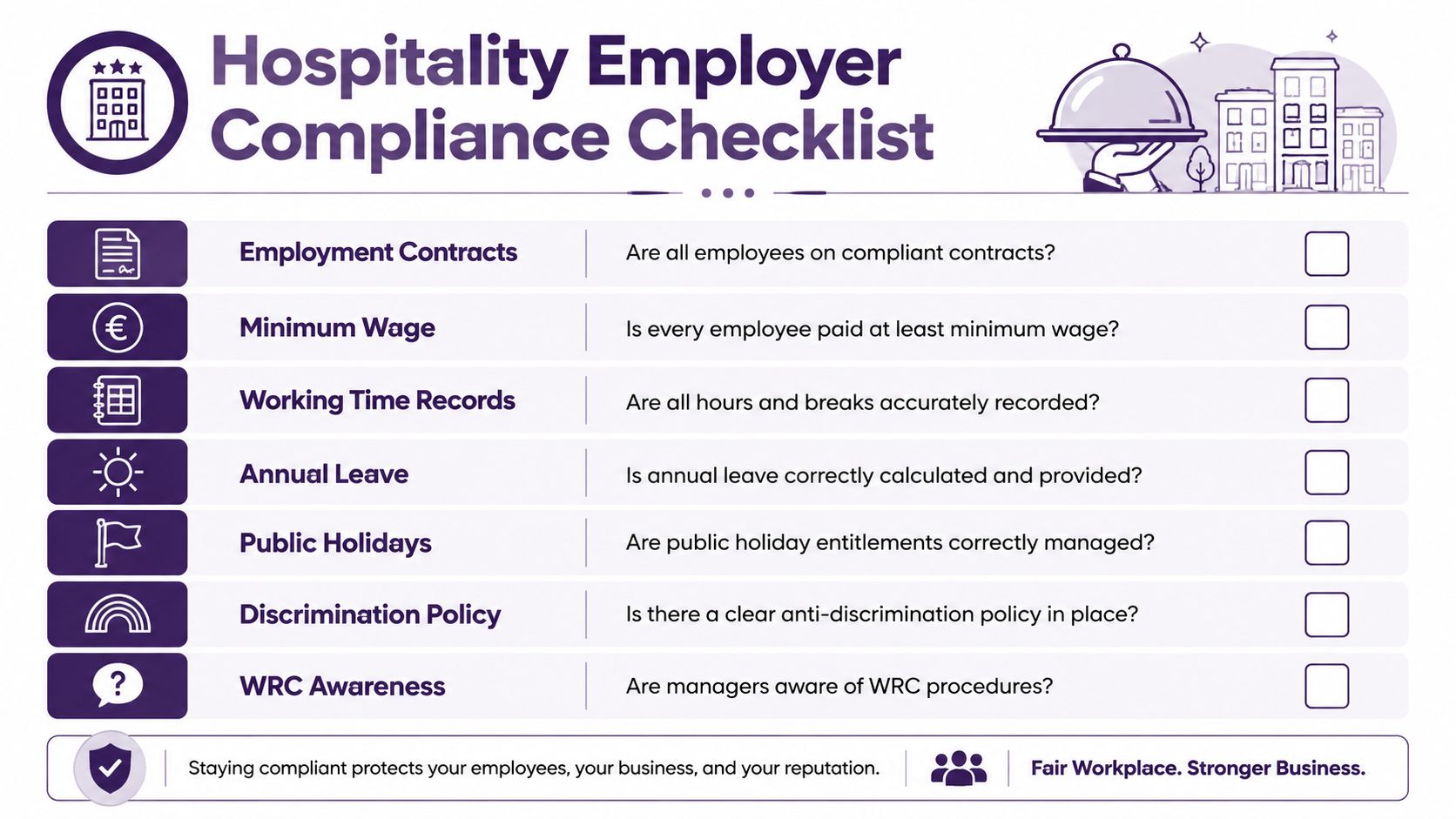
Contract and onboarding checks
Start with documents that set the employment relationship.
- Audit every live contract: Check that each employee is on the right contract for the job they do, including casual, part-time, seasonal, and variable-hours roles.
- Prioritise variable-hours staff: In hotels and restaurants, these are often the cases where the written terms no longer match the roster pattern.
- Check onboarding records: Keep signed acknowledgements for contracts, handbook policies, pay rates, and any tip or service charge rules issued at the start.
- Review role changes: If a staff member moved from bar to floor, breakfast to banqueting, or part-time to full-time, confirm the paperwork kept up.
Payroll and pay practice checks
Staff spot pay errors quickly. They also remember them.
- Match hours worked to hours paid: Compare clocking data, approved timesheets, and payroll output rather than relying on the roster.
- Check minimum wage compliance: Pay risks often arise after birthdays, training periods, role changes, unpaid trial shifts, or deductions for uniforms and till shortages.
- Review premium and additional payments: If the business pays Sunday rates, late-night allowances, or sleepover arrangements, make sure payroll applies them consistently.
- Write down the rule for tips and service charges: Staff and managers should understand what belongs to employees, what counts as a service charge, and how the business distributes either.
Rostering and time record checks
This area catches many hospitality employers because the roster is only the starting point.
- Track actual hours, not planned hours: Early starts, late finishes, and covering absent colleagues can change weekly totals fast.
- Review close-open patterns: Daily rest problems often show up where staff finish late and return for breakfast, cleaning, or prep.
- Check split shifts and broken time: They can be operationally useful, but they need close monitoring for rest, fatigue, and retention reasons.
- Record breaks properly: If a break was shortened, delayed, or missed because service got busy, managers need to record it and deal with the pattern.
- Review average working time over the correct reference period: A lawful-looking weekly rota can still create an unlawful average if nobody checks the cumulative position.
In hospitality, a compliant roster on paper is not enough. Employers need records that show what happened in service.
Policy and manager behaviour checks
A good handbook does very little if line managers improvise under pressure.
- Test disciplinary practice: Managers should know when to investigate, when to suspend, when to hold a formal meeting, and when not to rush to a warning.
- Check grievance routes: Staff need a clear route to raise concerns about a head chef, duty manager, or department lead without fearing lost hours or awkward shifts.
- Look at equality in day-to-day decisions: Review who gets the best shifts, who gets cut first, who is offered overtime, and who is passed over for training or promotion.
- Check probation decisions: Extensions, confirmations, and dismissals during probation should be documented and handled with basic fairness, not treated as informal management calls.
Where to get operational help
If this review shows gaps, deal with the system behind the problem. That may mean updating contracts, tightening time-and-attendance controls, rewriting handbook policies, retraining managers, or checking whether payroll and rostering processes work together properly. Beacon Recruitment provides HR and compliance support for hospitality employers, including contracts, handbooks, people audits, and WRC-focused process reviews.
Need help putting this into practice?
If you want help turning this checklist into a working system, Beacon Recruitment can support hospitality employers with practical HR and compliance work that fits real venue operations, from contract audits and handbook updates to process reviews that stand up better under WRC scrutiny.
Is Your Hospitality Venue WRC-Ready?
Don't wait for an employee complaint to expose your roster and payroll gaps. Book a Free Consultation with Beacon today to audit your HR systems and protect your business.