Food Safety Training for Hospitality Ireland
Food Safety Training for Irish Hospitality Teams
Practical food safety and hygiene training for hospitality staff — delivered on-site, tailored to your operation, and documented for EHO compliance.


Training That Actually Changes How Your Team Works
EHO inspectors do not just inspect your premises and your paperwork — they speak to your staff. They ask about allergen procedures, about what happens when a food item is outside its temperature range, about how cross-contamination is prevented between raw and ready-to-eat foods. The answers they get tell them everything they need to know about whether your food safety system is operational or just documented.
Food safety training in hospitality is often treated as a box to tick — a basic food hygiene certificate that staff complete online and forget within a week. That approach protects nobody. What actually changes behaviour is training that connects to the specific kitchen the person works in, the specific risks on their menu, and the specific procedures they are expected to follow every day.
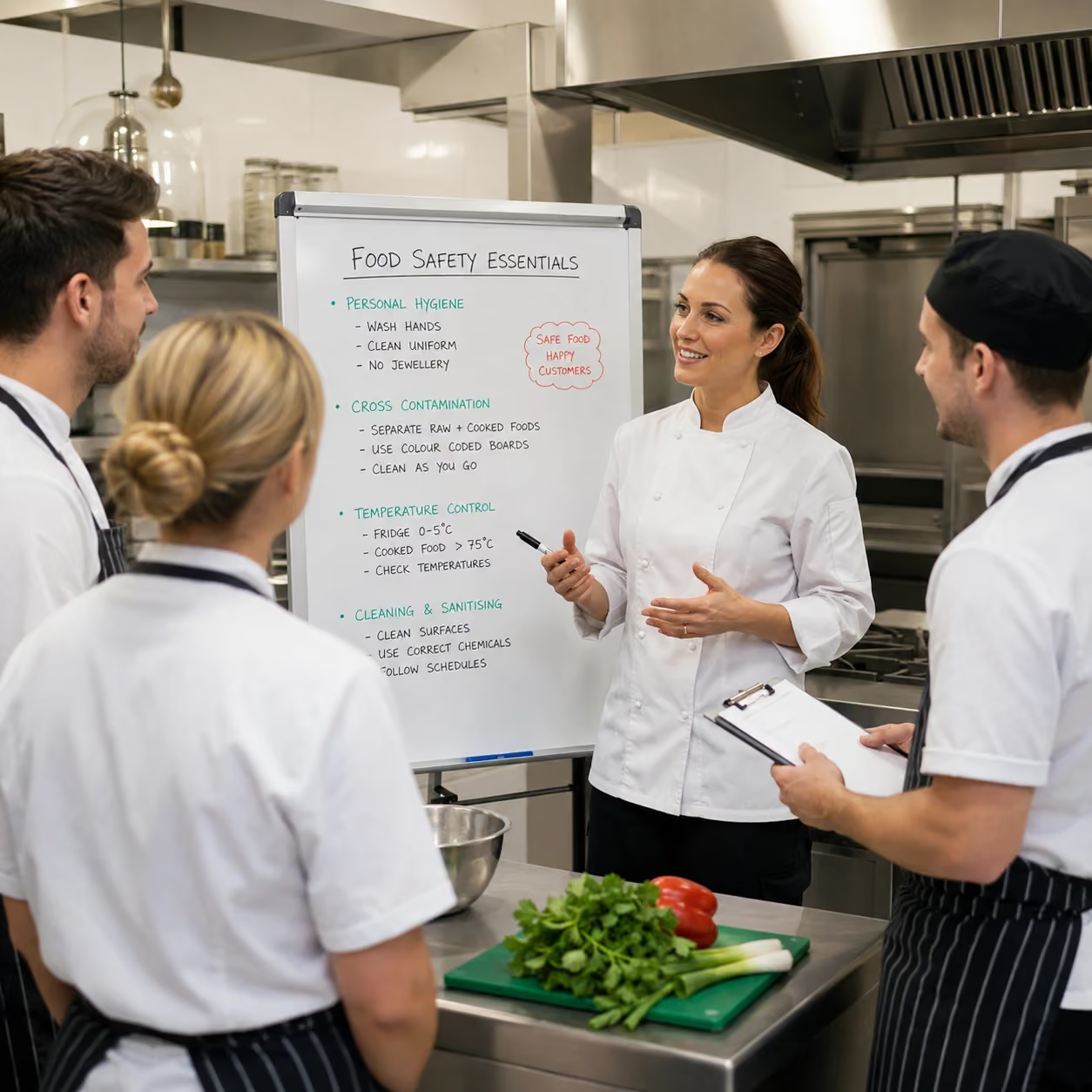
At Beacon, we deliver food safety training on-site, in your kitchen, tailored to your HACCP plan and your food safety management system. Sessions are practical, not lecture-based — and every attendee receives documented proof of training that satisfies EHO requirements.
We train your team around your operation — not a generic course that could apply to any kitchen in the country.
At a Glance
What You Get
On-site food safety training + certified records
BEST FOR
Restaurants, hotels, cafés & catering teams
Typical Timeframe
Half-day to full-day depending on team size
How We Work
On-site, nationwide
The Risk When Your Team Doesn't Understand Food Safety
Untrained or poorly trained staff are the most significant food safety risk in any hospitality operation. These are the consequences.

Untrained Staff as the Primary Food Safety Risk
The vast majority of food safety incidents in hospitality trace back to human error — incorrect temperature control, poor allergen handling, cross-contamination between raw and ready-to-eat food. Training is the only systematic defence against this.

HACCP Plan Without Staff Understanding
A HACCP plan that your team has never been briefed on is non-operational. If staff do not understand what the Critical Control Points are and what they are expected to do at each one, the plan exists only on paper.

Poor Allergen Communication Under Service Pressure
Allergen awareness breaks down most often not through ignorance but through pressure — a busy service, a verbal handover that gets lost, a substituted ingredient that was not communicated to the front of house. Training builds the habits that hold under pressure.

Cross-Contamination Incidents
Cross-contamination between raw proteins and ready-to-eat foods — or between allergen-containing and allergen-free dishes — is a consistent cause of food safety incidents and EHO improvement notices in Irish hospitality.
No Evidence of Training for EHO
EHO inspectors will ask to see training records. A business that cannot produce evidence of food safety training for its team — not a certificate from three years ago but recent, documented, role-relevant training — is at immediate risk of an improvement notice.

High Turnover Creating Continuous Knowledge Gaps
Hospitality has one of the highest staff turnover rates of any sector. Without a structured onboarding training process, every new team member represents a period of elevated food safety risk until they learn your systems informally from colleagues.
What's Covered in Your Food Safety Training
Practical, on-site training covering every area your team needs to understand — connected to your actual HACCP plan and daily food safety procedures.

Food Safety Fundamentals Module
Core food safety knowledge for every team member — covering the causes of food poisoning, personal hygiene, temperature control, cross-contamination prevention, and the legal responsibilities of food handlers under Irish law.
HACCP Awareness Training
A practical walkthrough of your HACCP plan with your team — covering what the Critical Control Points are, what monitoring is required at each one, and what to do when something goes wrong.
Allergen Awareness Training
Training on the 14 major allergens, your specific allergen matrix, and the procedure your team must follow for every allergen request — from customer communication through to kitchen preparation.
Hands-On Practical Demonstrations
Practical demonstrations of correct food handling techniques, cleaning procedures, and temperature monitoring — carried out in your kitchen so the training connects directly to your team's daily work.

Training Records & Certificates
A certificate of training completion for every attendee and a full training record — documenting who was trained, what was covered, and the date of training — suitable for EHO inspection.

Manager Food Safety Refresher
An enhanced session for your kitchen managers covering supervisory food safety responsibilities — ensuring they can oversee the food safety system, manage monitoring records, and respond correctly to EHO inspector questions.
Who Needs Food Safety Training
Every person who handles food in your operation needs to understand food safety. These are the situations where formalised training is most urgent.
From First Call to Fully Compliant
Four steps from uncertainty to fully audit-ready.
Free Discovery Call
A brief consultation to understand your team size, the roles involved, your current HACCP system, and any specific food safety concerns or recent EHO observations we should address in the training.
Training Needs Assessment
We review your HACCP plan, your menu and your existing training records to identify what your team already knows and where the gaps are — so the training covers what actually matters for your operation.
On-Site Training Delivery
We deliver a practical, interactive training session in your kitchen — covering food safety fundamentals, HACCP awareness, allergen management, temperature control, and personal hygiene, all connected to your specific operation.
Training Records & Certificates
Every attendee receives a certificate of training completion. We provide a full training record suitable for EHO inspection — documenting who attended, what was covered, and the date of training.
Why Businesses Choose Beacon


Got Questions?
We’ve Got Answers.
Yes. Under EU Regulation 852/2004 and the EC (Hygiene of Foodstuffs) Regulations 2006, food business operators are required to ensure that food handlers are supervised and instructed and/or trained in food hygiene matters, commensurate with their work activity. This does not specify a particular certificate or qualification, but EHO inspectors will assess whether your team has received appropriate training — and will ask to see evidence of it. The training must be relevant to the role and must be documented.
A food hygiene certificate — such as the FSAI-endorsed Level 1 or Level 2 qualification — provides general food safety knowledge for food handlers. HACCP training is specific to your business's food safety management system — it teaches your team what your Critical Control Points are, what monitoring they are responsible for, and what to do when something goes outside the acceptable limits. Both are valuable, but HACCP-specific training is what connects your documentation to your team's daily practice. We provide both as part of our on-site training sessions.
There is no fixed legal interval for refresher training, but the general expectation from EHO inspectors is that food safety training is kept current — typically every one to two years for existing staff, and at induction for all new team members. Refresher training is also recommended following a menu change, a change to your HACCP system, or after any food safety incident or EHO observation. We can design a training schedule that makes sense for the size and turnover of your team.
EHO inspectors routinely speak directly to kitchen and front-of-house staff during an inspection. They typically ask questions such as: what do you do if a dish comes out of the oven below the required temperature? How do you handle an order from a customer who declares a nut allergy? What are the correct storage temperatures for raw chicken? Where are the temperature records kept and how often are they completed? Staff who cannot answer these questions confidently are a direct indicator to an inspector that food safety training has not been embedded in practice.
Please speak to us about your team's language requirements. Irish hospitality teams are frequently multilingual and we work to ensure training is accessible and understood by every attendee. Where a significant portion of your team works in a language other than English, we can discuss the best approach to ensuring the training content is fully understood and embedded — which is ultimately what matters for both food safety and EHO compliance.
Ready to Get Your Team Trained?
Book a free call. We'll explain what training covers for your type of operation and team — no charge, no obligation.

.avif)