Hospitality Operations Consultant Ireland
Operations Review & Efficiency Consulting for Irish Hospitality
A structured review of how your hospitality business operates — identifying inefficiencies, cost drivers, and inconsistencies, and building a clear plan for a more effective and profitable operation.


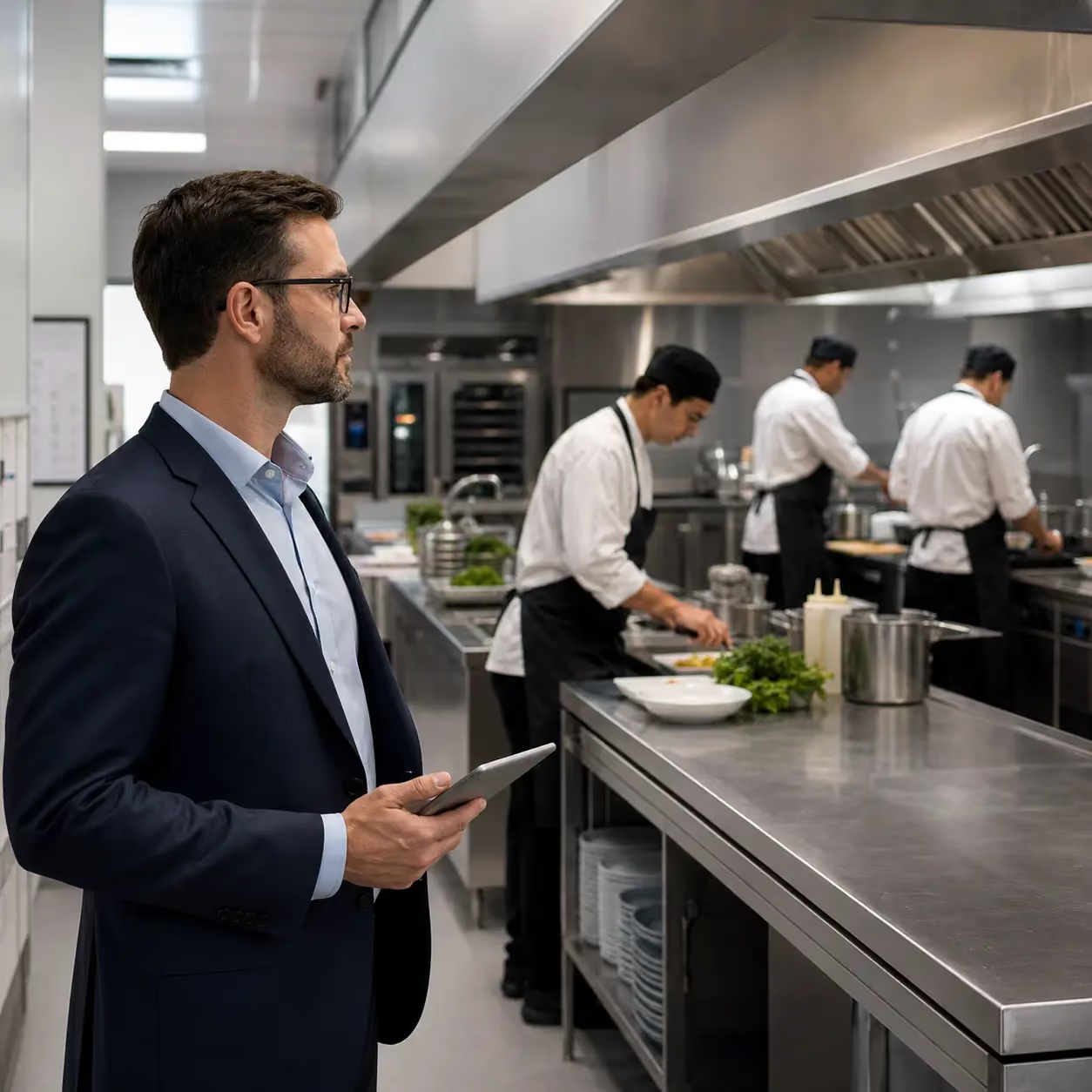
Busy Operations Hide Their Own Inefficiencies
In a hospitality operation that is running at pace, inefficiency becomes invisible. The labour schedule that has never been modelled against actual demand patterns. The kitchen that is producing four times the prep it needs on a Monday because nobody reviewed the prep list since the menu changed. The purchasing process where three different managers are ordering from eight different suppliers with no consolidated buying power. The service flow that adds four minutes to every table turn because a process decision made two years ago was never revisited.
None of these problems announce themselves. They sit inside the operation and quietly drain margin, create inconsistency, and burn out the people who have to work around them every day. The only way to find them is to step outside the operation and look at it objectively — which is the one thing you cannot do when you are running it.
At Beacon, we conduct structured operations reviews for Irish hospitality businesses — spending time inside your operation, mapping your processes, and identifying where inefficiency, cost, and inconsistency are coming from. The output is a clear, prioritised set of recommendations with a realistic implementation plan that your team can execute without needing to stop trading to fix things.
We have reviewed over 180 Irish hospitality operations. We know exactly what an efficient hospitality business looks like — and we can tell you the distance between that and where you are now.
At a Glance
What You Get
Full operational assessment + implementation roadmap
BEST FOR
Restaurants, hotels, bars & catering operations
Typical Timeframe
2–4 weeks
How We Work
On-site assessment + remote analysis
Where Operational Inefficiency Hides in a Hospitality Business
Operational inefficiency in hospitality is almost never a single problem. It is a set of interconnected issues that together determine how much of your revenue reaches the bottom line.

Kitchen Inefficiency and Throughput Limits
A kitchen that is not producing at its maximum throughput capacity during peak service is leaving revenue on the table. Poor flow design, inadequate mise en place systems, and unclear section responsibilities all create constraints that limit covers and increase labour cost per dish.

Labour Cost Above Benchmark Due to Poor Scheduling
Labour scheduling in most hospitality businesses is reactive — built around historical patterns rather than forecast demand. The result is consistent overstaffing on quieter periods and reactive panic on busy ones. A properly modelled schedule typically reduces weekly labour cost by three to six percentage points.

Inconsistent Product Quality Across Shifts
Quality inconsistency in food or service that varies by shift rather than by team is almost always a systems problem, not a people problem. Without clear SOPs, recipe specifications, and quality checks, each shift produces a slightly different product — and no amount of management oversight can replace an operational system.

Supplier Costs Not Reviewed Regularly
Most hospitality businesses do not have a structured supplier review process. Prices increase gradually, delivery charges compound, and the buying power of consolidated purchasing is never captured because orders are placed across multiple channels by multiple managers. This is frequently where the most immediate cost savings are found in an operations review.

No Standard Operating Procedures
A hospitality business that operates without documented SOPs is entirely dependent on the knowledge and habits of the people working that day. Every new hire, every staff change, every management transition creates a period of degraded operational quality. SOPs are the foundation of a consistent business.

Revenue Potential Not Being Captured
Upselling, table turn management, private dining utilisation, event capacity, and secondary revenue streams — most hospitality operations are leaving revenue on the table not because customers will not spend, but because the operational systems to capture that spend are not in place.
What's Covered in Your Operations Review
A systematic review of every operational area that drives cost, consistency, or efficiency in a hospitality business.

Full Operational Assessment
An on-site review of every operational area of your business — kitchen production, service flow, front-of-house management, scheduling, purchasing, stock management, and management practices — across multiple dayparts to capture the full operational picture.

Kitchen and Service Flow Mapping
A detailed mapping of your kitchen production and service flow processes — identifying bottlenecks, constraints, and inefficiencies that are limiting throughput, increasing labour cost, or creating inconsistency in the product reaching the guest.

Labour Scheduling Analysis
A structured analysis of your labour scheduling model against your actual revenue patterns — identifying where you are consistently over or under staffed, and building a more efficient scheduling framework that reduces cost without compromising the guest experience.
Supplier Cost and Purchasing Review
A review of your purchasing process, supplier base, and pricing — comparing current costs against market rates, identifying consolidation opportunities, and recommending a supplier management structure that gives you better buying power and clearer cost visibility.

SOP Gap Analysis and Recommendations
An assessment of the operational areas where the absence of Standard Operating Procedures is creating inconsistency, training difficulty, or quality variance — with specific recommendations on where SOP development will have the most impact on operational performance.
.svg)
Operations Report & Implementation Roadmap
A written report with every finding quantified where possible, a prioritised set of recommendations, and a phased implementation roadmap that your team can execute without stopping trading — with realistic timelines and clear ownership for each action.
Who This Is For
An operations review is most valuable when the business is trading well enough but the effort required to run it is disproportionate to the return — or when margins are under pressure without a clear cause.
From First Call to Fully Compliant
Four steps from uncertainty to fully audit-ready.
Free Discovery Call
A conversation to understand your business, the operational areas of greatest concern, and the commercial context driving the need for a review — so we can focus the assessment where it will deliver most value.
On-Site Operations Assessment
We spend time in your operation across multiple dayparts — observing kitchen production, service flow, scheduling, purchasing, and management practices. We map your processes, identify bottlenecks, and analyse cost data alongside operational observation.
Analysis & Benchmarking
We analyse your operational data — labour scheduling, food cost and wastage, supplier costs, revenue per cover, and throughput — against industry benchmarks for your type of operation, quantifying the financial impact of each area of inefficiency we have identified.
Operations Report & Implementation Roadmap
You receive a written report with every finding clearly explained and quantified, a prioritised set of recommendations, and a phased implementation roadmap that your team can execute without disrupting trading.
Why Businesses Choose Beacon


Got Questions?
We’ve Got Answers.
A Beacon operations review involves on-site observation of your kitchen production, service flow, scheduling, purchasing, and management practices across multiple dayparts — combined with analysis of your financial data including labour cost, food cost, revenue patterns, and supplier pricing. The output is a written report quantifying every area of inefficiency and providing a prioritised set of specific recommendations, together with a phased implementation roadmap your team can execute without stopping trading.
The most effective way to reduce labour cost in hospitality is to build your schedule against a revenue forecast rather than historical habit. Most operations overspend on labour in quieter periods because the schedule was built for peak and never properly adjusted. Modelling your weekly schedule against daily and hourly revenue patterns — and giving managers a labour budget target for each shift — typically reduces labour cost by three to six percentage points without any reduction in service quality on busy periods. We do this as part of every operations review.
A well-managed food cost for a full-service restaurant typically sits between 28% and 35% of food revenue. Achieving this requires correct portioning enforced consistently across all shifts, a purchasing process that consolidates supplier relationships and reviews pricing regularly, a kitchen production system that minimises waste and controls prep quantities against forecast demand, and a menu that is costed accurately at current supplier prices with the correct yield factors applied. Most hospitality operations can improve their food cost by one to three percentage points with operational changes alone.
Consistency across shifts is a systems problem, not a people problem. The businesses with the most consistent product are the ones with the clearest Standard Operating Procedures — recipe cards with photographs, portioning tools, prep lists, opening and closing checklists, and service sequence standards — combined with a management structure that checks compliance with those standards at the start of every shift. Training alone does not create consistency. Training plus documented systems and regular compliance checks does.
Most operations reviews involve two to three days of on-site assessment across different dayparts, followed by one to two weeks of analysis and report writing. You receive the full operations report and implementation roadmap within two to three weeks of the on-site work. If you need a faster turnaround — for example, ahead of a board meeting, an investment decision, or a bank review — speak to us and we can discuss an accelerated timeline.
Want to Know What's Making Your Operation Harder Than It Should Be?
Book a free call. We'll explain what an operations review covers for your type of business — no charge, no obligation.

.avif)