July 16, 2026
Allergen Management Ireland Restaurant: 2026 Guide
Master allergen management Ireland restaurant challenges with our 2026 guide. Covers FSAI rules, staff training, and building a foolproof system for dine-in &

Friday evening. Full restaurant. Delivery tablets firing. A server gets stopped at table seven with a simple question that isn't simple at all: “Can I have the chicken dish without dairy, and is there mustard in the dressing?”
If the answer lives only in one chef's head, you don't have an allergen system. You have luck.
That's the core issue with allergen management in an Ireland restaurant. It isn't a menu note, a folder in the office, or a quick word from the pass. It's a live operating system that has to hold together under pressure, across dine-in, takeaway, phone orders, QR menus, and third-party delivery apps.
Why Allergen Management Is a Non-Negotiable Pillar of Your Business
The legal baseline is clear. In Ireland, allergen management in restaurants is anchored by EU food information law requiring the declaration of 14 specific allergens, and Safefood notes that this written information must be provided by food businesses in a format customers can access without needing to ask staff (Safefood guidance on food allergen labelling).
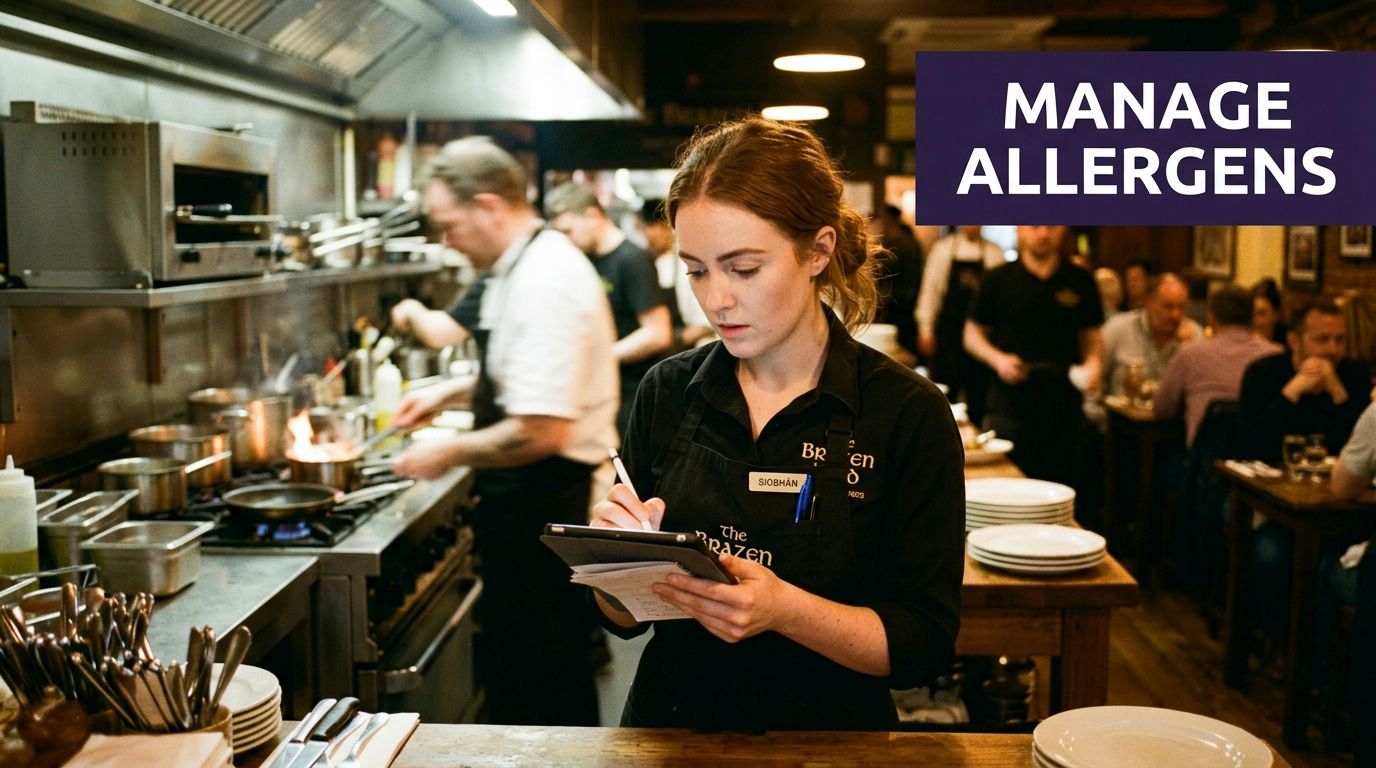
That requirement matters because customers don't experience your operation in departments. They don't separate front of house from prep, or supplier paperwork from menu design. They ask one question and expect one accurate answer. If your answer changes depending on who picks up the phone or who's on garnish, the risk isn't theoretical. It's built into your service model.
Why menu labelling alone doesn't protect you
A lot of operators think they're covered because allergens appear on the printed menu. Sometimes they are, sometimes they aren't. The failure usually appears in the gap between the menu and the plate.
Common pressure points look familiar:
- Recipe substitutions during service: A chef switches one sauce, garnish, bread, or stock because an item runs out.
- Supplier changes without sign-off: A new spec sheet arrives, but nobody updates the customer-facing information.
- Customisations handled informally: “No sauce” turns into “same plate, same utensils, same station.”
- Split-channel menus: The restaurant menu says one thing, the delivery app says another, and the till buttons say something else.
Practical rule: If a customer answer can't be traced back to a written record, it isn't reliable enough.
The business risk is broader than compliance
Owners often frame allergens as an inspection issue. It's bigger than that. It touches trust, online reviews, staff confidence, and whether a customer ever comes back.
An effective allergen system does three things at once:
- Protects customers by making information accurate and accessible.
- Protects staff by giving them a clear source of truth.
- Protects the business by reducing guesswork during busy periods.
There's also a practical operating benefit. Restaurants with disciplined allergen control usually have tighter recipe management, better supplier control, cleaner service communication, and stronger handover routines. In other words, the same habits that reduce allergen risk also make the kitchen more organised.
That's why allergen management in an Ireland restaurant has to be treated as a core pillar of the business. Not a once-a-year task. Not a laminated afterthought. A real system that still works when the head chef is off, two agency staff are on the floor, and the app orders won't stop.
Decoding FSAI Allergen Rules for Irish Restaurants
Most confusion comes from operators mixing up what must be declared, how it must be shown, and who is allowed to answer questions. Those are different issues. You need all three under control.
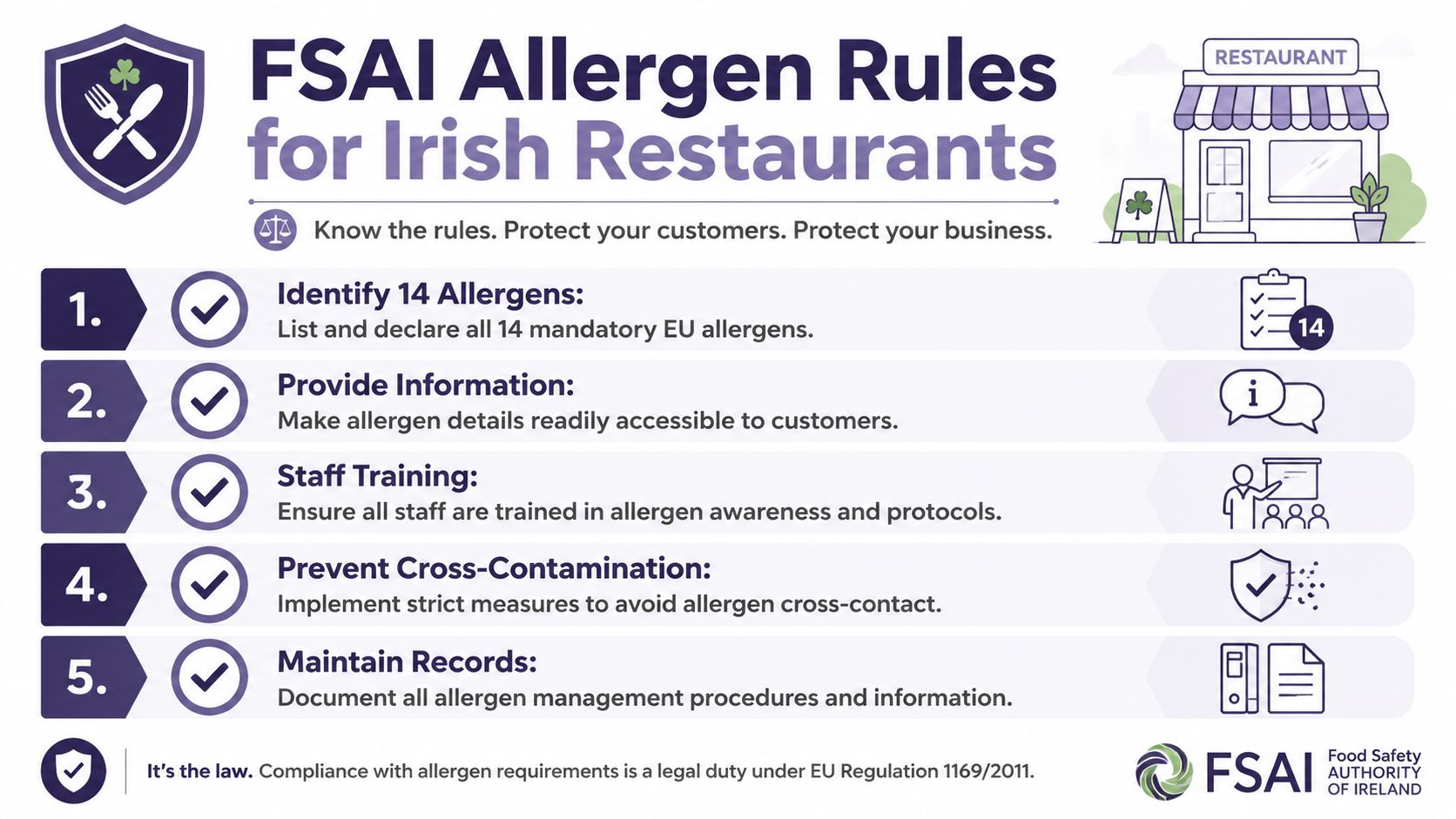
The 14 allergens you must manage
Every Irish restaurant should have clear control over these regulated allergens:
- Cereals containing gluten
- Crustaceans
- Eggs
- Fish
- Peanuts
- Soybeans
- Milk
- Nuts
- Celery
- Mustard
- Sesame seeds
- Sulphur dioxide and sulphites
- Lupin
- Molluscs
If your team needs a quick refresher, Beacon's summary of the 14 major allergens is a useful reference point for training packs and inductions.
What Irish operators actually need to provide
The practical expectation is stricter than many teams realise. Written allergen information must be available to customers in an accessible format. A verbal-only system is weak, and in many venues it falls apart the moment the experienced supervisor goes on break.
Your core obligations should be treated like a mandatory checklist:
- Identify each allergen by dish: Don't rely on broad statements such as “our kitchen uses nuts” or “sauces may contain allergens.”
- Make the information accessible: Customers shouldn't need a scavenger hunt to find it.
- Keep records aligned with the live menu: If a recipe changes, the allergen answer changes too.
- Control front-of-house communication: Staff should confirm, not improvise.
- Back every answer with documentation: The written record is the source of truth.
The weak point in many restaurants isn't the law. It's the handoff between paperwork, prep, and the person speaking to the customer.
There's a useful comparison here with other markets. If you work across jurisdictions, it helps to see how local rules shape operations differently. For example, this essential guide for NYC restaurant owners shows how compliance frameworks shift by location. In Ireland, the practical burden lands heavily on accurate allergen communication at point of sale.
What EHOs expect to see in practice
The most actionable operational method for Irish venues is straightforward: verify supplier specs on receipt, update the allergen matrix after any formulation change, train front-of-house to avoid guessing, and use written records as the source of truth for all customer-facing answers. Common pitfalls include unlabelled recipe drift, informal verbal-only systems, and inadequate traceability (Irish allergen methodology summary).
That means your “compliance pack” can't just be a file sitting untouched in the office. It should show up in day-to-day operations:
- At goods-in: supplier declarations are checked.
- At menu updates: dishes are re-reviewed before launch.
- At pre-service briefing: staff know which items changed.
- At customer query stage: the answer comes from written records.
- At audit time: you can show how the system works, not just that a policy exists.
A tidy folder impresses nobody if the floor team still says, “I think that should be fine.”
Creating Your Restaurant's Allergen Matrix and Controls
If you want allergen management to survive a busy Saturday, the allergen matrix has to sit at the centre of the operation. Not in theory. In daily use.
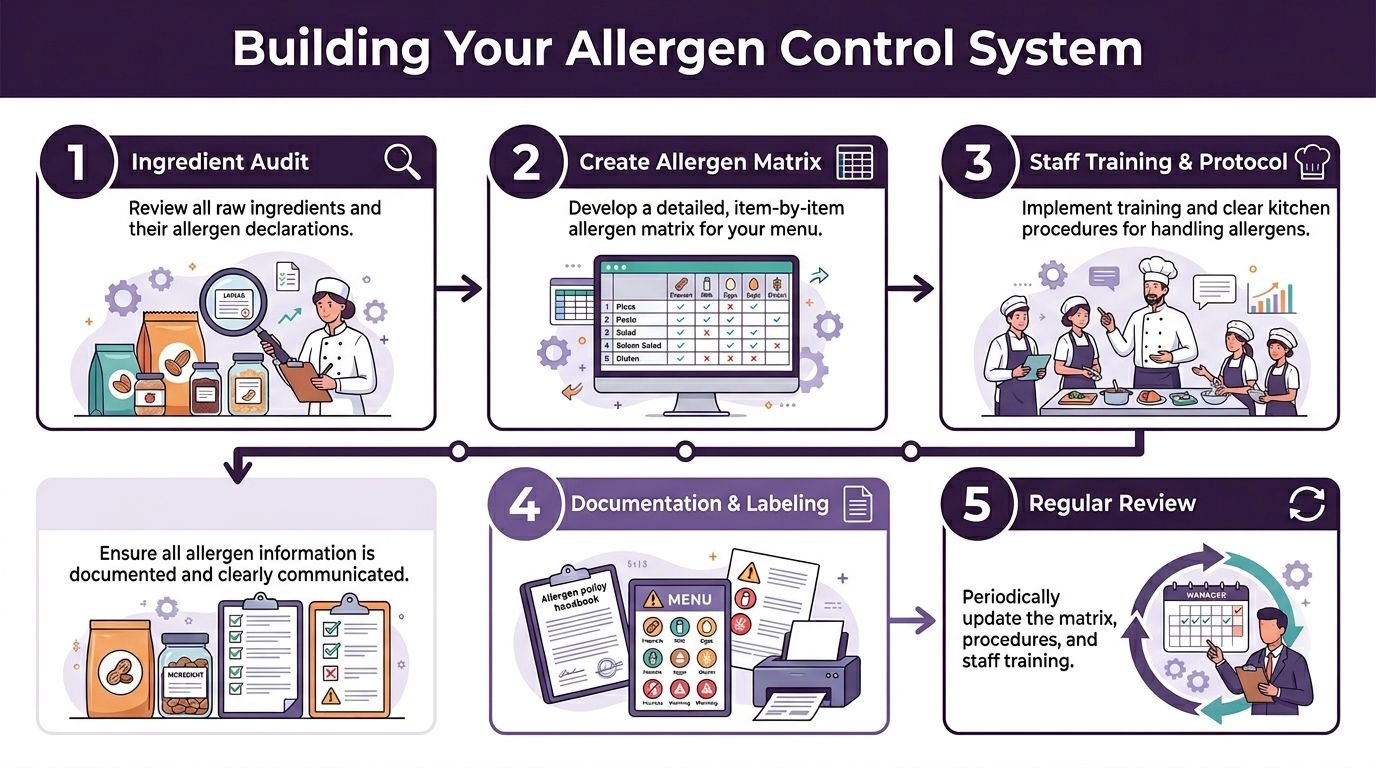
In Ireland, restaurant allergen management is most thorough when it's built as a documented control system: compile a full ingredient and allergen matrix, require allergen declarations on every supplier specification, and run a formal risk assessment. The main operational failure points are ingredient changes, reused leftovers, and missed cross-contact during prep or service (documented control system guidance).
Start with supplier reality, not menu assumptions
Many allergen systems fail at the first step because the business builds records from recipes instead of specifications. Recipes matter, but supplier data is where hidden risk often sits.
Your starting point should be an ingredient audit:
- Pull every current supplier specification: sauces, marinades, spice blends, breads, desserts, oils, garnishes, pre-made sides.
- Check declarations on every version in use: the “backup brand” in dry stores matters as much as the main one.
- Match spec names to stock names: if the kitchen says “burger relish” but the file says three different relishes, traceability is already weak.
- Separate branded facts from internal shorthand: staff nicknames for products create confusion fast.
If a supplier can't provide clear allergen information, that ingredient shouldn't sit comfortably in your system.
Build the matrix dish by dish
The matrix is your control document. It should list each menu item, every component within it, and the relevant allergens attached to each component. Don't stop at the main plate. Add sides, optional extras, garnishes, dressings, dipping sauces, and dessert toppings.
A working matrix usually needs to answer these questions:
- What dish is being sold?
- What ingredients and sub-recipes sit inside it?
- Which of the 14 allergens are intentionally present?
- Where is there cross-contact risk in prep or service?
- What customer modifications are possible, and what remains risky?
A good matrix doesn't just tell you what's in a dish. It tells your team where the answer could go wrong.
For some operators, spreadsheet control is enough if version control is tight and only authorised staff can amend it. Larger groups often need a more managed system tied to menu engineering, purchasing, and recipe files. Beacon also offers allergen management compliance support for venues that need full menu audits, matrices, procedures, and implementation support. That works best when the business already accepts that allergen control is an operational project, not just paperwork.
Put physical controls around the paper system
A matrix on its own won't stop cross-contact. You need kitchen controls that match the risk assessment.
Focus on the points where allergens move:
- Storage: Keep high-risk allergen ingredients clearly identified and sensibly positioned. Open containers with weak labels create preventable mistakes.
- Preparation: Separate utensils, chopping boards, containers, and prep sequencing where possible.
- Cleaning: Cleaning has to be specific enough to remove allergen residues, not just visible debris.
- Service: Plates, garnish stations, pass communication, and ticket notes all need discipline.
- Leftovers and rework: Reused components are a common blind spot. Once an ingredient has moved through service, its allergen status must stay traceable.
Revalidation is where strong systems stay strong
Most venues don't fail because they never created a matrix. They fail because they stopped updating it.
Build revalidation into normal management routines:
- Supplier change check: New product, new spec, new review.
- Recipe amendment check: Even a minor substitution triggers a matrix update.
- Seasonal menu review: Before launch, not after the first complaint.
- Walkthrough audit: Follow one allergen query from customer to kitchen to answer.
- Allergen drill: Ask a team member to verify a dish under service conditions and watch for weak points.
That last point matters. Walkthroughs and drills test whether the system survives real pressure. A calm office review is useful. A live service check tells the truth.
Turning Staff Awareness into Your Strongest Defence
Even the cleanest allergen matrix is useless if staff don't trust it, don't know where it lives, or think speed matters more than accuracy.
The training gap in Irish food businesses is real. A University of Limerick study of 101 food business respondents found that 45 received no training on food allergens, meaning 56 had received some training. Among those trained, 63% reported receiving food allergen training only once a year (University of Limerick allergen training study).
That should worry any operator with rotating menus, changing suppliers, and normal staff turnover. Annual training might tick a box. It doesn't keep a fast-moving hospitality team sharp.
Front of house must learn one habit above all
Front of house carries the final communication risk. The customer doesn't ask the prep list. They ask the person taking the order.
The single rule that matters most is simple: never guess.
Train FOH to do these things every time:
- Acknowledge the query clearly: Don't brush it off with “I'm sure that's fine.”
- Check the written source: Menu key, allergen file, digital system, approved matrix.
- Escalate uncertainty immediately: If the record isn't clear, the answer isn't clear.
- Repeat back the dish and concern: This reduces confusion with modifiers and sides.
- Record the alert on the order pathway: Till, docket, kitchen note, handoff.
A practical service script helps. “I'm going to check the written allergen record for that dish so I can give you an accurate answer.” That sounds professional because it is professional.
Service standard: Confidence is not the goal. Accuracy is.
Back of house training has to be operational
Kitchen teams usually understand the seriousness of allergens. Where they struggle is consistency during pressure, substitutions, and service shortcuts.
Train BOH around actual risk moments, not generic slides:
- Recipe discipline: No unapproved swaps.
- Utensil control: Don't borrow from another section because it's busy.
- Prep sequencing: Handle sensitive orders in a controlled way.
- Pass communication: Confirm special allergen orders verbally and on docket.
- Leftover control: Reused components must remain identifiable.
One of the best ways to strengthen this is to build short refreshers into line checks, pre-service briefings, and menu change rollouts. Frequent, practical reminders work better than one long annual session that nobody remembers by Christmas.
Managers dealing with wider team instability should also look at the staffing side. Retention and consistency affect food safety more than many owners admit. This guide to reducing staff turnover is useful because it treats training as part of keeping standards stable, not just getting people through induction. For venues that want structured support, Beacon's food safety training service is one route to formalise those routines.
Train for handoffs, not just knowledge
The weakest staff training programmes focus only on facts. Strong ones train handoffs.
Run short scenarios such as:
- A customer asks about mustard in a dressing during a rush.
- An app order includes a note about milk allergy but no follow-up call.
- A chef substitutes a sauce mid-service.
- A runner receives a plated allergen-sensitive meal with no verbal confirmation.
Those moments are where systems break. Train there.
Allergen Safety for Online Orders and Takeaways
Online ordering exposes weak allergen systems faster than the dining room does. In-house, a customer can ask follow-up questions. On a delivery app, they often can't. If your information is missing, vague, or buried, the risk lands before the food is even prepared.

FSAI guidance states that allergen information for non-prepacked food ordered online or by phone must be provided in writing before ordering or at delivery, and it must be easy to locate and accessible before purchase. This is a common operational gap for restaurants using third-party platforms (FSAI allergen advice for food businesses).
Where online systems usually break
The common issue isn't that restaurants know nothing. It's that their channels don't match.
A typical failure chain looks like this:
- The printed menu is updated.
- The website PDF is old.
- The delivery platform listing is missing allergen detail.
- The till still uses old modifiers.
- The kitchen gets a vague note like “allergy?” with no dish-specific instruction.
That's how a business ends up technically trying to manage allergens, while operationally leaving gaps at every handoff.
Build one multi-channel source of truth
The safest approach is to use your matrix as the master record, then push the same information into every sales channel.
That means checking:
- Website menus: dish names, descriptions, modifiers, sauces, add-ons.
- QR menus: same allergen fields as the printed version.
- Third-party apps: each exact item must carry accurate information.
- Phone ordering scripts: staff must know where to check and what to say.
- Collection and dispatch labels: the order leaving the premises must still match the declared dish.
Phone orders deserve extra attention because they often bypass digital checks. Staff need a script that confirms the exact menu item, any modification requested, and whether the written allergen information has been checked before completing the sale.
Online allergen control fails when the menu team, the floor team, and the delivery platform all work from different versions of the truth.
Practical controls for takeaway and delivery
The kitchen and handoff process matter just as much as the online listing.
Set up practical controls such as:
- Daily allergen sign-off: One manager checks that active menus and platforms match current records.
- Clear order routing: Allergen notes must pass from app or phone to till to kitchen without translation.
- Packaging discipline: Sensitive orders should be packed in a way that reduces mix-ups during dispatch.
- Handoff confirmation: Staff should confirm the special instruction before the order leaves.
- Customisation limits: If a platform can't support safe communication for certain changes, remove that option.
One hard truth. Some dishes are manageable in-house but unsafe to offer through delivery customisation. If the platform setup invites ambiguity, the safest decision is often to simplify the menu online.
That's the future of allergen management in an Ireland restaurant. Not just legal wording. Operational consistency across every way you sell food.
Making Allergen Management a Core Business Advantage
Restaurants that handle allergens well earn a level of trust that generic service standards don't create. Customers notice when answers are clear, staff don't guess, and systems feel calm rather than improvised.
That advantage doesn't come from one policy. It comes from alignment. Supplier specs are checked. The matrix is current. Kitchen controls are realistic. Front of house knows how to respond. Online and takeaway channels match the live operation.
There's also relief in running it properly. Managers spend less time firefighting. Staff stop relying on memory. Customer queries become easier to answer because the information is already organised.
Strong allergen control signals a well-run business. Customers may never see your matrix, but they can tell when your team is in control.
If your current setup depends on a few experienced people carrying the knowledge, it's fragile. If it works only in the dining room and falls apart on delivery apps, it's incomplete. If it exists on paper but not in service, it won't hold up when it matters.
The businesses that get this right don't treat allergen control as a burden. They treat it as part of professional operations.
If your venue needs a proper allergen system rather than another patch, Beacon Recruitment can help put the operational pieces in place. That includes practical support around documented allergen procedures, menu audits, staff training, and the day-to-day controls that make compliance workable in real Irish hospitality settings.
Stop Guessing with Allergen Queries During a Rush
Turn chaotic kitchen handoffs and vague menu labels into a single, reliable source of truth. Talk to our food safety experts today to implement practical allergen controls that protect your guests, your staff, and your business.