July 19, 2026
Cost to Hire a Chef from Abroad Ireland
Understand the complete cost to hire a chef from abroad Ireland for 2026. Our guide details permit fees, salary floors, and hidden strategic expenses.
If you're asking about the cost to hire a chef from abroad in Ireland, the core legal numbers are simple: €1,000 for the employment permit application and a minimum annual base salary of €36,605 for eligible chef roles. Those are the starting figures, but they're not the part that usually causes the biggest damage to a hospitality business.
Right now, you're probably dealing with the same mess I see across the trade. Your rota is stretched, your senior kitchen team is covering too many stations, service quality is wobbling, and every week without the right chef costs you consistency, morale, and management time. That's why most owners asking about the cost to hire a chef from abroad in Ireland aren't really asking about a permit fee. They're asking whether the whole move is worth it, how much risk sits behind it, and how to avoid making an expensive hiring mistake.
The Real Question Behind Hiring an International Chef
The obvious question is, “What does it cost?” The better question is, “What does it cost if this goes wrong?”
For Irish operators, the market for experienced chefs is tight. You can advertise locally for weeks and still end up with weak applications, no-shows, or candidates who don't fit the standard your kitchen needs. Hiring internationally can solve that. But only if you treat it as an operational decision, not a desperate patch job.
The first numbers matter. The Department of Enterprise, Trade and Employment General Employment Permit application fee is €1,000 for a permit duration of 6 to 24 months, and the employer must pay it. It can't be deducted from the worker's wages. Chef de Partie, Sous Chef, and Head Chef roles also need a minimum annual base salary of €36,605, excluding tips, commission, and bonuses, as outlined in this guide on hiring a chef from overseas in Ireland.
That answers the search query. It doesn't answer the business problem.
What actually hurts your business
The permit fee is visible. The hidden costs are what drain you.
- Service disruption: If the hire is delayed, your existing team absorbs the pressure.
- Bad fit in the kitchen: A technically good chef can still fail if the environment is disorganised.
- Compliance mistakes: Sloppy documents and poor process create avoidable risk. Good right to work checks for Irish employers aren't admin theatre. They protect the business.
- Repeat recruitment: If the chef leaves early, you start again from scratch with more downtime and more management hours burned.
Practical rule: Don't judge international hiring by the permit fee alone. Judge it by whether the chef is still performing well in your kitchen after the settling-in period.
A lot of operators approach overseas hiring like buying emergency stock because the fridge is empty. That mindset is understandable. It's also expensive. If you want the hire to stick, you need to think past the transaction and build the conditions that let a strong chef succeed.
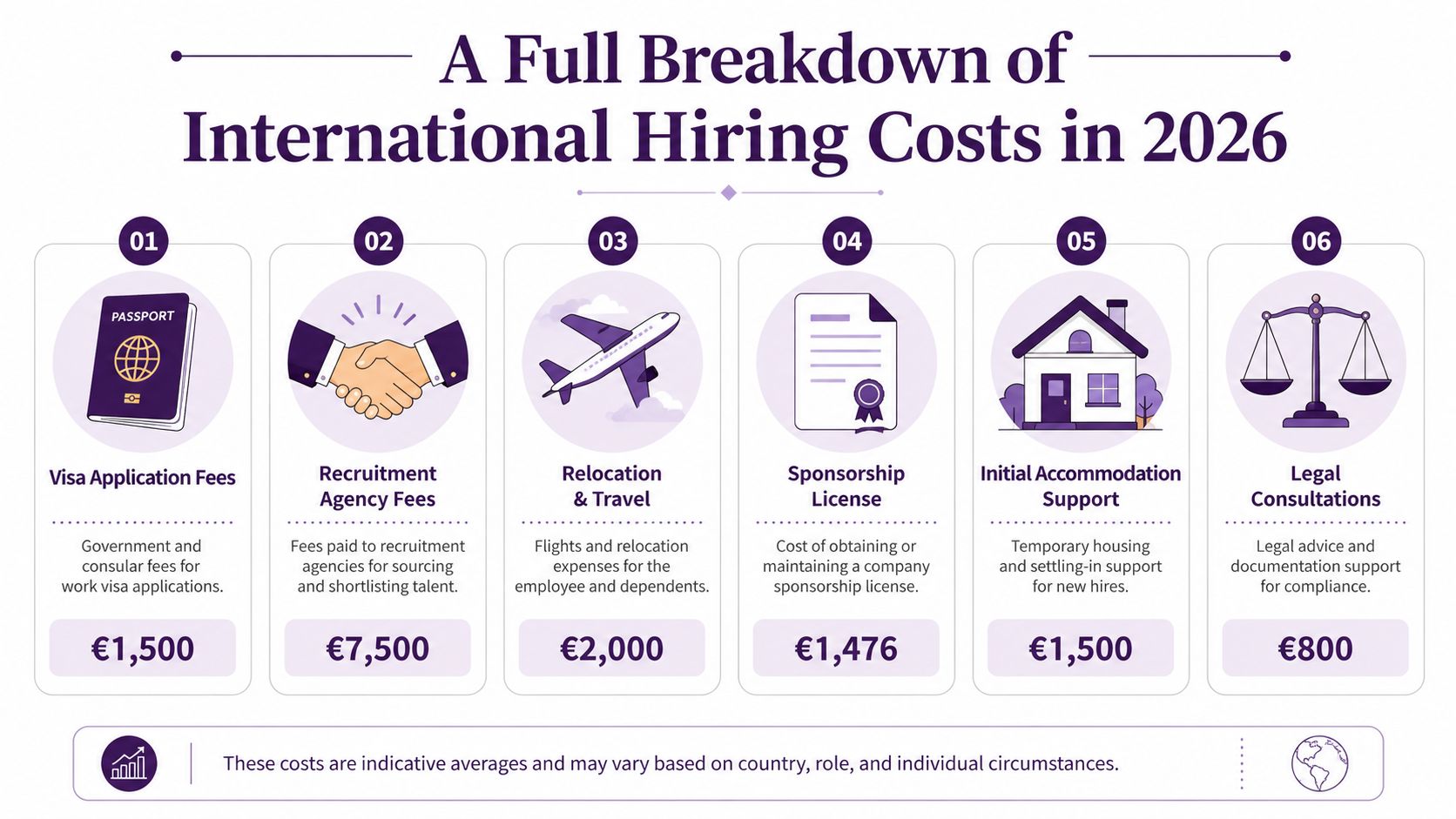
A Full Breakdown of International Hiring Costs in 2026
There's the legal cost, and then there's the actual budget.
If you want a clean breakdown, start with what the law requires and then build outward into the practical costs your venue will carry. Many owners make a misstep here. They budget for the permit and salary, then act surprised when the actual hire takes more coordination, more support, and more leadership time than expected.
The non-negotiable legal costs
The clearest statutory costs are already set. The DETE General Employment Permit fee is €1,000 for a permit duration of 6 to 24 months, it must be paid by the employer, and it cannot be deducted from the worker's wages under Irish employment law. If the application is refused, 90% of that fee is refunded, with the remaining 10% retained for administration. Eligible chef roles also require a minimum annual base salary of €36,605. That salary floor excludes tips, commission, and bonuses, and standard employer obligations such as Employer PRSI contributions still apply, as explained in this overview of hospitality employment permits in Ireland for 2026.
The operating costs most owners forget
Once you move past the permit, the budget becomes venue-specific. I'd break it down like this:
- Recruitment handling: If you use an external recruiter, expect a commercial fee. The amount varies by role, urgency, and how much of the process they manage.
- Travel and relocation: Flights, airport collection, and initial settlement support often land with the employer in practice, even when not strictly required by law.
- Short-term accommodation: Many venues provide temporary housing or contribute to early accommodation to make the move workable.
- Admin time: Someone in your business still has to collect documents, coordinate start dates, manage onboarding, and keep communication clear.
Cheap hiring decisions often become expensive management problems.
You should also be careful with online graphics and cost calculators. Some combine UK sponsorship costs, generic relocation assumptions, and broad agency estimates into one eye-catching number. For example, Hyperleap AI's pricing comparison is useful as a reminder that labour cost analysis should be compared against process efficiency and role design, but it isn't a substitute for an Ireland-specific chef hiring budget.
My recommendation on budgeting
Don't ask, “What's the cheapest way to get a chef in?” Ask, “What budget gives this hire the best chance of landing well?”
Build your worksheet in three layers:
- Legal baseline
Permit fee, minimum salary, Employer PRSI. - Arrival support
Travel, accommodation, document handling, practical settlement help. - Operational onboarding
Training time, management time, and the temporary dip in productivity while the chef learns your kitchen, menu, suppliers, and standards.
That's the honest way to assess the cost to hire a chef from abroad in Ireland. The statutory part is straightforward. The business part is where good operators separate themselves from frantic ones.
Beyond the Hire A Smarter Approach to Talent
Most venues still treat recruitment as a vacancy-filling exercise. That's the root of the problem.
If your only goal is to get a body onto the section, you'll make short-term decisions. You'll rush communication. You'll ignore the landing process. You'll assume a strong chef can “just get on with it”. Then you'll wonder why the fit feels shaky three weeks in.
Stop treating chefs like emergency stock
There's a simple analogy I use with owners. You can buy ingredients as a commodity, chasing whatever is available that morning. Or you can build a relationship with a trusted artisan producer who gives you consistency, quality, and fewer surprises. International recruitment works the same way.
A transactional hire fills tonight's gap. A strategic talent partnership strengthens the kitchen for the long haul.
That means thinking about the chef's success before they arrive. It means asking practical questions.
- Can your kitchen absorb a new leader or specialist without confusion?
- Are the SOPs clear enough for someone joining from another system?
- Will the existing team support the hire or resist them?
- Is the offer strong enough in real life, not just on paper?
Why churn usually starts before day one
Operators often blame the candidate when an international hire fails. Sometimes that's fair. Often it isn't.
The warning signs usually appear earlier. The role was sold vaguely. The housing was left uncertain. Nobody assigned responsibility for induction. The head chef was too busy to mentor. The owner expected instant output in an unfamiliar kitchen. None of that is about talent. It's about setup.
The hire isn't the finish line. It's the handover point between recruitment and operations.
A chef moving country for your business is taking a professional and personal risk. If your venue gives them chaos, mixed messages, and weak support, they'll either disengage or leave as soon as they can. Then you're back in the market again, explaining to the team why the section still isn't stable.
The smarter commercial view
A stable international chef hire can improve standards, consistency, and leadership in the kitchen. Not because overseas recruitment is magical. Because the businesses that do it well usually become more disciplined operators.
That's why I push owners to stop obsessing over the first invoice. The smarter move is to build a repeatable system for attracting, settling, and retaining skilled chefs. Once you have that, each future hire gets easier, faster, and less disruptive.
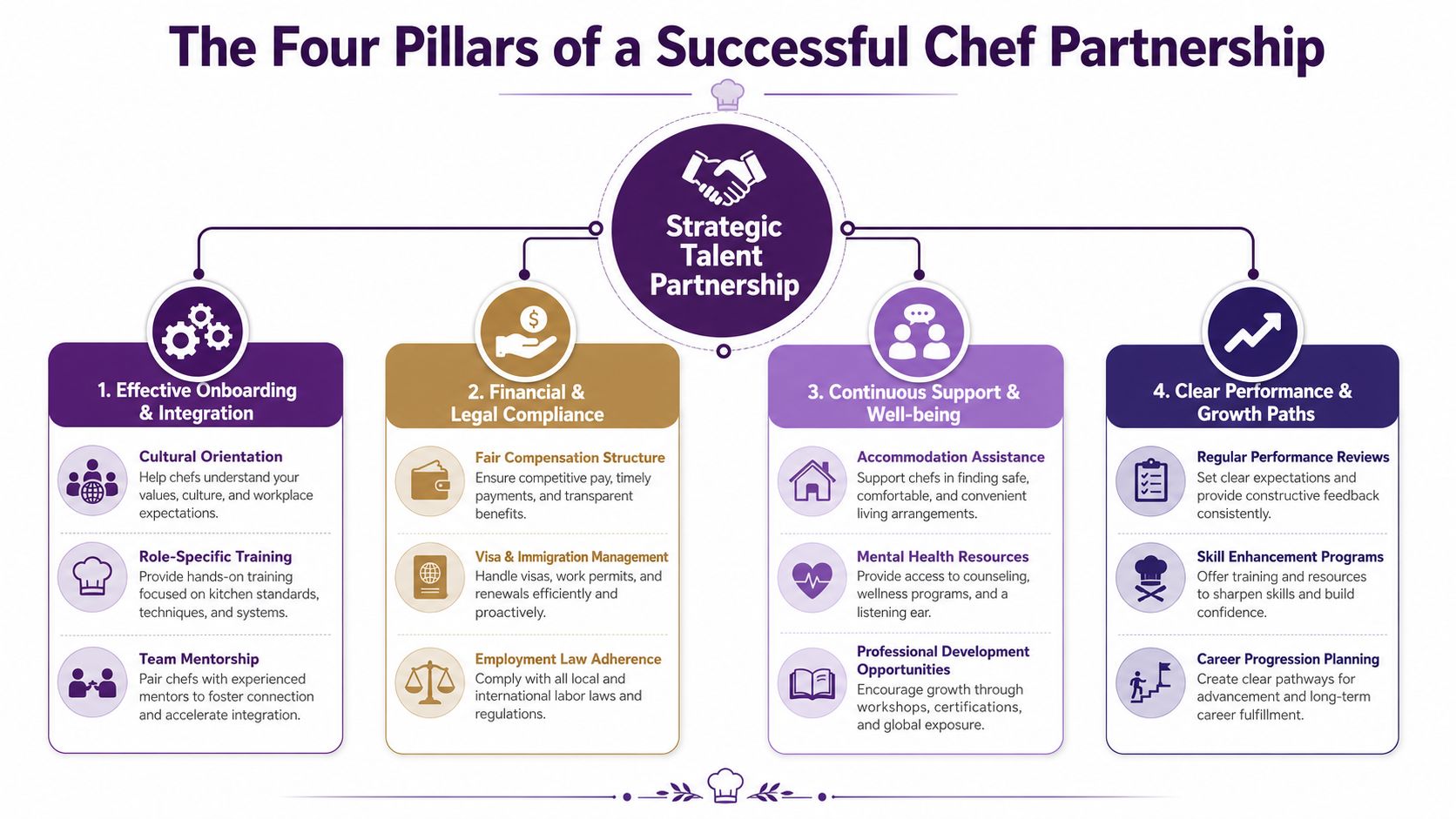
The Four Pillars of a Successful Chef Partnership
If you want an international chef to stay and perform, four systems need to hold up under pressure. Not one. Not two. All four.
Food safety and kitchen credibility
Serious chefs notice very quickly whether a kitchen is disciplined. They look at fridge organisation, labelling, handover standards, cleaning routines, allergen handling, and whether HACCP is living practice or just paperwork in a binder.
If the kitchen is messy, they won't trust the operation. If they don't trust the operation, they won't commit to it.
A compliant, audit-ready environment does more than satisfy inspectors. It tells the chef they've joined a business that takes standards seriously.
HR and compliance that actually protect people
Many hospitality businesses leave themselves exposed. Contracts are vague. Policies are outdated. Managers improvise. Problems get discussed informally until they become formal disputes.
For an international hire, that kind of looseness is worse. The chef needs clarity on terms, hours, reporting lines, leave, expectations, and what support exists if something goes wrong.
- Clear contracts: Remove ambiguity before it becomes conflict.
- Written policies: Give managers and employees a common reference point.
- Consistent treatment: Don't create one set of rules for local staff and another in practice for international hires.
Owner's note: If a manager can't explain the employment terms clearly, the business isn't ready to onboard properly.
Commercial stability in the background
A strong chef can't rescue a weak business model. If your menus are mispriced, purchasing is sloppy, labour planning is erratic, and service standards change from week to week, the kitchen becomes a firefighting exercise.
That drives good people out.
A profitable venue with clear structure gives chefs room to perform. They can lead service, train juniors, refine dishes, and improve consistency because they're not constantly compensating for operational disorder.
Joined-up operations across the whole venue
The final pillar is the one operators neglect most. The chef doesn't experience your business in departments. They experience one operation.
If front of house and kitchen clash, if payroll is late, if accommodation is mishandled, if suppliers fail, if communication is chaotic, the chef feels all of it. That's why retention isn't solved by recruitment alone. It depends on how the whole machine runs.
A useful test is simple. Ask yourself whether your current operation would make a skilled chef feel supported or stranded. Most owners know the answer immediately.
Putting Your Strategic Hire into Practice
Good intentions don't retain staff. Process does.
Once you've made the hire, your next job is to turn a risky transition into a structured landing. That takes planning before arrival, discipline in the first few weeks, and proper follow-through after the honeymoon phase wears off.
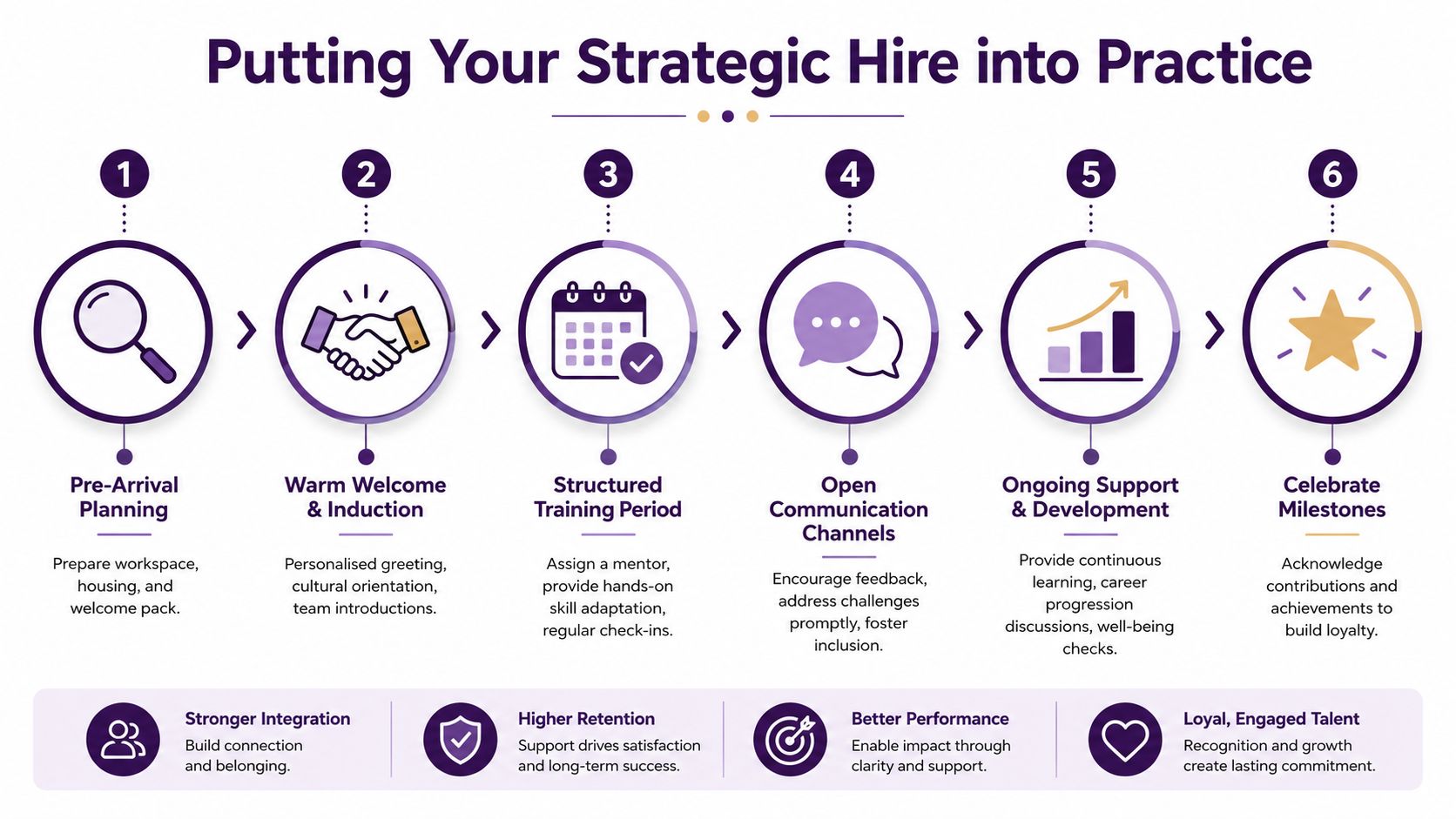
The onboarding checklist that actually matters
Use a practical checklist, not a vague welcome.
- Pre-arrival planning
Confirm rota expectations, uniforms, arrival logistics, accommodation arrangements, and who meets the chef on day one. - Kitchen induction
Walk through equipment, prep systems, suppliers, food safety routines, service style, and who signs off what. - Team integration
Introduce the chef properly. Don't leave them to “find their feet” while the brigade guesses where they fit. - Performance expectations
Set clear standards for service, prep, communication, leadership, and menu execution early. - Regular check-ins
Managers need scheduled conversations. Don't wait for a problem to become obvious in service. - Development path
Show the chef how they can grow in the business if they perform well.
A useful parallel exists in skilled trades. Businesses dealing with cross-border recruitment in other sectors know that licence recognition, standards alignment, and local operating rules matter just as much as the hire itself. That's why a resource like this guide to Australian trade licensing is a good reminder that technical ability alone never guarantees smooth integration into a regulated working environment.
The insider move many venues miss
For senior roles, don't assume the General Employment Permit is your only route.
For Head Chef or Executive Chef positions, venues can potentially use the Critical Skills Employment Permit route. The key advantage is speed. It has a 2-month processing time compared with the 6 to 8 month wait for a General Employment Permit, according to this analysis of international hospitality recruitment in Ireland. For operators hiring at the top end of the market, that's a strategic option worth examining alongside the broader Irish skilled worker visa process.
What managers should do in the first month
The first month is where retention begins to take shape.
- Week one: Focus on orientation, confidence, and relationship-building.
- Week two: Test understanding of standards and service flow.
- Week three: Address friction fast. Small frustrations harden into exit plans.
- Week four: Review performance, ask what support is missing, and make adjustments.
If your chef has to figure out everything alone, you haven't onboarded them. You've abandoned them politely.
The businesses that get value from international recruitment aren't necessarily the ones with the biggest budgets. They're the ones with the best operating habits. They prepare. They communicate. They support. Then they expect performance.
From Cost Centre to Strategic Asset
The narrow view is to see an overseas chef hire as a fee, a salary line, and a permit process. That's incomplete.
The better view is to see the hire as a strategic asset. A strong chef influences quality, standards, consistency, team confidence, and the guest experience every day. If you recruit well but onboard badly, you waste that asset. If you build the right operating environment around the hire, you give the business a much better chance of long-term stability.
That's the fundamental answer to the cost to hire a chef from abroad in Ireland. The statutory costs are easy to identify. The bigger commercial question is whether your venue is set up to turn that hire into lasting value.
Owners who understand that make better decisions. They stop chasing the cheapest short-term fix and start building kitchens people want to stay in.
If you're hiring internationally and want the operation around that hire to be as strong as the recruitment itself, Beacon Recruitment is built for that reality. They don't just help hospitality businesses find talent. They support the compliance, onboarding, and operational systems that make the hire work in practice.
Is Your International Chef Hire Costing You More Than You Think?
Don't let compliance mistakes and poor onboarding turn a strategic hire into an expensive failure—book a free consultation with Beacon to build a secure recruitment system.