July 16, 2026
How To Create Staff Handbook Ireland Effectively
Learn to create staff handbook Ireland for your business. Get practical guidance on Irish employment law, WRC compliance, and essential policies for 2026.
A lot of hospitality operators only think about the staff handbook when something has already gone wrong.
A supervisor sends someone home after an argument on shift. A chef says they were treated differently to another employee. A part-time staff member disputes leave or pay. Then a formal complaint lands, or a letter arrives from the WRC, and the scramble starts. Management looks for a policy, checks an old folder, finds three different versions, and realises nobody can say for certain which one the employee received.
That's why the effort to create staff handbook inIreland businesses can use matters so much. In hospitality, the handbook isn't an admin extra. It's the document that helps managers make the same decision on a busy Saturday night that they'd be expected to justify months later in a formal process.
Your First Defence in an Employee Dispute
The pattern is familiar. A venue has good people, decent intentions, and a set of unwritten rules that “everyone knows”. Then a dispute tests that assumption.
A duty manager thinks they handled lateness fairly because they gave a verbal warning. The employee says nobody ever explained the attendance rules clearly. Another manager says the same issue was ignored for someone else. Now the business isn't just dealing with conduct. It's dealing with consistency, proof, and process.
What the handbook does when memories differ
In a live dispute, verbal understandings don't carry much weight on their own. What matters is whether the business can show that rules existed, were communicated, and were applied through a recognisable process.
That's where the handbook earns its keep. It gives you:
- A fixed reference point for standards on conduct, timekeeping, leave, reporting lines, and procedures.
- A common rulebook for managers so one site or one shift leader doesn't make up their own approach.
- A record of communication when staff have been issued the handbook and acknowledged it.
- A cleaner path through conflict because grievance and disciplinary routes are already written down.
Without that, disputes drift into personal accounts of what was said and what was “normal practice”.
If a manager can't point to the policy, they usually end up defending the person, not the process.
In hospitality, speed creates risk
Hospitality businesses often make decisions quickly. That's part of the job. Someone doesn't show up, a complaint comes in from a guest, a till issue appears, or a conflict starts mid-service. The pressure to act fast is real.
But speed is exactly why documented process matters. When the venue is under pressure, managers fall back on whatever systems are easiest to use. A proper handbook turns those systems into something consistent.
If you're already dealing with a complaint or trying to understand the forum a claim may reach, Beacon's guide to the Workplace Relations Commission process is a useful starting point.
The real shift in mindset
Operators often treat the handbook as an onboarding document. In practice, it's closer to an operational shield. It helps before the dispute starts, during the dispute itself, and afterwards when someone asks whether the business acted fairly.
That's the value. A handbook won't stop every complaint. It will, however, stop a lot of avoidable confusion from becoming a much bigger problem.
Why a Handbook Is Not Just a Welcome Booklet
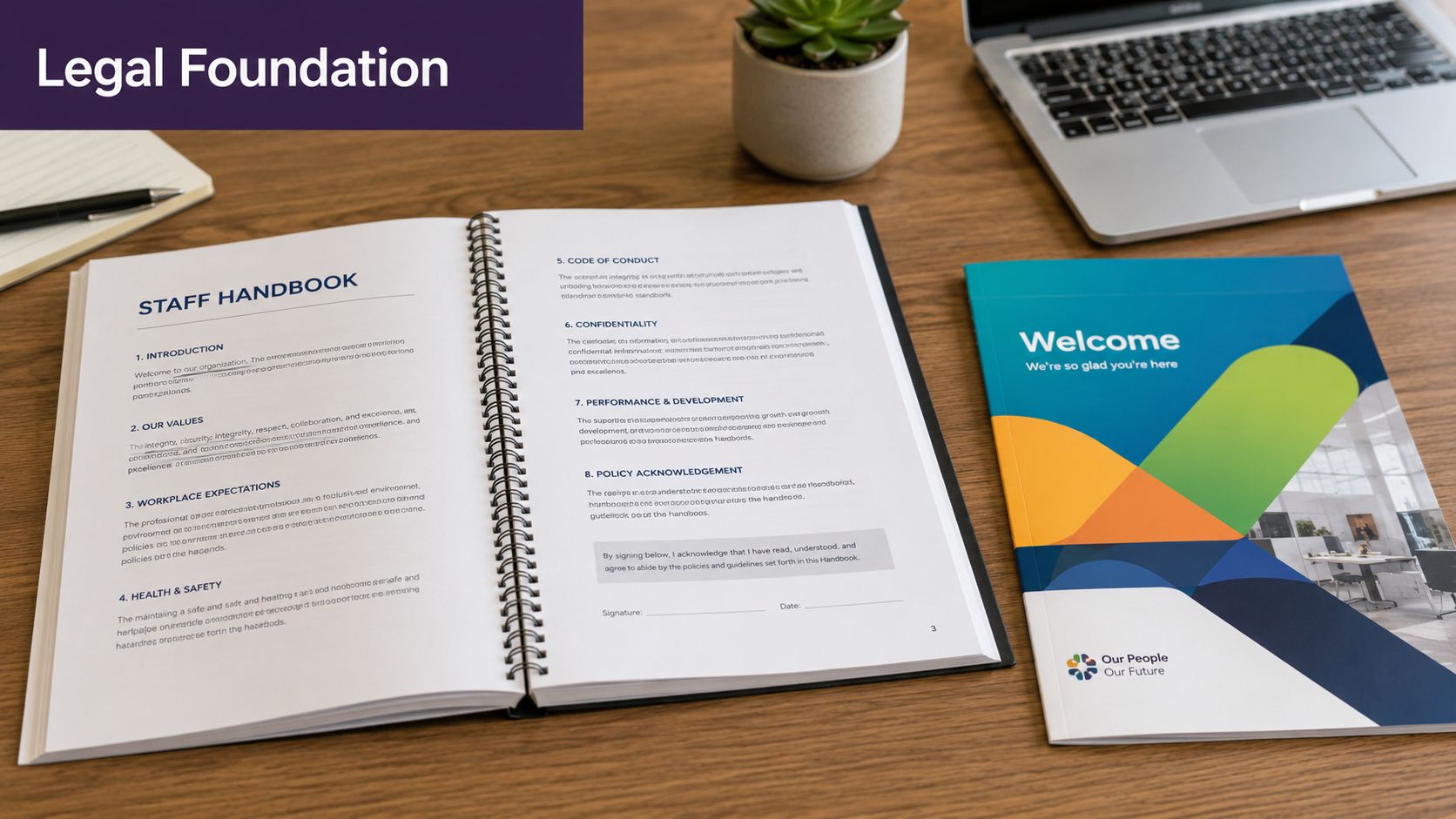
A welcome pack introduces the business. A staff handbook helps run it.
That distinction matters. In Ireland, a staff handbook is increasingly treated as a practical compliance tool. A well-written one must cover statutory leave and workplace procedures, aligning with Irish employment law and evolving expectations from the Workplace Relations Commission, as outlined in Irish handbook guidance from Genie AI.
It carries operational and legal weight
Many employers still think of the handbook as a culture document. The problem with that mindset is simple. Culture language doesn't help much when a manager has to show how they handled sick leave reporting, bullying allegations, or a disciplinary meeting.
A proper handbook gives written form to the way the business expects people to work. It supports onboarding, yes, but its bigger role is to make standards usable and provable.
Core point: The handbook should work as a daily management document first, and a welcome document second.
For hospitality businesses, that means it needs to do more than sound polished. It has to stand up to ordinary pressure:
- Busy managers need quick answers on rules for lateness, reporting absence, leave requests, and conduct.
- New starters need clarity early so they aren't learning policy by rumour.
- Senior management need consistency across departments, shifts, and sites.
- The business needs evidence that procedures were communicated, not just assumed.
What a weak handbook looks like
Most weak handbooks share the same flaws. They're full of vague statements, copied wording, and sections that don't reflect how the venue runs.
Typical examples include:
- Generic language copied from UK or US templates that doesn't fit Irish practice.
- No real procedures for grievances, discipline, or reporting concerns.
- A tone-only document heavy on brand values but light on rules.
- A file nobody uses because it's badly laid out and difficult to search.
That kind of document creates false comfort. It looks like compliance, but it doesn't support decision-making when something serious happens.
Why it matters more in hospitality
Hotels, restaurants, pubs, and multi-site groups deal with frequent starters, rotating managers, shift-based supervision, and pressure-led decisions. In that environment, “manager discretion” can quickly become inconsistency.
A handbook reduces that drift. It tells managers what the baseline is. It tells staff what to expect. It also helps stop ordinary issues from becoming formal disputes because nobody wrote the rules down in a way people could use.
The Core Components of a WRC-Ready Handbook
A handbook for Irish hospitality should be built as an operational compliance document, not a generic brochure. Sage's Ireland guidance recommends compiling policies, legal requirements, and company values in a logical sequence with clear headings and bullet points so staff and managers can quickly find the rule they need in day-to-day use, as set out in Sage's guide to creating an employee handbook.

Start with the sections managers actually need
The order matters. If people can't find the rule quickly, they won't use the document properly. In hospitality, the most useful handbooks usually move from general orientation into the rules that trigger the most day-to-day decisions.
Include clear sections for the following.
Employment terms and working arrangements
This section anchors the basics. It should reflect how work is organised in your business.
Include:
- Working hours with clear wording on rosters, attendance expectations, and how shifts are scheduled.
- Pay arrangements including when pay is processed, what deductions may apply where lawful, and who staff should contact about queries.
- Breaks and rest periods in plain language so managers and employees know what the standard is during normal operations.
- Probation and review points if your business uses them, written carefully and consistently.
Don't overload this part with legal phrasing. Staff need to understand what applies to them in practice.
Leave policies that reflect Irish obligations
Many hospitality handbooks struggle in this area. The leave section is either too brief or out of date.
A strong section should cover the categories that matter in real life:
- Annual leave and how requests are made.
- Public holiday arrangements and how these are handled operationally.
- Sick leave or sick pay rules including notification requirements.
- Protective leave where relevant to the workforce and legal framework applying to the business.
The point isn't to write a textbook. The point is to explain entitlement routes and reporting procedures clearly enough that managers don't invent their own rules on the floor.
A leave policy is only useful if a supervisor on an early shift can apply it without ringing three people for approval.
Dignity at work and behaviour standards
Hospitality businesses can't rely on a general statement about respect. They need a usable conduct framework.
This section should deal with:
- Expected workplace behaviour across kitchens, bars, floors, housekeeping, reception, and back office teams.
- Bullying and harassment concerns with a clear statement that complaints will be taken seriously.
- Reporting channels so staff know who to speak to if the issue involves their direct manager.
- Standards on communication and conduct during service, in staff areas, and in interactions with guests and colleagues.
A dignity-at-work section should be easy to find. If someone needs it, they usually need it quickly.
Grievance and disciplinary procedures
This is one of the most important parts of the document. If it's vague, the business is exposed. If it's clear, managers have a structure to follow when issues arise.
Your handbook should explain:
- How an employee raises a grievance
- Who receives the grievance
- What steps follow
- How meetings, investigations, and outcomes are handled
- How disciplinary issues are addressed
- Whether appeals are available and how they're made
If you need a practical benchmark for process design, Beacon's guide to a workplace grievance procedure is useful for mapping the basics.
Health, safety, data, and site rules
These sections often get pushed to the back, but they matter every day.
A hospitality handbook should also cover:
- Health and safety responsibilities so employees know the expected standard and reporting route for hazards.
- Data protection and confidentiality where staff handle bookings, guest information, payroll details, or internal records.
- Site-specific rules such as uniforms, lockers, keys, till handling, mobile phone use, or alcohol and substance rules where relevant.
- Company property and access including what must be returned at the end of employment.
Format is part of compliance
A handbook can have the right content and still fail in practice if it's unreadable. Use headings, bullet points, and a sensible order. Keep paragraphs short. Avoid stuffing important procedures into dense blocks of text.
That's how you create staff handbook Ireland teams will use. Not as a PDF that sits untouched in a folder, but as a document managers reach for when a decision has to be made.
How to Draft and Implement Your Handbook
The drafting process is where good intentions usually meet operational reality. Most hospitality businesses don't start from zero. They already have bits of policy in contracts, emails, onboarding notes, manager practice, rota systems, and old handbooks. The job is to pull that material into one controlled document and remove contradictions.
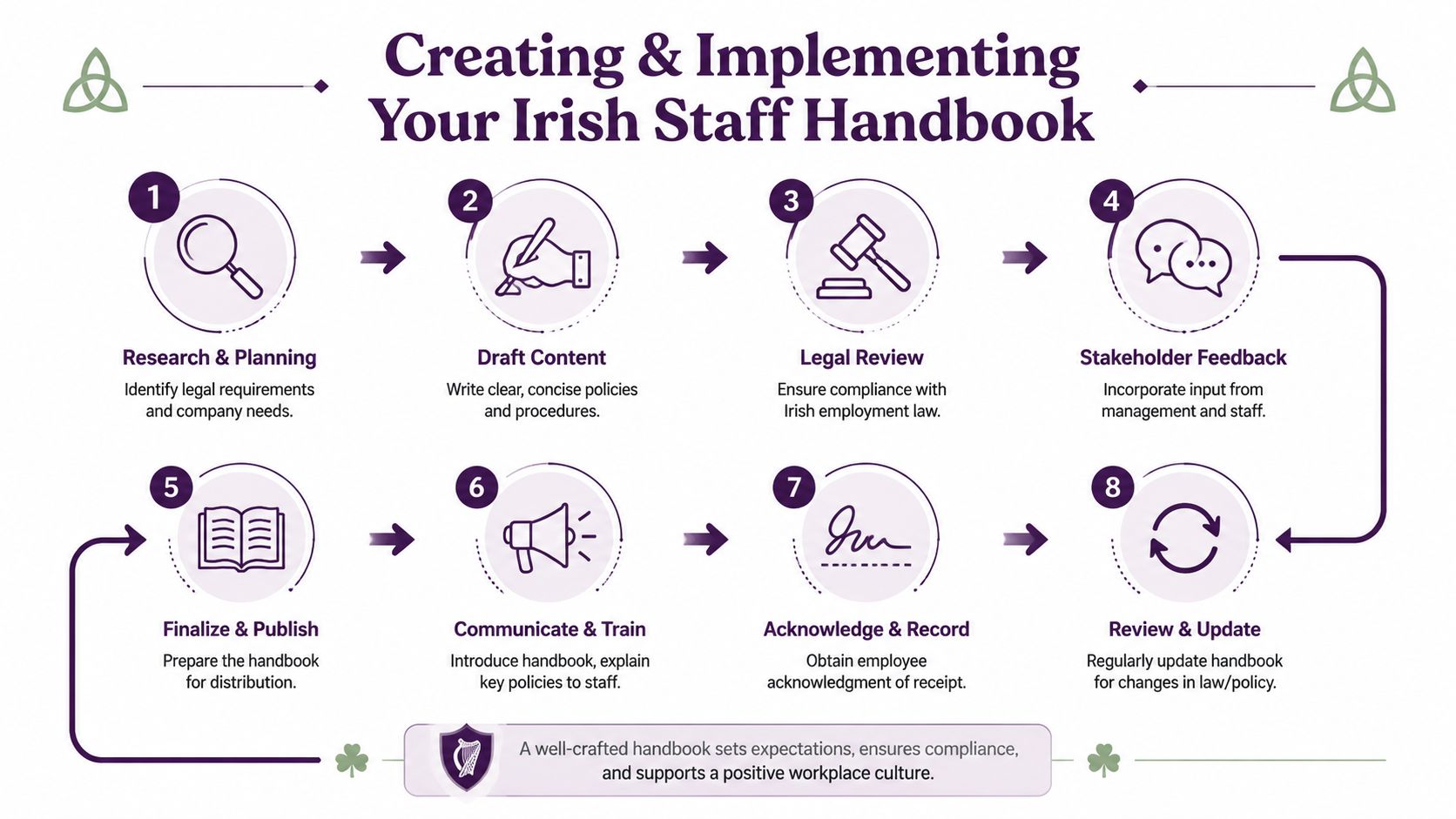
A workable drafting process
The cleanest approach is usually this:
- Gather what already exists
Pull together contracts, policy notes, leave rules, disciplinary templates, onboarding packs, manager checklists, and any site-level rules already in use. - Identify what's missing
Most gaps show up in the same places. Grievance steps, dignity-at-work language, reporting procedures, and version control are common weak spots. - Write in plain English
If a floor manager can't explain a clause clearly, rewrite it. Policies should be clear enough for a new starter on day one and precise enough for management later. - Structure it logically
Put the sections in an order people will use. Values and introduction can come first, but operational rules and formal procedures must be easy to find. - Get legal review where needed
A template is only a starting point. The final wording should fit Irish employment practice and the realities of your venue.
Readability is not cosmetic
Formatting gets dismissed far too often. In practice, it decides whether the handbook becomes part of operations or just another file.
Use:
- Clear headings so staff can scan for the right topic quickly.
- Bullet points where a process has multiple steps.
- Page numbers and appendices if the document is substantial.
- Consistent terminology so “manager”, “supervisor”, and “HR contact” aren't used interchangeably without meaning.
A handbook that looks neat but hides key rules in dense text usually fails in real-world use.
The best handbook wording is rarely the most legal-looking. It's the wording people can follow under pressure.
Distribution needs proof
Sending the handbook by email is not enough on its own. Businesses need to show not only that the document existed, but that staff received it and acknowledged it.
Irish guidance aimed at employers notes that a signed acknowledgement page is recommended to evidence that employees received and understood the handbook, and that this matters for audits and consistent communication of policy, as highlighted in Sport Ireland's employee handbook guidance.
That can be handled through:
- A physical signature page attached to the handbook
- A digital acknowledgement workflow through your HR system
- A tracked onboarding step where completion is recorded centrally
What matters is the audit trail.
Implementation is where handbooks succeed or fail
A new handbook shouldn't just be published. It needs to be introduced.
That means:
- Managers should be briefed first so they apply the same interpretation.
- Staff should receive it during onboarding, ideally at the start of employment.
- Key policies should be explained verbally, especially grievance, disciplinary, leave reporting, and conduct rules.
- Old versions should be removed from circulation so there's no confusion later.
For operators who want outside support, one available option is Beacon Recruitment's HR consulting service, which includes handbook and broader HR compliance support for Irish hospitality businesses.
The practical test is simple. If a new manager starts next week, can they use the handbook to run their shift decisions properly? If not, the document still needs work.
Common Handbook Mistakes That Cost Irish Businesses
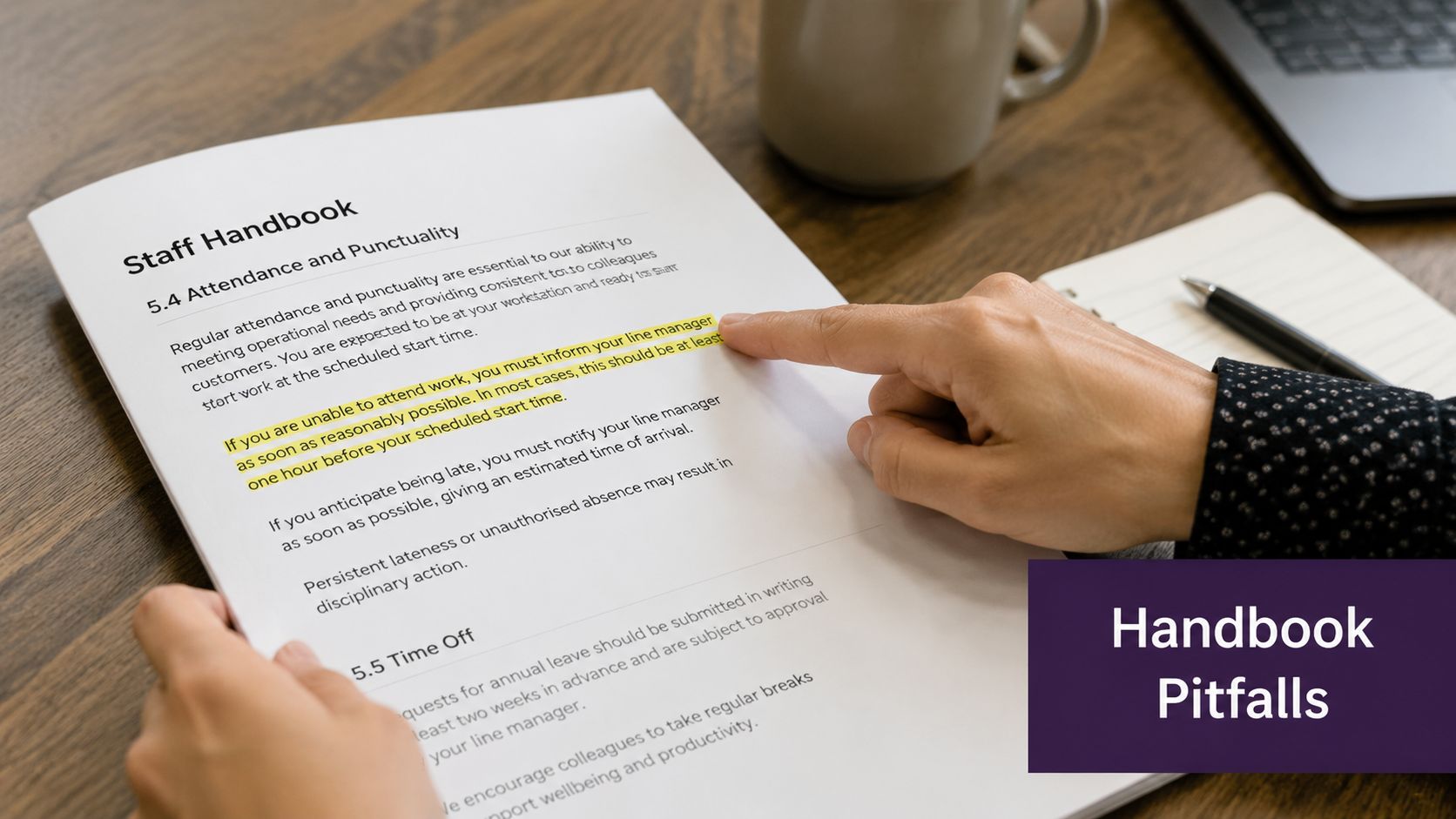
The most expensive handbook mistakes are rarely dramatic. They're usually ordinary shortcuts that look harmless at the time.
A manager downloads a template. Someone updates one policy but not the rest. A new site opens and keeps using an older version. A staff member signs nothing because “we emailed it over”. Months later, those shortcuts become the weak points in a dispute.
The document exists, but nobody uses it
One awkward truth is that many employees don't read handbook documents properly. HRLocker cites research showing that 60% of employees avoid reading their company handbook, which is why structure, readability, and trackability matter so much in practice, especially in operational sectors, as noted in HRLocker's employee handbook template guidance.
That means the answer isn't to make the handbook longer. It's to make it easier to use.
Common failures include:
- Dense blocks of text that bury the rule.
- No section logic so staff can't locate what matters.
- No training on key policies after distribution.
- No acknowledgment trail to show receipt.
If the handbook only works for HR, it doesn't work.
Generic templates create specific problems
A borrowed template often creates more risk than writing from scratch. Irish hospitality operators regularly end up with wording imported from another jurisdiction or another sector altogether.
Watch for:
- Non-Irish terminology that doesn't fit local practice.
- Office-based assumptions in a shift-based environment.
- Policies the business doesn't follow in real operations.
- Missing procedures because the template focused on culture rather than compliance.
That gap matters. A handbook should reflect how the venue operates. If it doesn't, managers will ignore it and fall back on habit.
Outdated versions quietly undermine you
One of the worst problems in multi-site hospitality is the spread of unofficial versions. A general manager amends one policy locally. HR updates another copy centrally. Seasonal staff receive whatever version happened to be saved to a desktop.
Practical rule: One handbook. One current version. One clear record of who received it.
If you can't prove which version applied to which employee, enforcement gets messy very quickly.
The dusty binder problem
Some businesses do create a decent handbook, then leave it untouched. It sits in a binder at reception, a shared drive, or an onboarding email chain. Nobody trains managers on it. Nobody updates it. Nobody checks whether it still reflects current practice.
That turns the handbook into a symbol rather than a control.
The better approach is straightforward. Review it regularly, replace old copies, brief managers on changes, and treat it as a live operating document. That's what keeps it useful when the pressure is on.
When to Call in a HR & Compliance Expert
There's a point where DIY stops being efficient.
If you're a small operation with stable management, one site, and a straightforward setup, you can make solid progress by gathering your policies, structuring them properly, and getting the document reviewed before rollout. But hospitality businesses rarely stay that simple for long.
Signs the handbook needs specialist input
Outside support usually makes sense when any of these apply:
- You have multiple sites and managers are interpreting policies differently.
- Seasonal hiring is frequent and onboarding needs to happen quickly but consistently.
- Your existing handbook has grown patch by patch and now contains overlap or contradiction.
- You're already dealing with a grievance, disciplinary issue, or formal complaint and need confidence that the underlying process is defensible.
- You can't prove distribution history for updated policies.
These aren't abstract risks. They're operational problems that affect how decisions get made every week.
Version control is the real headache
For many Irish hospitality operators, the hardest part isn't writing the first handbook. It's keeping the live version under control across sites, departments, and new starters.
That challenge is well captured in guidance discussing version control for mobile, digitally onboarded workforces. The key issue is making sure staff receive the latest version after policy changes and being able to prove it, turning the handbook into an enforceable evidence trail, as discussed in this video guidance on handbook version control and acknowledgement.
That's where external HR and compliance support often pays for itself. Not because the wording is magically different, but because the operating system around the handbook becomes tighter.
What expert support should actually do
If you bring in help, the value should be practical:
- Audit the current document against Irish employment practice and your actual operation
- Rewrite weak or vague sections so managers can apply them
- Align handbook wording with contracts and onboarding
- Set up acknowledgement and version control
- Train managers on using the handbook consistently
A handbook on its own won't solve poor management. But a good handbook, backed by proper implementation, gives management a reliable framework. That's often the difference between an issue being contained early and becoming a much more expensive distraction later.
If your handbook is outdated, inconsistent across sites, or too vague to rely on in a dispute, it may be time to tighten it up properly. Beacon Recruitment supports Irish hospitality businesses with operational HR systems, including staff handbook development, policy alignment, and compliance-focused people processes.
Will Your Staff Handbook Survive a WRC Claim?
Don’t wait for an employee dispute to discover your policies are outdated or unenforceable. Book a Free Consultation with Beacon today to build a compliant, WRC-ready handbook.