July 16, 2026
HR Compliance Checklist Ireland Employers: 2026 Guide
Get your 2026 HR compliance checklist Ireland employers. Navigate Protected Disclosures, contracts, & WRC rules easily with this essential guide.

A staff member sends an email at 10.42pm. It's vague, upset, and just specific enough to make your stomach drop. They say they were treated unfairly, that records don't match hours worked, and that they've “kept copies.” You read it from the office, from the bar, or in the car park before heading home, and your mind goes straight to the same place every hospitality operator knows too well. What have we missed, and how bad could this get?
That pressure is real in Irish hospitality. Hotels, restaurants, cafés, pubs, and visitor venues run on moving parts. Rotas change. managers cover shifts. international hires join quickly. A line manager gives an instruction verbally, but payroll, contracts, and HR files don't catch up. Most compliance problems don't begin with dramatic misconduct. They begin with small gaps that pile up under operational pressure.
The good news is that HR compliance becomes manageable once you stop treating it like a yearly paperwork exercise. In hospitality, it has to live in onboarding, scheduling, manager training, employee files, and exit processes. That's where businesses protect themselves. Not in a handbook sitting unread in a drawer.
Your Guide to HR Compliance in Irish Hospitality
The employers who feel most exposed are usually not reckless. They're busy. They've spent the morning on no-shows, supplier calls, guest complaints, and covering a shift on reception. HR gets handled in fragments. A contract goes out late. A probation review is discussed but not documented. A manager deals with an issue informally because service comes first.
That approach works until someone challenges a decision and asks for proof.

Irish hospitality creates a distinct compliance environment. You're often managing high turnover, variable hours, split responsibilities across supervisors, and a workforce that may include international staff with different levels of familiarity with Irish workplace rules. That means the standard office-style HR model often falls flat. You need something operational, visible, and easy for managers to follow during a busy service.
What hospitality operators are really dealing with
A practical HR compliance checklist for Ireland employers in hospitality has to reflect day-to-day reality:
- Shift-driven operations: Changes to hours, duties, and locations happen quickly, so paperwork has to keep pace.
- Front-line managers making people decisions: Supervisors often become the first point of contact for complaints, discipline, and informal promises.
- International recruitment and onboarding: Instructions, policies, and reporting routes need to be easy to understand and easy to access.
- Public-facing pressure: Staff issues don't unfold in a quiet office. They happen during check-in, at the pass, behind the bar, and in full view of guests.
A compliant process that nobody can follow during a Saturday night service isn't a working process.
If you want a wider operational view of HR for retail and hospitality, it helps to look at systems built for customer-facing sectors where people management and day-to-day execution are tightly linked. That's the mindset that works best here.
What actually works
The businesses that stay calmer under scrutiny usually do three things well. They standardise the basics, they document decisions as they happen, and they remove guesswork from manager actions. That sounds simple, but it changes everything.
What doesn't work is relying on memory, good intentions, or “the way we've always done it.” In hospitality, compliance has to be built for imperfect days, not ideal ones.
Core Employment Law Obligations for Every Employer
If your foundations are weak, every later HR issue becomes harder to defend. The first pass of any HR compliance checklist for Ireland employers should focus on the essential elements that support the whole employment relationship.
Written terms are not optional
In Ireland, written terms of employment should be treated as a hard control, not an admin afterthought. The Terms of Employment (Information) Act requires employers to provide core employment particulars to new hires within five days and the broader written statement of terms within one month, as outlined in this Ireland HR audit guide. In hospitality, where rotas shift and duties can change quickly, that delay creates knock-on problems because disputes about hours, leave, role scope, and conduct often come back to the original terms.
If contracts are late, managers start filling the gap with verbal explanations. That's where consistency breaks.
A reliable contract process should include:
- Offer issue control: No one starts without a tracked contract issue date.
- Role clarity: Job title, reporting line, place of work, and core duties should match operational reality.
- Pay alignment: Payroll setup should reflect the written terms from day one.
- Roster connection: If hours vary, the wording has to reflect how scheduling functions.
For a useful primer on worker status questions that often confuse smaller operators, BoloSign's employee vs contractor guide is worth reviewing before you draft anything informal for casual or flexible roles.
If contract wording is outdated or patched together from old versions, it's worth reviewing your contract of employment process before a dispute forces the issue.
Start with the basics managers can actually follow
A lot of employers own decent documents but still fail in practice because managers don't know what to do with them. Hospitality businesses need simple operational rules.
Use a short manager checklist at the point of hire:
- Confirm issue dates: Log when core particulars were given and when the full statement followed.
- Match payroll and roster setup: If the contract says one thing and the rota says another, fix it immediately.
- Store signed copies properly: A contract that can't be found quickly is almost as bad as one that was never issued.
- Record changes properly: Don't let changes to hours, duties, or reporting lines live only in text messages or verbal conversations.
Practical rule: If a manager can't find the contract, the notice terms, and the signed acknowledgement quickly, the process isn't under control.
Notice periods deserve more attention than they usually get
Statutory notice is one of those issues operators tend to think about only when someone is leaving. That's too late. Exit disputes often become more difficult because service dates were recorded poorly, probation wording was vague, or managers assumed the business could choose a shorter notice period than the law allows.
This is also where hospitality businesses with multiple sites get caught. One venue handles exits properly. Another uses an old template or informal wording. Inconsistent treatment creates avoidable risk.
What does not work
These habits cause trouble repeatedly:
- Backfilling paperwork after a dispute starts
- Using one generic contract for every role
- Letting supervisors make promises outside written terms
- Treating probation as a free-form period with no documented review
- Assuming payroll records alone will solve HR questions
Compliance gets easier when the written terms are right, issued on time, and used as the reference point for everyday management decisions.
The Protected Disclosures Act Explained
Many hospitality employers hear “protected disclosure” and assume it only applies to dramatic whistleblowing or serious fraud. That's too narrow. The practical risk is broader. A concern raised by a worker about wrongdoing can quickly become a legal process issue if the business handles it badly, dismisses it too quickly, or allows retaliation to creep in.

What counts in a hospitality setting
In real hospitality operations, concerns may arise around food safety practices, handling of records, financial irregularities, health and safety failures, or other conduct that a worker believes should be reported in the public interest. The mistake employers make is treating the issue as just another grievance because the person raising it is upset or because the manager knows them well.
That can be a serious error.
A grievance is usually about the worker's own treatment. A protected disclosure is about alleged wrongdoing. The two can overlap, but they are not the same thing and shouldn't be processed casually.
Examples that should trigger care include:
- Safety concerns: A worker reports that a procedure is being ignored in a way that could endanger staff or guests.
- Record manipulation concerns: Someone alleges time records or other business records are being altered.
- Financial concerns: A worker flags suspected misuse of company money or dishonest practices.
- Regulatory concerns: An employee says the business is ignoring a legal obligation and wants it examined formally.
Who may raise a concern
Employers often think only direct employees matter here. In practice, a wider group may come into the picture. That's why a hospitality business should avoid designing any reporting process around permanent full-time office staff only. If your workforce includes temporary workers, contractors, trainees, casual workers, or applicants interacting with your hiring process, your thinking has to be broader and more careful.
Don't ask first whether you think the complaint is valid. Ask whether your process for receiving it is safe, confidential, and consistent.
The employer mistake that causes damage
Most damage happens after the disclosure is made. A manager gets defensive. The worker is frozen out. Their shifts change unexpectedly. Colleagues are told too much. The reporter becomes “a problem” informally, even if nobody says that out loud.
That's where risk escalates.
Hospitality teams are close-knit. Information travels fast. A poorly handled disclosure can affect morale, culture, and trust long before any formal external step happens.
How to think about it properly
Treat protected disclosures as a separate controlled route. Keep the intake process clear. Limit who knows. Document actions carefully. Train managers not to improvise.
This area doesn't reward overconfidence. It rewards calm handling, clean records, and a disciplined process.
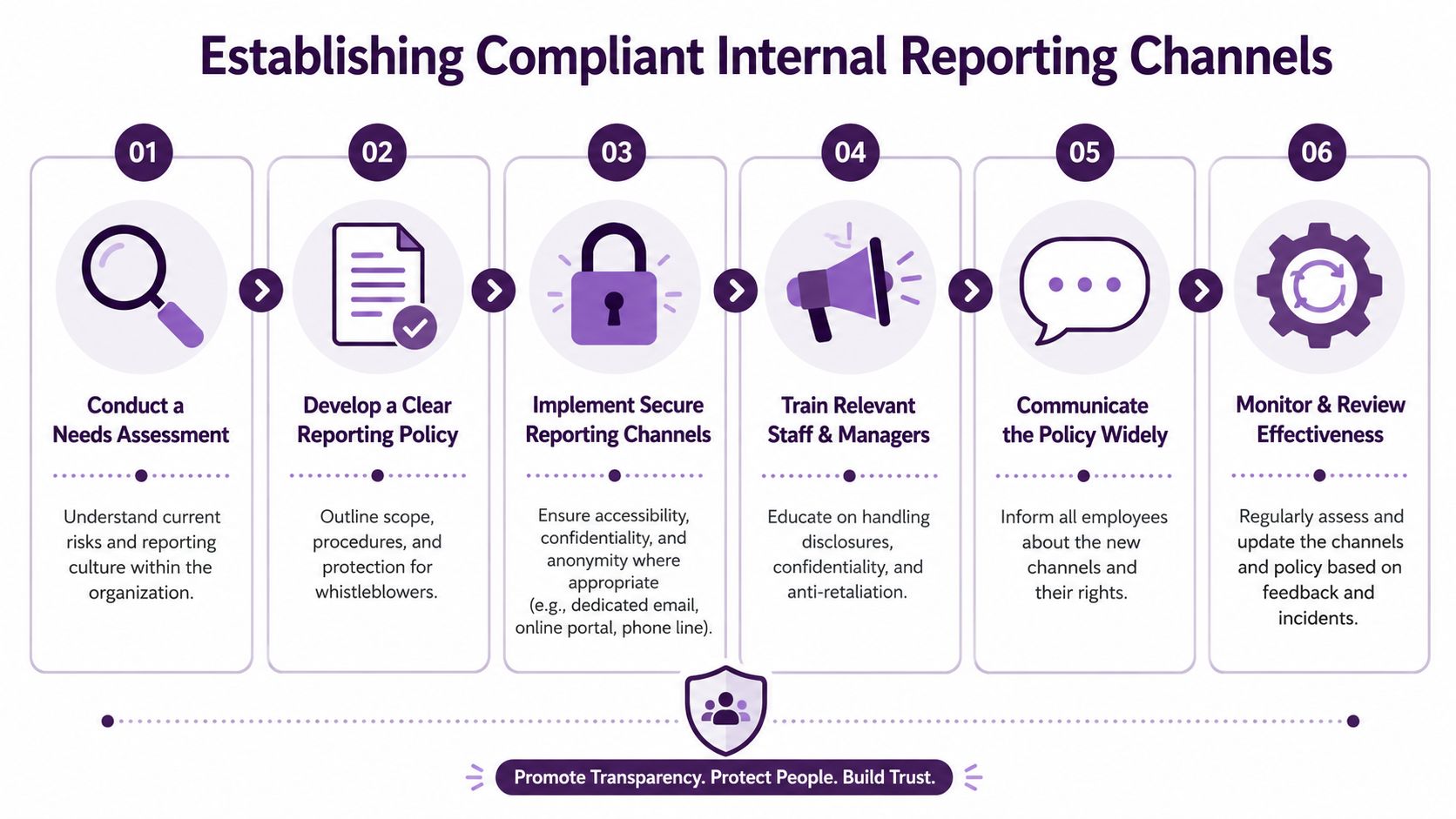
Setting Up Compliant Internal Reporting Channels
A reporting channel doesn't need to be fancy. It needs to be credible, confidential, and usable by people who work odd hours in a busy environment. In hospitality, the biggest failure isn't usually lack of policy. It's lack of a reporting route that staff trust enough to use.
Build the channel around how your staff actually work
A restaurant team member finishing late at night won't log into a complicated portal they've never seen before. A hotel employee with limited English may avoid a long policy document. A kitchen porter may not trust a route that goes straight to the same manager they're worried about.
Design the channel for those realities.
Good low-friction options include:
- A dedicated confidential email address: Simple and accessible, provided access is tightly restricted.
- A secure online form: Useful if it works on mobile and doesn't require a long login process.
- A named designated contact: This only works if the person is seen as impartial and trained properly.
- An external reporting support option: Some employers use outside advisers to receive or triage concerns where trust is low internally.
Timing matters because silence creates distrust
The process can't drift. Employers that fall behind often do so because nobody owns the channel and disclosures sit in a shared inbox.
Independent Ireland-focused guidance on mid-year compliance highlights the need to keep documentation and processes current throughout the year rather than treating compliance as an annual exercise. That same guidance notes the importance of ongoing monitoring in sectors with variable hours and changing staffing patterns, including hospitality, and refers to acknowledging a disclosure within 7 days and providing feedback within 3 months in practice-focused compliance workflows, as discussed in this 2026 mid-year compliance checklist for Ireland.
Those timelines are only manageable if someone is clearly responsible.
Appoint the right designated person
This role is often assigned too casually. Seniority alone isn't enough. The designated person has to be trusted, organised, discreet, and capable of staying neutral.
Avoid these common mistakes:
- Choosing the busiest manager in the building
- Assigning the role without training
- Giving access to too many people
- Letting line managers investigate concerns about their own teams
- Mixing disclosure handling with informal grievance chats
If your internal procedures around investigations, confidentiality, and manager conduct need work, a review of disciplinary and grievance procedures usually exposes where the reporting route will break under pressure.
Keep the process inspection-ready
The strongest systems are usually the simplest. A good channel has a clear intake route, a case log, restricted access, and a written process for acknowledgement, assessment, follow-up, and closure. It should also be visible in induction, handbooks, manager training, and staff communications.
If your reporting channel only exists in a policy document, staff won't treat it as real.
Make it accessible to an international workforce
Hospitality employers often miss this point. A process can be legally drafted and still fail operationally if staff don't understand how to use it. Accessibility means more than availability.
Use plain language. Avoid legal jargon in front-line guidance. Consider whether staff need a short translated summary, a visual one-page guide, or a QR code in staff areas linking to the reporting route. In multi-site operations, keep the route consistent across locations so employees don't get different answers depending on who they ask.
Review it after live use
The first real disclosure usually reveals the gaps. Maybe the inbox wasn't monitored on leave. Maybe the designated person stored notes in the wrong place. Maybe a manager spoke too freely. That's normal. What matters is whether the business reviews and corrects the process quickly.
One practical option some operators use is outside support for policy design, manager training, and case process reviews. Beacon Recruitment provides HR and compliance consulting for Irish hospitality businesses, including contracts, handbooks, people audits, and WRC-aligned support. That kind of external input can be useful where internal ownership exists but the process still feels exposed.
A Practical HR Compliance Checklist for Hospitality
A working HR compliance checklist for Ireland employers should be built like an operations checklist. Clear, repeatable, and easy to audit on a live site. If it's too abstract, nobody uses it. If it only lives with HR, line managers won't follow it.

Onboarding and contracts
Run these checks first because early errors spread into payroll, scheduling, and discipline later.
- Issue written terms on time: Track contract delivery and signed return, not just drafting.
- Match the reality of the role: Duties, reporting line, work location, and hours should reflect what the employee is doing.
- Complete right-to-work and identity checks properly: Store the evidence in the employee file, not in someone's email.
- Document probation reviews: A conversation that isn't recorded becomes hard to rely on later.
Policies and manager controls
A handbook matters, but manager behaviour matters more. Policies only protect the business when supervisors understand what they must do in real situations.
Check whether you have:
- Current disciplinary and grievance procedures
- A protected disclosures reporting route that staff can access
- Bullying and harassment procedures managers can apply calmly
- A health and safety approach that is visible in operations, not just filed away
- Data handling practices that limit who can access employee information
The strongest hospitality sites don't have the longest handbooks. They have the clearest manager habits.
Records and evidence
This is the area most often underestimated. Irish employers are explicitly required to keep specific employment records for defined periods, and failure to retain the right documents can weaken the employer's position in a WRC inspection or dispute, as explained in this piece on employee file compliance and record retention. The practical lesson is simple. Good filing is not admin vanity. It is evidence management.
Audit your files for:
- Signed contracts and amendments
- Service start dates and role changes
- Roster and working-time records
- Leave records
- Disciplinary notes, investigation records, and outcome letters
- Training acknowledgements and policy sign-offs
- Exit documents and final decision records
What doesn't work is scattering these records across payroll software, email folders, WhatsApp messages, and paper files at site level.
Mid-year monitoring
Hospitality compliance slips when businesses only review HR once a year. Variable hours, seasonal pressure, and international recruitment create changing obligations during the year. That means your checklist needs a live review rhythm.
Focus on these practical review points:
- After seasonal hiring rounds: Check whether onboarding volume created missing documents.
- After management changes: Review whether new supervisors are following the same process.
- After complaints or disputes: Test whether the file is complete enough to support the business position.
- Before busy periods: Make sure policies, contacts, and reporting routes are still current.
The aim isn't perfection. It's control. A short monthly file check is worth more than a beautifully planned annual audit that never quite happens.
When to Call a HR Compliance Expert
There's a point where internal handling stops being efficient and starts becoming risky. In hospitality, that line arrives faster than many owners expect because operational pressure pushes managers to act before the facts are clear.
Red flags that mean don't wing it
Bring in outside support if any of these are happening:
- You've received a formal complaint or disclosure and managers are already discussing the person informally
- A WRC inspection or request for records is on the horizon
- You're planning dismissals, restructures, or role changes and your paperwork is patchy
- Different sites are using different contracts or procedures
- You can't quickly confirm what is in each employee file
- Managers are relying on verbal warnings with little written follow-up
This isn't about panic. It's about recognising when the cost of getting it wrong is higher than the cost of getting help.
Notice calculations are a classic example
Employers often underestimate how basic errors become expensive. Ireland's statutory minimum notice rules create a fixed compliance threshold that must be reflected in contracts and exit processes. Employees with 13 weeks to 2 years of service are entitled to 1 week's notice, rising to 2 weeks after 2 years, 4 weeks after 5 years, 6 weeks after 10 years, and 8 weeks after 15 years of service, as set out in this guide to HR and compliance in Ireland.
That means service-date accuracy matters. If your records are weak, you can under-notice someone without realising it. In a multi-site hospitality business, one wrong start date or one inconsistent contract template can change the legal position quickly.
What expert support should actually do
Good support shouldn't drown you in theory. It should tighten the process, sort the files, fix the documents, and tell managers exactly what to do next. If you're facing an inspection, a dispute, or a wider HR clean-up, an external review of WRC compliance and HR audits can help you identify where the operational gaps really sit.
The right time to ask for help is before a scrambled email search, contradictory manager notes, and missing records become the story.
If your hospitality business needs calmer, more workable HR systems, Beacon Recruitment supports Irish employers with practical compliance help built around real operations. That includes employment documentation, HR audits, manager-ready procedures, and the day-to-day controls that make inspections, disputes, and staff issues easier to manage.
Are Your HR Records WRC-Ready?
Don’t let verbal agreements, missing contracts, and chaotic employee files leave your business exposed to costly disputes. Book a Free Consultation with Beacon today to audit your HR systems and secure your compliance.