July 16, 2026
Restaurant Manager Checklist Ireland: Boost Profit 2026
Master your restaurant in 2026. Get the ultimate restaurant manager checklist Ireland for WRC compliance, margin control, and leadership to boost profit.

You're probably doing what most restaurant managers in Ireland do. You've a checklist on a clipboard or in a shared doc. It covers cleaning, opening tills, checking bookings, maybe a quick walk through the kitchen, and a note to brief the team on specials.
That feels organised until the wrong question lands on your desk.
Not “Did the floor get mopped?” but “Where are your break records?”, “Who signed off the closing checks?”, or “Can you show the paperwork tied to the role and premises?” That's where a generic restaurant manager checklist falls apart. In Ireland, the list isn't just about keeping service tidy. It's part operational control, part legal defence, part profit protection.
Most templates online miss that completely. They're written for a broad audience, and broad advice is dangerous in hospitality. What protects a busy restaurant in Clare, Cork, Dublin, or Galway is a checklist built around Irish reality. That means WRC exposure, EHO readiness, margin pressure, and people management all in the same system.
If your current checklist only helps you open the doors, it's too small for the job.
The Problem with Your Current Checklist
I've seen this more times than I care to count. A manager finishes the morning walk, signs off that the dining room is clean, the fridges are on, staff are in, and the specials board is written. Service runs. Guests are happy enough. Then a dispute lands weeks later, or an inspection raises questions, and suddenly the business is trying to reconstruct what happened from memory.
Memory is useless when the records should already exist.
In Ireland, employers are required to keep prescribed employment records for at least 3 years, including evidence tied to working time, pay, leave, and contract details, as outlined in this restaurant compliance checklist for Ireland. That changes what a manager's checklist needs to do every day and every week. It can't stop at service readiness.
What most checklists get wrong
They focus on visible tasks:
- Cleanliness checks that prove the place looks ready
- Stock checks that prevent obvious shortages
- Front-of-house readiness like bookings, menus, and till floats
- Basic close-down tasks such as locking up and switching things off
All useful. None sufficient.
A proper Irish restaurant manager checklist also needs to capture the less glamorous things that hurt you when they're missing:
- Hours and breaks logged properly
- Payslip alignment with what was worked
- Annual leave records kept up to date
- Written terms and contract paperwork accessible
- Disciplinary and grievance actions documented
Practical rule: If a task affects pay, hours, leave, conduct, or safety, it belongs on the checklist somewhere.
The real cost of a weak checklist
The issue isn't that the manager forgot a box of lemons. The issue is that the business ran without a traceable record of who worked, what happened, and how problems were handled. That's the gap that causes stress, wasted management time, and expensive clean-up after the fact.
A clean floor won't save you if your records are a mess.
Why Generic Checklists Fail in Ireland
A downloaded checklist from a UK or US site might look polished. It might even improve consistency. But if it ignores Irish compliance demands, it gives you false confidence, and false confidence is worse than no checklist at all.

Ireland adds paperwork that generic templates ignore
A standard opening or closing list usually covers service, stock, cleaning, and cash. That's too narrow here. The Department of Enterprise checklist for a restaurant manager employment permit requires documents such as a valid Tax Access Number, a utility bill for the premises, and a letter from the Health Authority, as shown in the restaurant manager employment permit checklist.
That's not a side issue. For operators hiring internationally or managing growth, it means your checklist has to bridge operations, premises compliance, and employment administration.
One island, different systems
A lot of operators borrow templates from neighbouring markets because they assume the differences are minor. They're not. Legal frameworks, administrative requirements, and operating norms vary more than people think. If you want a broader cultural and institutional explanation, this short piece on reasons why Scotland and Ireland differ is a useful reminder that copying systems across borders usually creates blind spots.
That's exactly what happens with restaurant checklists. A template built elsewhere often assumes different labour processes, different inspection habits, and different proof requirements.
What a generic checklist leaves exposed
Here's where generic templates usually fail an Irish operator:
- Opening checks: While a generic checklist focuses primarily on readiness and presentation, the Irish reality dictates that it must also support inspection and compliance readiness.
- Staff records: Often ignored or treated as an HR-only task in generic templates, the Irish reality is that they need to be an active part of management control, not filed away and forgotten.
- Premises documentation: Rarely mentioned in generic lists, but the Irish reality is that this documentation can matter heavily for permits and operational legitimacy.
- Audit trail: Usually just a simple tick box on a generic checklist, whereas the Irish reality demands a system that shows sign-offs, dates, and clear follow-through.
- Manager role: Viewed strictly as an operational supervisor in generic guides, but the Irish reality requires them to act as an operational, compliance, and commercial control point.
A restaurant manager checklist in Ireland is not a convenience document. It's part of how you prove the business is run properly.
If your checklist came from a generic search result, assume it's incomplete until you've rebuilt it for Ireland.
The Manager and The Leader in Hospitality
Most restaurants don't struggle because nobody is working hard. They struggle because the manager is trapped in management and never gets to leadership.
That distinction matters.
Management is control
Management is the discipline of keeping complexity from turning into chaos. In a restaurant, that means the basics get done, standards stay in place, and people know what's expected.
A manager makes sure:
- Shifts are covered
- Stock is ordered
- Breaks are monitored
- Cash is reconciled
- Opening and closing routines happen on time
- Problems are logged instead of ignored
This is necessary work. If it slips, the place wobbles fast.
Leadership is direction
Leadership is different. It's not about whether the fridge check got done. It's about whether the team understands why standards matter, where the business is trying to go, and what better looks like next month, not just tonight.
A leader asks different questions:
- Why does this same handover issue keep happening?
- Who on the floor is ready for more responsibility?
- Which staff member needs coaching, not another warning?
- Which part of service is damaging repeat business?
- What's hurting margin, and who owns the fix?
Management keeps the shift running. Leadership improves the next shift, next month, and next team.
You need both hats
In hospitality, one person often has to switch between the two dozens of times a day.
At 10:30, you're a manager. You're checking attendance, deliveries, bookings, equipment, and prep. At 11:00, you're a leader. You're briefing the team with clarity, setting standards for service, and deciding how to handle a weak performer without poisoning morale. At 3:00, you're back in management mode sorting rotas, invoices, and supplier issues. At 5:00, leadership comes back again when the kitchen is under pressure and the team is looking at you to set the tone.
The checklist should support both roles
Most checklists only support management. They tell you what to inspect, verify, switch on, sign, and lock.
That's only half the job.
A stronger restaurant manager checklist in Ireland should also create leadership prompts:
- Who needs coaching today
- What guest feedback needs action
- What issue from yesterday still needs follow-up
- Which team member is showing reliability
- What one margin risk needs correcting this week
If your checklist only tells you what to tick, it turns a good operator into a glorified fire-fighter. If it also tells you what to review, coach, and improve, it starts to build a better business.
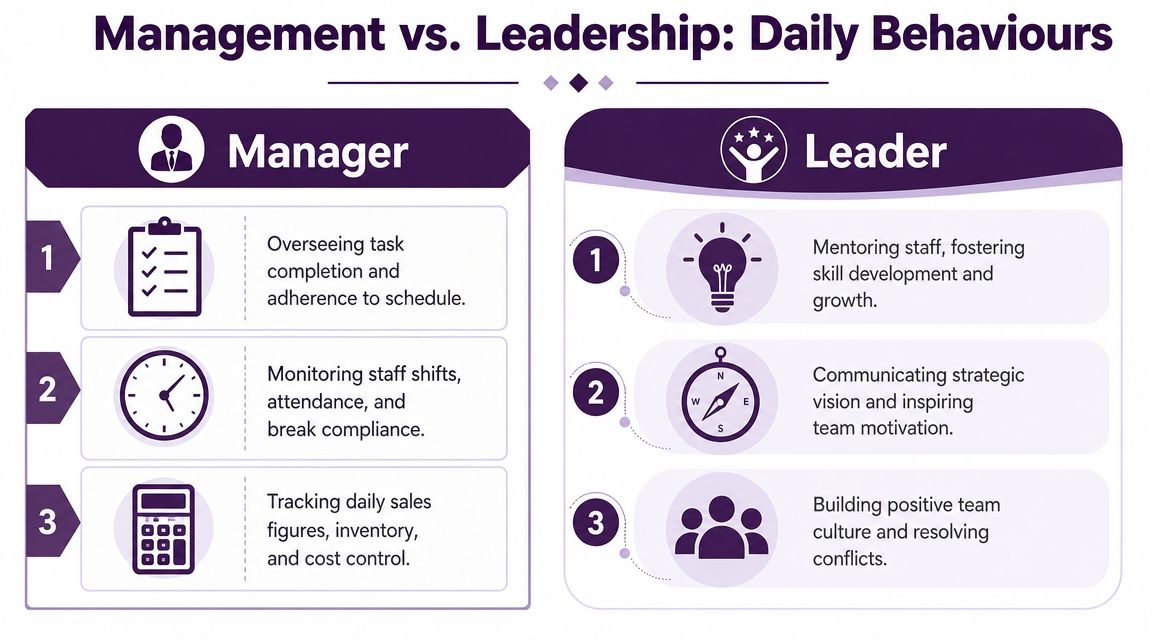
Daily Behaviours A Side by Side Comparison
The difference between a manager and a leader shows up in small daily choices. Same shift. Same restaurant. Different mindset.
Pre-service briefing
Manager approach
- Announces specials and confirms table bookings
- Assigns stations and checks uniform standards
- Flags immediate gaps like lateness or shortages
Leader approach
- Connects the shift to a goal such as tighter handover, cleaner upselling, or smoother allergen communication
- Uses guest feedback from prior service to sharpen standards
- Builds confidence by making expectations clear, not vague
Staff issues
Manager approach
- Deals with the symptom by moving someone, covering a section, or issuing a warning
- Records the incident if needed and gets through service
- Keeps the shift intact with minimum disruption
Leader approach
- Looks for the pattern behind the issue
- Coaches in private instead of performing authority in public
- Uses the moment to improve standards, trust, and accountability
Don't confuse busyness with leadership. A manager can solve ten problems in a day and still leave the team no stronger.
Inventory and waste
Manager approach
- Checks stock levels and places orders
- Responds to shortages as they appear
- Signs off deliveries and moves on
Leader approach
- Questions recurring waste
- Links ordering decisions to upcoming trade and real demand
- Pushes responsibility down by making section leaders own count quality and usage discipline
Hours and attendance
Manager approach
- Monitors clock-ins and breaks
- Fixes rota gaps
- Keeps records tidy enough to run payroll
Leader approach
- Spots reliability trends
- Uses attendance patterns to decide who is promotable and who is risky
- Builds fairness into scheduling so standards don't slip into resentment
Daily numbers
Manager approach
- Reviews sales and cash
- Checks comps, voids, and variances
- Closes the day properly
Leader approach
- Interprets what the figures mean
- Links weak numbers to staffing, service flow, menu mix, or waste
- Sets one corrective action instead of filing the report and forgetting it
Shift handover
Manager approach
- Passes on information about bookings, stock issues, incidents, and maintenance
- Makes sure the next person is informed
Leader approach
- Demands documented ownership
- Confirms who is doing what next
- Prevents repeated failures by closing loops, not just passing messages
Here's the blunt version. The manager protects today. The leader protects tomorrow.
You need both, but if your checklist only supports the left-hand column, the operation stays reactive.
Building Your Irish Restaurant Checklist Framework
Friday, 5:30pm. A chef calls in sick, a fridge is reading high, two starters are over-prepped, and a staff member asks about unpaid breaks. That is when you find out whether your checklist is doing real work or just making the office folder look organised.
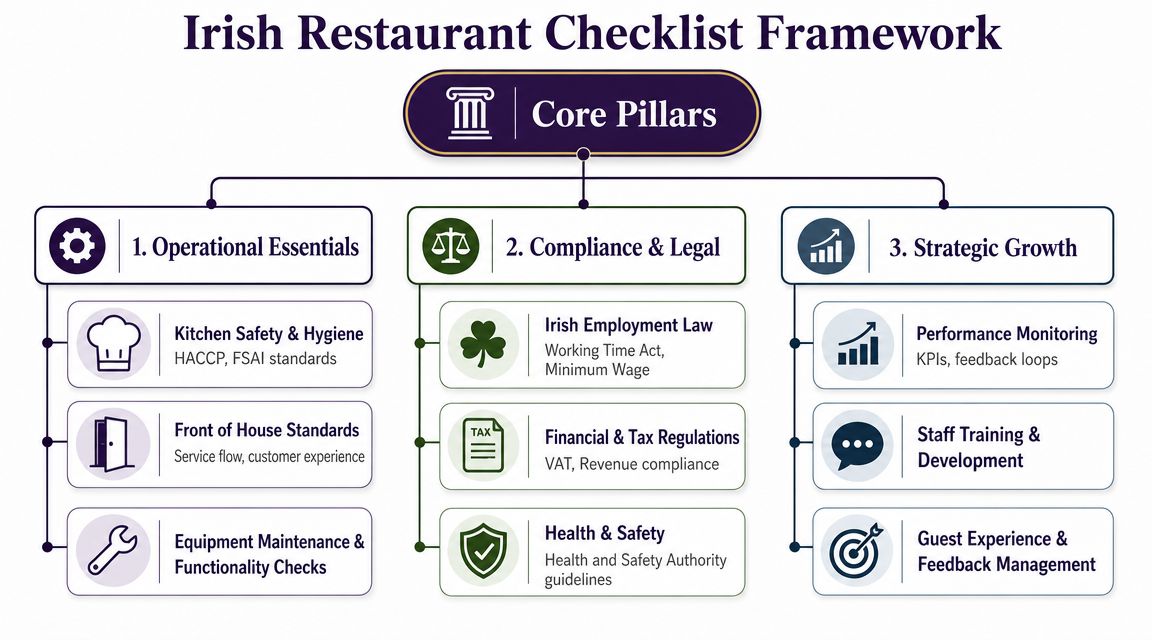
Build your restaurant manager checklist around four pillars: Compliance, Operations, People, and Profit. Those pillars match the pressure points that decide whether an Irish restaurant stays under control. WRC and EHO exposure sit in one corner, margin pressure sits in another, and poor management standards usually connect the two.
Compliance
This pillar protects the business first.
Irish restaurants get into trouble because records are missing, inconsistent, or written after the fact. A proper checklist should demand evidence. If a manager checks breaks, there should be a record. If there is an employee issue, there should be a note, a follow-up, and a date. If you employ permit-linked staff, your files need to stand up to scrutiny.
Include checks such as:
- Employment record review for missing contracts, leave gaps, or unresolved documentation
- Break and hours verification against rota and actual attendance
- Disciplinary and grievance logging where incidents occurred
- Premises and permit file checks where relevant to your staffing model
If it cannot be shown, it did not happen. Run your checklist on that rule.
Operations
Operations should be built in sequence. Too many restaurants still use a random list that mixes food safety, cleaning, briefing, and admin with no logic.
Start with the controls that can shut service down or create an EHO problem. Temperature checks sit at the top. Equipment function comes next. Storage, sanitation, and wash systems follow. Briefings and service setup come after that. The order matters because some checks affect every decision that follows.
Industry guidance on restaurant manager opening checklist guidance backs that approach, particularly around refrigeration logs, dishwashing checks, and storage verification before service.
Your opening flow should look like this:
- Check refrigeration, freezer, and other critical-path equipment first
- Confirm cooking equipment by heat-up priority
- Verify storage, sanitation, and machine readiness
- Run briefing, section setup, and final floor checks last
A checklist that puts food safety and equipment checks halfway down the page is poorly designed. Fix the sequence.
People
This pillar is where average managers fall short. They schedule bodies. They do not build a team.
Your checklist should force managers to notice performance while the shift is happening, not three weeks later when someone resigns or a grievance lands. Daily notes matter. So do follow-ups. So does recording who is improving, who is coasting, and who creates extra work for everyone else.
Include:
- Attendance and opener confirmation
- Training notes from service or kitchen issues seen on shift
- Follow-up actions from complaints, incidents, or conduct concerns
- Weekly one-to-one prompts for supervisors and promotable staff
If you want managers to think beyond task completion, a practical OKR checklist gives a useful structure for setting clear ownership and short review cycles without turning the restaurant into a corporate workshop.
For operators who need tighter consistency across sites or departments, performance management systems for hospitality teams can help turn those people checks into a repeatable management standard.
Profit
Profit should be in the daily checklist, not buried in the weekly report.
That matters more in Ireland, where payroll pressure, supplier increases, utilities, and waste can wipe out a decent sales day. Managers need prompts that make them act while the problem is still small. Waiting for month-end figures is poor discipline.
Build in checks such as:
- Waste log review
- Labour versus sales review
- Supplier issue escalation
- Menu item concern notes where sales are weak or wastage is high
- Cash-out and POS reconciliation
One more point. Split accountability properly. The strongest setup uses separate opening and closing workflows by function, with sign-off from the person doing the work. The restaurant opening and closing checklist guide makes the same case for distinct front-of-house, back-of-house, and management lists with dated sign-off.
That structure works because responsibility is clear. One oversized checklist dumped on the duty manager does not create control. It creates blind spots.
Turning Your Checklist into a Development Tool
A checklist shouldn't just control staff. It should develop them.
That starts with how you define the manager role. If your checklist only lists tasks like “open till”, “check stock”, “close cash”, and “lock up”, don't be surprised when you recruit task-doers instead of leaders. People rise to the role you define.
Use the checklist to hire better managers
Write job descriptions from the behaviours you need:
- Operational discipline around records, standards, and handover
- Commercial judgement around labour, waste, and service decisions
- People leadership through coaching, accountability, and follow-up
- Calm decision-making when the shift goes sideways
That gives candidates a real picture of the role. It also gives you a proper interview framework.
Use it in onboarding
A strong checklist is one of the best onboarding tools in the building because it shows a new manager what “good” looks like in your operation.
Break it into phases:
- First phase for essential compliance and service-critical routines
- Second phase for cash control, supplier handling, and issue escalation
- Third phase for coaching, team development, and weekly commercial review
That progression matters. Too many restaurants throw a new manager into the deep end and call it training.
Use it in performance conversations
A one-to-one goes nowhere if it's based on vague opinions. It improves fast when it's tied to observed behaviours and documented follow-through.
That's where a structured process helps. If you're formalising reviews, coaching cadence, and accountability, this kind of performance management systems support gives managers a framework to work from rather than making it up as they go.
A checklist becomes a development tool when it shows not just whether the task was done, but how consistently the person is thinking, following through, and improving others.
The best future GMs usually reveal themselves in the boring disciplines first. They keep records clean, close loops, follow standards without being chased, and improve the people around them.
Measuring What Matters Key Performance Indicators
A checklist earns its place when it changes results. Completed boxes mean nothing if payroll is drifting, waste is climbing, and your best staff are leaving.
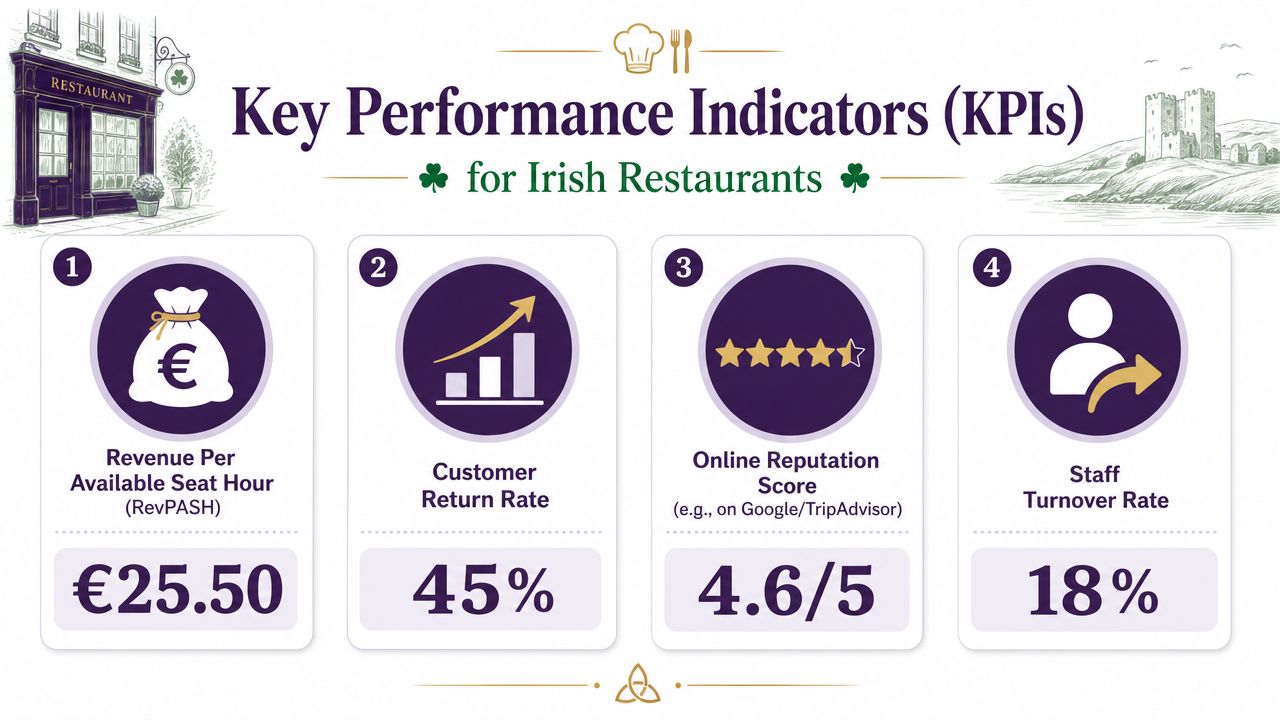
The KPI that matters least is task completion rate. It shows admin discipline. It does not show whether the restaurant is safer, more profitable, or better led.
KPIs worth your attention
Track numbers that connect directly to manager behaviour and to the three pressures that define restaurant performance in Ireland. Compliance, margin, and team stability.
- Labour cost percentage
Calculate total labour cost against total sales for the period. This shows whether rotas, clocking control, lateness, absence management, and shift planning are under control. - Average spend per head
Divide sales by covers across the period you are reviewing. This tells you whether managers are leading pre-shift briefings properly, pushing product knowledge, and setting a standard for selling rather than just serving. - Gross profit on food
Measure what food sales leave after product cost. This exposes over-portioning, poor ordering, weak stock discipline, supplier drift, and menu items that look busy but do not make money. - Staff turnover rate
Track who leaves, when they leave, and which manager they worked under. High churn usually points to poor supervision, weak onboarding, inconsistent standards, or managers who can run a shift but cannot lead people.
Match KPIs to checklist sections
Your checklist should drive these numbers.
- Compliance routines affect payroll accuracy, grievance risk, and whether records stand up when the WRC or EHO comes knocking
- Service and operational routines affect consistency, waste, speed, and guest spend
- People management routines affect retention, absenteeism, disciplinary issues, and bench strength
- Margin control routines affect labour efficiency, ordering, stock loss, and pricing discipline
If you want a clearer view of the people side, these people analytics insights help explain how patterns in turnover, attendance, and team structure show up in service standards and commercial performance.
Food safety should also show up in how you measure management quality. As noted earlier, temperature verification and record checks belong on the daily checklist because they protect you on two fronts. They reduce food safety risk, and they give you an audit trail that stands up under inspection.
If your numbers are hard to interpret, the problem is usually not the spreadsheet. The problem is that nobody has tied daily management behaviour to commercial review. A structured business planning and profitability audit for restaurant operators helps you connect labour, waste, pricing, and management habits so you can act on the right issue fast.
A good restaurant manager checklist in Ireland makes performance easier to read because standards are clear and followed. If the checklist keeps growing but margins stay tight, compliance stays shaky, and turnover stays high, the list is not managing the business. Your managers are just feeding paperwork.
Turn Daily Routines Into Better Margins
Empower your managers to control labor costs, reduce waste, and protect service quality. Schedule a Free Consultation with Beacon to upgrade your restaurant’s operating systems and management checklists today.