July 16, 2026
Grievance Procedure Ireland Employer: Your WRC Guide 2026
Master your grievance procedure Ireland employer responsibilities. Get WRC-compliant steps, templates, & legal advice for Irish businesses in 2026. Protect

It's a busy week. Your head chef says a senior floor supervisor is undermining them in front of staff. The supervisor says the chef is aggressive, impossible to approach, and has created a hostile shift pattern. Service is slipping, the kitchen is blaming front of house, and you're looking at the weekend rota wondering which key person might walk first.
That's how many grievance issues start in hospitality. Not with a solicitor's letter. With tension on the pass, WhatsApp messages after midnight, upset staff in the dry store, and a manager trying to “sort it informally” while keeping the floor covered.
If you run a hotel, bar, restaurant, or multi-site venue, a grievance procedure isn't paperwork for the drawer. It's a control system. It protects service, managers, morale, and your position if a complaint later lands before the WRC. In hospitality, where timing matters and personalities are strong, the businesses that handle grievances well usually do one thing better than everyone else. They document the process properly and they keep it fair from the first formal step.
Why A Grievance Procedure Is Your Business's Best Defence
In this sector, unresolved conflict rarely stays contained. One complaint about bullying can turn into allegations about scheduling, favouritism, training, harassment, or retaliation. What began as “two people not getting on” can spread through a brigade or front-of-house team in a matter of shifts.
The mistake I see most often is delay disguised as pragmatism. An owner or general manager knows there's a problem, speaks to one or two people casually, hopes the next roster settles it, and carries on. That can work for a minor misunderstanding. It usually fails when one employee believes they raised a serious concern and the business didn't treat it as such.
Hospitality problems become operational problems fast
A grievance in a hospitality venue isn't happening in a quiet office. It's happening during breakfast service, in prep time, on split shifts, or after a rough Saturday night. That creates pressure to cut corners.
Common examples include:
- Kitchen versus floor conflict: One manager says standards are being challenged in front of junior staff.
- Shift allocation complaints: A team member says they're being frozen out of good hours after raising an issue.
- Customer-facing incidents: A staff member says a manager failed to support them after abuse from a guest.
- Accommodation and transport tensions: In some operations, disputes outside the venue spill back into work.
Those situations need more than a chat and a handshake. They need a process that shows who raised what, when it was acknowledged, who investigated, what evidence was reviewed, and how the outcome was reached.
A grievance procedure is often the difference between a contained internal issue and a claim shaped around poor process.
What works and what doesn't
What works is straightforward:
- A written route for formal complaints
- A manager who recognises when informal resolution has ended
- Clean records in one place
- A separate appeal stage
- Written outcomes instead of verbal assurances
What doesn't work is equally clear:
- Telling the employee to “leave it with me” and never confirming next steps
- Allowing the subject of the complaint to run the process
- Holding meetings with no notes
- Mixing grievance, disciplinary, and rota decisions together
- Treating a serious complaint as personality clash because the weekend is busy
If you want to protect the business, your grievance procedure in Ireland as an employer has to do two jobs at once. It must give the employee a fair route to be heard, and it must create a defensible record that shows the business acted reasonably under pressure.
The Legal Foundations of a Fair Process in Ireland
Irish employers don't need a law degree to handle grievances properly, but they do need to understand the legal baseline. The foundation is the Code of Practice on Grievance and Disciplinary Procedures made under S.I. No. 146/2000, and Irish employer guidance treats it as the main benchmark for fair handling of workplace complaints under the Irish grievance procedure guide.

That matters because the code isn't just broad advice. It expects a written procedure, escalating stages, a right to be accompanied, and an appeal route. Irish guidance also stresses that the formal complaint should be in writing, with dates, times, and witnesses, before the formal process can properly proceed.
What fair process means in practical terms
In hospitality, “fair process” means more than being well intentioned. It means your steps are structured and can be shown afterwards.
The usual internal structure moves like this:
- Informal resolution first: The employee raises the issue with the relevant manager where possible.
- Formal written complaint next: If it can't be resolved, the complaint is set out in writing.
- Escalation through management: The matter moves to a more senior stage if needed.
- Appeal at the end: A final review by someone not involved in the original decision.
If you want a plain-English overview of the body employers deal with when disputes leave the workplace, Beacon's guide to the Workplace Relations Commission and WRC process is a useful operational reference.
Four pillars of a fair grievance procedure
- Written procedure: Staff need a clear policy that explains how to raise a complaint formally.
- Progressive stages: The process should move through defined steps rather than ad hoc conversations.
- Right to be accompanied: The employee must be allowed support at the formal stage.
- Appeal route: A decision isn't complete until there is a route to challenge it internally.
Informal concern versus formal grievance
Managers often get stuck here. An employee vents after service, sends a frustrated message, or says they “want this on record”. That's the moment to slow down and clarify the status.
Use a simple question: is this an issue they want addressed informally, or are they now making a formal complaint?
Once it becomes formal, don't run it casually. Ask for the complaint in writing. Get dates, times, locations, and witness names. Confirm receipt. Then move into the documented procedure.
Practical rule: The moment an employee asks for a matter to be treated formally, stop managing it as a corridor conversation.
That discipline protects both sides. It also prevents one of the most damaging WRC-era problems in hospitality. The business thinks it was handling matters sensibly. The employee later says no real grievance process ever happened.
How to Build Your Hospitality Grievance Policy
A good policy has to survive real trading conditions. It must work on a Monday morning in admin, but also on a wet Friday night when the duty manager is covering absences and the complaint lands mid-service.

Irish small-employer guidance is clear that a sound procedure should be a documented, progressive process: the employee raises the issue in writing, an impartial investigator is appointed, evidence is gathered, a formal hearing is held, a written outcome is issued, and an appeal is heard by a different decision-maker, with written timeframes used throughout in the Irish grievance procedure process guidance.
The clauses your policy needs
Your policy should cover the following points clearly.
- Purpose and scope: State what the policy covers. Include complaints about treatment, management conduct, working relationships, allocation of duties, workplace behaviour, and other employment-related concerns.
- Informal stage: Allow room for early resolution where appropriate, but make clear that serious matters may move straight to formal handling.
- How to raise a formal grievance: Require the complaint in writing. Ask for enough detail to investigate properly.
- Who receives the complaint: Name the role, not just a person. Staff need an alternative contact if the complaint concerns their line manager.
- Investigation and hearing steps: Separate fact-finding from decision-making where possible.
- Right to be accompanied: Confirm this at the formal stage.
- Written outcome and appeal: State that outcomes and appeals will be confirmed in writing.
- Confidentiality and records: Explain that information will be handled carefully and records kept together.
The grievance process from complaint to resolution
- Formal submission: Employee submits grievance in writing with details of the complaint. (Timeline: Use a written timeframe set by your policy)
- Acknowledgment: Employer confirms receipt and next steps in writing. (Timeline: Use a written timeframe set by your policy)
- Appointment: An impartial investigator or hearing chair is assigned. (Timeline: Use a written timeframe set by your policy)
- Investigation: Evidence is gathered and relevant witnesses are spoken to. (Timeline: Use a written timeframe set by your policy)
- Hearing: A formal meeting is held to hear the grievance. (Timeline: Use a written timeframe set by your policy)
- Outcome: Decision is issued in writing with reasons. (Timeline: Use a written timeframe set by your policy)
- Appeal: Appeal is heard by a different decision-maker. (Timeline: Use a written timeframe set by your policy)
Write for shift-based reality
The policy must reflect hospitality conditions. For example, if a complaint is raised during dinner service, your managers shouldn't attempt a full grievance discussion on the spot. They should acknowledge the concern, protect service, and set the next formal step in writing promptly after service.
That means your wording should help managers make good decisions under pressure. Avoid fluffy statements like “issues will be dealt with as appropriate”. That gives no one any certainty.
Use direct language instead. If you're updating your wider handbook at the same time, it helps to review grievance wording alongside your broader staff handbooks and HR policies for hospitality employers.
The policy should tell a tired duty manager exactly what to do at 10.30 pm when a complaint is raised after a difficult shift.
A sample clause you can adapt
Formal grievance clause
Any employee who wishes to raise a formal grievance must do so in writing, setting out the nature of the complaint and, where possible, the relevant dates, times, locations, witnesses, and any supporting documents. The Company will acknowledge the grievance in writing, appoint an appropriate person to manage the process who is not the subject of the complaint, investigate the matters raised, hold a formal grievance hearing where required, issue a written outcome, and provide a right of appeal to a different decision-maker.
Trade-offs small operators need to manage
Small hotels and independent restaurants often hit the same difficulty. There may be no obvious “independent” manager on site. Everyone knows everyone, and senior staff may already have views.
In that situation:
- Don't force neutrality where it doesn't exist: If the owner has already taken a side, they shouldn't hear the appeal.
- Separate roles where possible: One person investigates. Another hears the grievance. Another handles the appeal.
- Pause operational instinct: Speed matters, but rushed fairness is bad fairness.
- Keep one master file: Complaint, invitations, notes, evidence, outcome, and appeal papers should stay together.
A grievance procedure Ireland employer policy should read like something your venue can realistically follow. If it looks polished but can't survive a real shift pattern, it won't protect you when you need it.
Implementing the Procedure and Training Your Managers
The policy isn't the protection. The lived process is. If supervisors, head chefs, restaurant managers, and front office leads don't know what the policy requires, your written procedure will fall apart at the first difficult complaint.

These situations expose employers. A line manager thinks they're helping by “keeping it informal”, but they fail to acknowledge a formal complaint. A head chef interviews witnesses in the middle of prep and gives their view before any hearing takes place. A duty manager promises confidentiality they cannot maintain. None of that comes from bad intent. It comes from no training.
Train managers to spot the trigger point
Managers in hospitality need to know the difference between friction and grievance. Not every disagreement becomes formal. But the trigger point has to be recognised early.
Train them to act when an employee:
- Says the issue is formal
- Alleges bullying, harassment, discrimination, victimisation, or retaliation
- Raises repeated concerns that haven't been resolved
- Complains about how a manager handled an earlier complaint
- Starts referring to resigning because nothing is being done
That last point matters. Irish guidance notes that a weak or ignored grievance process can be used to argue constructive dismissal, with the employee claiming they had no option but to resign, while employers can rely on proof that internal mechanisms existed and were not used, as discussed in this Irish constructive dismissal guidance video.
Constructive dismissal risk is often created by poor handling
Managers tend to focus on the meeting. The bigger risk is usually the build-up before the meeting. Delay. Silence. No written acknowledgment. No proper appeal route. The employee starts to believe the process is performative.
That's why training should cover behaviour, not just paperwork:
- How to respond in the moment
- What not to promise
- How to avoid prejudging the complaint
- When to escalate
- How to preserve records
- Why notes matter even after an informal conversation
For teams reviewing their wider systems, practical resources on documentation and consistency, such as AuditReady's HR compliance insights, can help managers understand how process discipline reduces risk beyond the grievance itself.
Rollout has to be visible
Don't just upload the policy to a shared drive and assume it exists in practice. Roll it out.
A workable implementation plan includes:
- Staff communication: Issue the policy and explain where it sits in the handbook.
- Manager briefing: Run scenario-based training using real hospitality examples.
- Acknowledgment process: Make sure staff confirm receipt.
- Escalation map: Managers should know exactly who handles formal complaints.
- Refresher routine: Revisit the process when you promote new supervisors.
If your venue needs a clearer framework for handling formal complaints and disciplinary crossover points, a defined disciplinary and grievance procedures service can be one way to formalise who does what.
Managers don't need to become lawyers. They need to become reliable first responders who know when fairness requires structure.
Navigating Investigations and Hearings with Confidence
Investigations and hearings are where many grievance procedures wobble. Not because the complaint is impossible, but because the business mixes fact-finding, opinion, and decision-making into one rushed conversation.
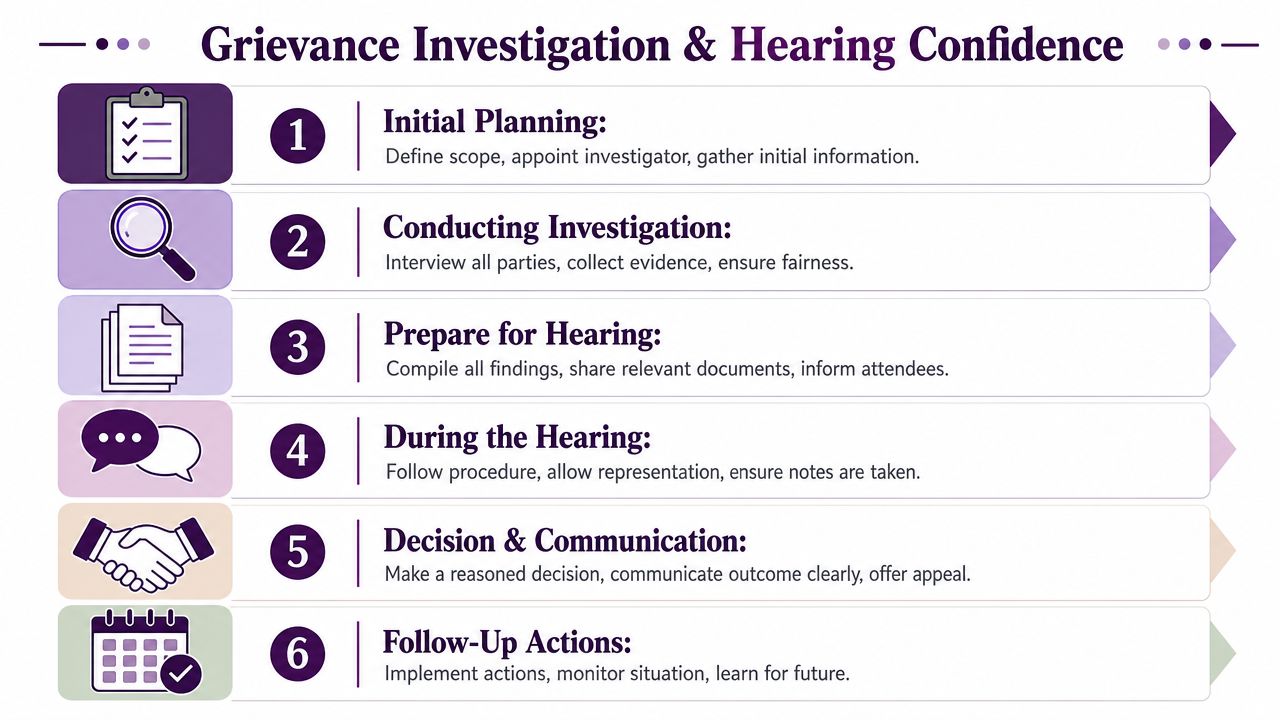
In hospitality, that risk is higher. Witnesses are often friends. Managers may have worked the disputed shift themselves. CCTV may exist for some areas but not all. A complaint raised by a sous chef against a restaurant manager can involve two departments, multiple timelines, and very different personalities.
Start with role clarity
An investigation is not the hearing. The investigator gathers facts. The hearing decides the grievance. When one person does both, especially in a small venue, the paperwork must be especially careful and the appeal stage needs proper separation.
Use this checklist.
- Do: Define the allegations clearly. | Don't: Start interviewing people before the complaint is pinned down.
- Do: Appoint someone not directly involved. | Don't: Use the person complained about to gather evidence.
- Do: Take signed or confirmed witness notes. | Don't: Rely on memory after service.
- Do: Review documents, messages, rotas, and relevant footage. | Don't: Cherry-pick evidence that supports management's view.
- Do: Share relevant material for the hearing. | Don't: Ambush the employee with new allegations in the room.
- Do: Keep investigation notes and outcome notes separate. | Don't: Blend findings, sanction thinking, and gossip into one file.
Evidence quality matters more than volume
You don't need a huge bundle. You need reliable material.
That usually includes:
- The written grievance
- Acknowledgment correspondence
- Witness meeting notes
- Relevant rota records
- Any messages or emails relevant to the complaint
- Hearing invite and notes
- Written outcome and appeal documents
CCTV, where relevant and lawfully reviewed, can help with timing or presence. It rarely tells the whole story about tone, context, or earlier interactions. Treat it as one part of the picture, not the answer.
Some employers find it useful to review workflow tools used for case logging and evidence control. A practical overview of investigation management software for HR can help if your business is trying to move from scattered emails and folders to a more controlled process.
Hearings should be calm, structured, and recorded properly
A grievance hearing is not a courtroom, but it must feel organised. The employee should know the issue being considered, have the chance to respond, be accompanied where the procedure allows, and receive a reasoned outcome afterwards.
Keep the hearing disciplined:
- Open with the purpose of the meeting
- Confirm who is present and why
- Work through the complaint points in order
- Ask questions to clarify, not to trap
- Take notes throughout
- Close by explaining next steps and timeframe for the outcome
If the hearing becomes an argument about personality, the chair has lost control of the process.
The strongest outcomes are usually the simplest. They identify what was upheld, what was not upheld, what evidence was relied upon, and what happens next. Not every grievance ends with a dramatic finding. Some end with communication measures, reporting changes, mediation, or management instruction. What matters is that the outcome can be understood and defended.
Your WRC Compliance Checklist and Next Steps
Most hospitality businesses don't need a thicker policy. They need a grievance procedure that managers can follow on a live site, under pressure, without compromising fairness.
Use this as a quick audit of your current position:
- Written policy in place: Do you have a grievance procedure in writing that staff can access?
- Formal complaint route: Does your policy require a formal grievance to be raised in writing?
- Escalation clarity: Do staff know who to go to if the complaint concerns their direct manager?
- Impartial handling: Can you appoint someone who is not the subject of the grievance to investigate or chair the matter?
- Hearing process: Do you issue invites, hold a structured meeting, and take notes?
- Written outcomes: Are decisions confirmed in writing with reasons?
- Appeal separation: Is the appeal heard by a different decision-maker?
- Record control: Are all grievance records kept together in one file?
- Manager training: Can your supervisors spot when an issue has moved from informal conflict to formal grievance?
- Resignation risk awareness: Do your managers understand that poor grievance handling can feed a constructive dismissal argument?
If you answered “no” or “not consistently” to several of those points, the risk isn't abstract. It usually shows up first in staff turnover, inconsistency between managers, and complaints that come back later with a much sharper edge.
A solid grievance procedure Ireland employer framework should do three things well. It should help resolve issues internally. It should create a fair record. It should reduce the chance that an avoidable staff problem turns into a formal external dispute.
Beacon Recruitment supports Irish hospitality operators with the practical side of HR compliance, including grievance procedures, staff handbooks, contracts, manager training, and operational HR reviews. If your current process is informal, outdated, or inconsistent across sites, Beacon Recruitment can help you audit what you have, tighten the procedure, and build a system your managers can practically apply in service-led environments.
Are Unresolved Complaints Putting You at Risk?
Don’t let informal chats and undocumented grievances turn into costly WRC claims. Book a Free Consultation with Beacon today to build a legally compliant, defensible grievance procedure.