August 4, 2026
Ireland Work Visa vs Employment Permit: Hire Non-EEA Staff
Compare Ireland work visa vs employment permit to hire non-EEA staff legally. Learn 2026 eligibility, costs, timelines & compliance tips for hospitality.
A hotel GM in June usually isn't wondering about immigration theory. They're wondering who's covering breakfast, who can run a section on a Saturday night, and whether the chef they finally found can start on time. That's where the confusion around Ireland work visa vs employment permit turns into an operational problem.
In hospitality, people often use “visa” and “permit” as if they mean the same thing. They don't. If you get the sequence wrong, your candidate can't move when you need them. If you miss a compliance step after arrival, you can end up with a staff member who's in the country but not in a clean working position. For bars, hotels and restaurants already working around rotas, payroll pressure and seasonal peaks, that's not a paperwork issue. It's a staffing risk.
Introduction to Work Visa and Employment Permit
A common hospitality scenario goes like this. You've found a strong non-EEA chef or restaurant manager, the offer is accepted, the start date is pencilled in, and then someone asks whether they need a visa or a permit. If no one in the business is clear on the difference, the hiring plan starts slipping immediately.
That confusion matters more in hospitality than in many office roles. Venues hire against service patterns, events, occupancy swings and summer trade. If a paperwork step is missed, you don't just lose time. You lose cover for a section, continuity in the kitchen, and often the confidence of the candidate as well.
The practical issue isn't choosing one or the other. It's understanding how the two permissions fit together, who applies for what, and which mistakes stop the process. Employers who treat immigration as part of workforce planning tend to cope far better than those who treat it as an admin task after the contract is signed.
Understanding Ireland Work Visa and Employment Permit
The fastest way to cut through the confusion is this. An employment permit and a long-stay employment visa do different jobs, and different state bodies issue them.
What each permission actually does
The core legal distinction is clear. The Irish employment permit is issued by the Department of Enterprise, Trade and Employment and serves as legal permission for a specific employer to hire a specific non-EEA worker in a defined role, while the long-stay (D) employment visa is issued by Immigration Service Delivery and grants permission only to enter Ireland for work purposes, not to work itself. That distinction is set out in Recruitroo's explanation of the Ireland employment permit and work visa difference.
For hospitality operators, that has a direct consequence. If your hotel wants to hire a chef de partie from outside the EEA, the permit is the state's approval of that job arrangement. The visa, where required, is the candidate's route to enter Ireland to take up that approved role.
Practical rule: The permit attaches to the job. The visa attaches to entry.
That's why the phrase “work visa” often causes trouble. Employers use it as shorthand for the whole process, but the state doesn't. If your team calls every immigration document a visa, people start skipping steps, asking the candidate to travel too early, or assuming the job approval and entry clearance are interchangeable.
Why hospitality employers get tripped up
Hospitality recruitment moves quickly. A candidate can be interviewed, trialled remotely, and verbally agreed within days. Immigration doesn't move on verbal agreement. It moves on the correct authorisation in the correct order, with the role, employer and salary clearly defined.
That matters because permits are not generic. They're tied to a named employer and a named role. In practice, that means:
- You can't swap employers casually: A permit isn't a general right to work anywhere in Ireland.
- You can't treat job titles loosely: If the business offers one role but operates the worker in a different role, you create risk.
- You can't assume entry equals work permission: A person who has entered Ireland still needs the underlying employment permission to be in order.
A lot of confusion disappears once managers separate the questions properly:
- Question one: Does the business have state permission to employ this non-EEA person in this role?
- Question two: Does the person need entry clearance to come to Ireland for that employment?
If your team needs a broader hiring context before making that call, Beacon's guide on the Skilled Worker Visa for Ireland is a useful companion read for employers mapping roles against immigration options.
What works in practice
What works is using precise language internally. Call the permit the employment permission. Call the visa the entry permission. Brief your hiring managers that these are connected but separate.
What doesn't work is telling a candidate, “Your visa is in progress,” when the permit hasn't even been approved yet. That phrasing sounds harmless, but it creates false expectations and often leads to unnecessary pressure on start dates, accommodation planning and rota scheduling.
Navigating the Application Sequence
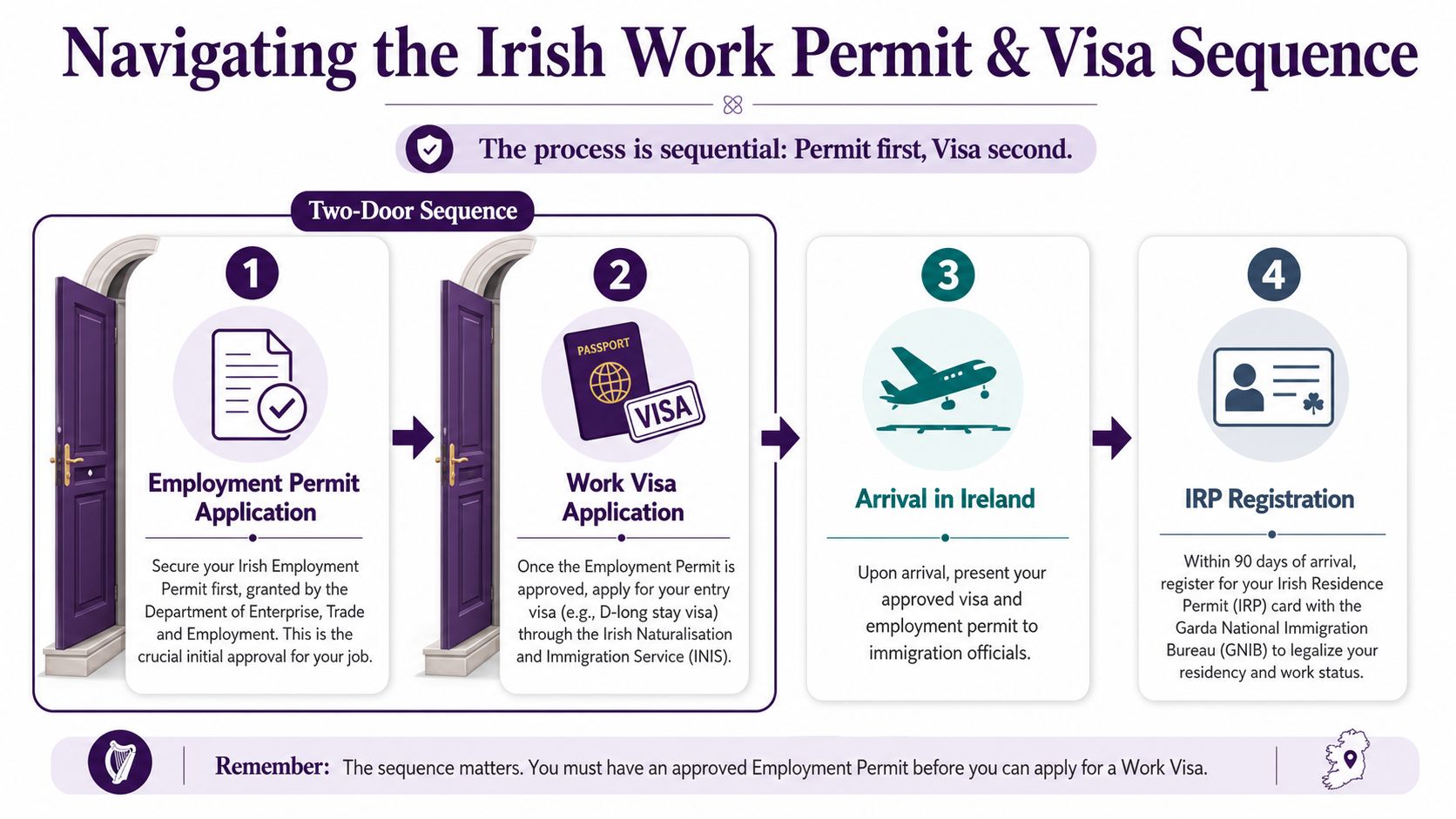
Irish hiring for non-EEA hospitality staff follows a strict sequence. If you try to push the second step before the first is complete, the process stalls.
The two-door sequence
The cleanest way to think about it is a two-door system. The first door is the employer's approval to hire. The second door is the worker's permission to enter Ireland for that job.
The order isn't optional. The Irish employment permit approval process follows a strict 13-week statutory timeline for standard permits, with Critical Skills Employment Permits processed faster due to priority status, and applications must be submitted at least 12 weeks before the proposed employment start date through the Employment Permits Online System, as outlined in Recruit Ireland's guide to Irish work permits and visas.
The same source also reflects the practical rule many employers learn the hard way. The employer must secure the permit first, and only then can the candidate move to the long-stay employment visa stage where that applies.
A workable recruitment timeline for venues
In hospitality, the mistake isn't just filing late. It's hiring late. If you start searching for a non-EEA sous chef when you're already short for August, immigration timing has already become a constraint.
A practical internal sequence looks like this:
- Confirm the role properly
Finalise title, salary, reporting line and location before any application starts. Loose drafts create mismatches later. - Prepare the employer-side file
Gather the company documents you'll need for the permit application and check they're current. - Submit through EPOS
The permit application goes through the Employment Permits Online System. This is the point where your proposed start date has to be realistic. - Wait for permit approval before moving the candidate to visa stage
Don't ask the candidate to guess, pre-file, or build plans around an unissued permit. - Support the candidate's visa file where needed
The candidate usually owns this step, but the employer still needs to supply clean supporting documents that match the permit.
The businesses that handle this best build immigration lead time into staffing calendars in the same way they build lead time into Christmas menus or summer recruitment.
Where operators lose time
The biggest losses usually come from avoidable sequencing errors:
- Starting too close to peak trade: A spring decision for a summer start often leaves no buffer.
- Using a target start date as if it were fixed: Immigration dates should shape the onboarding date, not the other way around.
- Treating permit approval as the finish line: It isn't. For many hires, there is still an entry step after that.
- Leaving ownership unclear: HR thinks operations is chasing documents. Operations thinks the recruiter is handling them. Nothing moves.
For hospitality employers dealing with ad restrictions or permit route questions before filing, Beacon's article on the Labour Market Needs Test for Ireland hospitality employers helps clarify one of the areas that often delays applications upstream.
How to schedule around seasonality
A well-run venue doesn't build its immigration calendar around optimism. It builds around service pressure. If your busiest period is summer, you should work backwards from the point where the employee must be on site, inducted and ready for service.
That usually means locking the role specification early, agreeing who owns document collection, and refusing to promise an arrival date until the permit stage is complete. By managing this process carefully, experienced recruiters and disciplined HR teams save operators real disruption. They don't just submit forms. They control the order of events.
Meeting Eligibility and Documentation Requirements
Most permit and visa problems aren't dramatic. They're technical. A document is missing, the role description is thin, or the employer file doesn't show enough to support the application cleanly.
The documents that matter most
One refusal pattern stands out on the visa side. The most common refusal ground for Irish Long Stay (D) Employment Visas is insufficient evidence of qualifications and previous work experience, which must be explicitly documented alongside the employment contract, according to Irish Immigration's employment visa guidance.
That matters a lot in hospitality because employers often know a candidate is capable long before the file proves it. A strong trial shift history, a good referral or a polished interview won't replace formal evidence when the visa application is assessed.
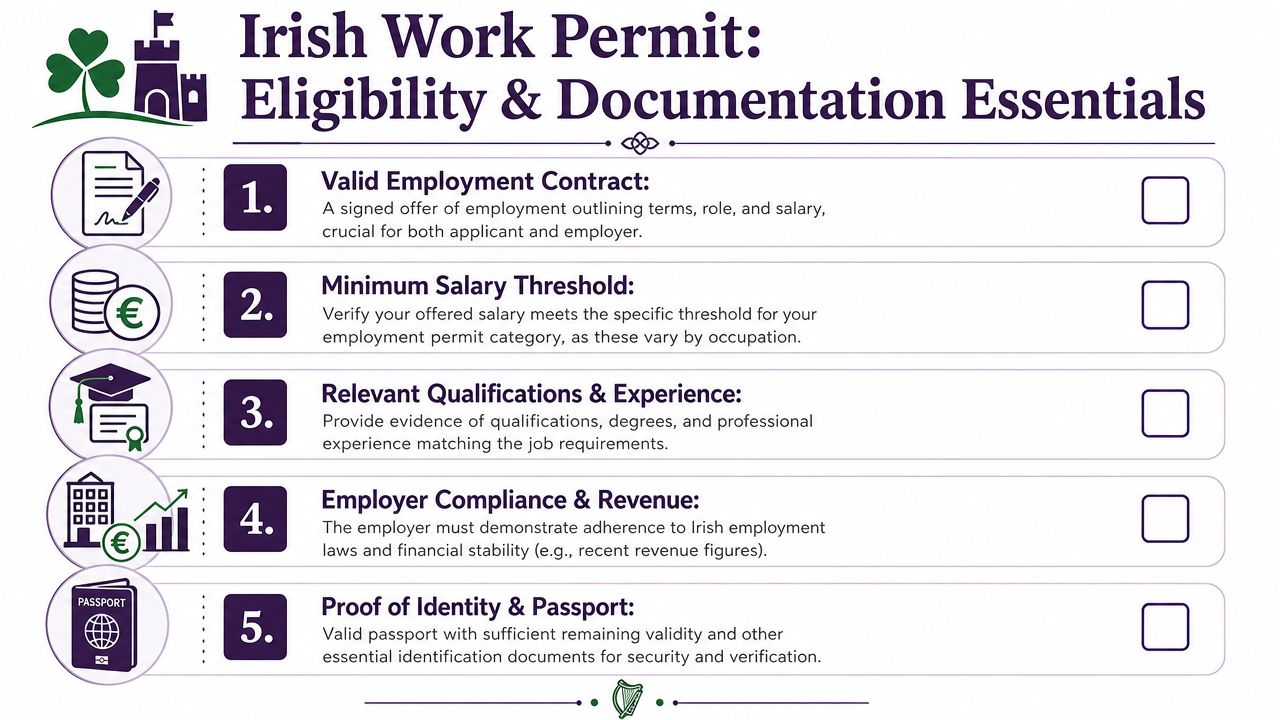
A practical pre-submission checklist
Before submitting anything, hospitality employers should check for a complete and consistent file:
- Signed employment contract: The contract should clearly state the role, salary and key terms. It needs to match the application details exactly.
- Qualification evidence: Gather certificates, training records and any documents that show the candidate is properly qualified for the role.
- Previous work evidence: CVs alone are weak if they aren't backed up by employer references or other supporting records where available.
- Passport and identity documents: Check validity early. A last-minute passport issue can halt momentum.
- Employer revenue compliance: A critical rejection point is failure to provide the employer's monthly statutory revenue return within the last three months, or SEPA direct debit proof, because the Department checks this to verify operational viability.
- Role definition: The role must be specific enough to show what the worker is being hired to do. Generic wording creates avoidable questions.
What hospitality employers often overlook
Restaurants and hotels usually focus hardest on the candidate file. In practice, employer-side readiness causes plenty of trouble too. The revenue return point catches businesses that are otherwise trading perfectly well but haven't organised their statutory proof in a way that supports the application.
Checklist discipline beats firefighting. If the contract, salary, role title and qualifications line up from the start, the file moves more cleanly.
Another common issue is mismatch. The contract says one thing, the permit form says another, and the interview notes suggest a broader role again. In hospitality, where people naturally help across functions, that kind of looseness is culturally normal. Immigration files don't read it that way. They read for precision.
A good internal habit is to appoint one person to compare every document line by line before submission. Not because the process is impossible, but because it is unforgiving of inconsistency.
Comparing Costs and Processing Times
Cost planning matters because immigration spend sits alongside relocation support, onboarding, uniform, accommodation assistance and early payroll costs. If you don't budget properly, the hire feels more expensive than expected and the business starts cutting corners elsewhere.
Permit and visa cost timeline comparison
For permit fees, the structure is clear. The General Employment Permit costs €500 for permits up to six months or €1,000 for permits up to 24 months, while the Critical Skills Employment Permit has a fixed fee of €1,000 for up to 24 months, as set out in Oyster's summary of Ireland work visa requirements.
Here's the side-by-side planning view.
Permit and Visa Cost Timeline Comparison
Permission TypeFeeProcessing TimeValidityGeneral Employment Permit€500 for up to six months. €1,000 for up to 24 monthsStandard permits follow a statutory processing timeline. Plan on the formal permit lead time already discussed.Up to six months or up to 24 months, depending on applicationCritical Skills Employment Permit€1,000 for up to 24 monthsProcessed faster than standard permits because of priority statusUp to 24 monthsLong Stay (D) Employment VisaCost depends on the relevant visa application routeFollows permit approval in the sequence. Timing varies by case and jurisdiction.Entry permission for employment purposesIRP registration after arrival€30010 to 15 business daysResidence permission linked to the underlying status
How to use the numbers operationally
For hospitality employers, the fee itself is only one part of the decision. The bigger trade-off is between role type, timing pressure and how stable you expect the hire to be over the permit period.
A few practical budgeting points help:
- Shorter-term staffing still has admin weight: A lower permit fee doesn't make the process light-touch.
- Priority matters when the role qualifies: Faster handling on the permit side can materially improve hiring certainty.
- Arrival costs continue after travel: IRP registration is often forgotten in workforce planning even though it affects the employee's practical ability to settle properly.
- Cheap planning is expensive planning: Under-budgeted hires tend to create stress around accommodation, payroll setup and start-date changes.
Time matters more than most employers think
In most venues, the hidden cost isn't the permit fee. It's the gap between when the business needs the person and when the person can realistically begin. A delayed start can mean overtime, agency cover, manager shifts on the floor or reduced trading capacity.
That's why good operators don't compare permit types on fee alone. They compare them on operational fit. The right question is not, “Which route costs less?” It's, “Which route aligns with the role, the lead time and the service period we're trying to protect?”
Avoiding Common Pitfalls in Compliance
A lot of employers think the hard part ends once the worker lands in Ireland. It doesn't. Post-arrival compliance is where many hospitality businesses drift into avoidable risk because day-to-day operations take over.

The mistakes that cause the most trouble
The main issue is often timing after arrival. Non-EEA nationals must register with Immigration Service Delivery for an Irish Residence Permit within 90 days of arrival, and the IRP fee is €300 with a processing window of 10 to 15 business days. Miss that, and the person can fall into an unauthorised position. The same immigration guidance also notes a strict cap for the Seasonal Employment Permit of a maximum seven months per calendar year, under the Employment Permits Act 2024 from early 2025, which is particularly relevant for seasonal hospitality staffing.
There's another trap operators sometimes create themselves. If the salary level or the actual role drifts away from what the permit was granted for, the permission can become invalid because the permit is tied to the employer, role and salary rather than a broad right to remain in the labour market.
Don't treat arrival as the end of the process. Treat it as the handover from recruitment compliance to in-employment compliance.
A better control system for venues
The fix is usually simple, but it has to be intentional:
- Set IRP reminders immediately: Put the arrival date and registration deadline into the same system you use for probation reviews or contract end dates.
- Check payroll against permit terms: If hours, earnings structure or job title shift, review the immigration impact before changing anything.
- Track seasonal workers separately: Don't manage them in the same casual way you manage recurring summer returners from inside the EU.
- Train site managers on right-to-work checks: Local managers often control rotas and role allocation, so they need to understand the limits of the permission on file.
For operators tightening their internal checks, Beacon's guide to right to work checks in Ireland for employers is useful for turning immigration obligations into a repeatable site process.
The employers who stay out of trouble aren't usually doing anything fancy. They just connect immigration dates to payroll, onboarding and HR records so nothing gets lost between departments.
Next Steps for Hospitality Employers
If you're hiring outside the EEA, the practical lesson is straightforward. Don't ask whether the worker needs a visa or a permit as if it's an either-or decision. Start by identifying the role properly, then map the full permission path, then build your start date around that reality.
The venues that handle Ireland work visa vs employment permit well tend to do three things early. They assign one owner for permit documents, one owner for post-arrival tracking, and one realistic staffing calendar tied to trade peaks rather than wishful start dates. That alone removes a lot of avoidable pressure.
If you're preparing your first non-EEA hire, keep the process disciplined:
- Use EPOS early: Don't leave permit filing close to the proposed start date.
- Keep role details consistent: Contract, salary and job title need to match across the file.
- Support the candidate through the visa stage: Even when the candidate applies, employer responsiveness still matters.
- Track post-arrival obligations: IRP timing and in-role compliance need active management.
Hospitality operators don't need to become immigration specialists. They do need a system that treats immigration as part of workforce operations, not as last-minute admin.
If you need practical help with non-EEA hiring, Beacon Recruitment manages hospitality recruitment alongside permit handling, visa support and the operational compliance work that sits around onboarding international staff.
Is Confusion Over Visas and Permits Delaying Your Hires?
Avoid costly start-date delays and compliance breaches by getting your permit and visa sequencing right the first time.