July 19, 2026
Holiday Entitlement for Part Time Workers Bank Holidays
Holiday entitlement for part time workers bank holidays - Discover your holiday entitlement for part-time workers and bank holidays in Ireland. Essential guide
Friday afternoon. The Easter Monday rota still isn't final, two staff have asked whether they're “owed double”, your payroll person is looking for a clear answer, and one part-time team member who never works Mondays wants to know why the bank holiday should matter to them at all.
That's a very normal hospitality problem in Ireland. Hotels, cafés, restaurants and bars run on mixed patterns: fixed part-time shifts, casual weekend cover, students whose availability changes by the week, and managers who are trying to fill service gaps without creating a payroll problem three weeks later.
The risk isn't only a wages complaint. When bank holiday pay is handled badly, staff notice fast. They compare payslips, they swap screenshots in WhatsApp groups, and they remember who felt short-changed. In hospitality, where retention already depends on trust and fairness, sloppy holiday calculations can cost you more than the amount on the payslip.
Managers also get caught by rules that sound simple until real rosters get involved. Someone works every Saturday and Sunday but never Monday. Another has variable hours and took annual leave during the qualifying period. Another is rostered on the public holiday but thinks that means an automatic premium no matter what. In such cases, generic advice falls apart.
Holiday entitlement for part time workers on bank holidays has to be handled with a hospitality lens. Fixed office-style examples don't help much when your labour model depends on split shifts, weekend peaks and changing demand. The law still applies. The challenge is applying it properly when the roster is messy.
The Bank Holiday Rota Headache
The trouble usually starts with one assumption. A manager thinks bank holiday treatment should be obvious because “we've always done it this way”. Then the rota throws up three different staff scenarios and none of them fit the old shortcut.
Take a common bank holiday weekend in a hotel. Front office needs cover. Bar trade is up. Housekeeping needs extra hands for turnover. A part-time receptionist is rostered on the Monday. A food runner isn't. A weekend bartender wants to know whether working the day means double pay. None of those questions should be answered from memory.
What makes hospitality different
Hospitality businesses don't run on neat, identical weekly patterns. You're dealing with:
- Changing availability: Students, parents and second-job workers often move their days around.
- Mixed contracts: Some staff are part-time with fixed days, others are casual in practice even if the paperwork says otherwise.
- Operational pressure: The rota gets built around occupancy, bookings, events and call-outs, not around ideal payroll simplicity.
- Manager handovers: One manager approves shifts, another checks payroll, and the person answering entitlement questions may not have seen the contract.
That combination creates mistakes. The most common one is treating all part-time staff the same, when the entitlement depends on both qualification and working pattern.
Bank holiday problems rarely begin in payroll. They begin in rostering, record-keeping and assumptions.
Why getting it wrong hurts twice
The first cost is compliance. If your records don't support the payment decision, you're exposed. The second cost is cultural. Staff don't expect managers to know every rule off the top of their head, but they do expect consistency and a clear explanation.
What works is a process. Check qualification first. Check whether the employee normally works that day. Check what the contract says about any extra premium beyond the legal minimum. Then document the decision.
What doesn't work is making a promise on the floor during service and trying to justify it later.
Understanding The Pro-Rata Principle
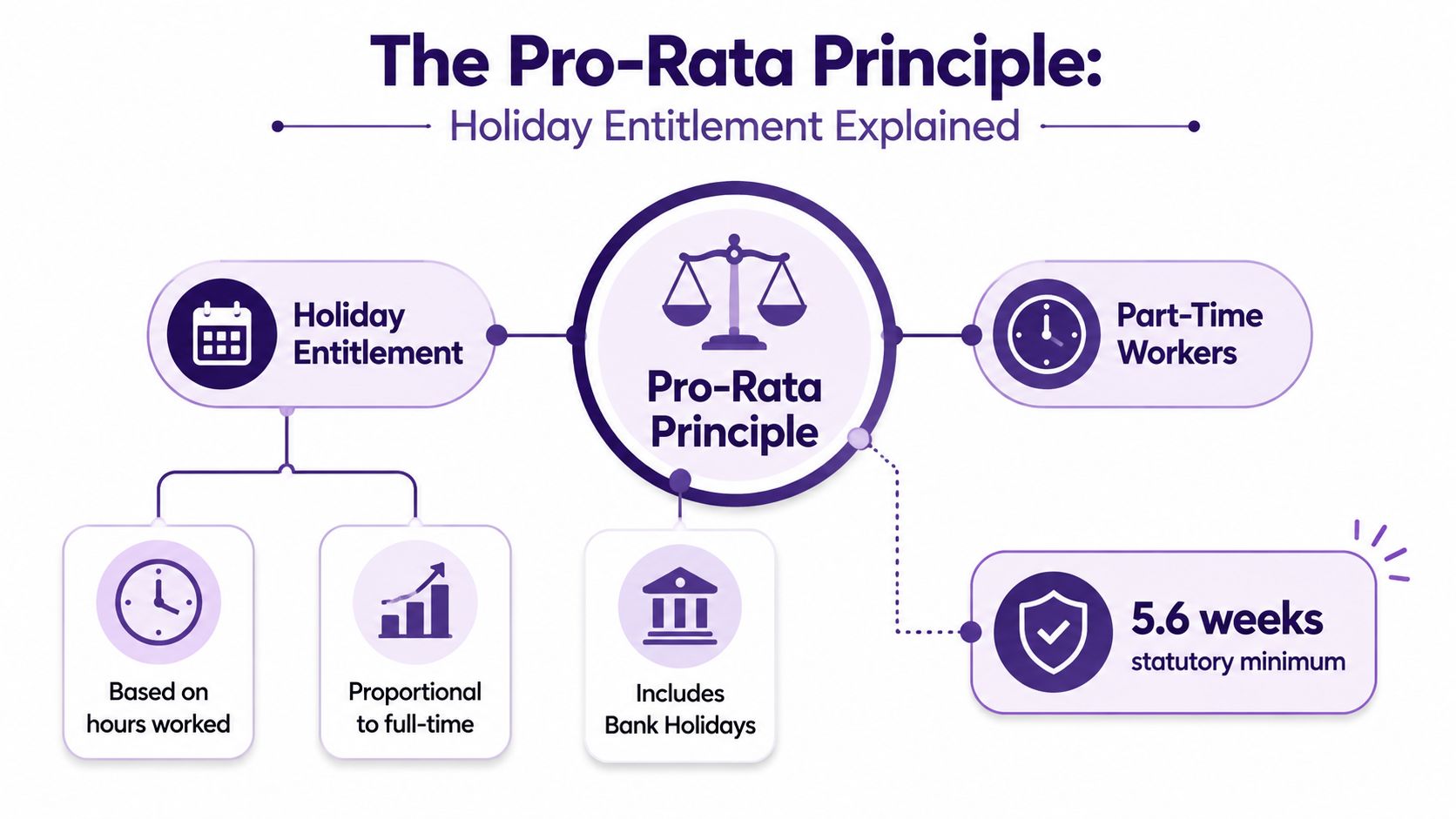
The core idea is simple. Part-time workers are entitled to the same statutory holiday protection as full-time workers, but on a pro-rata basis. In Irish practice, that means you stop thinking in vague terms like “they only do a few shifts” and start thinking in hours worked.
Under the Organisation of Working Time Act, 1997, a part-time worker's total statutory annual leave is 5.6 weeks, and this is now typically calculated as 12.07% of hours worked. That figure incorporates their pro-rata entitlement for Ireland's 10 public holidays, including the one added in 2023, as outlined in Maneely McCann's annual leave guidance.
What pro-rata means in practice
If a full-time employee receives the full statutory leave position, the part-time employee receives a proportion based on the hours they work. That matters in hospitality because a “three-day worker” in one venue may work very different hours from a “three-day worker” in another.
The 12.07% method is helpful because it follows the specific hours on the rota. For variable-hour hospitality staff, that's usually easier to administer cleanly than trying to force everyone into a days-per-week formula that no longer reflects how they work.
A practical example from the same guidance makes the point clearly. A part-time hospitality employee working 20 hours per week in Ireland would accrue 12.07% of 1,040 annual hours, which comes to about 125.5 hours or 15.7 days of total annual leave. That total includes the value of public holidays within the overall entitlement, as set out in this annual leave explainer for Irish employers.
Where managers get confused
Many managers mix up two separate questions:
- Annual leave accrual
- Public holiday benefit on a specific public holiday
Those are related, but they aren't the same payroll decision. Annual leave builds over time through hours worked. Public holiday benefit on a particular day depends on whether the employee qualifies for that day and what their normal pattern looks like.
Practical rule: Use the pro-rata principle to frame fairness across the year. Use the public holiday rules to decide what happens on the individual bank holiday date.
The mistake I see most often is over-simplifying part-time status itself. “Part-time” isn't the calculation. Hours worked are.
The 40 Hour Gateway to Entitlement
Before you calculate a cent of bank holiday pay, ask one question. Has the employee worked the qualifying hours in the relevant period?
In Ireland, part-time employees qualify for public holiday benefits only if they have worked an aggregate of 40 hours during the 5 weeks immediately before the holiday. That rule applies even if the public holiday falls on a day they are not scheduled to work, as noted in this guidance on bank holiday pay qualification.
The first check every manager should make
Your process should be:
- Pull the five-week look-back period
- Add the employee's aggregate hours
- Confirm whether paid annual leave in that period needs to be counted
- Only then decide what the public holiday benefit should be
That sequence matters. Managers often jump straight to “Were they rostered on Monday?” That's the wrong starting point. If they don't meet the qualification threshold, the rest of the calculation doesn't arise in the same way.
What counts and what trips people up
The qualifying check is where hospitality payroll falls over because records are often spread across rota apps, clock-ins and manual amendments.
Common failure points include:
- Missing leave records: Paid annual leave can matter to continuity, so incomplete records distort the result.
- Shift swaps not updated: The roster says one thing, payroll hours show another.
- Assuming casual means excluded: If the person worked the qualifying hours, labels like “casual” won't rescue a bad process.
- Checking the wrong period: Use the correct reference window, not a rough monthly look-back.
If you need a clean way to think about look-back periods generally, Beacon's note on the employment law reference period is a useful internal benchmark for managers and payroll teams.
If the qualification check isn't documented, you're relying on memory. That's not a defence. It's just a weak file.
How to Calculate Bank Holiday Pay Correctly
Once the employee has passed the qualification gateway, the next step is deciding which scenario applies. In hospitality, managers often blur “working on the day” with “entitled on the day”. Keep them separate.
Scenario one when the employee is rostered to work
For a qualifying part-time worker in Ireland, if they are rostered to work on the public holiday, they are entitled to their normal daily pay plus an additional day's pay. In practical terms, that is the equivalent of double pay for that day, based on the verified rule set out in the earlier legal guidance.
This is the scenario managers usually recognise fastest because it feels intuitive. The staff member works the bank holiday and expects an enhanced outcome. The key point is that the entitlement flows from qualification plus the fact they are rostered to work on the public holiday.
Scenario two when the employee is not rostered but it falls on a normal working day
This catches managers out because they focus too heavily on the rota for the holiday itself. If the public holiday falls on a day the employee would normally work, the worker may still have an entitlement linked to their normal day's pay.
That's why normal working pattern records matter. If your contracts say one thing, your rota history says another, and your payroll coding says a third, you've built an argument against yourself.
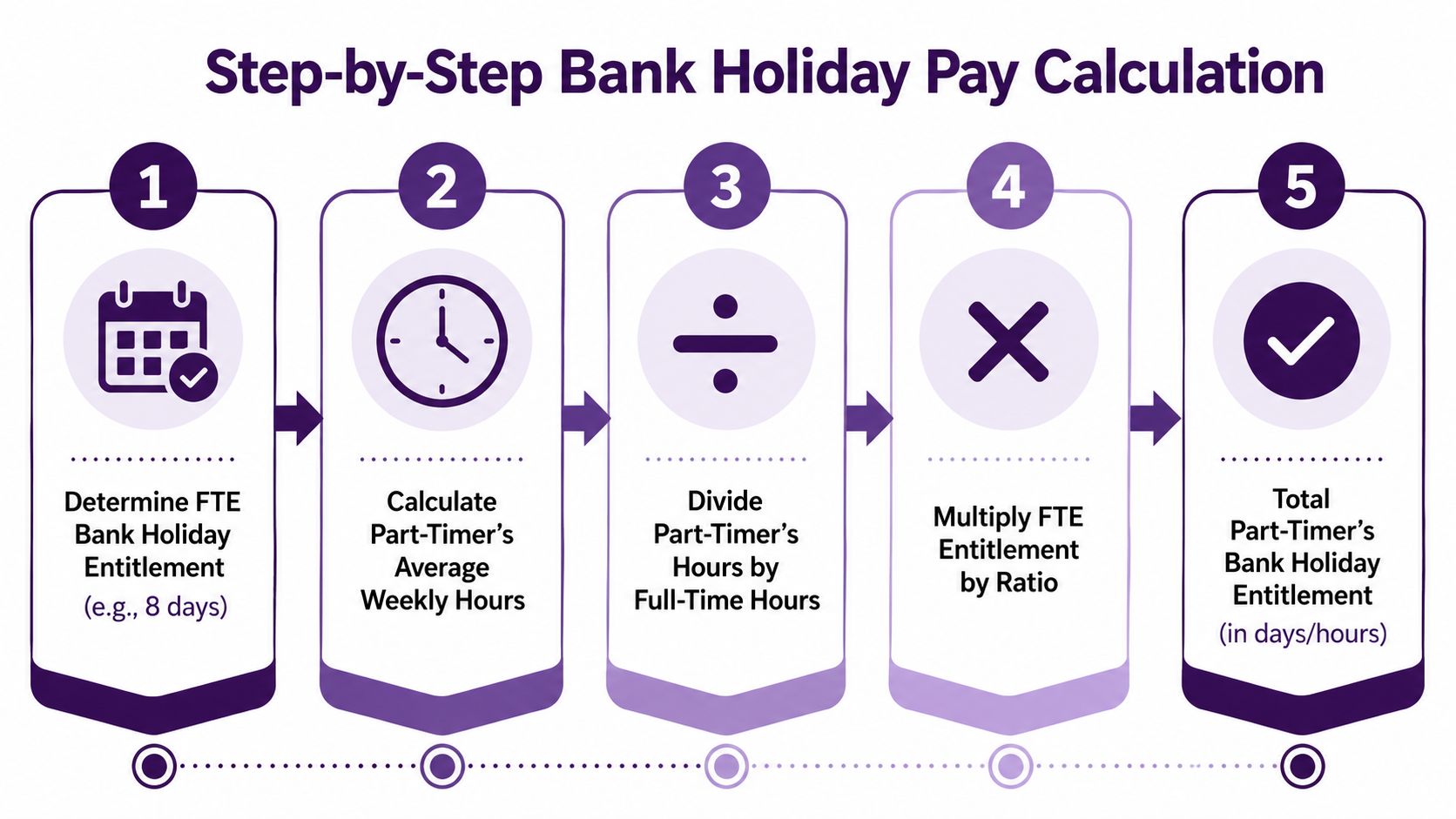
Scenario three when the employee is not rostered and it is not a normal working day
This is the one hospitality managers most often get wrong, especially with Friday-Saturday or weekend-only staff. If a qualifying part-time worker is not rostered on a public holiday, they are entitled to one-fifth of their average weekly pay, calculated over the preceding 13 weeks, as explained in Peninsula Ireland's public holiday compensation guide.
That means the answer is not “you don't work Mondays, so you get nothing”. If they qualify, there may still be compensation due.
A clean decision path for payroll
Use this sequence:
- Check qualification first: Confirm the employee has met the gateway condition before any payment decision.
- Look at the public holiday roster: Were they scheduled to work on the day?
- Check their normal working pattern: If not rostered, is this still a day they normally work?
- Apply the correct payment route: Daily pay treatment or the one-fifth weekly pay method, depending on the facts.
- Record the basis for the decision: Keep the rota, time records and payroll note together.
For owners who want a broader plain-English explainer on how holiday pay works for SMBs, that resource is useful background reading, but Irish hospitality operators still need to apply the Irish public holiday rules precisely. For the annual leave side of the equation, an Irish annual leave calculator can help managers sense-check figures before payroll is finalised.
What works and what doesn't
What works is a rule-based approach. Payroll should never be trying to infer entitlement from comments on the rota.
What doesn't work is using a blanket custom such as “all part-timers get the same” or “only people who worked the actual Monday qualify”. Those shortcuts create the exact inconsistency that ends up becoming a complaint.
Real World Examples from the Hospitality Floor
Theory becomes useful when it matches the shifts you run. These examples are closer to what hotel and restaurant owners deal with every month.

The weekend bartender
He works Friday and Saturday nights in a busy bar. Easter Monday arrives and he isn't rostered because Monday is never part of his normal pattern.
The wrong manager response is immediate dismissal: “You don't work Mondays.” The correct approach is to check whether he passed the qualification gateway in the prior five weeks. If he did, the next question is not whether he ever works Mondays. It's which public holiday compensation rule applies to a qualifying worker who is not rostered on that day.
This is exactly why holiday entitlement for part time workers on bank holidays needs to be handled through documented steps rather than habit. Weekend-only staff are often the ones most likely to be overlooked.
The student with variable hours
She works around college timetables and restaurant demand. Some weeks she picks up multiple shifts. Other weeks she only does a couple. Her availability is genuine, but her records are messy because managers swap her between floor, host and takeaway support.
With variable-hour staff, the practical issue isn't usually the legal principle. It's data quality. If the rota system, timesheets and payroll don't line up, managers struggle to determine qualification cleanly and payroll struggles to calculate average weekly pay correctly for public holiday compensation.
A good system does three things:
- Captures actual hours worked clearly
- Flags the five-week qualification check before each public holiday
- Stores the reasoning behind the payment result
The more variable the hours, the less room you have for informal payroll decisions.
The part-time cleaner on fixed mornings
She works a fixed 15-hour week over three set mornings. This is the kind of pattern managers often find easier because the normal working week is stable.
For public holiday hours, Irish guidance gives a helpful benchmark: the employee's normal weekly hours are divided by five to determine the hourly entitlement per public holiday. The worked example from the INMO shows that a part-time hotel receptionist in Clare working 24 hours weekly over 3 days is entitled to 4.8 hours of public holiday leave for each of the 10 Irish public holidays, calculated as 24 ÷ 5 = 4.8, according to the INMO guidance on part-time workers.
That example matters for hospitality because it reflects the same logic managers can apply to fixed-hour support roles such as reception, accommodation assistants and cleaning teams. The lesson isn't just the arithmetic. It's that fixed weekly hours make entitlement easier to defend because the normal pattern is visible and consistent.
What these examples tell you
Three staff. Three different realities.
- Weekend workers are often wrongly excluded.
- Variable-hour workers expose weak systems.
- Fixed-pattern workers are easier to process, but only if records and contracts match reality.
Managers who handle these cases well don't rely on memory or old custom. They use the same documented decision path every time.
Common Pitfalls and Your Compliance Checklist
Most bank holiday mistakes in hospitality are operational, not theoretical. The law is only part of the problem. The bigger issue is that many venues run people processes through hurried rota changes, copied contract clauses and payroll workarounds that were never designed for scrutiny.
The mistakes that keep recurring
One of the worst assumptions is that “casual” staff have fewer rights. If someone works in your business, labels won't fix a bad payment practice. The records and the actual hours are what matter.
Another recurring issue is Good Friday. In Ireland, Good Friday is a standard working day, not a public holiday, so part-time staff rostered that day are not automatically entitled to premium pay unless the contract says so, as confirmed by the Workplace Relations Commission public holidays guidance.
There's also the contract problem. Managers often inherit wording that is vague on public holidays, enhanced rates, normal working days, or how variable-hour staff are treated. Ambiguity creates disputes because staff fill the gap with assumptions.
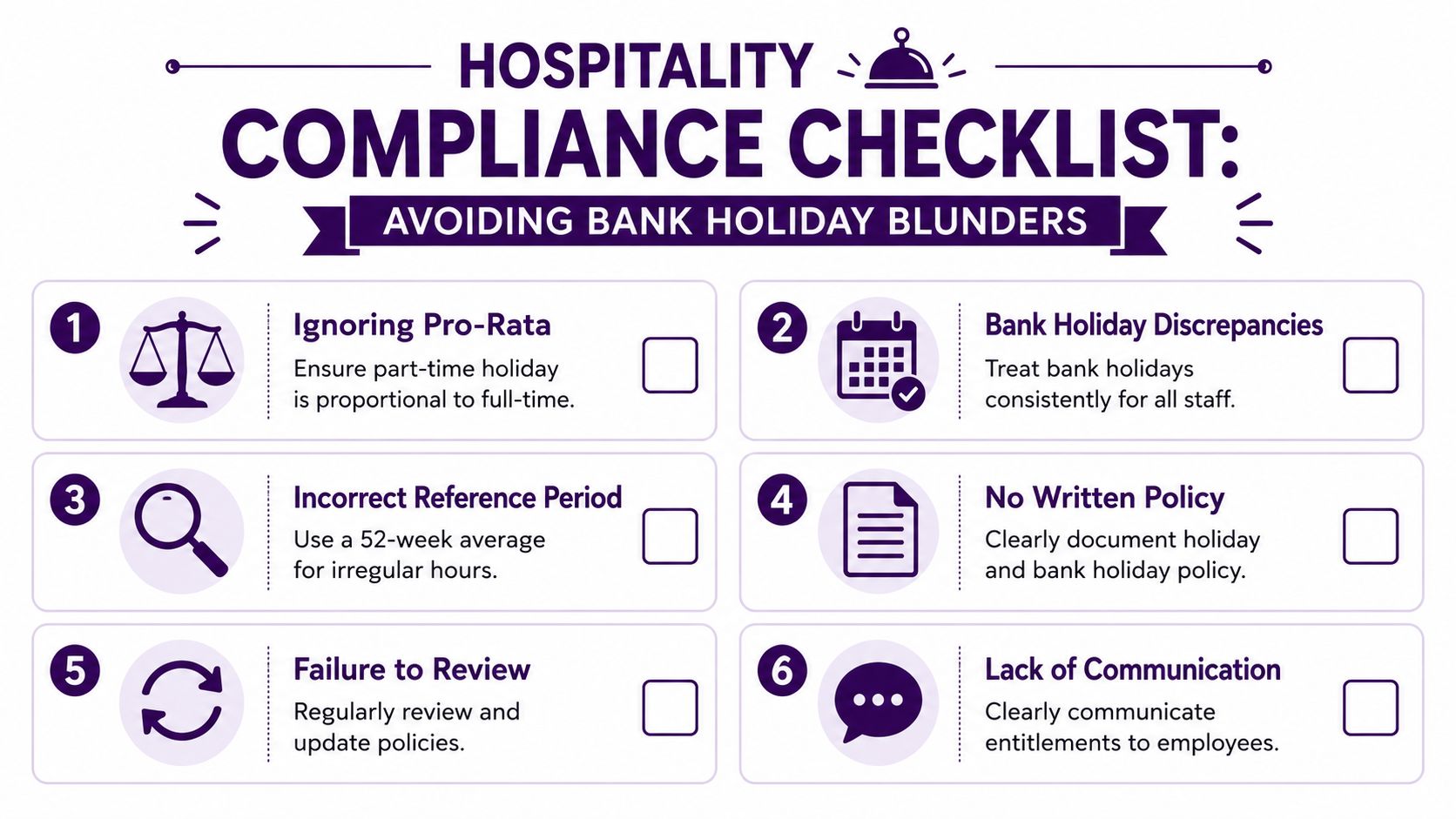
The checklist that actually helps
Run this against your business before the next public holiday weekend:
- Contracts match reality: Check that part-time and variable-hour contracts reflect how people work, especially around public holidays and any enhanced rates.
- Normal working pattern is identifiable: If a dispute arose tomorrow, could you show the employee's typical pattern from records rather than opinion?
- Qualification check is built in: Someone should be responsible for checking the gateway condition before payroll closes.
- Rota and payroll speak to each other: Shift swaps, sick leave and annual leave must be updated promptly.
- Good Friday is treated correctly: Don't apply a public holiday premium by accident, and don't deny a contractual premium if one exists.
- Managers know what not to promise: Supervisors on the floor shouldn't be improvising legal answers during service.
- Records are audit-ready: Keep time records, leave records, rota history and payroll notes together.
What a defensible process looks like
A compliant system doesn't need to be fancy. It needs to be consistent. The cleanest operations usually have one named owner for the legal check, one source of truth for hours, and a simple written rule for how bank holiday queries are answered.
If you want a wider employer-focused reference point, this essential compliance guide for hospitality operators is useful for pressure-testing your broader employment practices. The key in Irish hospitality, though, is making sure your own roster, payroll and contract workflow can stand up to scrutiny.
Manager's note: If you can't explain the payment in two or three clear sentences and support it with records, your process needs work.
Stop Guessing and Build a Compliant System
Bank holiday administration gets messy when the venue is busy, managers are stretched and staff patterns change week to week. That's exactly why the process needs to be boring, repeatable and written down.
Keep the key rules front and centre:
- Check qualification first
- Identify the correct bank holiday scenario
- Apply the correct payment method
- Keep clean records of hours, leave and rota history
- Treat Good Friday separately from public holidays
- Don't let floor-level assumptions become payroll decisions
Good compliance is good management. Staff stay calmer when pay is consistent. Managers waste less time arguing over payslips. Owners reduce the chance of a WRC issue that started with nothing more than a sloppy rota decision.
If your operation relies on part-time, seasonal or variable-hour hospitality staff, this area can't be left to guesswork. Build the system once, train managers on it, and make every bank holiday run through the same process.
Beacon Recruitment helps Irish hospitality operators build that kind of system properly. If you need support with contracts, staff handbooks, people audits or practical HR compliance that holds up under WRC scrutiny, talk to Beacon Recruitment. Their HR and compliance support is built for real hospitality operations, not generic office environments.
Are Your Bank Holiday Payroll Checks Legally Compliant?
Stop relying on guesswork and messy rotas—book a free consultation with Beacon to build an audit-proof payroll and compliance process.