August 12, 2026
Compliance Risk Assessment for Irish Hospitality Operators
Run a compliance risk assessment that actually protects your venue. A practical guide for hospitality operators covering food safety, HR, WRC and EHO risk.
You don't need another policy binder. You need to know what happens when a Workplace Relations Commission investigator shows up midweek, or when an EHO walks into a kitchen on a Saturday when the pass is full and nobody has time to look calm. That's the moment most venues fail, not because they have no rules, but because nobody ever tested those rules against real pressure.
In Irish hospitality, compliance risk assessment should be treated like fire drills, not paperwork. If your venue can't show who owns the risk, what evidence sits behind the control, and what changes when something breaks, you're guessing. Guessing is how clean-looking operations get embarrassed in front of an inspector.
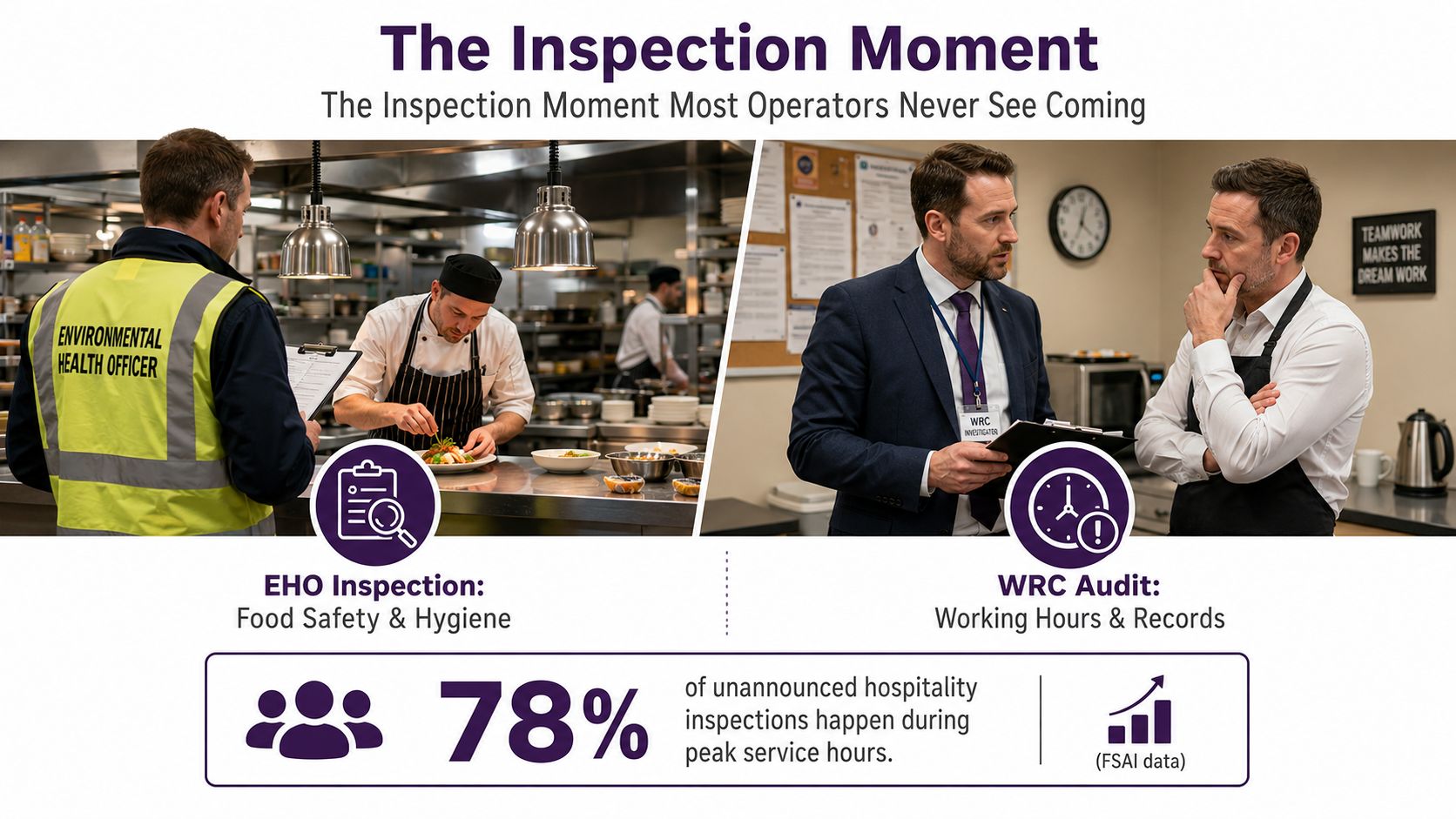
The Inspection Moment Most Operators Never See Coming
A hotel kitchen can look immaculate at 6.30pm and still be a headache by 8pm. Tickets are stacking up, the sous chef is covering a sick call, and the GM is in the office trying to solve a rota gap. That's when an inspector appears, not after a warning and not when the team has had time to tidy its story.
Irish operators get caught because they confuse having a policy with being able to prove control. A folder on a shelf won't save you if no one can show the walk-in checks, the rota records, the induction files, or the training that happened. That's why a proper compliance risk assessment matters, it turns “we should be fine” into a working operational control.
The pressure is real. The Workplace Relations Commission reported 11,852 workplace complaints in 2024 and completed over 5,000 inspections that year, while also securing €2.45 million in compensation and arrears for workers through complaints resolution in 2024. Those figures, in plain English, mean compliance failures can move from nuisance to money fast. They also explain why hospitality venues with high turnover, casual labour and shifting rosters need a live risk process, not a once-off tidy-up. WRC complaints, inspections and compensation figures
Practical rule: if your evidence only exists after someone asks for it, you're not in control yet.
That's the point Beacon Recruitment has been leaning into as an operational partner, not just a hiring shop. If you want support on the inspection side itself, Beacon's EHO audit support sits in the same world as the work you should already be doing internally.
By the end of this, you should be able to look at your own venue and name the exact areas that would fail first, the controls that hold up, and the triggers that force a fresh review before an inspector does it for you.
The Six Stages of a Working Compliance Risk Assessment
A working assessment isn't a spreadsheet with scary colours. It's a repeatable management routine, and it needs to be simple enough for a GM to run, but strict enough to survive scrutiny. If your team can't explain each step without drifting into jargon, the process is too vague to be useful.
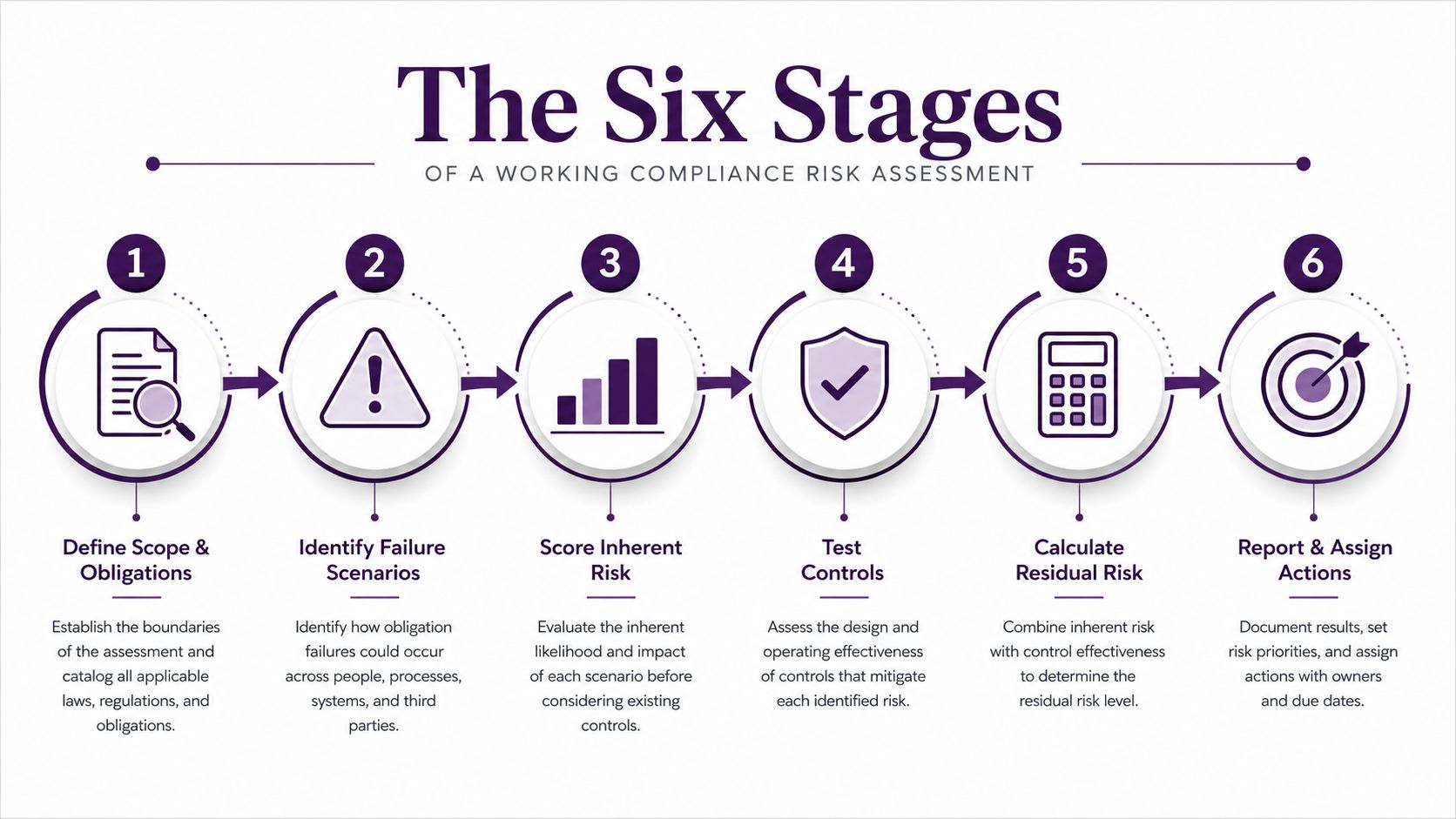
1. Define the scope and obligations
Start with the actual business, not the theory. A city-centre bar with late trading, a hotel with staff accommodation, and a restaurant group using agency workers do not face the same risk map. In Ireland, that scope should clearly include EHO-facing food safety duties and WRC-facing employment compliance, because those are the regimes that bite hardest in day-to-day operations.
2. Identify failure scenarios
Write down what can go wrong in operational language. Not “food safety non-compliance”, but “fridge temperature not recorded on a double shift” or “rest-breaks not captured on a split roster”. Good scenarios are concrete, because concrete scenarios can be tested.
3. Score inherent risk
This is the raw risk before controls do any work. A high-risk event might look severe because of the impact on guests, staff, or enforcement exposure. If you're looking for a practical outside reference point on structured assessment thinking, boutique hotel compliance advice gives a useful sense of how hospitality-specific compliance checks can be framed without turning into generic corporate fluff.
4. Test controls
Weak assessments collapse. A policy is not a control until someone proves it operates. That means checking records, observing practice, and looking for evidence that the process runs on a busy day, not only when the auditor is nearby.
5. Calculate residual risk
Residual risk is what remains after the controls have been tested. This is the point most operators skip, and they shouldn't. If a control works, the risk may fall below your tolerance, but you can only say that if you've checked the control's design and operating effectiveness.
6. Assign owners and dates
A risk without a named owner is just a complaint with formatting. Put each item into a register with the gap, the action, the deadline, and the person accountable. The hard rule is simple, risk acceptance needs a named approver. If nobody signs off, the register becomes a dead document.
The best register is boring. It tells you what failed, who owns the fix, and when the fix is due.
For teams looking to compare assessment structures with broader employment controls, Beacon's WRC compliance and HR audit work fits neatly into the same logic, because the method is the same even when the subject matter changes.
Scoring Risk So It Means Something
A likelihood-times-impact matrix only works when people stop treating it like a maths exercise. In hospitality, the job is not to produce a clever score. The job is to decide where management attention goes first, and what can wait.
Take a walk-in fridge temperature failure. If the log is missed during a busy service, the likelihood may look modest on paper, but the impact is serious because it touches food safety, waste, customer trust and inspection exposure. If the fridge has a working alarm, a second-person verification check, and a documented escalation step, the residual risk may fall far enough to sit within tolerance.
Now take a missed rest-break for an hourly worker. The single event may look small, especially to a busy supervisor. Repetition changes that fast. Repeated misses create employment-law trouble, payroll dispute risk and morale damage. For a restaurant paying tipped-out staff on tight rotas, that is not trivia, it is a compliance defect that can end up in a file.
Pick the matrix that matches your operation
A 5x5 matrix gives more detail. A 3x3 matrix is easier to run if your team is small or your managers hate overcomplicated admin. Choose the tool you will use, not the one that looks impressive in a meeting. A dense matrix that nobody updates is worse than a simple one that gets reviewed.
Write both the number and the story
The register should show a score and a short narrative. For example, “temperature logging missed during peak service, current check is manual only, escalation not consistently followed”. That matters because non-specialists, owners, GMs and department heads need to read the same record and understand the risk without decoding the spreadsheet.
If you want a practical benchmark for avoiding lazy scoring in people-related controls, the 80% hiring rule guide is a useful reminder that structured decisions need a real method behind them, not a gut feel dressed up as process. For a related look at how compliance review and HR audit work fit together, Beacon Recruitment's WRC compliance and HR audit work sits in the same logic.
My view: if your scoring cannot survive a five-minute challenge from a GM, it is too abstract to be useful.
Set clear appetite thresholds. If a risk sits above tolerance, it needs an action, not a debate. If it is below tolerance because controls have been tested and proven, record that properly and move on.
EHO Risks and WRC Risks Are Not the Same Problem
A single checklist is a lazy answer. EHO risk and WRC risk live in different parts of the operation, and they fail for different reasons. If you mix them together, you'll either drown the kitchen in HR paperwork or ignore the employment records that matter most.
On the EHO side, the focus is food safety, hygiene, temperature control, cleaning schedules, allergen awareness and HACCP evidence. An inspector wants to see the records, but the records need to match what's happening on the floor. Fridge logs, cleaning rotas, allergen procedures and staff food training all matter because they prove the system is real, not decorative. For operators who want a good benchmark on general health and safety compliance thinking, DynamicsHub's compliance guide is a useful reference point.
What the WRC will care about instead
The WRC is looking at employment practice. That means contracts, timesheets, working hours, breaks, payslips, rota logic, grievance handling and whether the evidence matches what staff were asked to do. A slick handbook won't save you if records are missing, inconsistent or obviously backfilled after a complaint.
The overlap zone is where many venues get careless. Training records matter to both regimes, because they show that people were taught what the venue expects. Induction records help too, especially where a role touches both food handling and working-time controls. But don't fool yourself into thinking one policy covers everything. A food safety manual does not fix payroll issues, and an HR handbook does not satisfy the kitchen inspector.
A clean way to split the register is to create two active streams:
- Food safety risks, with controls like temperature logs, cleaning verification, HACCP checks and allergen training.
- Employment risks, with controls like contracts, working-hours records, rest-break evidence and manager sign-off.
- Shared training risks, where the same induction supports both regimes but must be evidenced separately.
- Escalation risks, where complaints, incidents or failed checks trigger a deeper review.
That split keeps neither side neglected. It also stops managers from assuming that because one file looks tidy, the whole venue is compliant.
Third-Party and Agency Staffing Risk
The biggest blind spot in many hospitality venues sits outside the payroll system. It lives in outsourced payroll, booking platforms, cleaning contractors, maintenance firms and agency labour. If you only assess what your own managers directly control, you'll miss the stuff that still lands on your desk when it goes wrong.
Agency staffing is the sharp edge here. If you rely on international hospitality workers supplied through a partner, you still own the venue's exposure when documentation, induction or working practices are weak. The same goes for a booking system that drives over-commitment, a cleaning contractor that never trained its people properly, or a maintenance provider whose certifications are out of date.
What to demand from vendors and recruitment partners
Don't buy reassurance. Buy evidence. Your due diligence should ask for contract clauses that assign responsibilities clearly, escalation triggers for missed obligations, and a file of proof you can inspect when needed. For a recruitment partner, that should include right-to-work checks, induction records, role-specific training evidence and confirmation of what was completed before the worker ever hit the floor.
The vendor file should answer four questions:
- Who owns the obligation? If the vendor says they do, show it in the contract.
- What evidence is available? A promise is not evidence.
- What triggers escalation? Missed training, repeated issues, or inconsistent documents should all have a route up.
- What happens when it fails? The operator needs a clear corrective path, not a vague apology.
A fourth-party lens helps. It's not enough to know your contractor. You also need to know the service chain behind them, because payroll processors, subcontracted cleaners and temporary labour suppliers can all create exposure that still lands on your venue.
If a third party can create the failure, your register needs a line for that party, not just for your own staff.
The practical move is to add vendor-specific rows into the risk register. Include the supplier name, the control evidence you expect, the review frequency, and the escalation route if the evidence doesn't arrive. That makes third-party risk visible instead of theoretical.
Why a Once-a-Year Assessment Is Your Biggest Gap
The worst mistake is not skipping the annual review. The worst mistake is treating the annual review like it's enough. In hospitality, risk changes when the roster changes, the tech changes, the ownership changes, or the regulator changes its focus.
A fixed annual cycle is too slow for a live operation. A WRC complaint in March, a food safety issue in June, or a new scheduling tool in October changes the risk profile immediately. If you don't re-score after the event, your register is already out of date.
Build trigger-based reassessment into the rhythm
Quarterly review is a sensible baseline. But it should be paired with event-driven reviews when something material happens. The trigger can be simple, but it must be formal. If the event changes the risk, the register needs an update.
Typical trigger points include:
- A complaint or inspection finding, because the risk has already moved from theory to evidence.
- A staffing spike in peak season, because controls that work in quiet weeks often fail when the room fills up.
- A new digital scheduling or HR tool, because automation changes how records are created and reviewed.
- A change in ownership or site structure, because the operating model has shifted.
- A new regulation or enforcement focus, because the bar has moved.
Once the trigger is logged, record the date, the old score, the new score, the new control or remediation step, and the owner. That's how the register stays alive. It's also how you stop static templates from pretending they can keep pace with a real business.
Risk taxonomies are changing faster than most templates. If your business moved, but your risk map didn't, you're managing last year's venue.
Remediation, Templates and When to Bring in a Partner
A good assessment doesn't end with a report. It ends with actions that can be tracked. If you want the process to matter, build every remediation row with the same fields, every time: risk description, current controls, gap, recommended action, owner, timeline, and success metrics. That structure keeps the register usable for managers, auditors and owners.
For a quick mock-inspection checklist, keep two short lists on hand. On the EHO side, check temperature logs, cleaning records, allergen controls, staff training and the last corrective action. On the WRC side, check contracts, timesheets, break records, payroll accuracy and whether the rota matches actual working patterns. If those files aren't current, you're not ready.
If you want a practical route into internal support for HR work, Beacon Recruitment's small business HR outsourcing guide is relevant because the same principle applies, fix the system before the complaint forces you to.
Bring in outside help when the venue has repeated findings, when nobody owns the register cleanly, when agency labour is a major part of the workforce, or when managers can't explain the controls without notes. That's not weakness, it's a signal that the internal operating model needs support.
Beacon's consulting work sits in three places that matter here, food safety, HR and compliance, and business strategy, with a broader operational partnership coming next. If your problem is tied to inspections, staffing, or control design, those are the right categories to look at.
A few quick questions come up again and again.
How often should the assessment be refreshed? Quarterly is a sensible minimum, then again after any material trigger.
Who should own the risk register? One accountable manager should own it, usually the GM or an equivalent operator, with functional owners feeding evidence into it.
What does it cost for a single site versus a small group? The cost depends on scope, depth and how much remediation is needed, so don't let anyone sell you a one-size-fits-all answer.
If you want a venue that can survive a real inspection, not just a tidy internal review, Beacon Recruitment can help you build the controls, audit the gaps, and put the right people around the process. Visit Beacon Recruitment and start with the parts of your operation that would fail first under pressure.
Is Your Venue Ready for a Surprise Compliance Audit?
Stop relying on outdated policies and guesswork—book a free consultation with Beacon to build an audit-ready compliance risk register.