July 16, 2026
Hospitality Employment Permits Ireland 2026: A Guide
Get your guide to Hospitality Employment Permits Ireland 2026. Understand salary thresholds, the 50/50 rule, manager quotas, and the full application process.
A lot of Irish hospitality operators are in the same position right now. The rota is covered on paper, but service still feels fragile because one key hire is missing. It might be a Head Chef who can stabilise the kitchen, or a manager who can take pressure off the owner. You advertise locally, interview what comes in, and still end up short.
That's why hospitality employment permits in Ireland 2026 have moved from a niche HR topic to an operational one. International hiring isn't a side project anymore. For many hotels, restaurants and multi-site groups, it's part of keeping standards up, rooms sold, and teams functioning without constant firefighting.
The Staffing Challenge in Irish Hospitality
A hotel GM in this market can lose money two ways at once. First, through empty roles that weaken service. Second, through the management time spent trying to fill them. The same pattern shows up in restaurants. The owner isn't just hiring. They're covering shifts, dealing with supplier issues, handling customer complaints, and still trying to run interviews for a role that has already stayed open too long.
That's where non-EU recruitment has become a practical route rather than a last resort. In April 2026, the hospitality sector saw 361 employment permits issued, more than double the 168 issued in April 2024, according to DETE permit reporting analysed here. That tells you something simple. More employers are relying on the permit route because the staffing pressure is real.
Why operators are turning outward
The mistake is thinking this is only about recruitment volume. It isn't. It's about role type.
Some gaps hurt more than others. A missing kitchen leader affects menu delivery, training, stock control and consistency. A missing senior operational hire leaves owners stuck in the building when they should be working on margins, standards and growth. International recruitment can solve those problems, but only if the permit strategy matches the actual vacancy.
Practical rule: Start with the role that removes the biggest operational bottleneck, not the role that feels most urgent on a bad day.
There's another issue owners often miss. Permit hiring won't fix weak retention on its own. If a venue has poor onboarding, unclear standards or no progression path, imported talent won't stay any more happily than local hires. If retention is part of the problem, this guide for HR leaders on retention is worth reading alongside any permit plan because it forces the right question: are you filling a vacancy, or fixing the staffing system that keeps creating one?
Why generic guidance falls short
Most public-facing articles stop at eligibility and paperwork. They don't deal with substantive commercial trade-offs. Should you spend months on a manager application if the quota risk is tightening? Should you use the permit route for a senior role or restructure around a different hire that keeps the operation moving?
Those are the decisions that matter. Hospitality employment permits Ireland 2026 isn't just an immigration process. It's a resource allocation problem inside a live business. Get it right and you relieve pressure. Get it wrong and you burn months, legal effort and management attention on an application that was never viable.
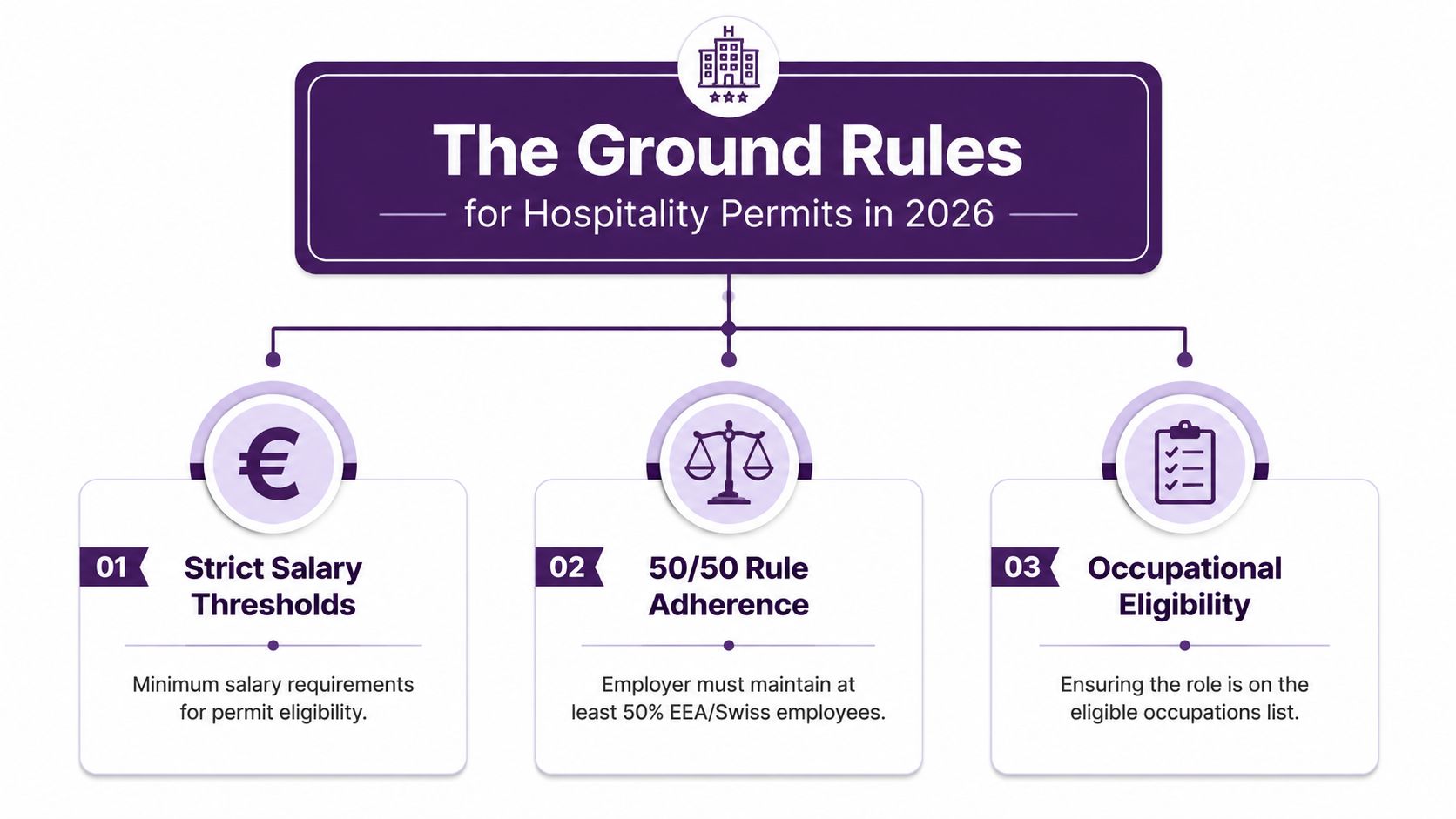
The Ground Rules for Hospitality Permits in 2026
Before you look at candidates, agencies or start dates, check whether the role is even workable under the current rules. Most failed permit plans don't collapse at submission. They were unworkable from day one.
The first screen is pay. As of 1 March 2026, the minimum salary for a General Employment Permit is €36,605, and the Labour Market Needs Test extends the realistic hiring timeline to 4 to 5 months for most non-EU recruits, as set out in this Ireland 2026 employer guide. If the role can't support that salary, stop there. Don't spend time sourcing candidates for a role that won't clear the threshold.
Salary comes first
Operators sometimes treat salary as a later negotiation point. That doesn't work here. The permit route starts with a compliant role design.
Ask three blunt questions:
- Can the business support the salary level: The permit threshold has to work in your budget before you advertise.
- Does the title match the pay and duties: Inflating a title to justify a package usually creates scrutiny instead of solving a problem.
- Will the contract still make sense operationally: A permit-compliant offer that distorts your whole pay structure can create internal issues fast.
If the economics only work when you assume overtime, tips or informal add-ons, it's the wrong starting point.
The 50 50 rule catches more employers than they expect
The second screen is workforce composition. Hospitality employers must satisfy the 50/50 rule, meaning more than half of the workforce must be EEA nationals at the time of application, unless a recognised exemption applies.
Smaller venues frequently encounter this difficulty. A business may be compliant today and non-compliant after one or two hires. That's why permit planning has to happen against the full workforce picture, not just a single vacancy.
Count your workforce before you choose your candidate. The stronger applicant is irrelevant if the ratio fails on submission day.
A practical self-audit helps:
- Check headcount live: Use current staff numbers, not last quarter's organisation chart.
- Review all sites properly: Group structures can confuse the actual employing entity.
- Test the next hire, not just this one: A permit approval today can affect what becomes possible next.
The Labour Market Needs Test is not a box-ticking exercise
The third screen is the Labour Market Needs Test. For hospitality roles, it remains mandatory. That means the role has to be advertised in Ireland for the required period before the permit application can go in.
Owners often underestimate what that does to timing. You're not choosing between “hire now” and “hire later”. You're choosing whether to begin a process that already has built-in delay. If you wait until the kitchen is unstable or a senior manager has already resigned, the permit route may still be correct, but you're already late.
The businesses that handle this well usually do four things:
- They start from workforce planning, not panic.
- They build the advertising stage into the timeline from the start.
- They prepare compliance documents before the role goes live.
- They avoid role designs that fail salary or eligibility checks.
That discipline saves more time than any clever workaround.
Navigating the General Employment Permit Process
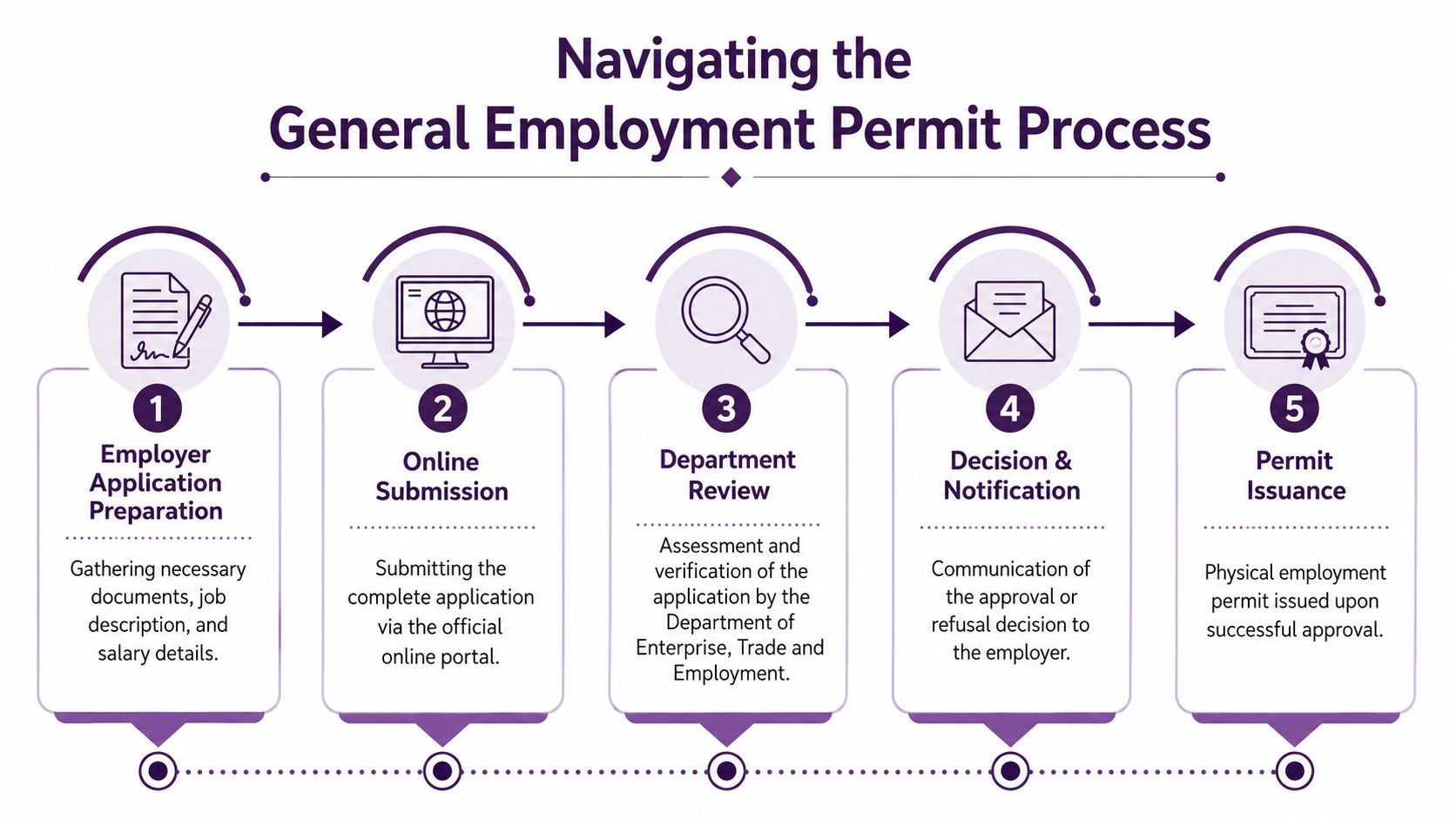
Most employers imagine the permit process begins when they submit the application. It doesn't. It starts when they define the vacancy. If the role description, salary, contract terms and ad copy aren't aligned, the rest of the file becomes harder than it needs to be.
A clean process is chronological. Miss a step early and the problem usually surfaces later, when the fix is slower and more expensive.
Start with a file that can survive scrutiny
Before any submission, build the employer side of the file properly. That includes the job description, contract terms, salary detail, company information and the evidence that supports the Labour Market Needs Test.
The easiest way to create delay is to treat these as admin tasks for later. They aren't. They are the application.
Common weak points include:
- Loose job descriptions: Duties are too vague or don't match the proposed role.
- Inconsistent pay detail: Salary figures differ across the contract, advert and form.
- Expired employee documents: The candidate side of the file isn't checked early enough.
- Entity confusion: The wrong employing company appears in part of the paperwork.
Good operators use checklists. Regulated hiring leaves very little room for memory-based administration. The same logic shows up in other compliance-heavy areas too. This piece on 2026 AI governance best practices is from a different field, but the principle carries over neatly: if you rely on ad hoc judgement instead of process control, avoidable errors stack up.
Run the process in the right order
Once the vacancy is defined, the sequence matters. A practical route usually looks like this:
- Confirm the role is viable
Check the salary, duties and eligibility before advertising. - Run the Labour Market Needs Test properly
Keep records organised from the start. Don't assume you can recreate evidence later. - Collect employer and employee documents early
Chasing missing documents after ad expiry slows everything down. - Submit through the official portal
The online stage should be the final assembly step, not the moment you realise half the file is incomplete. - Track status and respond quickly
Delays often get worse when employers don't monitor follow-up requests tightly.
For employers who want a role-specific reference point, this General Employment Permit knowledge base guide gives a useful operational overview of the route.
What tends to go wrong in practice
The permit process rarely fails because one issue is dramatic. It usually fails because several small issues sit in the file at once.
A permit application should read like one coherent story. The role, salary, contract, ad record and candidate documents should all support the same position.
That means no mixed dates, no title drift, no casual edits by three different people, and no waiting until the final week to gather core documents. In hospitality, where HR is often split between operations, finance and external support, ownership matters. One person should control the file. Everyone else can contribute, but one person has to guard consistency.
The New Manager Quotas A Strategic Minefield
Many general guides fall short by telling employers that hospitality manager roles have become eligible and leaving the impression that the route is open. That isn't the full picture.
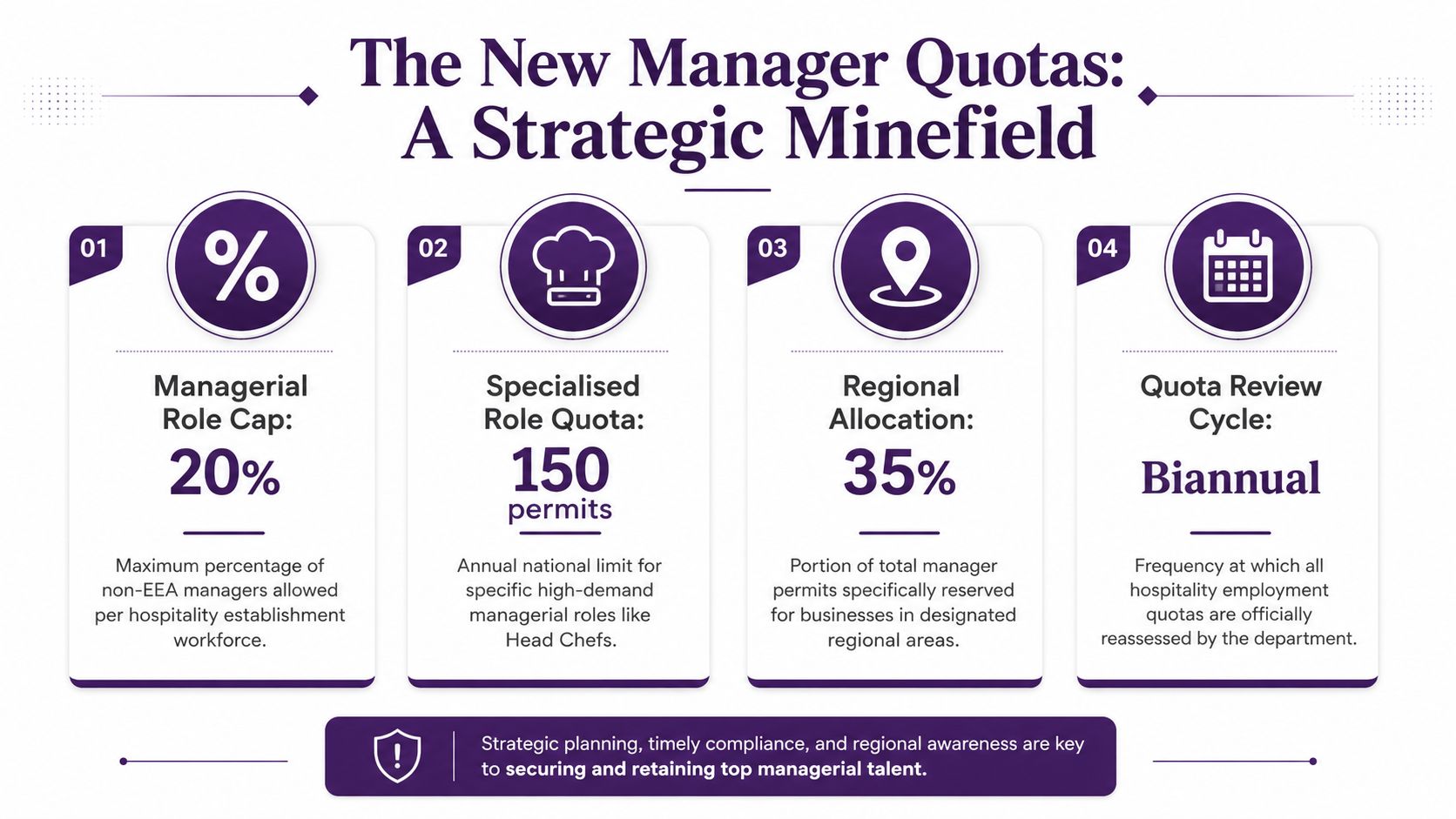
The critical distinction is between eligible and available within quota. A role can be legally eligible for a permit and still be restricted by a hard cap. If you miss that difference, you can build a recruitment plan around a role that cannot be secured when you need it.
Eligibility is not the same as access
As of 28 May 2026, hard quotas limit new non-EU hires to 100 Hotel/Accommodation Managers and 200 Restaurant/Catering Establishment Managers annually across all of Ireland, as outlined in this May 2026 occupations list update.
That changes the planning problem completely. If you run a hotel group and assume you can hire several non-EU managers over the course of the year, you may be planning against capacity that isn't there. If you operate a restaurant and wait until the resignation lands before acting, your timing is now part of the risk.
What this means for owners and GMs
The strategic error is overcommitting to manager recruitment without a quota plan.
A better approach is to ask:
- Is the manager role the first international hire you should prioritise: In some venues, a senior kitchen hire solves more operational pressure than a manager title.
- Do you need the title or the function: Sometimes the business needs leadership capacity, but the permit route may be more viable through a different structure.
- Can the business carry the delay if quota availability tightens: If not, your contingency plan should already be in place.
For restaurant operators exploring this route, a specialist service like restaurant manager recruitment in Ireland can help map the vacancy against real permit constraints rather than just candidate availability.
The biggest trap in hospitality employment permits Ireland 2026 is assuming a manager role is “open” because it's no longer ineligible. Quota-restricted roles require timing, prioritisation and backup options.
Competitive advantage comes from sequencing
More disciplined operators distinguish themselves. They don't just ask whether they can recruit internationally. They decide which role deserves quota exposure.
That might mean using the permit route first for a chef or another eligible operational role while handling management needs through domestic recruitment, internal progression or interim cover. It might mean bringing forward a manager decision because waiting introduces unnecessary quota risk.
The point isn't that manager hiring is impossible. The point is that it now needs strategy. The employers who treat it as simple eligibility are the ones most likely to waste time.
Beyond the Permit Employer Responsibilities and Onboarding
Permit approval feels like the finish line when you've been buried in advertising records, document checks and submission admin. It isn't. It's the handover point from recruitment into employment compliance.
That matters because the cost of a weak post-approval process is higher than most employers expect. If onboarding is chaotic, the employee starts under pressure. If records are poor, the employer carries compliance risk long after the permit has been granted.
Your responsibilities don't stop at approval
Once the worker is engaged, the employer has to maintain proper records, monitor changes, and keep employment terms aligned with what was approved. That includes keeping an eye on renewals and making sure any material changes are handled correctly rather than informally agreed in the background.
For hospitality businesses, right-to-work discipline and broader HR compliance require careful integration. A useful operational reference is this guide to right to work checks in Ireland for employers, especially for teams that have recruitment, payroll and site management split across different people.
The practical risk points are usually familiar:
- Contract drift: Duties or pay evolve informally after the employee starts.
- Renewal blindness: Expiry dates are known by HR but not tracked actively by operations.
- Poor document storage: Key records exist, but nobody can produce them quickly.
- Manager inconsistency: Site leaders make changes without understanding permit implications.
Good onboarding protects the hire you worked so hard to secure
International recruitment asks more of the employee than many employers realise. They're not just starting a job. They're entering a new country, a new workplace culture and often a new support system.
That's why structured onboarding isn't a soft HR extra. It's a retention tool and an operational safeguard.
A strong first phase usually includes:
- Arrival planning: Airport collection, clear contact details and a realistic first-week schedule.
- Accommodation support: Even temporary arrangements reduce early stress.
- Workplace orientation: Team introductions, kitchen or site systems, reporting lines and basic practical expectations.
- Cultural settling-in: Explain how the venue runs, not just what the handbook says.
Employers who onboard international hires properly usually reduce early confusion, avoid preventable friction, and get staff productive faster.
What works and what doesn't
What works is simple, organised and human. One named contact. Written instructions. A proper induction. Early check-ins with the employee and the line manager.
What doesn't work is assuming a permit-approved employee will “settle themselves” after arrival. In hospitality, where service pressure can swallow management attention, that assumption leads to avoidable turnover, performance issues and frustration on both sides.
This is one area where outside support can make sense. Some employers keep it internal. Others use an operational partner to manage the compliance side and the practical relocation steps. The right choice depends on internal capacity, not just budget.
Partnering for Success Your Next Steps
Hospitality owners don't struggle with permit hiring because they can't read the rules. They struggle because permit hiring sits on top of everything else they already have to run. Payroll, staffing gaps, food safety, customer standards, rotas, supplier problems and margin pressure are already there before the first permit document is opened.
That's why the 2026 system creates so much drag. You have salary thresholds to budget for, workforce ratio rules to monitor, a Labour Market Needs Test that lengthens hiring, and manager quotas that can derail a plan if you treat eligibility as access. None of that is impossible. It is time-consuming, detail-heavy and unforgiving of sloppy process.
Why operators hand this off
The primary value of external support isn't just paperwork help. It's reducing decision errors early.
A capable specialist can tell you whether the role is viable before you advertise, whether the manager route is worth pursuing, whether your workforce position supports the application, and whether your onboarding process is likely to protect the hire after arrival. That saves time, but primarily it saves wasted effort.
Some operators also use broader tools to tighten hiring operations internally. If you're reviewing your wider recruitment stack, this HR recruitment technology guide is a practical starting point for thinking about process support, visibility and coordination.
The sensible next move
If you're dealing with hospitality employment permits Ireland 2026, the sensible next step is to assess your vacancy list before you launch another hiring cycle. Separate the roles that are permit-viable from the ones that aren't. Then decide where international hiring gives the business the clearest operational relief.
That's where a service like Beacon Recruitment can be useful. It handles international recruitment, permit administration and onboarding support for hospitality employers, which is often most valuable when internal teams don't have the time or specialist oversight to run the process cleanly.
If you need help deciding whether a hospitality role is permit-viable, how the manager quotas affect your hiring plan, or how to structure a compliant international recruitment process, speak to Beacon Recruitment.
Need to Hire Skilled Chefs from Abroad?
Get expert, hands-on support to manage your chef permits, mandatory advertising, and international onboarding tailored for Irish hospitality.