July 16, 2026
Allergen Awareness Training: Irish Hospitality Guide 2026
Irish hospitality operators: master allergen awareness training, legal duties, staff roles, and EHO audit readiness with our practical guide.
Friday evening. The pass is full, the bar is three deep, and a server stops beside the till with the question every operator dreads.
A guest at table four says they have a severe allergy. They want to know whether the sauce contains mustard, whether the chips share oil with breaded products, whether the garnish came from a prep bench used for other dishes, and whether the answer is certain or just “probably fine”.
That moment decides whether your allergen controls are real or cosmetic. It doesn't matter that the kitchen completed a food safety course six months ago if the waiter guesses, the supervisor can't find the allergen sheet, and the chef has changed a supplier without updating the file. In Irish hospitality, allergen awareness training only works when it shows up under pressure, during live service, with a real guest waiting for a clear answer.
The Moment of Truth at Table Four
Most owners and general managers have seen some version of it. A capable server gets asked an allergen question mid-rush. They turn to a colleague. The colleague asks the kitchen. The kitchen says the dish “should be okay”. Nobody checks the recipe spec. Nobody checks the supplier label. Service slows, confidence drops, and the guest can see the uncertainty.
That's the problem with treating allergen awareness as a kitchen-only issue. The first point of risk is often front of house. The first answer usually comes from a waiter, host, bartender, or supervisor. If that person isn't trained to handle the question properly, the damage starts before a pan is lifted.
I've seen operators focus heavily on prep controls and still leave a dangerous gap at the table. They train chefs on cross-contamination, storage, and cleaning, then assume service staff will “pick it up”. They won't. Not reliably. And an EHO won't accept guesswork as a system.
What the pressure really looks like
The operational stress isn't abstract. It lands in a few very familiar ways:
- A guest asks a detailed question: The staff member needs to know whether to answer, where to verify, and when to escalate.
- A menu item changed yesterday: The printed allergen matrix is now out of date unless someone updated it.
- A supplier substituted an ingredient: A product that was safe last week may now contain a declared allergen.
- An inspector arrives unannounced: The business has to show not just paperwork, but a working system.
If you want a broader view of the compliance pressures that sit around allergen control, this restaurant compliance checklist for Ireland is worth reviewing alongside your own operating procedures.
Practical rule: If a front-of-house employee can't answer safely, they must know how to stop, verify, and return with a confirmed answer. Fast service matters. Accurate service matters more.
Why this matters beyond the kitchen
Operators usually worry first about the immediate safety risk, and rightly so. But there's a business risk sitting beside it. An allergen failure can trigger an EHO problem, a complaint trail, staff panic, and long-term reputational damage that no discount campaign will fix.
That's why allergen awareness training has to be built as an operating system. Not a certificate in a folder. Not a poster in the back corridor. Not a one-off induction talk no one remembers by the next bank holiday weekend.
The businesses that handle this well do something simple. They train the whole team for the exact moments that happen. Table questions. Verbal checks. recipe changes. Supplier substitutions. Service handoffs. Plate delivery. Record keeping.
That's where compliance becomes credible.
Understanding Your Legal Duties in Ireland
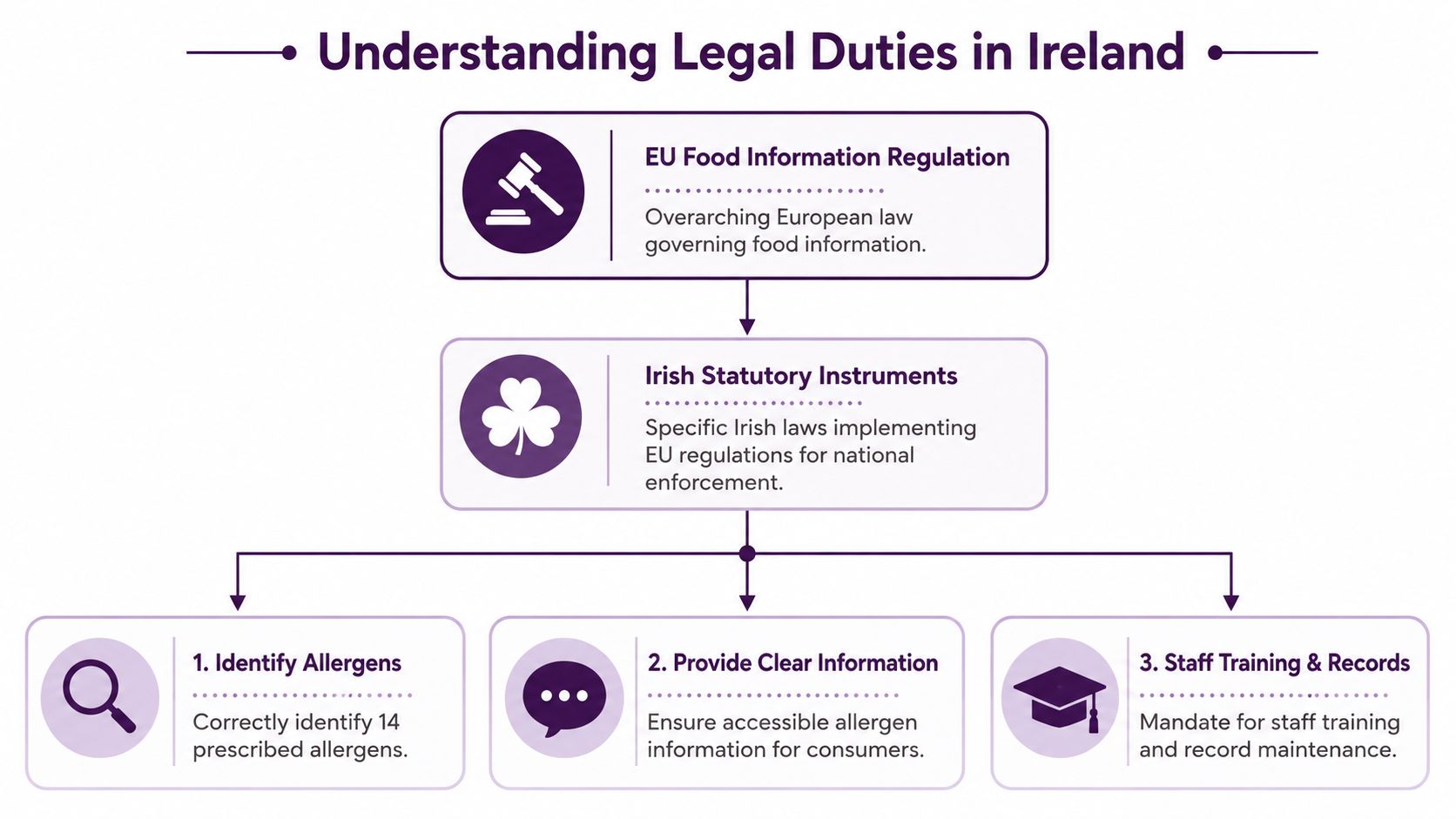
The legal baseline in Ireland is clear. The legal framework for allergen awareness training is anchored in EU Regulation 1169/2011, and Ireland enforces it through the FSAI's Be Food Allergen Aware guidance. Food businesses must declare the use of all 14 specified allergens in writing for non-prepacked food, and the information must be legible, clear, easily accessible, up to date, and verified against supplier data according to the FSAI's Be Food Allergen Aware guidance.
The 14 allergens you must control
Your team must be able to identify and communicate the legally recognised allergens in non-prepacked food:
- Cereals containing gluten
- Crustaceans
- Eggs
- Fish
- Peanuts
- Soybeans
- Milk
- Nuts
- Celery
- Mustard
- Sesame
- Sulphur dioxide
- Lupin
- Molluscs
This isn't just ingredient knowledge. Staff need to recognise where these allergens appear in recipes, sauces, marinades, garnishes, desserts, bought-in products, and substitutions.
What “in writing” means in practice
A lot of venues still get this wrong. They rely on verbal answers backed by nothing consistent. That leaves staff exposed and makes audits harder than they need to be.
A workable Irish compliance setup usually includes:
- A written allergen matrix linked to every menu item.
- Recipe sheets that match what the kitchen prepares.
- Supplier specifications for bought-in goods.
- A clear point of access so staff can find current allergen information quickly.
- A checking routine whenever recipes, menus, or suppliers change.
If your team needs a refresher on the wider food safety structure this sits within, 10Seat's guide to understanding HACCP for restaurants is a useful primer because allergen controls work best when they're tied into your broader hazard system rather than treated as a standalone task.
If the written record says one thing and the chef serves another, the written record won't save you.
The five-step compliance sequence EHOs look for
Irish operators should think in a sequence, not a slogan. The sequence is straightforward:
- Declare allergens in writing: Every non-prepacked offering needs written allergen information.
- Make it accessible: Customers and staff must be able to find it without friction.
- Keep it readable: Tiny print, vague notes, and half-complete folders don't meet the standard.
- Keep it current: A correct file from last season is now a wrong file.
- Verify supplier information: You have to check what your suppliers tell you and update your records accordingly.
For practical templates and documentation support, the FSAI Safe Catering Pack knowledge base is a useful operational reference point.
The trade-off here is simple. The more informal your system is, the faster it feels in the short term. It also breaks faster. Businesses that pass audits cleanly usually accept a little more discipline up front so staff don't have to improvise later.
Designing a Whole-Team Training Curriculum
Most Irish allergen awareness training content is built around kitchen work. That's useful, but incomplete. Existing Irish content overwhelmingly targets kitchen staff, leaving a critical compliance gap for front-of-house teams, and EHOs during audits frequently cite “inadequate FOH knowledge” as a primary failure point according to AcornStar's discussion of allergen awareness training in Ireland.
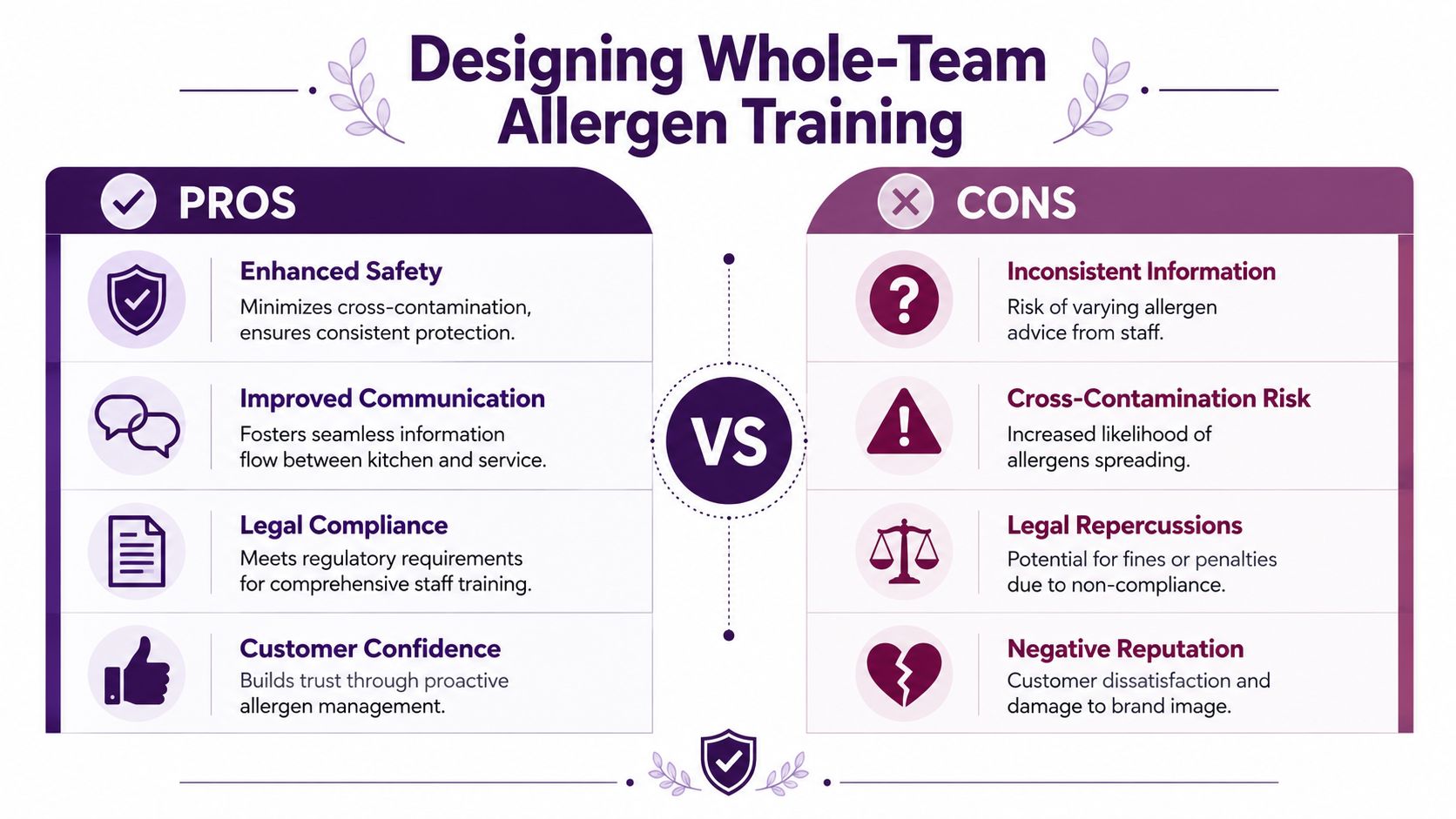
That finding matches what operators experience on the floor. The kitchen may understand separation and cleaning. The service team may still answer allergen questions casually, misuse the till flags, or fail to escalate uncertainty.
Back of house needs a control curriculum
Kitchen training should be practical and specific to the menu, not generic slideshow material. The basics matter, but so do the details that tend to cause failures during service.
A useful BOH curriculum should cover:
- Ingredient identification: Staff must know where the 14 allergens appear, including in sauces, stocks, dressings, desserts, and bought-in components.
- Cross-contamination control: Separate utensils, clean surfaces, storage discipline, and clear workflow rules matter more than broad warnings.
- Recipe integrity: Chefs can't make casual substitutions without checking allergen impact.
- Supplier change handling: If procurement changes a product, the kitchen file has to change too.
- Final dish verification: The plate that leaves the pass has to match the allergen promise made to the guest.
One of the easiest ways to sharpen this training is to work from actual menu items, not abstract examples. If your team also caters for broader dietary needs, these tips for special diet meal planning are useful because they show how quickly menu complexity grows when restrictions aren't mapped properly from the start.
Front of house needs a communication curriculum
This is the blind spot. Front-of-house staff don't need a chef's technical depth, but they do need disciplined communication habits. A weak answer from FOH can create a safety issue even when the kitchen would have handled the dish correctly.
Train FOH on these situations:
- Receiving the enquiry: Staff should acknowledge the allergy clearly and never dismiss it as a preference.
- Using approved information only: They should check the allergen matrix, recipe file, or designated system. Not memory.
- Escalation rules: If anything is unclear, they stop and confirm with the trained decision-maker.
- Order marking: POS allergen flags need to be consistent and visible.
- Safe delivery: The runner or server must know which plate is the allergen-managed dish and avoid mix-ups at the table.
Service standard: “I'm going to verify that with the kitchen and our allergen information, then I'll come straight back to you.” That sentence is safer than any guess.
Build one curriculum, not two silos
The strongest setup is a joined-up curriculum with role-specific emphasis. Kitchen and service staff should train separately on their highest-risk tasks, then together on handover points.
That joint session should cover:
- How an allergy enquiry moves through the business
- Who has authority to confirm an answer
- Where allergen information is stored
- How dish changes are communicated
- What happens when the answer is no
For operators who want a simple reference tool for staff, this guide to the 14 major allergens is useful as a baseline, but it should sit beside your own menu-specific documentation, not replace it.
What doesn't work is sending everyone on the same generic module and assuming competence transfers across roles. It doesn't. Chefs need control habits. Servers need language, escalation, and verification habits. Managers need oversight habits. Treat those as different training jobs.
Implementing Training Sessions That Stick
A training plan fails when staff can pass a quiz but freeze during service. The point of allergen awareness training isn't exposure to content. It's confident action under pressure.
In Ireland, 63% of food handlers have received formal training in allergen management, and that figure is higher than the 37% recorded outside Ireland in the same academic investigation. The same source states that the FSAI requires staff in businesses with significant allergen risk to complete an additional Allergen Awareness certificate alongside standard HACCP Level 2, and that training should come from accredited providers recognised by EHOs, as outlined in the Clare Fagan investigation on allergen management practices.
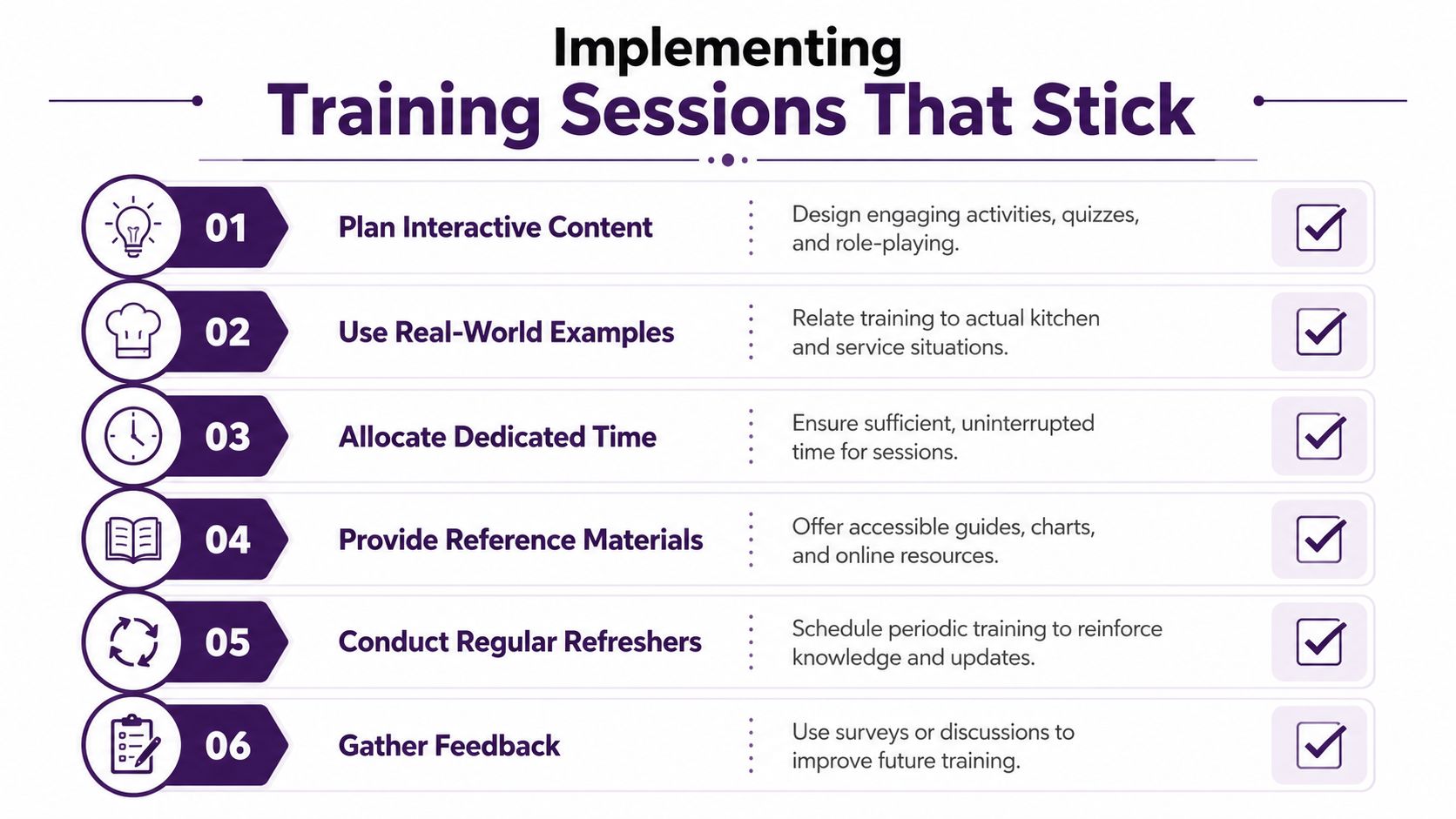
In-person workshops for real operational behaviour
Face-to-face training works best when a venue needs to reset habits, fix weak communication, or launch a new system. It lets managers see where people hesitate.
A strong in-person session might look like this:
- Opening scenario: Start with a live service example. A guest asks whether a dish is safe. Ask FOH what they would say first.
- Menu walk-through: Review actual dishes, recipes, sauces, garnishes, and supplier-dependent items.
- Kitchen hazard spotting: Show prep photos or use the kitchen. Ask BOH to identify cross-contamination risks.
- Role-play handovers: Run the chain from guest question to order marking to kitchen confirmation to plate delivery.
- Debrief: Correct weak phrasing, vague assumptions, and broken steps.
This method works because people remember mistakes they almost made. They rarely remember a policy paragraph read off a screen.
E-learning for consistency and scale
Online training is useful for induction, multi-site consistency, and documenting baseline knowledge. It also helps with seasonal staff and shift patterns that make classroom delivery awkward.
But online-only training has a weakness. It can create false confidence if it isn't followed by site-specific instruction. Staff may know the rule and still not know where your allergen file is kept, how your POS flags work, or who signs off uncertain answers.
A practical e-learning structure includes:
- Short modules: Keep each topic narrow. Allergens, cross-contamination, communication, escalation.
- Micro-quizzes: Test recognition immediately after each module.
- Downloadable job aids: One-page allergen checks, FOH scripts, kitchen verification prompts.
- Manager sign-off: Someone on site confirms the employee can apply the training in your operation.
Online modules teach the principle. The site briefing teaches the behaviour.
Blended training usually works best
For most Irish hospitality businesses, blended delivery is the sweet spot. Use accredited online or classroom certification to meet the formal requirement. Then run venue-specific training on your menu, layout, team roles, and service standards.
Operators often overcomplicate the process. You don't need a glossy academy. You need a repeatable training rhythm:
- At induction: Every new starter learns the allergen process before independent service.
- Before menu changes: Update everyone on recipe amendments and substitutions.
- After supplier changes: Review labels, specs, and affected dishes.
- After near misses: Retrain the exact broken step, not the whole policy binder.
What makes training memorable
Staff retain what they can use the same day. Build sessions around friction points they recognise:
- A vague booking note that says “allergy” with no detail
- A changed dessert garnish nobody updated
- A bar order where the bartender is asked about nut ingredients
- A breakfast buffet with shared utensils
- A late substitute chef who doesn't know the house matrix
The businesses that get this right don't chase perfect theory. They rehearse the awkward moments. That's what sticks.
Assessment Records and Continuous Improvement
Training without records is a weak investment. You may have spent time and money getting staff certified, but if you can't show who was trained, when they were trained, what they were assessed on, and when they were refreshed, you're relying on memory at the worst possible time.
Technical guidance for effective allergen training in Ireland states that all staff should receive training on induction, with regular refresher sessions whenever menu recipes or suppliers change, and warns that the absence of training records severely compromises defence in litigation related to food safety incidents according to this Irish allergen training guidance video reference.

What an EHO expects to see
An inspector isn't looking for decorative paperwork. They want evidence that training is current, role-relevant, and tied to real controls.
Your records should show, at minimum:
- Staff name and role
- Training type completed
- Date completed
- Trainer or provider
- Assessment result or competency sign-off
- Next refresher due
- Any remedial follow-up
That can live in a spreadsheet, HR system, training platform, or compliance folder. The format matters less than the discipline. If the records are fragmented across emails, WhatsApp messages, and signed sheets in a drawer, retrieval will fail when you need it.
A simple training matrix beats a complicated system
Many operators think they need specialist software. Usually they don't. A clean matrix works if somebody owns it.
A practical matrix includes separate lines for:
- HACCP Level 2 status
- Dedicated allergen awareness certificate
- Venue-specific induction
- Refresher training after menu changes
- Corrective retraining after an error or near miss
Keep a linked folder behind it with certificates, sign-in sheets, short test results, and manager verification notes.
Audit mindset: If you had to prove staff competence in five minutes, could you put the records on the table in order?
Assess the role, not just the rule
The assessment should match the job. FOH and BOH shouldn't sit the same practical check.
Examples for FOH:
- A guest says they have a sesame allergy. What is your first response?
- Where do you verify allergen information for a daily special?
- What do you do if the chef says “I think it's safe”?
Examples for BOH:
- Which documents must you check after a supplier substitution?
- What controls prevent cross-contamination during prep?
- What happens if a garnish is changed during service?
Managers should also be assessed on oversight:
- Who updates allergen records after a menu change?
- Where are current supplier specs stored?
- How do you verify agency or temporary staff have been inducted?
Continuous improvement is operational, not theoretical
A near miss should trigger action. So should a customer complaint, an unclear answer at pre-shift briefing, or a change in supplier specification. Good operators don't wait for an inspection to discover that a process has drifted.
Review allergen performance during routine management checks. Sample a few dishes. Ask a server how they'd handle an allergen enquiry. Ask a chef to show the source record for a bought-in sauce. Those small checks tell you more than a framed certificate on the wall.
Embedding Allergen Safety into Your Culture
The best hospitality businesses don't treat allergen awareness training as a side programme run by one careful manager. They treat it as part of how the venue works. The booking team logs the information properly. Front of house handles questions without guessing. The kitchen follows the agreed controls. Management keeps the records current. Everyone understands that the answer to an uncertain allergen question is verification, not reassurance.
That cultural standard matters because Irish compliance isn't satisfied by good intentions. In Ireland, allergen awareness training must be delivered as a dedicated certificate in addition to mandatory HACCP Level 2, and the compliance method requires businesses to declare the 14 allergens in writing, ensure the information is accessible, keep it updated, and monitor suppliers, with failures subject to enforcement, as outlined in AcornStar's Irish allergen training overview.
What culture looks like in practice
You can recognise a strong allergen culture quickly. It shows up in routine behaviour:
- Pre-shift discipline: Managers flag menu changes, shortages, and special requests before service starts.
- Clear ownership: Someone is accountable for updating allergen records after recipe or supplier changes.
- Consistent language: Staff use approved phrases instead of improvising.
- Operational honesty: If a dish can't be served safely, the team says so clearly and respectfully.
Weak culture looks different. Information lives in one person's head. New staff copy old habits. Service staff ask rushed questions at the pass. Temporary fixes become permanent. That's how risk gets normalised.
Compliance is only the floor
Good allergen control does more than keep you on the right side of an inspection. It builds trust. Guests remember when a team handles their allergy calmly, clearly, and without drama. They also remember hesitation, contradiction, and vague answers.
Operators who want to strengthen the people side of that consistency can learn from broader hospitality culture tools such as MyCulture.ai for retail hospitality, because the same principle applies here. Standards hold when teams understand the behaviour expected of them and managers reinforce it daily.
A safe allergen answer is never ad-libbed. It comes from a system people follow even when service is busy.
Allergen awareness training works when it stops being a separate compliance topic and becomes part of the venue's identity. That's when audits are easier, guests feel safer, and managers spend less time firefighting preventable mistakes.
If you want help turning allergen awareness training into a working system, Beacon Recruitment supports Irish hospitality businesses with practical food safety consulting, mock audit preparation, staff training, and operational compliance support that fits real service conditions.
Is Your Allergen Training EHO-Ready?
Don’t let front-of-house guesswork and outdated matrix files leave your venue exposed to EHO failures and reputational damage. Book a Free Consultation with Beacon today to build an audit-proof allergen control system.