July 16, 2026
Right to Work Checks Ireland Employers: Your 2026 Guide
Master Right to Work Checks Ireland Employers with our 2026 guide. Learn permit types, processes, and avoid costly WRC penalties for hospitality.

You've likely had this happen already. A strong candidate walks in, interviews well, can start fast, and fills a real gap on the rota. Then someone asks the awkward question: “What's their permission to work?”
That's where too many hospitality employers in Ireland get sloppy. They treat right to work checks like a document grab on day one, file a passport copy somewhere, and move on. That approach is lazy, risky, and far more expensive than doing it properly.
Hotels, restaurants, bars, and contract catering businesses hire at speed. They also deal with shift work, seasonal pressure, student staff, and international applicants. That mix creates real exposure. If your process is weak, you won't spot the worker whose permission is limited, expired, or never covered the role in the first place.
If you're searching for practical guidance on right to work checks for Ireland employers, start with one rule: this is an operational control, not an admin exercise. Run it with the same discipline you'd apply to payroll, food safety, or licensing.
Why Right to Work Checks Are Non-Negotiable
Saturday night. The kitchen is short, covers are stacking up, and your head chef wants a new hire on the line by tomorrow. The candidate looks right, sounds experienced, and says they can start immediately. If you hire first and check later, you are gambling with your business.

In Ireland, an employer must confirm that each worker has permission to do the job offered. Get that wrong and the risk is not abstract. It can mean illegal employment, failed inspections, payroll problems, rota disruption, and a scramble to replace someone you should never have put on shift in the first place.
Hospitality gets caught more often because the pressure points are obvious. Fast hiring. High turnover. Student staff. International applicants. Managers covering service gaps and pushing people through before anyone checks the permission properly.
The expensive mistake is treating this as a day-one file check. It is an ongoing compliance duty. If a worker's immigration permission or permit expires, your responsibility does not expire with it. You need a system to re-check, record new documents, and stop managers rostering people on expired status. That is where many hotels, restaurants, bars, and catering operators get exposed.
Watch the high-risk groups closely:
- Workers on time-limited permissions who need follow-up checks before expiry
- Students whose hours may be restricted depending on their permission
- Spouses or dependants whose work rights depend on the specific stamp they hold
- Short-notice hires pushed through by operational managers under staffing pressure
A copy of a passport is not enough. You need the right document, the right permission, the right role match, and a diary system for repeat checks.
Practical rule: If permission expires, your check expires with it. Re-checking staff is part of compliance, not an optional admin tidy-up.
For a solid baseline, Beacon's right to work guidance for Irish employers sets out the checks and records employers should have before work starts. For broader context on permit routes, see DynamicsHub on Ireland work permits.
The operators who avoid trouble do not rely on memory or good intentions. They use a repeatable process, train managers to respect it, and re-check permissions before they lapse. That is how you protect service, payroll, and the business itself.
Navigating Irish Work Permit Types for Hospitality
Most employers overcomplicate this part or guess. Both are bad ideas. You don't need to memorise every immigration route. You need to know which permission fits the role you're hiring for, and which people don't need a permit at all.

Start with the people who usually don't need a permit
A lot of wasted time comes from employers trying to process permits for people who already have permission to work.
You generally start in the “no permit required” lane for people such as:
- Irish citizens
- EEA and Swiss citizens
- UK citizens
- Certain people with Stamp 4 permission
That last group matters in hospitality. Employers often panic when they see a non-EEA passport and assume a permit application is needed. Sometimes it is. Sometimes the person already has an immigration permission that allows them to work.
The point is simple. Don't react to nationality alone. Check the actual permission.
Match the permit to the job, not the job title you wish it had
Hospitality employers often describe roles loosely. Immigration systems don't. The role, duties, pay, and eligibility all need to line up.
Here's the practical view.
Critical Skills Employment Permit
This permit is usually associated with in-demand, highly skilled occupations. In day-to-day hospitality recruitment, it's not the common route for most venue-level roles.
If you're hiring a specialist senior position and think it may qualify, don't assume. Check the occupation, the duties, and the salary criteria carefully against the current rules. If you want a detailed overview of how this route works, Beacon's Critical Skills Employment Permit guide gives the basic framework.
For most restaurants, pubs, and hotels, this is not the permit they'll use most often.
General Employment Permit
This is the permit many hospitality employers end up dealing with. It's commonly the relevant route for eligible roles in the sector, but only where the occupation qualifies and the application meets the required conditions.
Employers frequently misunderstand this point. They assume a staffing shortage automatically means the permit will be granted. It doesn't work that way. The role has to be eligible, the pay has to meet the relevant threshold, and the supporting evidence has to be consistent.
Other routes that matter occasionally
Some businesses ignore the less common categories until a specific case lands on their desk. That's fine, as long as you recognise them when they do appear.
- Atypical Working Scheme: More relevant to short-term or unusual arrangements than standard long-term hiring.
- Intra-Company Transfer Permit: Relevant if a multinational hospitality group is moving an existing employee into Ireland.
- Stamp 4 Permission: Not a permit, but often a valid right to work route for certain family members or other eligible individuals.
If the person says, “I've worked in Ireland before,” that tells you nothing useful on its own. Check what permission they hold now and whether it covers this job now.
A practical hiring filter for managers
Before anyone promises a start date, ask four things:
- Who is the candidate? Irish, EEA, UK, or non-EEA
- What permission do they currently hold? Passport alone rarely answers enough
- Does that permission cover this role? Not every right to remain is a right to work freely
- If a permit is needed, which route fits? Don't guess and submit
To gain a broad orientation, DynamicsHub on Ireland work permits is a helpful background read, especially for employers trying to understand the difference between permit categories before they start the formal process.
Clarity at this stage saves weeks of confusion later.
The Work Permit Application Process Deconstructed
The permit process goes wrong long before the online form. Most refusals and delays start with poor preparation, mismatched paperwork, or a role that was never suitable for the route chosen.
Treat the application like a mini audit. If your documents, advertising trail, and job details don't line up, the system won't rescue you.

Pre-application discipline matters most
Before anyone logs into EPOS or starts uploading files, the employer should have already answered the basic questions.
Is the role eligible? Does the candidate fit the route? Is the proposed pay consistent with the permit category? Are the duties described clearly enough to support the application?
If those answers are vague, stop there. Hospitality businesses get into trouble because they rush from staffing pain straight into form-filling. That's backwards.
The Labour Market Needs Test is where many applications wobble
For roles that require it, the Labour Market Needs Test must be handled properly. Employers often treat advertising as a box-ticking exercise, then wonder why the application is challenged.
You need to be able to show that the vacancy was properly tested in the market and that the ad trail is complete, consistent, and retained. The role title, duties, location, and pay should match what appears elsewhere in the application. If your adverts say one thing and your permit form says another, you've created your own problem.
A sound internal file usually includes:
- Copies of all adverts placed for the role
- Dates and publication evidence showing the ads ran as required
- A role description that matches the permit application
- A recruitment record showing how the process was handled
Employers don't usually get refused because one form field was awkward. They get refused because the evidence tells an inconsistent story.
Document gathering is where speed is won or lost
Hospitality operators often underestimate how many supporting documents need to be assembled from both sides.
From the employer side, you'll typically need evidence of trading status, registration details, and documents that support the legitimacy of the role and business. From the candidate side, you'll need identity and immigration documentation that is current, legible, and consistent with the application.
Before you submit anything, make sure you have scanned copies organised in one secure folder. Name them clearly. Keep versions final. Don't leave a manager searching WhatsApp for a passport image while the portal times out.
A simple working file should cover:
- Employer documents proving the business is operating and the role is genuine
- Candidate identity documents that are clear and current
- Job offer details aligned with the permit route
- Supporting recruitment evidence where required
The online submission is the easy part, if the groundwork is clean
EPOS isn't the hardest part. Bad preparation is.
Once the role, candidate, and paperwork are aligned, the online application becomes a data-entry exercise with document uploads. That's why strong operators do the essential work before they go near the system.
Keep one person accountable for the submission. Not three people half-owning it. Split ownership leads to mismatched drafts, missing attachments, and confusion over who confirmed what.
What to check before hitting submit
- Role description matches every document
- Candidate name and passport details are identical across records
- Salary and hours are stated consistently
- Supporting files are readable and final
- Internal approval is done before submission
Approval isn't the end of the journey
Once approved, the permit is only one part of the worker's legal path into employment. Depending on the person's circumstances, they may still need to complete immigration-related steps before they are fully in place and ready to work lawfully.
For employers, the bigger issue is planning. Don't build your rota around assumptions. Build it around confirmed status, realistic lead times, and documented onboarding controls.
If you run international hiring regularly, this process should sit in a standard operating procedure, not in one HR manager's memory.
Common Pitfalls and Why Applications Get Refused
Friday evening. Service is full. A long-standing team member says their permission is being renewed and asks if they can stay on the rota for “another week or two.” If nobody in management can pull up a current right to work record on the spot, you already have a compliance problem.
Refusals usually start long before the decision email arrives. They start with sloppy checks, weak records, and employers treating permission to work as a hiring-stage task instead of an active control that needs attention throughout employment.
The assumptions that cause expensive mistakes
As summarised in IFAC's review of employers' legal duty to confirm right to work in Ireland, employers are expected to stay aware of a worker's immigration status for the full period of employment. A PPS number does not prove permission to work. Employing someone without the required permission can expose the business to criminal liability under the Employment Permits Acts.
Three bad habits show up repeatedly in hospitality:
- Treating a PPS number as proof of work rights
- Assuming an onboarding check covers the whole employment relationship
- Relying on what a previous employer may or may not have checked
None of those protects you. Your business carries the risk, and your records need to prove that your checks were done properly and repeated when required.
A file can look clean on day one and still become non-compliant later if expiry dates are ignored.
Where otherwise workable applications break down
Some refusals are caused by eligibility issues. Many are caused by employers undermining their own case with preventable errors.
The usual failure points are clear:
- Wrong role classification. The duties described do not fit the permit route being used.
- Weak Labour Market Needs Test evidence. Ads are inconsistent, incomplete, or missing from the file.
- Salary inconsistencies. The figures in the contract, application, and supporting records do not match.
- Poor employer evidence. The file does not clearly show the vacancy, business need, or supporting documents expected.
- Outdated templates. Old forms and inherited checklists are reused after the law or guidance has changed.
That last mistake causes more trouble than employers expect. Old onboarding packs create false confidence. A manager thinks the process exists, so the process must be compliant. It often is not. If your business has not reviewed its checking process recently, get a WRC compliance HR audit for hospitality employers and fix the gaps before they become a refusal or an enforcement issue.
The bigger risk is what happens after the worker starts
Generic guides focus on getting the first approval. That is too narrow, especially in hospitality.
The point many articles miss is simple. The more common failure is not always the initial application. It is the worker who had valid permission when hired, then hits an expiry date, changes status, or drifts outside the approved terms while nobody in the business notices.
High turnover makes this worse. So do rotating managers, seasonal demand, casual scheduling changes, and poor file ownership. If permission expiry dates live in an inbox, a notebook, or one supervisor's memory, your system is already too weak.
Smart employers track time-limited permissions actively, re-check before expiry, and keep evidence in one controlled file. That is how you avoid refusals, protect the business, and stop a routine staffing issue turning into a legal one.
Beyond the Permit Post-Approval and Ongoing Compliance
A permit approval feels like the finish line. It isn't. It's the point where proper employer control should tighten up.
Once the worker is cleared to move into employment, your business still has to translate that approval into compliant day-to-day practice. That means contract terms, payroll setup, record retention, line manager awareness, and ongoing status monitoring all need to be aligned.
What needs to happen immediately after approval
Start with the basics. The employment contract should reflect the actual terms connected to the hire. Payroll details need to be accurate. The person's file should contain the verified documents you relied on, not half-complete screenshots and email fragments.
Managers also need instruction. If your floor manager thinks they can swap duties, increase hours freely, or move someone into a different role because “they're already on the books,” you've got a governance problem.
A clean post-approval process usually includes:
- A compliant contract matching the agreed role and terms
- Payroll setup that reflects the worker's lawful employment position
- Secure document retention with clear file ownership
- Manager briefing so operational decisions don't drift away from what was approved
Ongoing right to work checks are where strong employers separate themselves
This is the part many businesses neglect. They hire correctly, then stop checking.
That's reckless in hospitality. Permissions can expire. Student conditions can be breached through rosters. Immigration status can change during employment. If nobody is tracking dates and re-checking documents, the initial good work becomes irrelevant.
Your system should be boring, repeatable, and impossible to forget.
- Diarise expiry dates early: Put reminders in a shared compliance calendar, not a personal inbox.
- Assign ownership: One named person should own follow-up, escalation, and file completion.
- Schedule re-checks: Don't wait for an expiry date to arrive before asking for updated evidence.
- Audit the file: Check that the current role, hours, and retained documents still match the person's permission.
The safest process is the one that still works when your HR manager is on leave and the General Manager is covering two sites.
Keep your records ready for inspection
A WRC inspection is not the time to discover missing files, blurry scans, or undocumented decisions. If your records are patchy, your defence is patchy.
Good records are simple. Clear copies of relevant documents. Notes of what was checked and when. A live list of expiry dates. Evidence that follow-up happened. That's what inspectors, auditors, and sensible operators want to see.
If your current setup is inconsistent across sites, a structured WRC compliance and HR audit review can help standardise document control, manager responsibilities, and re-check routines before an issue escalates.
A permit gets someone in the door. Compliance keeps your business protected after they arrive.
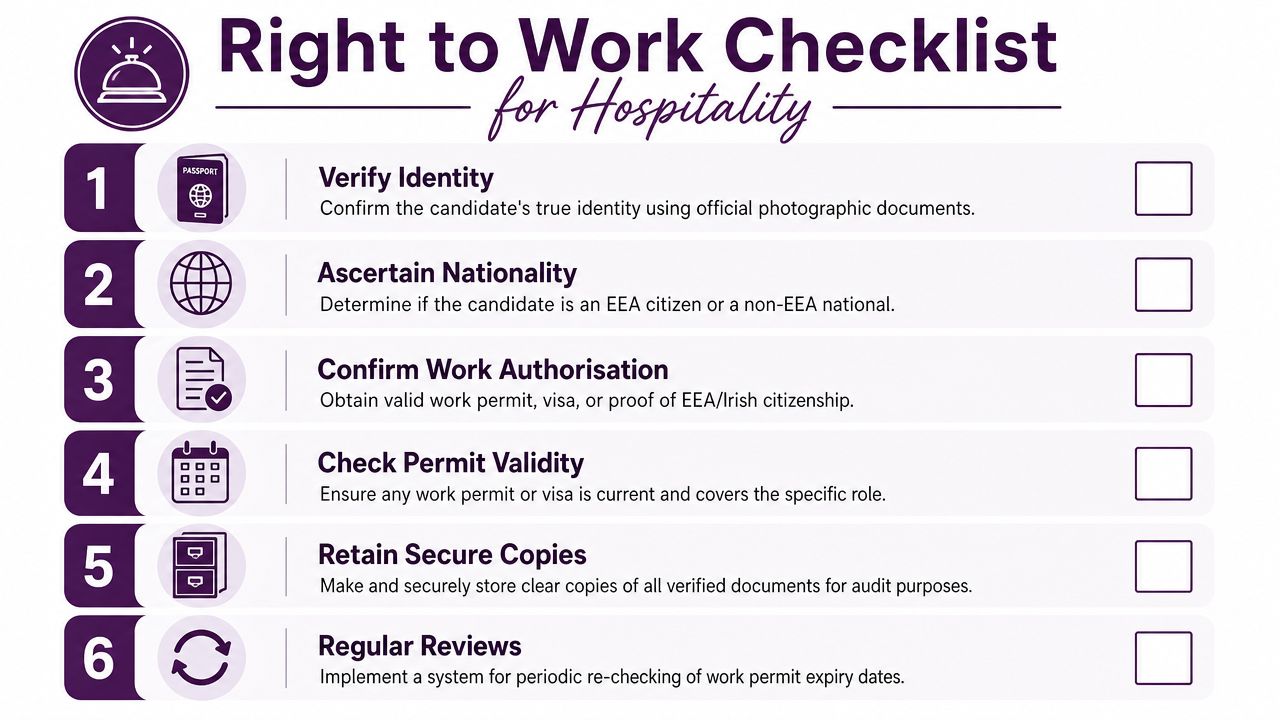
The Ultimate Hospitality Right to Work Checklist
Most right to work failures don't come from one dramatic mistake. They come from small missed actions repeated across busy sites. The fix is a checklist that managers actively use.
Pre-application due diligence
- Verify identity: Check the original photographic document and make sure the person presenting it matches it.
- Confirm nationality and status: Establish whether the candidate is Irish, EEA, UK, or non-EEA, then verify the actual permission held.
- Match permission to role: Confirm that the person can do this specific job, at this site, under these conditions.
- Review restrictions: Flag any limits that affect rostering, duties, or timing.
Application submission control
- Check role eligibility: Make sure the route you're using fits the actual vacancy.
- Build a complete evidence file: Keep adverts, role details, employer documents, and candidate documents together and consistent.
- Use one accountable owner: One person should control the submission and final review.
- Store final copies securely: Don't rely on email chains as your filing system.
Post-approval and live compliance
- Issue the right contract: The terms given to the employee should align with the lawful basis on which they're hired.
- Add expiry tracking immediately: Put review dates into a shared compliance calendar before the employee's first week disappears into operations.
- Re-check during employment: Treat permission review as a live duty, not a joining form.
- Keep audit-ready records: If you can't retrieve the file quickly, the system isn't working.
If your internal filing is spread across inboxes, shared drives, and paper folders, it's worth looking at ways to solve HR manual record-keeping chaos so document retrieval, reminders, and retention don't depend on memory.
A right to work checklist only works if it lives inside your hiring and onboarding process. Print it. Build it into your manager pack. Review it site by site. Then your compliance starts to become routine instead of reactive.
If your business hires international staff, manages student workers, or wants a tighter process around right to work checks in Ireland, Beacon Recruitment can support the operational side of it. That includes practical hiring controls, compliant onboarding documentation, and hospitality-focused HR systems that help you keep checks current long after the start date.
Are Your Right to Work Checks Legally Compliant?
Don’t let expired permissions, missing files, and chaotic onboarding leave your business exposed to WRC penalties. Book a Free Consultation with Beacon today to audit your HR records and build a compliant checking process.