July 16, 2026
A Guide on How to Hire Chefs from Abroad Ireland
Learn how to hire chefs from abroad Ireland with our 2026 guide. Navigate work permits, the Labour Market Test, and avoid common pitfalls.

A chef gives notice just before a busy stretch, the rota is already thin, and the people left in the kitchen are covering doubles to keep service moving. That's usually the moment owners start searching how to hire chefs from abroad in Ireland. It can work very well, but only if you treat it as an operational project, not a rescue move.
The legal route is clearer than it used to be. The practical route still catches people out. Most failed chef hires don't collapse because the candidate was weak. They collapse because the role title was wrong, the salary was structured badly, the Labour Market Needs Test was sloppy, or the business didn't see the knock-on effects early enough.
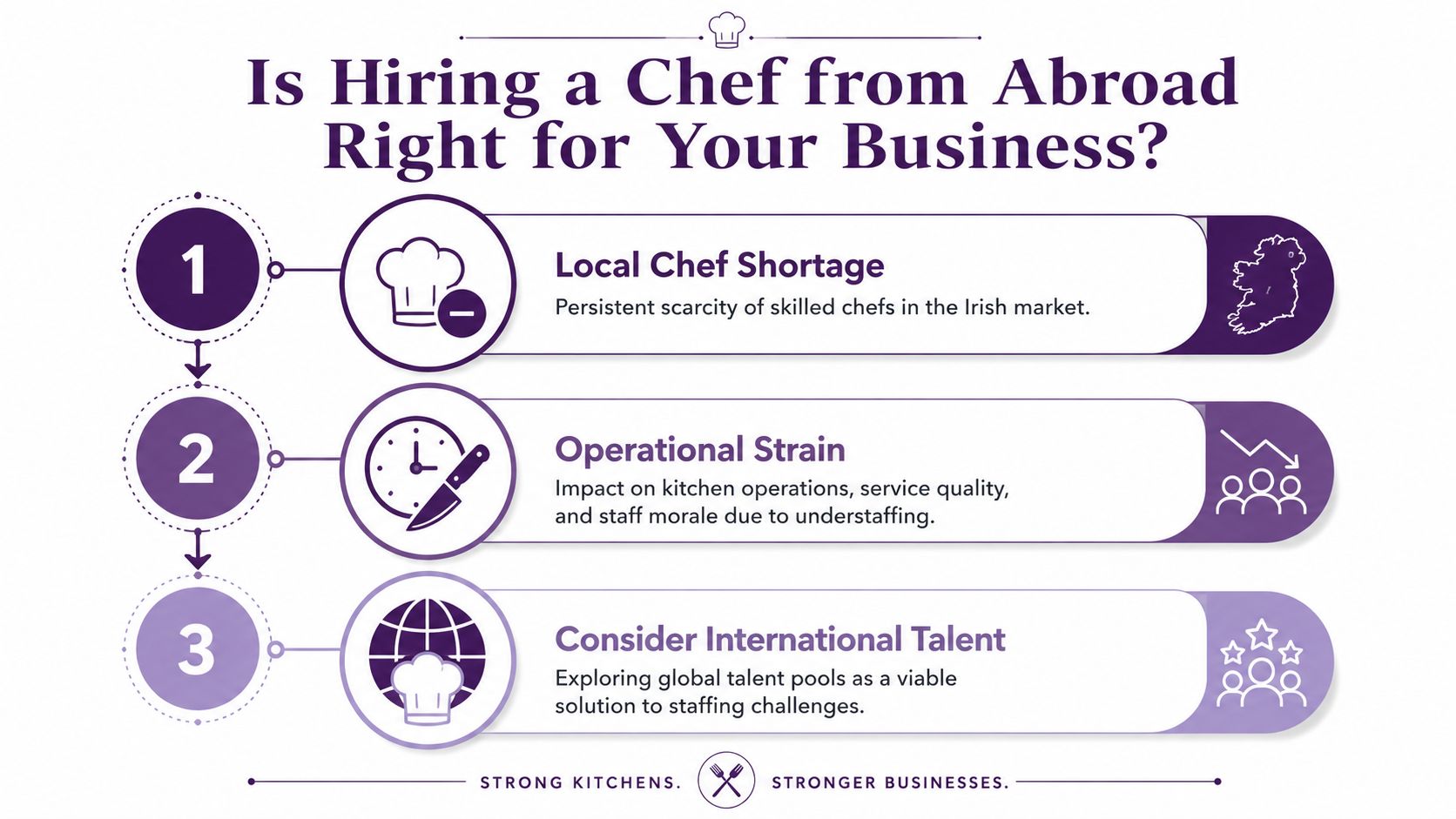
Is Hiring a Chef from Abroad Right for Your Business
If your venue needs one strong kitchen leader to stabilise standards, protect margins and stop service from slipping, hiring internationally can make sense. If you're hoping to plug a gap next week, it won't. International hiring solves the right problem when the role is hard to fill locally and important enough to justify the admin, compliance and onboarding work.
That distinction matters. A head chef replacement, a specialist cuisine role, or a sous chef who can take pressure off an overstretched senior team can justify the process. A loosely defined kitchen role usually can't.
Which roles are actually viable
The biggest misunderstanding is assuming any kitchen role can go through the permit system. It can't. The role has to fit an eligible chef category in both title and substance.
According to the official chef checklist from the Department, Executive Chefs, Head Chefs and Sous Chefs qualify and require a minimum of 5 years of experience, while Chef de Partie and Commis Chef roles require a minimum of 2 years of experience. That sounds straightforward until someone labels a role “chef” on paper while the actual duties look more like an ineligible kitchen post.
International chef hiring works best when the role is already well defined in your kitchen. It goes badly when the title is being used to solve a staffing panic.
There has been one important shift. As of 2026, all chef grades in Ireland are now fully eligible for employment permits and the occupation has been removed from the quota system, which removed the old numerical cap problem that delayed chef hiring for many employers, as outlined in this update on Ireland's permit changes.
When it makes business sense
Before you start, test the decision against three practical questions:
- Is the role central enough to justify the process
If losing this person would affect menu consistency, staffing structure or service quality, the role is usually worth international recruitment. - Can your business support a proper arrival plan
Permit approval is only one part of the job. You still need onboarding, accommodation planning and a realistic start path. - Are you hiring for stability, not just relief
The strongest international hires are usually attached to a clear kitchen structure and a sensible reporting line.
Some operators also compare permit hiring with alternative cross-border employment setups before deciding how to structure international growth. That's where broader resources on best EOR solutions for startups can help, especially if the business is looking beyond one chef hire and thinking about international workforce models more generally.
Passing the Labour Market Needs Test
The Labour Market Needs Test is where rushed applications start to unravel. Owners often think it means putting up an ad and waiting. In practice, it means creating a file that shows a genuine attempt to recruit locally, with dates, platforms and wording that can stand up to scrutiny.

What the test requires
The core rule is specific. To hire a chef from outside the EU/EEA, employers must carry out a Labour Market Test by advertising the role through the Department of Social Protection for at least four weeks, publishing it on two online platforms including JobsIreland.ie, and filing the permit application within 90 days of the initial advertisement, as set out in this Ireland chef work permit guide.
That timeline creates a simple reality. If your ad dates are wrong, your screenshots are missing, or you wait too long after the campaign, the file weakens immediately.
What compliant looks like in the real world
A good LMNT file is boring in the best way. It's tidy, dated and easy to follow. Build it like an audit pack.
- Write the role properly from day one
Use the correct title, state the duties clearly, and avoid vague language that drifts into ineligible work. - Keep evidence as you go
Save advert copies, screenshots, posting dates and platform records. Don't rely on memory later. - Match the ad to the contract
If the advert says one thing and the employment contract says another, questions follow quickly.
Practical rule: If an external reviewer opened your recruitment file cold, they should be able to see exactly where the role was advertised, when it ran, and what you were genuinely recruiting for.
Common LMNT mistakes
Some mistakes look minor but create avoidable friction:
- Changing the role halfway through
A revised title or rewritten duties after advertising can make the process look inconsistent. - Using weak job descriptions
“Chef wanted” is useless. The ad should reflect the seniority, kitchen responsibility and experience level you'll rely on later. - Missing the filing window
The ad campaign doesn't stay valid indefinitely. If the application isn't submitted in time, you may need to start the advertising cycle again.
The LMNT is not the clever part of the process. It's the disciplined part. Businesses that treat it casually often pay for that later.
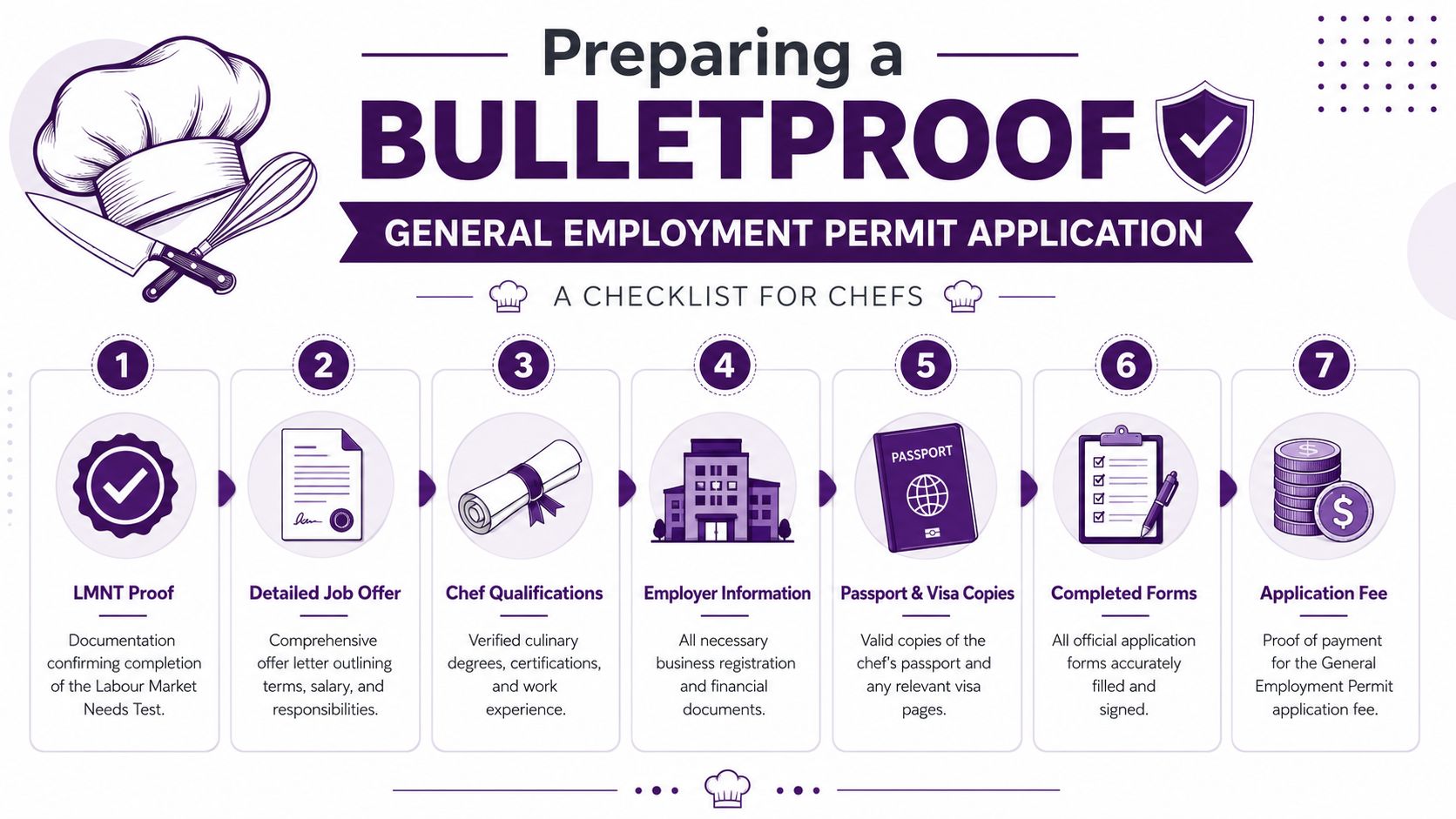
Preparing a Bulletproof General Employment Permit Application
Once the advertising stage is complete, the permit application becomes an evidence exercise. It is at this stage that solid businesses still get rejected because the documents don't tell a coherent story. The title, contract, salary, workforce ratio and candidate profile all need to line up.
The two checks that stop applications fastest
For eligible chefs on the General Employment Permit route, the role must meet a minimum annual remuneration of €36,605, and at least 50% of the employer's workforce must be EEA nationals at the time of application, according to the General Employment Permit rules. The same guidance makes clear that failure on the 50:50 rule is a common reason permits are refused.
That means owners need to check the business structure before they fall in love with a candidate. A restaurant can have the right chef, the right budget and the right paperwork, then lose the case because the workforce ratio is off on the day the file is lodged.
What to gather before submission
A strong file usually includes documents from both sides of the hire. I'd organise it in working categories rather than one long admin pile.
- From the employer
LMNT evidence, the signed job offer, the contract, company details, payroll information and any records needed to support workforce composition. - From the candidate
Passport copy, CV, experience evidence and qualifications where relevant. - From both together
A role description that matches the contract, the ad wording and the actual kitchen need.
One useful reference point if you want to compare your paperwork against the permit route itself is this General Employment Permit overview for employers.
What a good application feels like
A permit officer should be able to answer three questions quickly by reading your file:
- Is this role eligible
- Is this business compliant
- Is this candidate suited to the exact role being offered
If any one of those answers is fuzzy, the case weakens.
The cleanest applications read like one consistent story. The messy ones feel like documents collected from five different versions of the same job.
Don't treat the application like a form
This part is where operators often become too passive. They assume the online submission system will guide them into compliance. It won't. The form accepts information. It doesn't repair a bad role definition, an unstable workforce ratio or a contract that hasn't been thought through.
If you want a bulletproof file, pressure test it before submission. Read the job ad, then the contract, then the candidate CV. If they don't describe the same job at the same level, stop and fix it.
The Hidden Traps That Derail Chef Work Permits
A restaurant can do the ad, pick a strong candidate, submit the permit, and still hit a refusal over something that looked minor at the start. I see that happen most often where the role sounds like a chef job operationally, but the paperwork describes something closer to a cook post, the salary only works if tips are counted, or the staffing ratio has slipped without the owner noticing.

Title on the contract means less than owners think
Plenty of operators assume they can solve eligibility by writing Head Chef on the contract. Permit officers look past the label. They assess the duties, the level of responsibility, the kitchen structure, and the candidate's background against the role being offered.
That is where businesses get caught. Cook and generic Chef titles are not permit-friendly, and a title upgrade on paper will not help if the job still reads as routine prep, standardised production, or limited control over menu and kitchen operations. This practical breakdown of chef role assessment explains how closely the role is examined.
The supporting business detail matters as well. Owners need to show what kind of establishment they run, how food is prepared, who the chef reports to, and whether the kitchen setup supports a genuine senior chef role. The Department also expects the business to confirm that the role is not in fast food, and that food safety, trading history, and tax compliance are in order. Weak detail here makes the case look dressed up.
Tips and service charge don't rescue a low base salary
This catches employers more often than it should. The salary threshold has to be met in guaranteed pay. Tips do not count. Service charge does not close the gap.
That creates a practical budget problem. On a busy site, the overall package may feel competitive to the candidate, but permit assessment looks at contractual salary, not what the chef might make in a good month. If the base figure is too low, the case is exposed before anyone looks at how strong the CV is.
If the numbers only work once gratuities are added in, the role is usually priced below permit level.
The 50 to 50 rule catches businesses that are already stretched
The 50:50 rule is one of the biggest failure points in hospitality because staffing moves quickly. A restaurant can be compliant when it starts recruiting and out of line by the time the permit is reviewed.
Small teams are especially exposed. One resignation, one delayed replacement, or one roster change can shift the ratio enough to cause trouble. Owners who only check this once are taking a risk.
Check the workforce position before advertising. Check it again before submission. Check it again before approval if the process has dragged on. Good operators also make sure their right to work checks for employees in Ireland are current, because poor records make an already sensitive ratio issue harder to defend.
Candidate strength on paper isn't enough
A polished CV proves very little on its own. I have seen candidates interview well, look strong on file, and then struggle badly once questions move into service pace, ordering responsibility, menu input, HACCP discipline, or communication under pressure.
Reference checks help, but they are not always straightforward across borders. Qualifications do not always translate neatly either. The safer approach is to test the actual job. Ask who designed menus. Ask what volume they handled. Ask what happened on a bad service. Ask what they controlled directly and what they only assisted with.
Some employers bring in outside support at this stage because sourcing, screening, permit handling, and arrival planning can become one long chain of avoidable mistakes if nobody owns the process end to end. Beacon Recruitment is one example of a provider that manages chef sourcing, permit handling and arrival logistics for Irish hospitality employers.
From Permit Approval to Your Kitchen Floor
Permit approval feels like the finish line. It isn't. It's the point where the process shifts from compliance into logistics, and bad planning here can still delay the start date badly.
The permit gives the person permission to work in Ireland in the approved role. Depending on nationality, there may still be separate travel or entry formalities to handle before they can board a flight and start employment. Owners who miss that distinction often tell staff and suppliers a start date that isn't secure yet.
What happens after approval
A practical handover from approval to arrival usually involves a chain of tasks:
- Travel coordination
Flights, travel dates and document checks need to line up with the approved employment route. - Entry planning
The chef needs clear instructions on what documents to carry and what steps they'll complete after arrival. - Accommodation
This is one of the biggest operational delays. A permit holder without stable accommodation can't settle properly, and even a good hire can start badly if the first weeks are chaotic.
The onboarding part most operators underestimate
The first few days shape retention. That doesn't require grand gestures. It requires order. Someone needs to know who's meeting the chef, where they're sleeping, when they're reporting, what uniform or kit they need, and who is responsible for the first induction shift.
A permit gets a chef into the country. A proper arrival plan gets them into the job.
There's also a compliance side after arrival. Right to work checks, document handling and employment records still need to be done properly at venue level. This guide to right to work checks for Irish employers is a useful reminder that permit approval doesn't replace the employer's ongoing checking responsibilities.
Keep the first month simple
Don't overload the arrival period with promises and moving parts. A good first month usually includes:
- A realistic rota
Don't land someone into the worst week of the quarter with no support. - A kitchen introduction with substance
Show them the service flow, prep expectations, ordering chain and standards. Don't assume they'll infer it. - Clear contact points
One person should own practical issues. Another should own kitchen performance. When no one owns either, frustration builds quickly.
The best international placements don't feel dramatic on arrival day. They feel organised.
Your Partner in Hospitality Operations
Hiring chefs internationally is possible, and it's becoming more normal in Ireland. In the first five months of 2026, Ireland issued 15,535 new employment permits to non-EU/EEA workers, a 15% increase on the 13,471 issued in the same period of 2025, according to this report on Irish employment permit issuance in 2026. That tells you the route is active and widely used. It doesn't tell you the process is easy.
The friction points are usually operational, not theoretical. The role has to be framed correctly. The LMNT has to be clean. The salary package has to work on base pay, not assumptions about tips. The workforce ratio has to hold on the day you apply. Then the chef still has to arrive, settle and perform inside a real kitchen with real pressure.
What good operators do differently
Strong operators treat international hiring as part recruitment, part compliance and part operations. They don't separate those pieces because the permit route doesn't separate them either.
- They define the role before sourcing starts
That avoids title drift and weak advertising. - They budget the actual cost, not the hopeful cost
If the salary only works with side assumptions, they revisit the plan first. - They build onboarding into the hire
Travel, accommodation and induction are treated as part of the project, not afterthoughts.
Many owners are also reviewing broader operating models at the same time, especially around labour pressure, guest expectations and profitability. For that wider lens, these insights for modern restaurateurs are worth a read because they connect staffing decisions to the bigger operational picture.
For businesses that want one partner covering recruitment, compliance and operational support, Beacon's hospitality operations partner service brings those functions together in one model.
If you're serious about how to hire chefs from abroad in Ireland, the right conclusion usually isn't “this looks simple”. It's “this is achievable if the business treats it properly”. That's the correct mindset. International hiring can stabilise a kitchen, strengthen standards and reduce long-running recruitment pressure. But it needs proper handling from the first advert to the first service.
If you want to de-risk the process, speak with Beacon Recruitment. They work with Irish hospitality employers on international chef hiring, permit management and the wider operational issues that sit around the hire, so the plan works not just on paper, but in the kitchen.
Stop Losing Service Over Empty Kitchen Rotas
End the chef shortage panic and let our experts handle the complex international sourcing, paperwork, and arrival logistics for you.