July 16, 2026
How to Measure Customer Satisfaction: Hotel & Restaurant
Learn how to measure customer satisfaction in your Irish hotel/restaurant. Covers key metrics, survey design, & turning feedback into profit.
You've probably seen the pattern already. One guest leaves a glowing review about your team. Another complains about waiting at check-in, a cold starter, or a room issue nobody logged. You scan Google, TripAdvisor, comment cards, maybe a few WhatsApp screenshots from duty managers, and still can't answer the one question that matters. Are guests satisfied, and if not, where is the problem starting?
That's why most hospitality feedback systems fail. They collect opinions, but they don't create operational clarity. A pile of reviews is not a measurement system. It's noise unless you organise it around touchpoints, staff behaviour, repeat patterns, and follow-up actions.
In Ireland, that gap matters more than many operators realise. Only 23% of customers in the Irish hospitality sector report being “very satisfied”, while 44% are open to trying new brands according to Hanover Research's customer satisfaction analysis. If you're relying on instinct, or waiting for complaints to show up publicly, you're already behind. Measuring customer satisfaction properly isn't a marketing exercise. It's a core business function.
Why Vague Feedback Is Costing Your Business
A lot of venues think they're listening because they read reviews and ask tables whether everything was alright. That's not enough. Reviews are selective, staff often hear only the softened version of a complaint, and managers tend to remember dramatic incidents more than recurring friction.
The result is predictable. You react to whatever is loudest, not whatever is most common.
Reviews tell you what happened. They rarely tell you what to fix
A one-star review might mention rude service. A five-star review might praise a friendly server. Neither tells you whether the issue sits in rostering, training, handover, menu design, wait times, room readiness, or a weak manager presence on shift.
That's the commercial problem with vague feedback. It feels useful because it's visible, but it doesn't give you a stable operating signal. If your guest feedback process starts and ends with online platforms, you're letting random guest motivation decide what management sees.
Practical rule: If feedback can't be tied to a touchpoint, a team, or a recurring pattern, it can't reliably improve operations.
Hospitality businesses don't lose ground all at once. They lose it through small unresolved irritants. Slow greeting. Confusing booking confirmation. Staff who look drained. Delayed check-in. A breakfast service that feels disorganised even when the food is fine.
Satisfaction has to be measured like an operating system
The operators who handle this well don't ask, “Did we get any bad reviews this week?” They ask better questions:
- Which touchpoint is underperforming
- Which manager or shift needs support
- Which complaints repeat without being formally escalated
- Which guests leave neutral, not angry, and do not come back
That's where structured measurement starts to pay off. You stop treating satisfaction as a soft concept and start treating it as a trackable business signal.
If you want a useful outside perspective on the service side of the guest journey, Splash Access guest satisfaction advice is worth reading because it reinforces something operators often miss. Guest satisfaction improves when the experience is designed deliberately, not when management just hopes staff will “look after people”.
Vague feedback costs money because it delays decisions. It hides repeatable service failures inside isolated stories. In a market where many guests are open to switching, that delay is expensive.
Choosing Your Key Hospitality Satisfaction Metrics
A hotel can finish the week with decent review scores and still be bleeding margin. The pattern is familiar. Check-in takes too long on busy arrivals, staff are stretched, small complaints get solved inconsistently, and guests leave feeling "fine" rather than eager to return. If you only measure satisfaction at the end, you spot the problem after revenue has already been lost.
That is why metric choice matters. A useful measurement system does two jobs at once. It tracks what guests felt, and it shows where the operation is creating friction before those guests disappear.
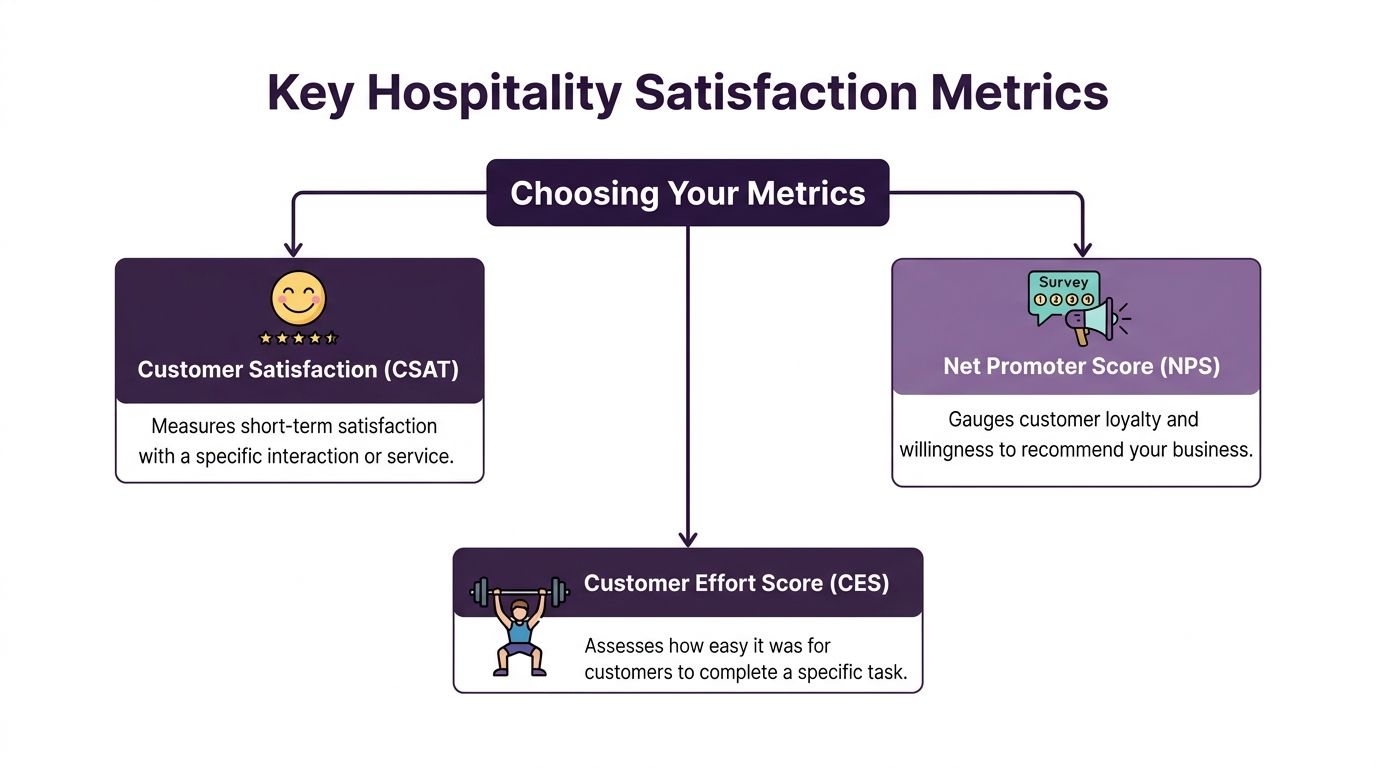
For a hotel, restaurant, bar, or mixed venue, we usually recommend four core measures. Three come from the guest side. One comes from the team.
CSAT for specific service moments
Customer Satisfaction Score, or CSAT, is the cleanest way to measure a single interaction. Use it at touchpoints where managers can intervene. Check-in. Table service. Breakfast. Checkout. Complaint resolution.
A practical CSAT question stays narrow:
- Hotel example: How satisfied were you with your check-in experience?
- Restaurant example: How satisfied were you with your meal and service today?
Used well, CSAT gives operators something they can assign and fix. If Monday breakfast drops while dinner holds steady, that points to a staffing, setup, or handover issue. If check-in scores fall only on weekends, look at queue management, rostering, and training before blaming the whole front office.
The limitation is clear. CSAT is excellent for moments. It is weaker at telling you whether guests are building loyalty to the business overall.
NPS for relationship strength
Net Promoter Score, or NPS, works at a broader level. It measures whether a guest would recommend you, which makes it useful for tracking brand trust and repeat intent across the full experience. CallZent's customer satisfaction guide gives a helpful overview of how businesses use NPS alongside other service metrics rather than in isolation.
In hospitality, that distinction matters. A guest can rate a stay as satisfactory and still have no strong reason to come back. We see this often in venues that run competently but feel interchangeable. NPS helps expose that problem.
Use NPS for quarterly trend lines, post-stay relationship checks, and benchmarking over time. Do not use it to diagnose one bad shift or one broken process. It is too broad for that.
CES for operational friction
Customer Effort Score, or CES, is the metric many operators miss. It measures how easy or difficult it was for a guest to complete something. That makes it highly practical for the parts of hospitality that affect satisfaction long before a review is written.
Use CES for tasks such as:
- changing a booking
- finding check-in instructions
- resolving a billing question
- requesting dietary adjustments
- getting a refund or receipt
- redeeming a voucher
This is often where profit leaks hide. Guests forgive the occasional delay more readily than repeated hassle. A friendly team member can soften a problem, but they cannot fully offset a clumsy booking flow, unclear communication, or a complaint process that requires too much effort.
For operators, CES is often the bridge between guest feedback and process improvement.
Staff sentiment as an early warning signal
Guest scores are usually lagging indicators. Staff sentiment gives you an earlier read on whether service quality is about to slip.
When morale drops, it rarely stays internal. It shows up in slower greetings, weaker upselling, missed details, and a lower tolerance for difficult moments with guests. In hotels, that can hit arrival, housekeeping coordination, and breakfast flow. In restaurants, it often appears first in greeting times, table attention, and how well problems are recovered.
We advise venues to track staff sentiment in a simple, repeatable way. One short pulse question each week is enough to start. Add manager observations and shift-level notes, then review them beside CSAT, NPS, and CES rather than in a separate HR silo.
That is the shift many businesses need. Satisfaction measurement stops being a passive survey exercise and becomes part of operational control.
A practical scorecard for most venues looks like this:
- CSAT: Measures satisfaction at specific touchpoints
- NPS: Tracks loyalty and likelihood to recommend
- CES: Reveals friction in key guest tasks
- Staff sentiment: Flags service pressure before it reaches the guest
Used together, these metrics give a fuller picture of performance. You see what guests experienced, how likely they are to return, where effort is too high, and whether the team delivering the service is in shape to sustain standards.
How to Design Surveys Guests Will Actually Complete
A guest has just checked out after a two-night stay. The room was clean, but check-in was slow and breakfast service felt under pressure. If the survey arrives three days later with ten questions about everything at once, you will get one of two outcomes. No response, or a vague score that tells you nothing useful.
Good survey design protects signal quality. In hospitality, that means short, timed to a real moment, and tied to decisions a manager can make on the floor.
Timing shapes the quality of the answer
Send the question while the experience is still clear in the guest's mind. Post-checkout, post-meal, post-booking change, or after a complaint is resolved all work well because the feedback relates to one specific event.
Delayed surveys create noise. Guests forget details, blend several moments together, or respond based on the last irritation they remember. That weakens the value of CSAT and CES in particular, because both depend on a fresh read of a defined touchpoint.
The practical rule is simple. Trigger surveys by guest action, not by a fixed day on the calendar.
Keep the survey tight and operational
For most hotels and restaurants, a useful survey has three parts:
- One score question
- One diagnostic follow-up
- One open comment box
That is usually enough.
Anything longer needs a strong reason. A boutique hotel with a serious refurbishment programme might ask a few extra room questions for a limited period. A restaurant testing a new lunch format may want one added question on pacing. Outside those cases, longer surveys reduce completion rates and lower the quality of written comments.
Use this checklist to keep surveys clean:
- Use one consistent scale: If CSAT is 1 to 5, keep it 1 to 5 every time.
- Ask about one touchpoint: Check-in, room cleanliness, booking ease, speed of service, complaint handling.
- Use plain language: Guests should understand the question in one read.
- Avoid leading wording: Ask for an honest rating, not praise.
- Match the channel to the moment: SMS after checkout, a QR code on the bill folder, a tablet at reception, or email after departure can all work.
- Make the open question specific: “What should we improve?” gets better answers than “Any other comments?”
If you want a broader overview of formats and channels, CallZent's customer satisfaction guide is a useful companion read.
Write questions staff can act on tomorrow
The test we use is blunt. Can a duty manager read the answer and change something before the next shift?
“Overall satisfaction” has value, but it is weak on its own. “How satisfied were you with check-in speed?” gives the front office manager something concrete to examine. “How easy was it to get help when you needed it?” points to staffing, training, or communication gaps. Those are operational questions, not vanity questions.
Examples for hotels:
- How satisfied were you with your check-in experience?
- How satisfied were you with the cleanliness of your room?
- How easy was it to get help when you needed it?
- What should we have done better during your stay?
Examples for restaurants:
- How satisfied were you with the speed of service today?
- How would you rate the attentiveness of your server?
- How easy was it to make or change your booking?
- What should we have done better during this visit?
Many venues falter in this regard. They ask broad questions because broad questions feel safe. Safe questions rarely uncover the friction that costs repeat business.
Use surveys as a trigger, not the whole system
A short survey should identify where to look next. It should not carry the full weight of your insight programme.
Low scores need follow-up. A manager call to a guest who scored poorly on check-in or complaint handling will usually reveal more than another batch of generic survey responses. The same applies on the restaurant side, where a brief conversation after a poor service score can expose issues with table allocation, handover, or kitchen timing.
We also advise operators to test the guest journey themselves. A structured mystery shopper programme for hospitality venues helps verify whether the problems guests mention in surveys are isolated incidents or repeatable service failures.
That is the real shift. Surveys stop being a passive box-ticking exercise and become part of a wider operating system. You collect a score, identify friction, check whether staff conditions contributed to it, and fix the process before the pattern hardens into lost revenue.
Gathering Feedback Beyond the Online Survey
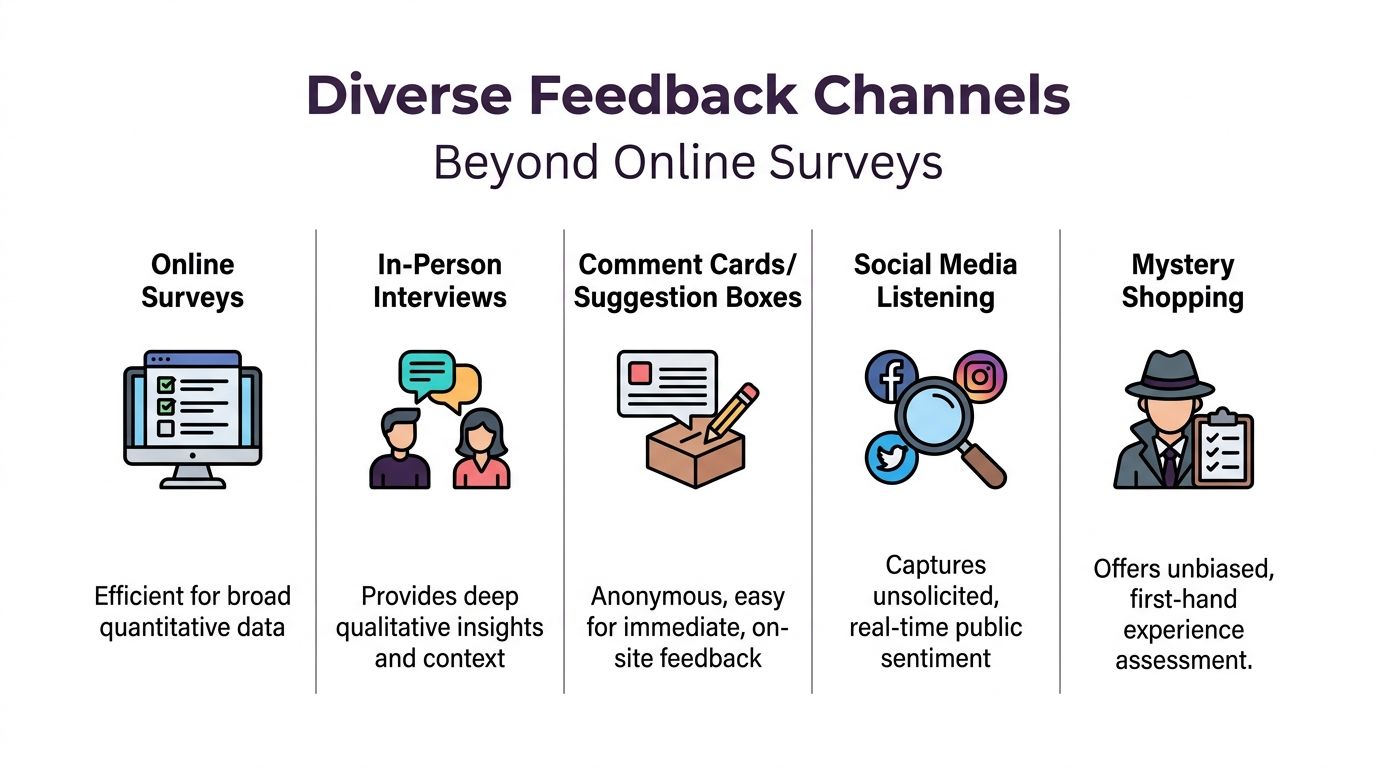
Online surveys are useful, but they only capture the guests who choose to answer. That excludes a large silent group. Some are happy and busy. Some are disappointed and gone. If you rely on survey links alone, you'll miss too much of the story.
Strong operators build multiple listening posts. Each one catches a different type of truth.
Comment cards still work
A lot of people dismiss Guest Comment Cards as old-fashioned. That's a mistake.
In Irish hotels, Guest Comment Cards remain the most widely deployed tool for measuring satisfaction, with 92% of venues in the Clare and Galway regions using them to capture real-time feedback on attributes like food quality and staff empathy, according to this hospitality satisfaction study hosted on Scribd.
That makes sense on the ground. A card at checkout, on a breakfast table, or in-room can catch feedback from guests who won't scan a QR code or answer email later. It also lets you collect low-friction comments while the experience is still fresh.
Comment cards work best when they are:
- Short: A few ratings and one comment box
- Visible: Not hidden at reception
- Collected consistently: Not left for weeks in a drawer
- Reviewed by managers: Not treated as admin clutter
Floor feedback needs training
“Was everything alright?” is usually a wasted question. Guests often say yes because they don't want a scene.
Managers need to ask better, more specific questions in service:
- How was the pace between courses?
- Did check-in go smoothly for you?
- Was there anything awkward about the booking process?
Those questions invite useful detail. They also help catch issues before the guest leaves. That's the difference between service recovery and post-mortem.
The best floor feedback happens when managers ask one specific question, listen without defending the operation, and log the answer after the interaction.
Mystery shopping and social listening fill the blind spots
Mystery shopping is valuable because it removes internal bias. Staff behave as they normally do. Standards are tested in real conditions. Friction that managers no longer notice becomes obvious again. For operators who want an independent operational view, Beacon's mystery shopper programmes show how structured assessments can surface service gaps across the guest journey.
Social listening serves a different purpose. It captures unsolicited, public sentiment. That matters because not every dissatisfied guest complains directly. Some post later. Some mention your venue in stories, comments, or local groups. Others disappear and tell friends privately.
A practical mix looks like this:
- Surveys for structured scoring
- Comment cards for quick in-venue reactions
- Manager conversations for live recovery
- Mystery shopping for objective observation
- Social listening for unfiltered public sentiment
If you're serious about how to measure customer satisfaction, don't ask one channel to do the work of five.
Turning Satisfaction Data into Actionable Insights
A busy Saturday can look fine on the floor and still be storing up problems for next month. Service moved, tables turned, rooms sold. Then the feedback comes in and a pattern appears. Guests felt rushed at breakfast, check-in queues were too long, and one team leader was firefighting all weekend.
That is the point of analysis. It is not to produce a prettier report. It is to spot the operational drag before it shows up in reviews, repeat booking decline, or staff turnover.

Build one operating dashboard
Keep all satisfaction inputs in one place. If survey scores sit in one system, reviews in another, and team issues live in a manager's phone, nobody sees the full picture quickly enough to act on it.
A useful dashboard does not need to be complicated. It needs clear categories, consistent tagging, and one person responsible for reviewing it every week.
Track feedback by:
- Touchpoint: check-in, breakfast, bar service, room cleanliness, complaint handling
- Location or outlet: if you run more than one site
- Shift or daypart: breakfast, lunch, dinner, late bar, overnight
- Manager or department: where ownership sits
- Theme: speed, friendliness, cleanliness, accuracy, ease
This changes the conversation. Instead of arguing over one bad review, managers can see that low scores keep clustering around Sunday lunch, late check-ins, or handovers between shifts. That is where profit leaks out.
Put guest sentiment beside staff reality
Guest satisfaction is usually treated as an external measure. In practice, it starts inside the operation.
When friendliness scores drop, look at staffing levels, break compliance, shift patterns, training gaps, and who was leading that service. A tired, unsupported team rarely delivers calm, consistent hospitality. Owners know this instinctively, but many still measure guest sentiment and staff sentiment in separate silos.
We advise clients to review both together. A weekly guest score trend means more when it sits next to staff pulse results, absence levels, rota pressure, agency dependence, and turnover risk. That is how you move from passive measurement to active control.
For operators who need a structured outside view of service standards, friction points, and ownership gaps, our customer service audits help turn scattered feedback into a clear action plan.
If you want another practical view of what strong follow-up looks like across the guest journey, how to improve guest satisfaction offers useful ideas.
Turn findings into weekly decisions
Action should happen at three levels.
Immediate fixes deal with live issues. If guests repeatedly mention slow bar service on Friday nights, adjust staffing, prep, or station setup before next Friday.
Manager actions deal with repeat patterns. If one department keeps attracting complaints about attitude or accuracy, review supervision, standards, and training.
Leadership decisions deal with structural causes. If scores dip every time occupancy rises above a certain point, the issue may be labour planning, not frontline effort.
Use a simple response process:
- Low scorers
Contact them quickly, acknowledge the issue, and decide whether recovery is appropriate. - Middle scorers
Ask what stopped the visit from being better. This group often highlights the friction that management has normalised. - High scorers
Thank them and make it easy to return, review, or book again.
The venues that get real value from satisfaction data do one thing consistently. They use it to change rotas, training, handovers, service design, and manager behaviour. Once that discipline is in place, measurement stops being a box-ticking exercise and becomes part of how the business protects reputation, keeps teams steadier, and improves margins.
A Practical Implementation Timeline for Your Venue
Most operators don't need a grand transformation. They need a clean rollout that the team will maintain.
Start small. Keep it disciplined. Add layers only when the basics are working.
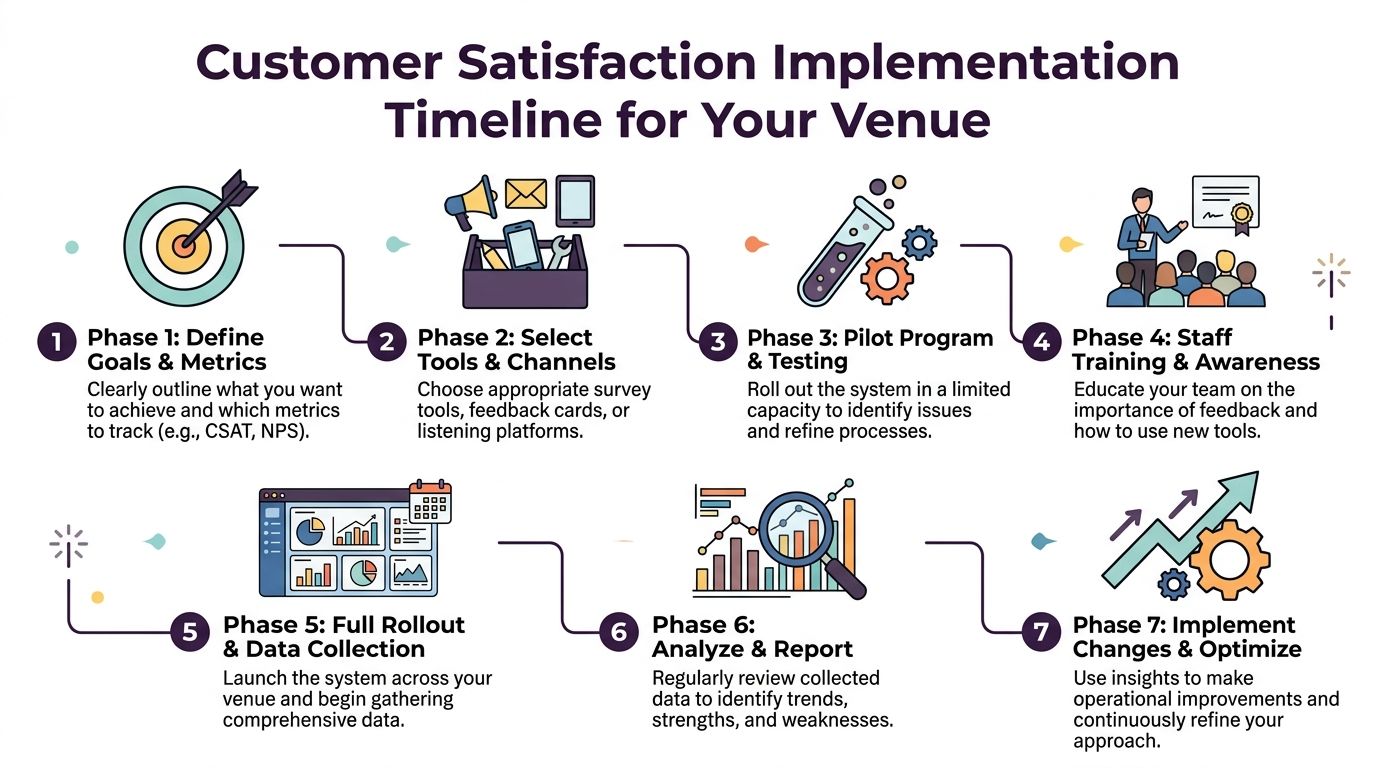
First phase and first month
Begin by defining what you want to measure and why. For most venues, that means choosing a limited set of guest touchpoints and deciding which metric fits each one. Don't start with everything.
A single-site restaurant might begin with post-meal CSAT, booking CES, and a short weekly team pulse. A hotel might start with check-in CSAT, checkout CSAT, and an occasional NPS survey for staying guests.
Key actions:
- Choose your metrics: Keep the set tight and relevant
- Choose your channels: QR code, SMS, email, comment card, or tablet
- Assign ownership: One manager must review results every week
- Brief the team: Staff need to know why feedback is being gathered
Second phase and rollout period
Launch with one outlet or one department before going venue-wide. That pilot will reveal messy wording, poor timing, or weak response rates.
Then train managers to use the information. Not just read it. Use it in pre-shift briefs, service reviews, and one-to-ones.
A practical rollout sequence:
- Pilot one journey first: check-in, post-dining, or checkout
- Review comments weekly: Look for repeated operational themes
- Follow up on poor scores: Build the habit early
- Adjust survey wording if needed: Confusing questions kill data quality
Systemise it for the long term
By the third phase, your priority is rhythm. Feedback systems fail when they depend on bursts of enthusiasm.
For single-site operators, keep it simple. One dashboard. One review meeting. One owner. Multi-site operators need tighter standardisation. Same survey scale, same categories, same reporting cadence across every venue. Otherwise comparison becomes pointless.
Use a recurring review cycle:
- Weekly: review low scores and urgent themes
- Monthly: compare touchpoints and staff sentiment
- Quarterly: decide which service or training change to implement next
If you're building this at group level or want a broader operational structure wrapped around it, a hospitality operations partner model can help connect guest feedback with staffing, compliance, and service delivery across the venue.
Done properly, customer satisfaction measurement becomes part of how the business runs. Not a survey project. Not a marketing task. A management discipline.
Beacon Recruitment works with Irish hospitality operators who need more than advice. As Beacon Recruitment expands its role as an operational partner for the sector, the focus is on helping venues build systems that hold up in real life, from service standards and customer experience reviews to compliance, staffing, and day-to-day operational control. If your hotel, restaurant, or group needs practical support turning feedback into a stronger operation, Beacon is built for that job.
Stop Guessing Why Guests Don't Come Back
Turn scattered feedback and vague reviews into clear, actionable operational data. Talk to our hospitality experts to implement practical measurement systems your managers can actually use to improve service.