July 16, 2026
Outsource HR for Small Business: Your 2026 Guide
Ready to outsource hr for small business in Ireland? Our guide for hospitality owners covers when to act, what to delegate, & how to choose a partner.

It's 10:40 on a Friday night. A chef has called in sick, two floor staff are arguing over next week's rota, a guest is waiting to speak to the manager, and someone has just asked whether a new starter signed the right contract. That last question is the one that usually gets parked until Monday.
In Irish hospitality, that's how HR problems build. Not through one dramatic mistake, but through small delays in a busy operation. A missing clause in a contract. Payslips nobody has checked properly. A handbook that still reflects how the business worked two years ago. Owners and GMs rarely ignore HR because they don't care. They ignore it because service comes first, and the people paperwork sits behind everything else until it turns into a WRC issue.
That's why the decision to outsource HR for small business matters so much in hotels, pubs, cafés, and restaurants. It isn't about handing your culture to an outsider. It's about taking the high-risk, detail-heavy work off a manager's plate before it starts affecting service, staff retention, and compliance.
The Reality of HR in Hospitality
Hospitality doesn't give you a quiet admin window. People join fast, leave fast, swap shifts, challenge hours, ask for references, need disciplinary meetings, and expect answers immediately. In a small venue, those jobs usually land on the owner, GM, or duty manager.
That creates a false sense of control. Because HR tasks are spread across the week, they don't always look like “HR”. They look like replying to a text about annual leave, fixing a payroll query before lunch, or writing up a verbal warning after service. But together, they form a system. If that system is loose, the risk is real.
Why informal HR breaks down quickly
Irish SMEs are already under pressure. 90% of Irish organisations face skills shortages and over one-third report significant HR burdens due to rapidly changing employment laws, according to PurpleTree's summary of CIPD Ireland's HR Practices in Ireland 2025 findings. The same source notes that a competent in-house HR manager in Ireland typically costs €50,000+ annually, while outsourced support gives access to HR capability without the full-time commitment.
For hospitality operators, that trade-off is practical, not theoretical. Many venues need proper HR judgement, but they don't need a full-time HR manager sitting in the office every day. They need contracts tightened, policies updated, payroll issues spotted early, and managers coached when a staff matter is going off track.
Practical rule: If your supervisors are making HR calls between breakfast service and supplier deliveries, you already have an HR function. It's just unmanaged.
A stronger model is usually hybrid. Management keeps ownership of team standards, service culture, and final hiring calls. An external HR partner handles the documents, systems, legal updates, and difficult process work.
What good outsourcing actually changes
When outsourcing works, the venue doesn't lose control. It gains structure.
That means:
- Managers spend less time guessing: They know what form to use, what process applies, and when to escalate.
- Employee issues are documented properly: Warnings, meetings, probation reviews, and contract changes stop living in text messages.
- Operations get breathing space: Service leaders focus on guests and staffing, not constant admin recovery.
For venues that need broader operational support alongside people systems, it helps to think in terms of an operational partner for Irish hospitality rather than a narrow back-office supplier. In hospitality, HR never sits neatly in one box. It touches staffing, compliance, training, food safety, and day-to-day management.
The Tipping Point for Outsourcing HR
Most owners don't wake up one morning and decide to outsource HR. It usually happens after a near miss. A former employee requests records. A contract hasn't been issued on time. Payroll doesn't match hours worked. A manager realises nobody is sure what paperwork exists for half the team.
The tipping point is rarely headcount alone. It's when informal habits stop being safe.
The hidden problem of compliance drift
In hospitality, compliance drift is what happens when the business grows faster than its HR structure. New starters come in. Old templates get reused. Managers make practical decisions in the moment. Nothing feels broken, but the paperwork slowly stops matching the reality of the operation.
That's where small venues get caught. A pub, café, or guesthouse can look manageable from the outside while carrying major HR exposure inside. Data from the Irish Hospitality Federation in 2025 found that 42% of small Irish hospitality venues with 1 to 25 employees received at least one WRC warning in the last 12 months for outdated employment documentation, with fines averaging €3,500 per violation. For a venue hiring its 6th employee, the risk becomes immediate.
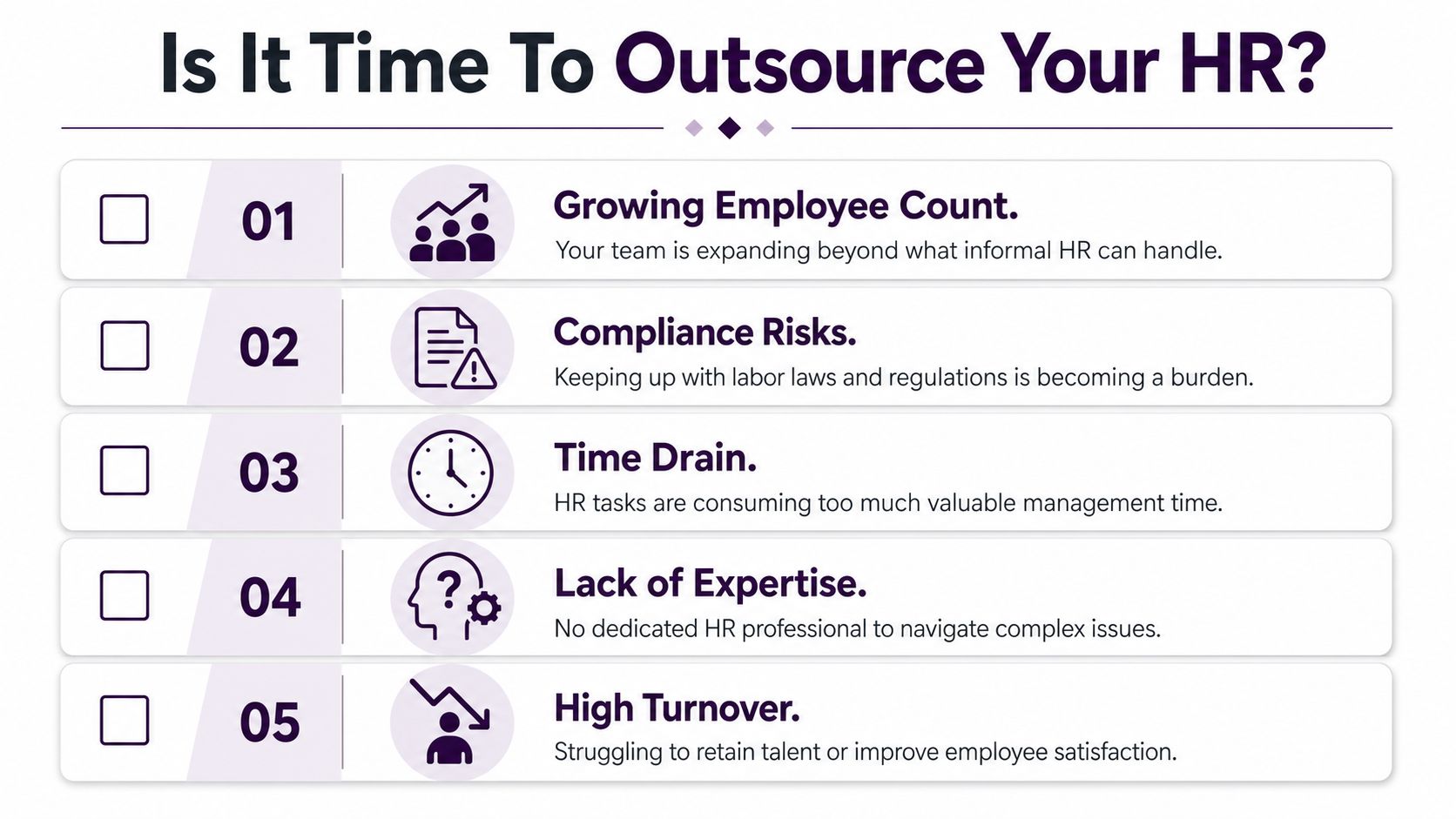
That 5-employee threshold matters operationally. Once a venue moves beyond a tiny founder-led team, there are more rotas, more contract variations, more leave records, and more room for inconsistency. Waiting until the business feels “big enough” usually means waiting too long.
Signs you've outgrown DIY HR
A few warning signs show up again and again in restaurants and hotels:
- New starters are onboarded differently each time: One person gets a clean contract pack, another gets a verbal explanation and a promise to sort the paperwork later.
- Payroll queries keep coming back: The same issues around hours, deductions, holiday pay, or rates keep resurfacing.
- Managers are improvising employee relations: One supervisor gives informal warnings, another jumps straight to formal action.
- You rely on memory instead of records: If someone asked for proof of rate changes, roster history, or signed policies, it would take too long to pull together.
- Busy periods expose weak response times: Seasonal pressure doesn't create HR problems. It reveals them.
If you're assessing systems beyond day-to-day paperwork, tools and frameworks built around enterprise HR risk prevention can be useful because they force you to think in terms of exposure, escalation, and controls, not just admin completion.
The dangerous point isn't when HR becomes annoying. It's when the venue is one complaint, one inspection, or one former employee away from discovering its records don't hold up.
What to Outsource vs Keep In-House
Outsourcing HR doesn't mean outsourcing leadership. That's where many small businesses get this wrong. The aim is to move repetitive, compliance-heavy, and process-dependent work to specialists, while keeping the parts of people management that depend on your standards, brand, and daily presence.
Globally, payroll outsourcing leads HR function adoption at 70% of contracts, followed by Recruitment Process Outsourcing at 28% and multiprocess HR outsourcing at 26%, according to Insignia Resource's HR outsourcing statistics roundup. That pattern makes sense in hospitality because payroll, documentation, and compliance are the areas where errors are expensive and consistency matters most.
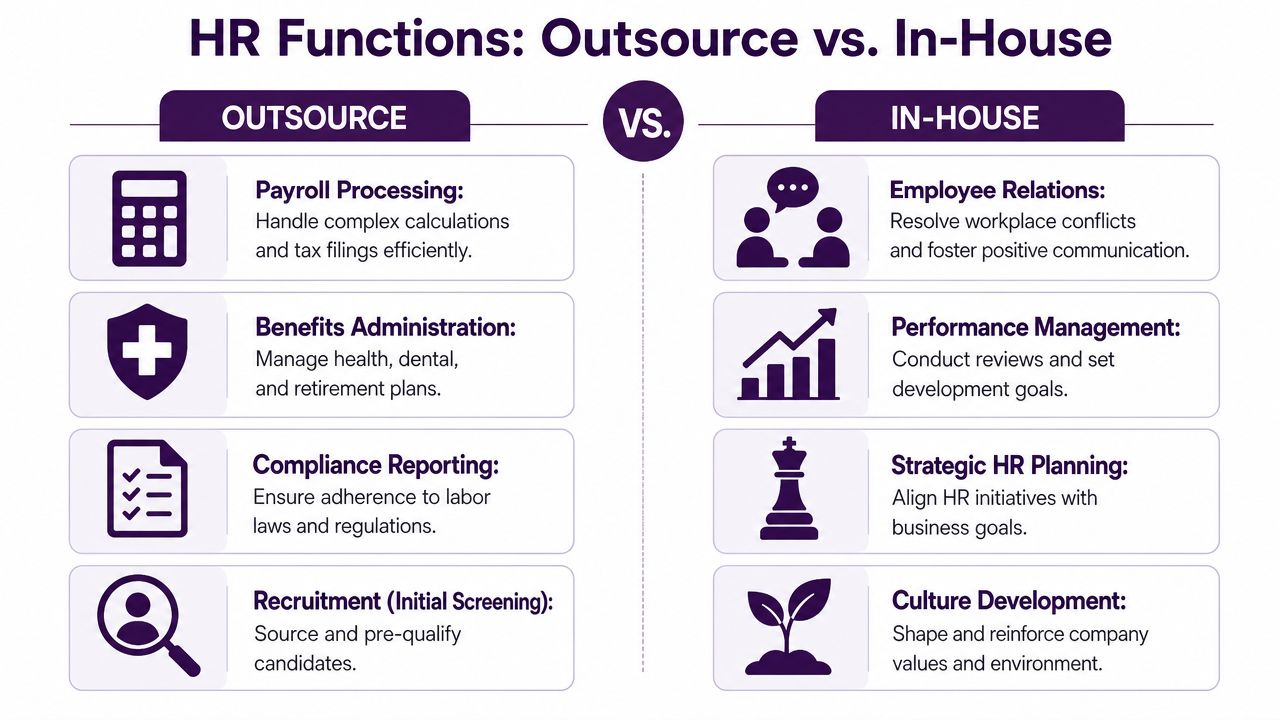
What usually belongs with an external HR partner
These are the functions most small hospitality businesses should consider moving out:
- Payroll processing: This is usually the first win. Calculations, payslip consistency, deductions, and payroll administration need precision.
- Contract generation and updates: New starter contracts, role changes, probation letters, disciplinary templates, and policy acknowledgements all need a proper version-controlled process.
- Compliance tracking: Leave records, document expiry dates, signed policy logs, and audit readiness are better managed systematically than from email folders.
- Initial recruitment admin: Drafting ads, screening CVs, arranging interview stages, and reference chasing can be outsourced without losing the final say.
If you want a broader view of how operators are thinking about HR for small business, it helps to compare where admin support ends and where leadership accountability still needs to stay internal.
What should stay close to the venue
Some responsibilities should remain firmly in-house because they shape the employee experience directly:
- Final hiring decisions: You know who fits your kitchen, front-of-house team, or management group.
- Daily employee relations: Staff won't build trust with a remote provider they never see. They need a visible manager who can listen, resolve conflict, and set expectations.
- Performance conversations: Reviews, coaching, and standards management should come from operational leaders.
- Culture and tone: The way your venue feels to work in is created on shift, not in policy files.
Best fit: Outsource process. Keep presence.
A practical hybrid model
For most hospitality businesses, the strongest model looks like this:
- External HR manages the framework.
- Site management handles the human side.
- Both agree exactly who owns what.
That last point matters. When nobody owns the handoff, documents stall, investigations drag on, and employees get mixed messages.
Choosing a Partner Not Just a Provider
Generic HR support often sounds fine in a proposal. You get policy templates, payroll help, contract support, and an advice line. On paper, it covers the bases. In hospitality, it often falls apart the first time the venue hits a busy bank holiday weekend, loses two temporary staff, and needs an answer before lunch.

The problem is what I think of as the fractional HR manager trap. A provider offers part-time HR support, but they don't understand how a live hospitality operation works. They know policy language. They don't know the pressure points of split shifts, last-minute cover, seasonal turnover, tip issues, kitchen hierarchies, or food-safety-linked staffing gaps.
Why sector knowledge matters
A hotel or restaurant doesn't need an HR partner who only reacts to paperwork requests. It needs one that understands operational timing. If a manager rings about a contract issue affecting tomorrow's roster, a response next week is useless.
That gap shows up clearly in the sector. A 2025 Irish Small Business Association study found that 68% of small hospitality businesses using standard outsourced HR providers were dissatisfied with response times during seasonal surges, contributing to 25% higher temporary staff turnover costs. That doesn't just point to poor service. It shows that generic providers often miss the reality of how hospitality staffing moves.
Questions that separate specialists from generalists
When you're choosing an HR partner, ask questions that expose whether they understand venues, not just employment law.
- Ask about seasonality: How do they handle a surge in hiring between May and September when onboarding speed matters?
- Ask about WRC readiness: What records do they expect a venue to maintain for contracts, hours, payslips, and leave?
- Ask about hospitality-specific employee issues: Have they dealt with split shifts, fluctuating hours, probation failures in live service environments, or no-show patterns?
- Ask about EHO-adjacent HR risk: Can they coordinate staff documentation and policy practice where food safety training and people compliance overlap?
- Ask about response standards: If a manager has a same-day disciplinary or urgent contract query, who answers and by when?
A weak provider talks in generalities. A strong partner talks about workflows, escalation points, and who does what when service is live.
What good partnership looks like on the ground
You don't need perfection. You need fit.
A useful HR partner for hospitality will usually do three things well:
- Build systems managers can use
- Respond fast enough for operational reality
- Prevent problems before they become claims or inspections
“If your HR provider needs a week to understand your rota structure, they're already behind.”
There's also a cultural point here. Small hospitality businesses often worry that outsourcing will strip away the personal touch. That risk is real if you hand over employee interaction entirely. It's far lower if you use outsourced HR for structure, advice, and documentation, while managers stay present with the team.
Your Irish HR Compliance Playbook
Irish employment compliance becomes much easier when you stop treating it as a legal mystery and start treating it as an operating checklist. WRC inspectors don't assess good intentions. They assess records, timing, consistency, and whether your documents match what's happening on the floor.
The contract deadlines that trip up employers
One requirement gets missed constantly in hospitality because recruitment is often fast. Under Irish employment law, employers must provide written terms of core employment, including job title, working hours, payment terms, and notice periods, within five days of an employee's start date. A full contract must be provided within two months, and failure to comply can lead to WRC penalties, as outlined in this guide to key Irish employment laws for employers.
That means “we'll sort the contract next week” isn't safe. If someone starts on a Monday, the clock has already started.
What to check before a WRC issue checks it for you
Use this as a practical audit list inside the business:
- Core terms are issued on time: Every starter has written core terms delivered within the legal timeframe.
- Full contracts are complete and signed: Don't rely on unsigned templates sitting in a folder.
- Role changes are documented: If someone moved from part-time to full-time, changed rate, or changed responsibilities, the paperwork should show it.
- Policies are current: Handbooks should reflect the way the venue operates, not an old version copied from another business.
- Leave and absence records are centralised: Annual leave, sick leave, and other absences should be logged consistently.
For a practical benchmark, this HR compliance checklist for Ireland employers is the sort of operational reference worth keeping close to hand when reviewing your setup.
What payroll records need to stand up
Payroll is where many hospitality businesses assume they're covered because wages go out on time. That isn't the same as being inspection-ready.
According to Beacon Recruitment's overview of the WRC inspection checklist in Ireland, payroll records should include:
- Gross-to-net calculations
- Detailed payslips showing the basis of pay
- Documented hourly rate changes with approval dates
- Proof of lawful deductions
The same source notes that inspectors may compare contracts, rosters, hours, payslips, and leave records for random employees during on-the-ground checks. In a restaurant or hotel, that means your systems have to reconcile across departments, not just look tidy in isolation.
Operational test: Pick three random employees from different roles and compare their contract, latest rota, recorded hours, payslip, and leave log. If they don't align cleanly, your process needs work.
Making It Work A 90-Day Onboarding Plan
The hardest part of outsourced HR isn't signing the agreement. It's making the relationship usable in a live business. A poor onboarding phase creates months of confusion. A strong one sets ownership, deadlines, and communication habits early.
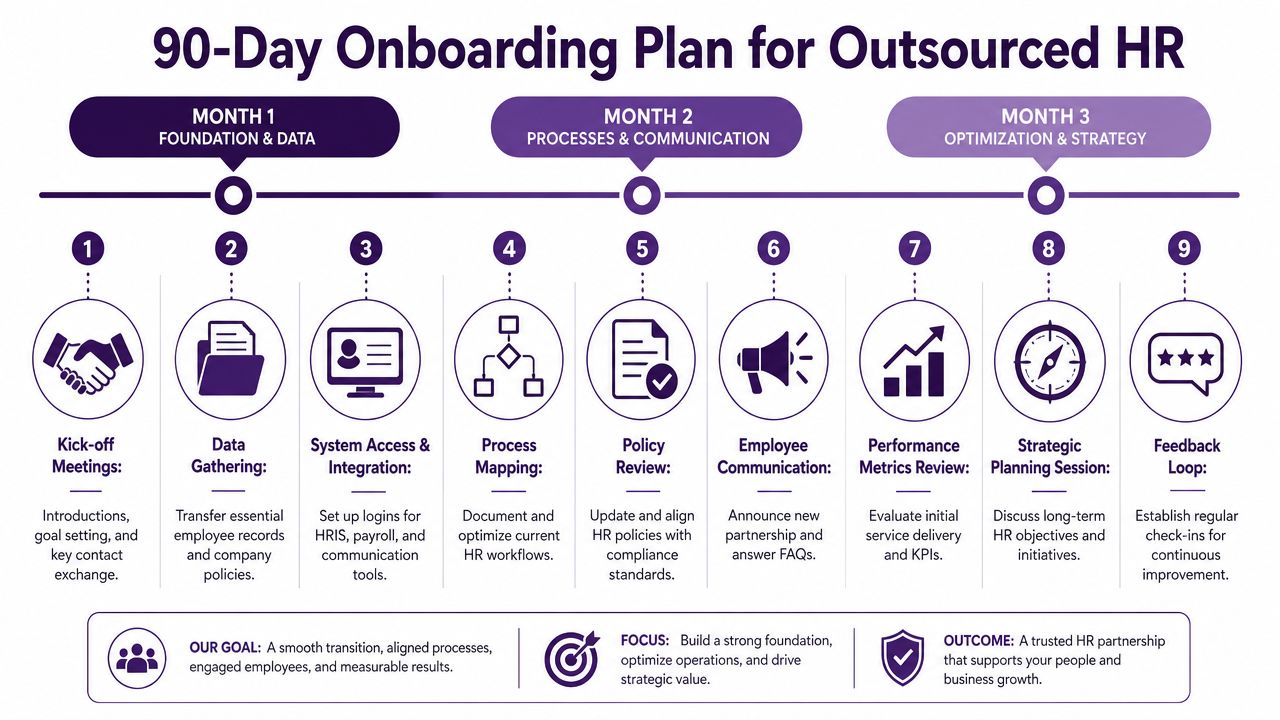
Days 1 to 30 set the foundations
The first month is about visibility. Your new partner needs a complete picture of the current state, not an idealised one.
Start with:
- A document handover: Contracts, handbooks, policy files, disciplinary records, payroll processes, role lists, and current staffing details.
- Named contacts: One person at site level, one senior decision-maker, and one person responsible for payroll or admin coordination.
- System access: Shared folders, HR software if used, payroll inputs, and communication channels.
This is also the right time to define practical service levels. If you need new contracts turned around quickly, say so now. If managers need same-day phone advice for urgent employee issues, that should be written into the arrangement.
Days 31 to 60 turn the service into a routine
Month two is where outsourced HR either becomes embedded or remains distant.
Focus on:
- Process mapping so everyone knows how starters, leavers, warnings, investigations, and payroll queries move through the business.
- Policy review to clean up anything outdated, duplicated, or inconsistent.
- Manager communication so supervisors know when to handle something themselves and when to escalate.
If you're also tightening staff entry processes, resources that help streamline onboarding processes can be useful for shaping a cleaner handoff between hiring, induction, and HR compliance.
A practical retainer model often works best once the relationship is live, especially where there's regular site support, policy review, and manager access built into the service. That's the sort of structure reflected in ongoing HR support retainer visits.
Days 61 to 90 measure whether it's working
By month three, the question isn't whether the provider is friendly. It's whether the service is improving control.
Review points should include:
- Contract turnaround times
- Whether document gaps have been closed
- How quickly urgent manager queries are answered
- Whether payroll issues are reducing
- Whether managers are following the agreed process
Good outsourced HR should feel calmer by month three. Fewer surprises. Fewer loose ends. Faster answers.
KPIs and SLA terms worth agreeing early
Not every hospitality business needs the same dashboard, but these measures are practical:
- Contract delivery target: New starter contracts and core terms issued within an agreed turnaround.
- Query response window: Clear response standards for routine and urgent cases.
- Monthly compliance review: A scheduled check on missing documents, policy updates, and risk points.
- Case handling process: Named ownership for investigations, warnings, probation issues, and exits.
- Quarterly review meeting: Time set aside to assess service quality, recurring issues, and needed changes.
Small businesses in Ireland often look at outsourcing because they can't justify a full in-house HR salary but still need proper support. That logic is sound. The value only shows up, though, when onboarding is disciplined and expectations are clear from the start.
If you're running a hotel, restaurant, bar, or multi-site hospitality business and need HR support that effectively fits the pace of operations, Beacon Recruitment brings together hospitality recruitment, compliance, and operational consulting in one place. Their work is built around the realities Irish venues face every day, from WRC exposure and contract control to wider operational pressure across staffing, food safety, and business performance.
Get HR Support Built for Hospitality
Empower your managers to lead your team while we handle the contracts, compliance, and employment law updates. Schedule a Free Consultation with Beacon to outsource your HR administration today.