July 16, 2026
How to Reduce Food Waste in a Restaurant
Learn how to reduce food waste in a restaurant. Cut costs, boost profits & improve operations with our 2026 playbook. Get audit, menu & storage tips.
You're probably looking at your food spend, your labour line, your utilities, and your VAT obligations, and asking the same blunt question most restaurant owners ask at some stage: where is the margin going?
Part of it is obvious. Part of it isn't. The hidden leak is often food waste. Not the occasional returned plate or one tray of overcooked chips. The daily, repeated loss that slips through prep, ordering, storage, portioning, service, and close-down. If you want to understand how to reduce food waste in a restaurant, stop treating it as a side sustainability issue and start treating it like a controllable operating cost.
Why Food Waste Is a Margin Killer Not Just a Green Issue

Most owners don't need a lecture about doing the right thing. They need waste reduction to make commercial sense. It does.
In hospitality guidance for the Irish and wider IE market, 4% to 10% of food purchased never reaches a customer, while 31% to 40% of food served is left uneaten according to restaurant food waste guidance from EHL Hospitality Insights. That's the starting point. Not an extreme case. A baseline range that serious operators should be trying to tighten.
Waste hits profit twice
The first hit is obvious. You buy stock and throw part of it away.
The second hit is the one people underestimate. You also pay for the labour to receive it, check it, store it, prep it, cook it, plate it, clear it, and dispose of it. Waste isn't just wasted product. It's wasted purchasing effort, wasted refrigeration space, wasted chef time, and often wasted service capacity.
Practical rule: If food goes in the bin, the cost didn't start at the invoice. It started when you ordered it.
That's why waste belongs in the same conversation as rota efficiency, menu pricing, and purchasing discipline. It isn't separate from profitability. It is profitability.
Small leaks become a system problem
Most restaurants don't fail on one dramatic mistake. They bleed through repetition.
A tub of dressed leaves that turns. A garnish no one finishes. A prep list built for a busy Friday when it's a wet Tuesday. A chef who portions by eye. A delivery accepted even though the shelf life is poor. None of these feels catastrophic on its own. Together, they hammer the P&L.
The operators who get this under control usually stop asking, “How do we waste less?” and start asking sharper questions:
- What gets binned before service
- What gets over-prepped every week
- What comes back on plates repeatedly
- Which menu items create awkward, slow-moving stock
- Where ordering habits no longer match actual demand
If you're serious about protecting margin, waste needs to be reviewed with the same discipline you'd bring to wages or pricing. That usually starts with a hard look at the business model, menu logic, and cost controls. A proper business planning and profitability audit for hospitality operations can expose the patterns quickly, but the principle is simple enough. If you can see the waste clearly, you can manage it.
Conduct a Food Waste Audit That Actually Works
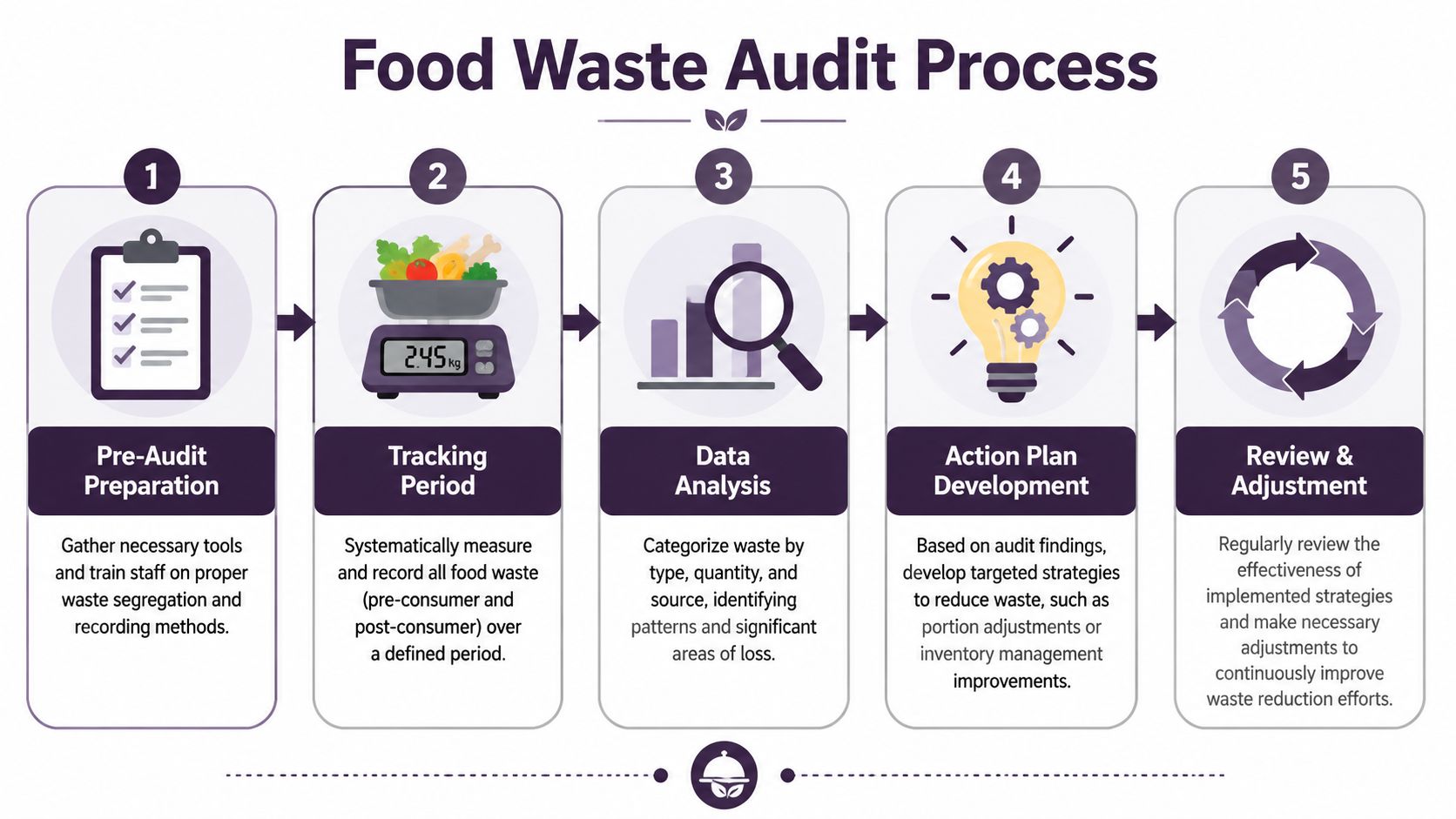
If you don't measure waste, your team will guess. Guessing is why the same problems stay in place for months.
The good news is you don't need expensive software to run a useful audit. You need a simple system, a short tracking window, and the discipline to keep staff honest for the duration.
According to guidance on reducing food waste from the National Restaurant Association, tracking waste can cut food costs by 2% to 6%, and restaurant food costs are often linked to roughly 28% to 35% of sales. The same guidance notes that a venue spending €1 million on food could, in theory, save about €20,000 to €60,000 annually by measuring discard categories, improving inventory rotation, and tightening production planning. That's why this isn't admin for the sake of admin.
Use three waste categories only
Don't overcomplicate the first audit. Split waste into three bins or three logged categories.
- Spoilage
Food that never makes it to prep or service because it expires, degrades, or arrives in poor condition. - Preparation waste
Trim, peels, off-cuts, overproduction, and mistakes made during prep. - Plate waste
Food that reaches the guest and comes back uneaten.
That structure gives you useful operational signals. Spoilage points to ordering and storage. Prep waste points to production habits and knife skills. Plate waste points to portion size, menu design, or guest fit.
Run the audit for a defined period
A week is usually enough to spot patterns if the team records properly. If your trade swings heavily between weekdays and weekends, make sure you capture both.
Set up the audit like this:
- Place a scale in the kitchen where waste is easy to weigh without disrupting service.
- Print a waste log sheet and keep it clipped in one place.
- Assign responsibility by shift so everyone knows who records what.
- Train staff before day one so they don't treat the process as optional.
- Review entries daily instead of waiting until the end.
Don't ask the kitchen to “keep an eye on waste”. Ask them to weigh, record, and categorise it every shift.
Keep the log brutally simple
A workable waste log might include:
- Date and shift
- Item discarded
- Waste category
- Approximate reason
- Weight or quantity
- Staff initials
The reason field matters. “Chicken” tells you very little. “Chicken supreme, over-prepped for lunch” tells you what to fix.
Analyse for causes, not just totals
At the end of the week, don't stop at the biggest number. Look for behaviour.
Ask questions such as:
- Is one section generating most of the prep waste?
- Are specific menu items driving plate returns?
- Are deliveries arriving with weak shelf life?
- Are prep lists being built from habit instead of bookings and recent sales?
- Are garnishes, sides, or bread baskets coming back untouched?
A good audit should lead to a short action list, not a long report.
What works and what doesn't
What works
- Daily recording by named staff
- Short categories
- A visible scale
- Reviewing findings with chefs and managers together
- Turning the results into changes in ordering, prep, and menu specs
What doesn't
- Running the audit once and forgetting it
- Logging “mixed waste” with no detail
- Leaving all recording to one overworked sous chef
- Collecting numbers without making operational changes
If your systems are loose, a deeper operations review for efficiency in hospitality businesses often helps connect the audit to rota control, purchasing discipline, and service standards. But the first move is still the same. Measure what's going into the bin.
Redesign Your Menu to Prevent Waste by Design

Once the audit shows where the losses are, the menu usually tells you why.
A lot of waste is designed into the operation. It sits in overcomplicated dishes, ingredients used once, oversized mains, fixed accompaniments guests don't want, and prep-heavy items that only sell occasionally. If you want to know how to reduce food waste in a restaurant for the long term, fix the menu architecture.
Guidance relevant to Irish operators recommends pairing portion control with FIFO stock rotation, date-label discipline, and flexible ordering. It also notes that smaller portions, à la carte sides, and menu engineering reduce plate waste, while over-prepping and ordering on fixed schedules are common failure points, as outlined in restaurant and foodservice waste prevention guidance from ReFED.
Cut one-off ingredients first
Single-use ingredients create drag. If an item appears on one dish only, it needs to justify its existence.
That doesn't mean your menu must become boring. It means each ingredient should earn its place across the menu. A herb oil used on fish, in a starter, and in a staff meal has operational value. A niche garnish that dies in the fridge after two services does not.
Look at your menu through three filters:
- Cross-use. Can this ingredient appear in multiple dishes without feeling repetitive?
- Shelf life. Can the team realistically use it before quality drops?
- Sales frequency. Does the dish move enough to support the stock holding?
Change how you build the plate
Portion control is often treated as stinginess. That's the wrong frame. Good portion control is consistency.
If guests routinely leave chips, salad, slaw, or bread, stop forcing those components onto every plate. Offer sides separately where it suits the concept. Tighten protein specs. Standardise scoop sizes. Write plating guides that survive a busy Saturday night.
A few menu adjustments usually pay off quickly:
- Offer sides à la carte instead of bundling low-value waste onto every main
- Use more than one portion format where the concept allows, especially for lunch versus evening trade
- Strip out decorative extras that regularly return untouched
- Retire weak sellers that demand awkward prep or specialist stock
- Use specials with discipline to draw down stock already in house, not to create new purchasing problems
The best waste-reduction menu is rarely the biggest or most creative one. It's the one the kitchen can execute cleanly, repeatedly, and profitably.
Use sales history, not instinct
Owners and chefs often keep low-performing dishes because they like them, a regular once praised them, or they “complete the menu”. None of that matters if the dish creates dead stock and prep waste.
Historic sales data should shape production. If a dish only sells occasionally, ask whether it deserves a permanent slot. If it stays, redesign it around ingredients already moving elsewhere.
For operators reviewing concepts or seasonal refreshes, it can help to discover food ideas for restaurants that are commercially usable, not just visually appealing. The key is to borrow ideas that improve ingredient overlap and ordering flexibility, not add complexity for its own sake.
What a stronger menu usually looks like
It usually has:
- Fewer ingredients with more crossover
- Cleaner prep routines
- Less forced garnish
- More consistent portions
- Better alignment between bookings, sales history, and mise en place
What it doesn't have is a long tail of dishes that look good on paper but create spoilage every week.
Master Your Ordering and Stock Rotation
Most food waste starts before the chef picks up a knife. It starts when someone places an order based on habit.
The common pattern is easy to spot. The same supplier order goes in on the same days, for roughly the same quantities, with minor tweaks made on instinct. That system works until weather shifts, bookings soften, an event cancels, a menu item slows down, or local trade changes. Then the walk-in fills with product the business didn't need.
Replace fixed ordering with demand-based ordering
A strong order is built from what the business expects to sell, what it already holds, and what shelf life is realistically available.
That means checking:
- Recent sales patterns
- Forward bookings
- Known local events
- Current stock on hand
- Open prep already in the fridge
- Delivery quality from the last drop
If your team orders from memory, they'll over-order. If they order from a prep sheet that hasn't been updated in months, they'll over-order more neatly, but they'll still over-order.
FIFO only works when the whole team can see it
Everyone says they use FIFO. Many venues don't use it properly.
FIFO fails when labels are unclear, shelving is chaotic, opened packs aren't marked, and staff shove new stock in front because service is busy. If stock rotation depends on one careful person, it isn't a system. It's luck.
A workable FIFO routine includes:
- Visible date labels on every opened or decanted item
- New deliveries stored behind older stock
- Shelves organised by product type and use
- Daily checks on vulnerable items
- Clear rules on what gets used first
- No unlabelled containers in the walk-in
If a product has no date and no owner, it becomes waste waiting for a bin bag.
Tighten delivery checks at the door
Many kitchens create spoilage by accepting poor deliveries. Once low-quality stock enters the building, the clock speeds up.
The receiving team should check condition, temperature where relevant, shelf life, packaging integrity, and whether the order matches what was requested. If produce is already tired, if dairy life is too short, or if chilled goods arrive in questionable condition, reject them. Too many businesses accept a bad drop because they're busy and deal with the loss later.
For operators trying to optimise hospitality stock control, practical inventory workflows can help, but they only work when the basics are enforced on every shift.
Build traceability into stock discipline
Waste control and compliance often overlap. If you can't identify what arrived, when it was opened, and where it moved, you'll struggle to manage both spoilage and accountability.
That's why clear product dating, batch awareness, and receiving records matter. Good food traceability practices in hospitality operations don't just support compliance. They help managers spot weak ordering, poor stock movement, and recurring handling mistakes before those issues become shrinkage.
Empower Your Staff to Champion Waste Reduction

Waste systems fail when management treats them as paperwork and staff treat them as someone else's problem.
The kitchen controls prep, storage, portioning, and most avoidable loss. Front of house sees what guests leave, what they complain about, and what they consistently don't want on the plate. If those two groups aren't feeding information back to each other, the same waste repeats.
Train the kitchen on yield, not just speed
Fast prep isn't efficient if too much of the product goes in the bin.
Chefs and kitchen porters need clear standards on trimming, portioning, storage, reheating rules where relevant, labelling, and handling open stock. Show them the expected yield from a case, the correct portion tool, the approved container, the right shelf location. Don't rely on verbal tradition.
Useful training points include:
- Knife skills and trimming discipline so prep waste doesn't creep up
- Portion tools and plating specs so every dish leaves the pass consistently
- Correct use of waste bins and logs so the data stays reliable
- Date-labelling standards so open product doesn't become mystery stock
- Shift handover routines so one team doesn't sabotage the next
Train front of house to gather usable feedback
A returned plate isn't just a service issue. It's operational data.
Front of house should know how to ask simple, professional questions when food comes back. Was the portion too large? Was a side unwanted? Was the dish too rich, too salty, too slow, or not what the guest expected? “They didn't eat much of it” isn't enough.
That feedback matters because plate waste often looks like a kitchen issue when it's really a menu description or expectation issue.
Ask the guest why the food came back. Ask the server what they observed. Then ask the kitchen whether the dish spec still makes sense.
Make waste visible to the team
You don't need theatre. You do need visibility.
If you want buy-in, share patterns from the audit in pre-service briefings or weekly manager meetings. Keep it short and specific. “We binned too much spinach” is weak. “We're over-prepping burger garnish on midweek lunches” is actionable.
A practical team routine might include:
- One waste point in the daily huddle
- One recurring issue assigned to one named person
- One quick review of plate returns each week
- One section lead checking labels and rotation every shift
Recognition beats nagging
Staff members switch off when every waste conversation sounds like blame.
Give credit when a commis reorganises a shelf properly, when a supervisor flags a poor delivery, or when a server identifies a side dish guests consistently leave. Appointing one or two shift-level waste champions can help, not because they police everyone, but because they keep the standards alive when managers are tied up elsewhere.
Good culture around waste is practical. It sounds like, “Use this first,” “Label that now,” “Drop prep on that item tonight,” and “We need smaller mash portions on this dish.” It doesn't sound like abstract speeches about sustainability.
Manage Unavoidable Surplus Legally and Ethically
Even a well-run restaurant will still have some surplus. The objective isn't perfection. It's making sure edible food is handled responsibly and inedible material is separated properly.
Start with a simple hierarchy. First, prevent surplus through menu, ordering, and prep controls. Second, where food is still safe and suitable, look at donation routes. Third, where donation isn't possible, use a proper waste stream such as composting or an approved collection service rather than mixing everything into general refuse.
Donation needs a process, not goodwill
If you want to donate surplus, treat it like any other controlled operation. Define what can be donated, who approves it, how it's labelled, how temperature control is maintained, and when collection happens. Don't leave donation decisions to an end-of-night scramble.
For Irish operators, the practical route is usually to partner with established surplus redistribution organisations and make sure your food safety controls are clear internally before anything leaves the building. The legal and reputational risk comes from vague processes, not from responsible donation carried out properly.
Composting is the backstop, not the strategy
Composting has a place, but it sits after prevention and redistribution. If a business starts talking about composting before it has fixed ordering, prep levels, and portion control, it's solving the wrong problem.
For unavoidable peelings, spoiled material, and non-donatable leftovers, commercial food waste collection is usually the cleanest route. If you're considering any on-site composting solution, check first that it suits your site, your volumes, and your local waste arrangements. Small systems sound attractive, but they still require space, discipline, and proper handling.
Keep the policy straightforward:
- Separate edible surplus from inedible waste
- Define who can approve donations
- Label and store surplus correctly
- Use licensed or appropriate disposal routes for the rest
- Document the process so managers and staff follow the same standard
Restaurants that handle surplus well usually find that guests, staff, and local communities notice. More importantly, the business stops treating the final stage of waste as an afterthought.
If food waste is draining margin in your venue, the fix usually isn't one big idea. It's tighter systems, better stock control, stronger management habits, and teams that understand what good looks like every shift. Beacon Recruitment supports Irish hospitality operators with the practical side of running a tighter business, from profitability and operations reviews to compliance, food safety, and the systems that help owners step back without losing control.
Is Food Waste Eating Your Profit Margins?
Don’t let poor ordering habits and chaotic stock rooms bleed your bottom line. Book a Free Consultation with Beacon today to run a profitability audit and tighten your operational controls.