July 16, 2026
Boost Restaurant Staff Retention Ireland: Guide 2026
Facing high turnover? Our guide to restaurant staff retention Ireland offers practical strategies for 2026, focusing on systems, training, & culture.
Friday night. Two bookings arrive early, one section is already waiting on mains, your KP is stretched, and a solid front-of-house operator texts in sick an hour before service. You reshuffle stations, drag a supervisor onto the floor, ask the kitchen to hold pace, and hope the team can carry it. They usually do. Until they don't.
That's what restaurant staff retention looks like in Ireland. It rarely looks like a boardroom problem. It shows up as a slammed service, a tired team, inconsistent guest experience, and managers spending their week plugging gaps instead of running the business properly.
Most operators still talk about retention as if it sits in HR. It doesn't. In restaurants, retention is operational. If your rota is chaotic, your onboarding is patchy, your managers are poor communicators, and nobody can see a future beyond the next weekend, good people leave. They don't need a dramatic reason. They just need one bad month too many.
The Revolving Door Dilemma in Irish Hospitality
A lot of Irish restaurant managers are running service with one eye on the pass and the other on the WhatsApp staff group. That's where the modern retention crisis lives. Not in theory. In last-minute swaps, no-shows, rushed training, and the constant feeling that one resignation could knock the whole week sideways.
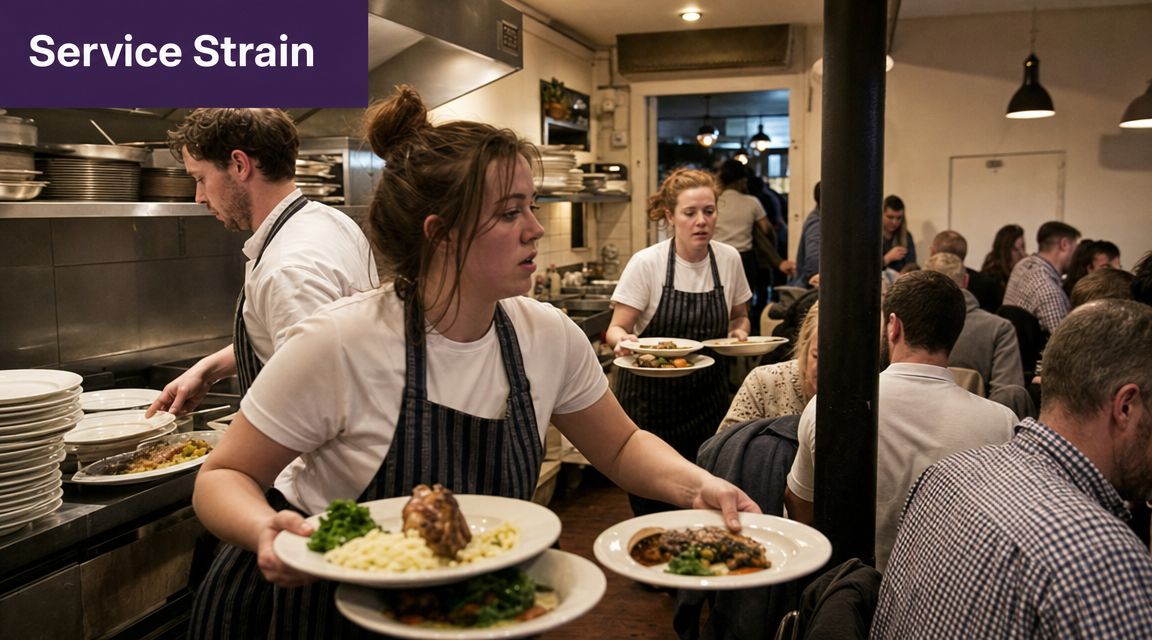
The pressure isn't imagined. A 2021 Oireachtas report found that around 40,000 workers left the Irish hospitality industry during the pandemic, which created severe recruitment and retention pressure for restaurants trying to rebuild teams in a tight labour market, as outlined in Skillnet Ireland's hospitality talent analysis.
This isn't a hiring blip
Too many owners still treat turnover as a temporary staffing issue. Hire again, train quickly, move on. That approach is costing them. When that many workers leave an industry, the market changes. The old assumption that someone suitable will always be available next week is gone.
That's why recruitment alone won't fix this. You still need to hire well, of course, and if you're filling hard-to-source roles, a specialist hospitality recruitment partner in Ireland can take pressure off. But if your operation keeps burning through decent people, every hire becomes a short-term patch.
Good staff don't leave one bad shift. They leave repeated disorder.
The warning signs are usually operational
You can spot a retention problem before the resignation lands. It usually looks like this:
- Shift resistance rises because the same dependable people are always asked to cover.
- Standards become inconsistent because new starters are learning on the fly.
- Managers get dragged into basics instead of leading service and improving margin.
- Team mood hardens because nobody believes the pressure is temporary.
The point is simple. Restaurant staff retention in Ireland isn't about morale posters, pizza after service, or a once-off wage review. It's about whether your operation is organised enough for staff to stay and do good work without burning out.
If the answer is no, turnover isn't random. It's the system speaking.
Why Your Best People Are Leaving
Let's cut through the lazy answer first. It's not just about money.
Pay matters. Nobody in hospitality works for appreciation alone. But if you believe higher wages are the whole fix, you'll miss the reasons your strongest people hand in notice. In Irish restaurant settings, the pressure points are broader and more damaging than that.
An Irish study on restaurant turnover found that dissatisfaction with management treatment, heavy workloads, and salaries that don't match the level of responsibility are primary reasons employees look elsewhere, as discussed in the Irish restaurant turnover research archive.
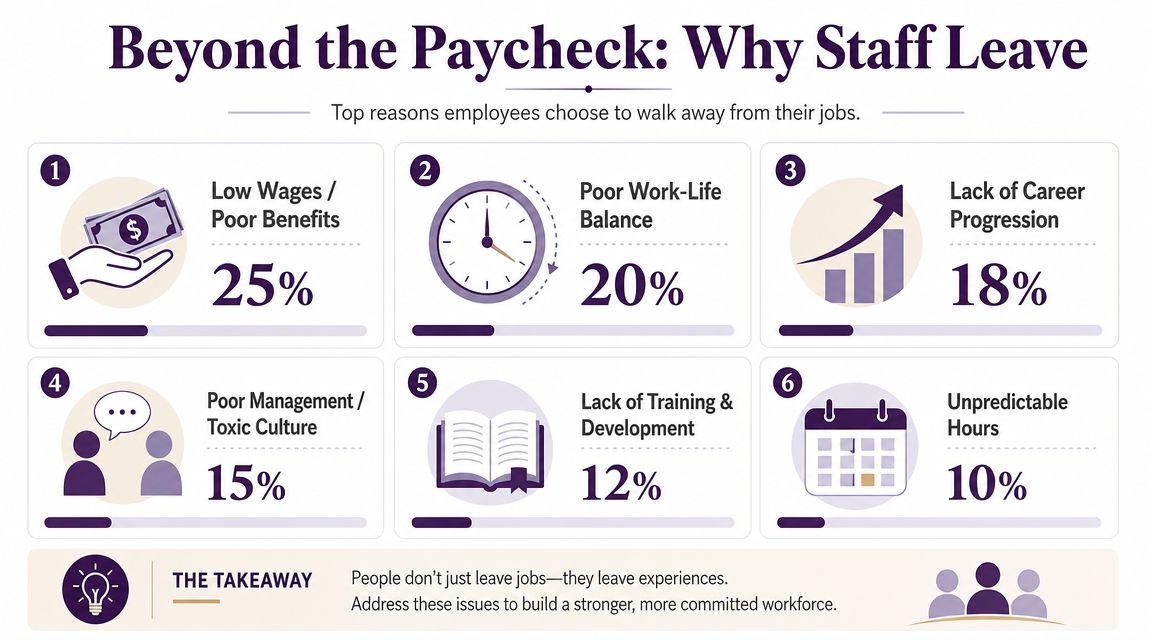
There's a reason that finding rings true to anyone who has managed a floor or kitchen in Ireland. Staff don't judge the job on hourly rate alone. They judge the whole experience of working for you.
Poor management drives exits faster than owners admit
Staff will tolerate a busy business. They won't tolerate being managed badly for long.
When managers bark instructions, ignore availability, fail to deal with conflict, or make favourites of a few trusted people, the team notices. Strong workers especially notice. They usually have options, and they won't stay in a place where the standards for management are lower than the standards expected of them.
If you're seeing repeat grievances, tension between shifts, or talented staff going quiet before leaving, don't write it off as attitude. Review how your supervisors communicate, how issues are documented, and whether your team has any confidence that complaints are handled properly. A clear grievance procedure for hospitality employers matters because people stay longer in businesses where they believe problems will be dealt with fairly.
Workload and stress aren't side issues
Restaurants are demanding by nature. That's understood. The problem starts when pressure becomes the operating model.
The same Irish research reported heavy workloads, high stress, lack of task rotation, and unbalanced hours that make work-life balance difficult. That combination pushes out exactly the staff you most need to keep. Reliable people become the solution to every hole in the rota. Eventually they realise competence is being rewarded with more strain, not more development.
Here's what that often looks like on the ground:
- Your best server closes late and opens early because they can “handle it”.
- Your chef de partie trains every new starter while still carrying a full section.
- Your assistant manager gets no protected admin time and spends every day firefighting.
- Nobody rotates out of the toughest shifts so resentment builds quietly.
Practical rule: If one team member is always the answer, your system is the problem.
Dead-end roles lose younger staff especially fast
Good people want to know where the job is going. If the answer is nowhere, they leave.
Irish hospitality retention research has shown that structured training, strong employer branding, and strategies specific to each generation improve commitment and reduce turnover. Younger workers tend to value flexibility and rapid growth, while older employees place more weight on stability and recognition. That means one-size-fits-all retention policies are sloppy management.
If you tell a capable younger team member to “stick at it” without showing a path to more responsibility, they'll go somewhere that does. If you ignore an experienced operator's need for consistency and proper recognition, they'll stop investing in your business emotionally long before they resign on paper.
The message is blunt. People don't just leave jobs. They leave poor management, unmanaged stress, and roles with no visible future.
Calculating the Real Cost of Staff Turnover
Owners often underestimate turnover because they count the obvious costs and ignore the operational ones. They'll note the ad, the interview time, maybe a recruiter fee, then move on. That's incomplete. The expensive part is what churn does to service, labour allocation, and management attention.
In Ireland, this matters at sector level as well as venue level. In 2020, the food and beverage service sector comprised over 15,000 enterprises and generated €4.7 billion in turnover, according to Irish food and beverage service sector research published via NCI's repository. When churn is widespread in a sector of that size, the damage isn't confined to individual sites.
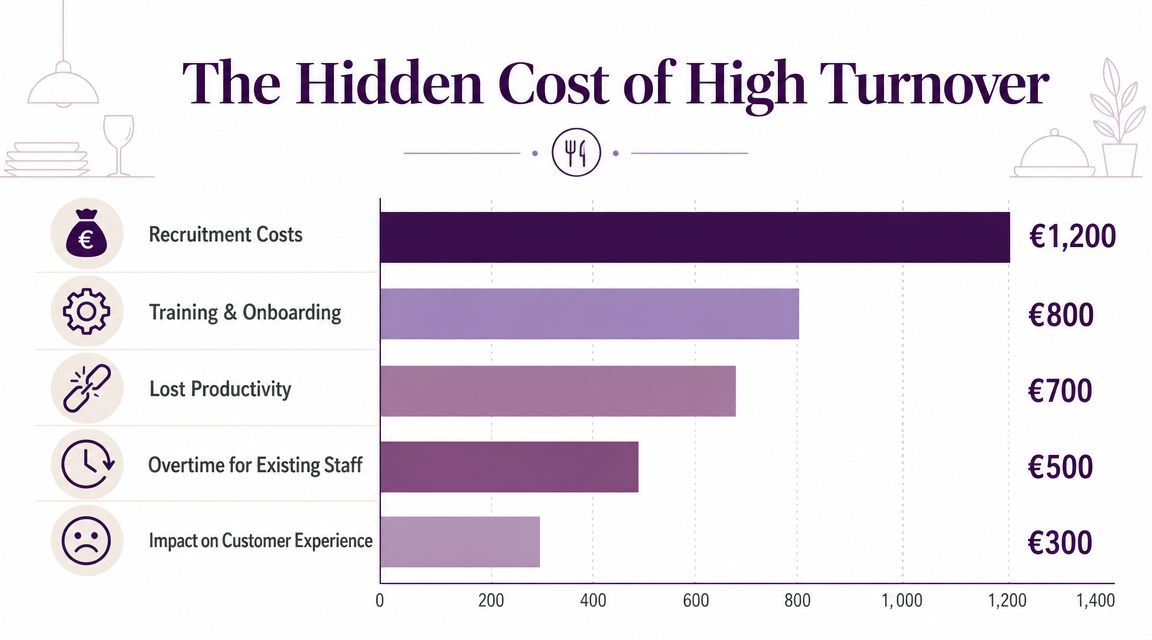
The visible costs are only the start
Every departure creates immediate workload. Someone writes the ad, screens CVs, interviews, checks references, sorts onboarding, updates payroll, explains systems, and re-trains standards that should already be embedded. In a lean restaurant, that work lands on people who already don't have spare capacity.
Then there's the service disruption. New hires rarely hit full speed on day one. Even good recruits need time to learn your menu, your section flow, your booking patterns, and your standards. While that happens, experienced staff carry extra weight.
The hidden costs are usually worse
These are the costs operators feel but rarely name properly:
- Lost consistency: Guests notice when service feels hesitant or unfamiliar.
- Manager distraction: Senior people spend their week plugging labour gaps instead of improving GP, training, or standards.
- Team fatigue: The remaining staff absorb extra shifts and emotional load.
- Standards drift: Training becomes reactive, shortcuts creep in, and discipline weakens.
- Momentum loss: Every new exit resets progress you thought you'd made.
That's why retention should sit in your operating model, not in a box marked “people issue”. If churn forces overtime, weakens service continuity, and drains management focus, it's a profit issue.
If your labour plan assumes constant replacement, your business is carrying instability as a fixed cost.
What to measure instead of guessing
You don't need a complicated dashboard to understand the damage. Start by reviewing a few basics every month:
- Time to competence: How long before a new starter can run their role without heavy oversight?
- Pressure on top performers: Who is always covering, training, or staying late?
- Service quality dips: When are mistakes, complaints, or delays most common after departures?
- Manager hours: How much time is being redirected from leadership into emergency staffing?
That's the cost framework. It forces you to see turnover for what it is. Not an occasional inconvenience. An ongoing operational drag.
Actionable Strategies to Improve Staff Retention
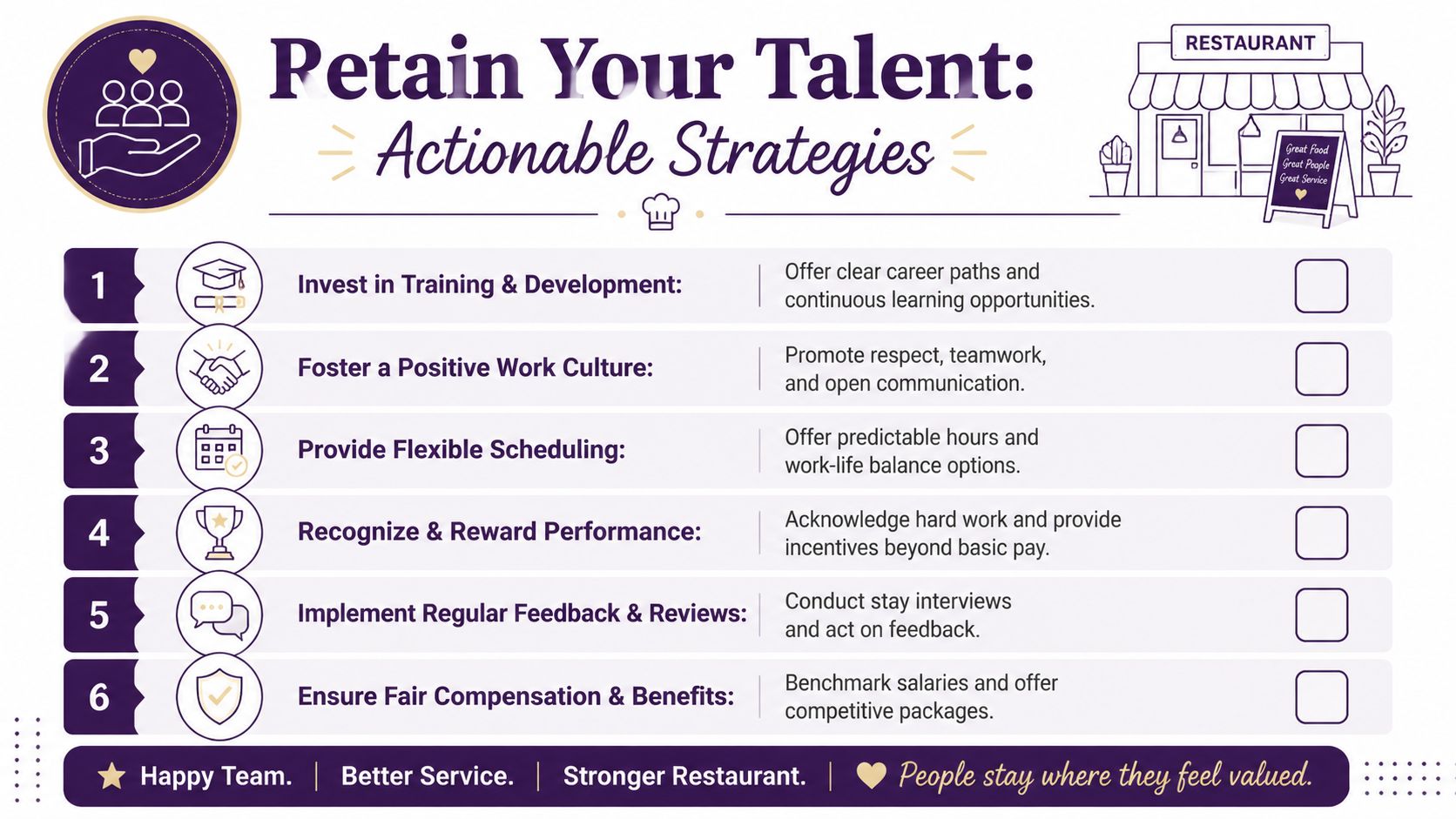
If your answer to turnover is “we need to pay more”, you're only solving one part of the problem. In Ireland, operators are already moving beyond that. Recent reporting found that 51% of hospitality businesses were offering more flexible work schedules, 39% were providing more training and upskilling, and a third were making more promotions available, according to The Irish Times reporting on how restaurants are trying to keep staff.
That's the correct direction. Retention improves when the job becomes more workable, more organised, and more worth staying for.
Fix the rota before you touch the staff noticeboard
Most retention problems are hiding in the schedule.
Unpredictable rotas tell staff their time doesn't matter. Constant changes tell them management is disorganised. Favouritism in weekend shifts or closing patterns tells them fairness is optional. If you want better restaurant staff retention in Ireland, start with roster discipline.
Use a clear weekly process:
- Set availability rules once. Don't renegotiate the same basics every week.
- Publish rotas consistently so staff can plan life outside work.
- Track fairness manually if needed. Late closes, opens, weekends, and split shifts should be visible.
- Stop rewarding reliability with punishment. Your best people shouldn't always get the worst cover burden.
A fair rota won't solve a toxic business, but an unfair one will destroy a decent business.
Build onboarding that survives a busy week
Many restaurants still onboard by shadowing a strong staff member for a shift or two and hoping for the best. That isn't onboarding. That's improvisation.
Your new starter should receive the same essentials every time. Not roughly the same. The same. Keep it simple and documented:
- Role basics: start time rules, break rules, uniform, reporting line.
- Service standards: greeting, section ownership, allergen escalation, complaint handling.
- Menu knowledge: core dishes, key modifiers, common guest questions.
- House systems: booking flow, POS basics, close-down tasks, handover expectations.
If you want outside support building proper systems around people management, Beacon Recruitment's HR consulting services are one example of a provider that helps hospitality operators formalise contracts, handbooks, audits, and compliance processes. For many restaurants, that kind of structure is what turns good intentions into repeatable practice.
Show people what progression actually means
Telling staff “there's room to grow” is useless unless you define growth.
Progression should be visible inside the operation. A commis should know what moves them towards chef de partie. A server should know what skills lead to trainer, supervisor, or assistant manager responsibility. A senior team member should know what leadership standards are expected before promotion.
Try this approach:
- Name the next role clearly instead of talking vaguely about development.
- List the behaviours required so promotion isn't based on personality or panic.
- Review progress in writing even if it's only a short monthly note.
- Create stretch tasks such as training a new hire, leading briefing, or owning a stock task.
Staff stay longer when progression is visible before the vacancy appears.
Train your managers to retain, not just control
Many operations falter at this point. They promote solid operators into management, then never teach them how to manage people. The result is predictable. Great server, poor supervisor. Strong chef, weak leader.
Managers need practical habits:
- Run short weekly check-ins instead of waiting for problems to explode.
- Correct privately and specifically rather than venting in the middle of service.
- Recognise consistency. Not just heroic effort in a crisis.
- Document recurring issues so standards are fair and defensible.
A calm, organised manager can stabilise a shaky team. A chaotic one can empty a good team in months.
Separate morale boosters from retention systems
Free coffees, staff meals, and after-work drinks are fine. They aren't retention strategy.
Real retention systems have three traits. They're repeatable, fair, and visible. Staff know how the rota works, how promotion works, how training works, and how concerns get addressed. When those basics are in place, morale improves because the workplace becomes less draining.
If money is tight, don't freeze and do nothing. Tight budgets make systems more important, not less. You may not be able to outbid the market, but you can out-organise weaker operators nearby.
Building a Long-Term Culture of Retention
A stable team doesn't come from one good rota, one training session, or one manager who happens to be decent with people. It comes from repetition. Staff stay where standards are consistent, expectations are clear, and managers behave like leaders every week, not just during inspections or staff shortages.
That's what a retention culture is. Not a soft concept. A pattern of operational behaviours that tells people this is a serious place to work.
Culture is built by line managers
Owners often say they want a better culture while leaving the daily experience entirely in the hands of supervisors who've never been trained properly. That's a mistake. Your line managers create the felt reality of the job. They decide whether feedback is respectful, whether shifts feel fair, whether standards are enforced consistently, and whether a rough week becomes a manageable problem or a full team fallout.
If you want long-term improvement, train managers in three areas:
- Communication: clear instructions, calm corrections, proper follow-up.
- Planning: rota discipline, prep for busy periods, sensible delegation.
- Coaching: helping staff improve before frustration turns into resignation.
Retention should be part of operating rhythm
If retention only gets discussed after someone quits, you're always late.
Build it into the monthly rhythm of the business. Review who is progressing, who is overloaded, where scheduling complaints are coming from, and which managers are keeping people engaged versus wearing them down. This doesn't need corporate theatre. It needs consistency.
A simple retention rhythm could include:
- Monthly stay conversations with a few key staff, especially your dependable middle layer.
- Quarterly role-path reviews so development isn't forgotten during busy periods.
- Manager calibration on discipline, recognition, and rota fairness.
- Exit pattern review to spot recurring faults in one department or under one leader.
You don't build loyalty by asking people to be committed. You build it by making the job worth committing to.
The competitive advantage is operational calm
The best retention outcome isn't just fewer vacancies. It's a calmer business.
When staff know the systems, trust the managers, and can see a future, service gets steadier. Training gets easier. Guests get a more consistent experience. Managers spend less time patching labour gaps and more time improving performance. That's not a “nice to have”. It's an operational advantage that weaker competitors struggle to copy because they're still stuck in reactive mode.
If you're serious about restaurant staff retention in Ireland, stop treating it as a side project. Build it into how the venue runs. That's where lasting improvement comes from.
Your Questions on Staff Retention Answered
How do I measure retention properly in a restaurant?
Don't rely on gut feel. Build a basic monthly tracker. Record starters, leavers, length of service, department, manager, and reason for exit. Then split your team into groups that matter operationally, such as kitchen, bar, floor, and supervisors.
You also need to track who stays, not just who leaves. If your strongest people are leaving inside their first year, or if one manager loses staff faster than another, that tells you far more than a single headline turnover figure.
What can I do this week if morale is poor and I've no budget?
Start with control and clarity. Publish the next rota cleanly and on time. Hold short one-to-one check-ins with your key people. Ask what's making the job harder than it needs to be, then fix one or two practical irritants immediately.
Low-cost wins are usually operational:
- Sort break discipline so people get the pauses they're due.
- Stop last-minute shift chaos by tightening confirmation and cover rules.
- Clarify responsibilities so nobody is carrying hidden extra work.
- Acknowledge good performance publicly and address poor behaviour privately.
Staff don't need management speeches. They need evidence that someone is running the place properly.
Where should I prioritise if I can't fix everything at once?
Start where turnover creates the most pressure on service. For most restaurants, that means rota fairness, manager behaviour, and onboarding consistency.
Use this order:
- Stabilise scheduling so the job becomes more predictable.
- Deal with any manager who is driving exits through poor treatment or disorganisation.
- Standardise onboarding so every new hire gets a fair start.
- Map progression paths for the people you most want to keep.
Don't launch six initiatives badly. Fix three core systems properly. That's usually enough to change the mood of the business and slow the revolving door.
If you're tired of replacing staff without ever fixing the pattern, talk to Beacon Recruitment. They work with Irish hospitality operators on the operational side of people problems, including recruitment, HR compliance, and the systems that help venues keep good staff longer.
Is High Staff Turnover Breaking Your Operation?
Don’t let chaotic rotas and poor onboarding drain your margins and ruin your service. Book a Free Consultation with Beacon today to audit your retention systems and stop the revolving door.