July 16, 2026
What Is Statutory Redundancy in Ireland: Eligibility & Pay
Our guide explains what is statutory redundancy in ireland, who is eligible, and how to calculate payments. Keep your business compliant.
You finish service, sit down with the rota, payroll, supplier invoices, and a set of trading figures you've already looked at twice. Lunch has softened. Midweek rooms aren't moving the way they used to. The restaurant is carrying labour you can't justify for the volume coming through the door. You don't want to cut heads, but you also can't keep pretending the numbers will fix themselves.
That's where a lot of Irish hospitality owners first ask a version of the same question. What is statutory redundancy in Ireland, and when do you have to pay it?
In practice, redundancy is never just an admin task. In a hotel, pub, café, or restaurant, you're often dealing with people you know well, mixed contracts, changing shifts, long service, and a team that sees everything. One wrong move can create a morale problem, an operational problem, and a legal problem at the same time. If you need steady HR support while working through difficult staffing decisions, that's why many operators lean on ongoing HR support retainer visits rather than trying to improvise under pressure.
That Difficult Conversation Every Business Owner Faces
A genuine redundancy situation rarely starts with a legal form. It starts with a business reality.
A boutique hotel loses regular corporate bookings. A restaurant closes lunch service because demand has shifted. A bar trims back quieter opening hours and no longer needs the same staffing structure. In each case, the problem isn't that an employee has done something wrong. The problem is that the business no longer needs the same role in the same way.
That distinction matters.
Hospitality owners often delay the decision because the human side is hard. You know the employee. You know their family situation. You know they helped you through a rough season, a chef shortage, or a reopening period. But if the role has disappeared, trying to avoid the issue by reducing hours indefinitely or dressing it up as something else usually makes matters worse.
A badly handled redundancy rarely stays contained. It spills into grievances, team distrust, and avoidable WRC exposure.
The law in Ireland treats statutory redundancy as a formal process, not a loose business option. If the role is permanently eliminated, there's a legal route. If the role still exists and you're really reacting to performance, conduct, or personality conflict, redundancy is the wrong route entirely.
Why hospitality businesses get caught out
The sector creates edge cases that cleaner office environments don't face as often:
- Variable rosters: A team member may work very different patterns across the year.
- Seasonal demand: Owners often assume a quieter season automatically means redundancy. It doesn't.
- Close-knit teams: Selection can look personal even when the business issue is real.
- Reduced hours before closure: Short-time work and layoff periods can trigger employee rights earlier than some employers expect.
If you're under pressure, the temptation is to move fast. The safer approach is to slow down just enough to check whether you're dealing with a genuine redundancy, who qualifies, and how the process should run.
The Legal Definition of a Genuine Redundancy
Redundancy is about the job, not the person.
That's the cleanest way to think about it. If a role disappears because the business no longer needs that work done in the same way, you may be in redundancy territory. If the job still exists and the issue is that the employee isn't meeting standards, that belongs in capability or disciplinary management instead. Employers who blur those lines often end up in the same legal territory as an unfair dismissal claim.
The simple test
Ask yourself one direct question.
If this employee left tomorrow, would you still need someone else doing substantially the same job?
If the honest answer is yes, be careful. Calling it redundancy won't fix a weak performance issue or a relationship breakdown. In hospitality, I often see this when an owner says a role is redundant but still needs breakfast service covered, still needs a duty manager on the same shifts, or still plans to recruit someone cheaper into almost the same slot.
What a genuine redundancy usually looks like
A genuine redundancy generally arises when the business no longer needs a particular role because of a real organisational change. In hospitality, common examples include:
- Service reduction: You stop offering lunch, late bar food, or seven-day breakfast service.
- Operational restructure: You centralise admin, merge supervisory duties, or flatten management.
- Closure of part of the business: A function room, outlet, or accommodation block closes.
- Changed methods of working: New systems or processes remove the need for certain tasks.
- Business contraction: Trading conditions no longer support the same headcount in a role category.
That still doesn't give you a free hand. You need to show the business rationale is real and that your actions line up with it.
Practical rule: If your paperwork says the role is gone, your rota, recruitment ads, and internal decisions should say the same thing.
What redundancy is not
Some situations are routinely mislabelled as redundancy:
- Performance concerns dressed up as restructuring
- Conduct issues handled outside a disciplinary process
- Personality conflicts between owner, manager, and employee
- A wish to replace a higher-paid worker with a lower-paid one in the same job
- Temporary quiet periods without a real longer-term change in the role
In hospitality, that final point is especially important. A rough quarter doesn't automatically mean a role has ceased to exist. A legal redundancy case is stronger when you can clearly connect it to a sustained business change, not a nervous reaction to one poor month.
Who Is Eligible for a Redundancy Payment
The eligibility question often gets messy in hospitality because the contract on file, the rota in practice, and the payroll history do not always line up.
A chef who works every summer for years may still raise a continuity issue. A bar supervisor moved onto short-time over a quiet winter may have rights you did not expect. If you get this wrong, you risk underpaying a valid claim or promising a payment that is not due.
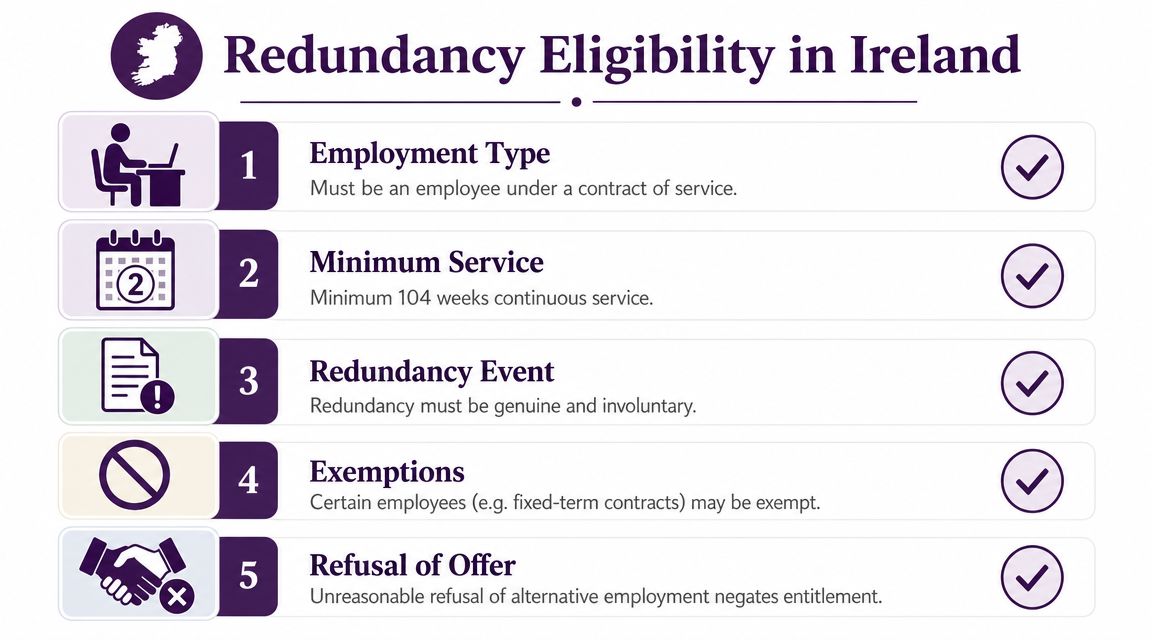
The starting point is clear enough. An employee generally needs 104 weeks of continuous service in fully insurable employment, usually under Class A PRSI, to qualify for statutory redundancy. In practice, the dispute is rarely about the headline rule. It is about whether the service was continuous and whether the employment status supports the claim.
The checks that matter before you say yes or no
Review the records before you make any statement to the employee.
- Continuous service: The employee generally needs 104 weeks of continuous service.
- PRSI class: Statutory redundancy usually depends on fully insurable employment, typically Class A PRSI.
- Age: Service before age 16 does not count towards the qualifying period.
- Genuine redundancy situation: Eligibility only arises if there is an actual redundancy situation, not just fewer hours or a breakdown in relationships.
- Employment pattern: Casual, seasonal, and variable-hour arrangements need a close review of the actual working history.
In hotels, pubs, and restaurants, that last point causes the most mistakes. Owners often focus on whether someone has been connected to the business for a long time. The better question is whether the employment record shows qualifying service without a break that defeats continuity.
Common hospitality trouble spots
Seasonal rehires are one example. If a team member returns every high season, you cannot assume they either qualify or do not qualify based on gut feel. The contract terms, gaps between periods of work, payroll treatment, and PRSI record all matter.
Variable hours create a different problem. A worker may move from full-time summer shifts to reduced winter hours and still remain an employee with continuous service. Reduced hours do not erase service.
Layoff and short-time arrangements need care as well. The Workplace Relations Commission sets out that employees put on layoff or short-time for 4 weeks or more may start the redundancy process using Form RP9. It also explains that if an employee resigns before redundancy takes effect, entitlement can be affected unless Form RP6 is used correctly. That guidance is worth checking before you treat layoff as a low-risk holding position: WRC redundancy guidance.
Practical checks for venue owners
Before you confirm entitlement, check these points against payroll and HR records:
- Seasonal staff: Review whether there was genuine continuity of service across repeat seasons.
- Variable-hour employees: Check the employment relationship, not just the weekly rota pattern.
- Layoff or short-time cases: Confirm whether the employee has gained the right to trigger a redundancy claim.
- Employees talking about leaving: Handle paperwork carefully. Resignation timing can affect entitlement.
- PRSI history: Confirm the worker was in the correct insurable class before you make a final call.
One practical rule has saved many employers from avoidable errors. Trust payroll records before assumptions.
If you are also working through the tax position on any payment, see Calculating redundancy pay tax.
In hospitality, rushed decisions usually cause the problem. Check service dates, contracts, PRSI class, layoffs, and resignation risk before you tell someone they do or do not qualify. Once that conversation goes wrong, it is hard to pull back.
How to Calculate the Statutory Redundancy Payment
The statutory calculation is straightforward once you strip away the noise.
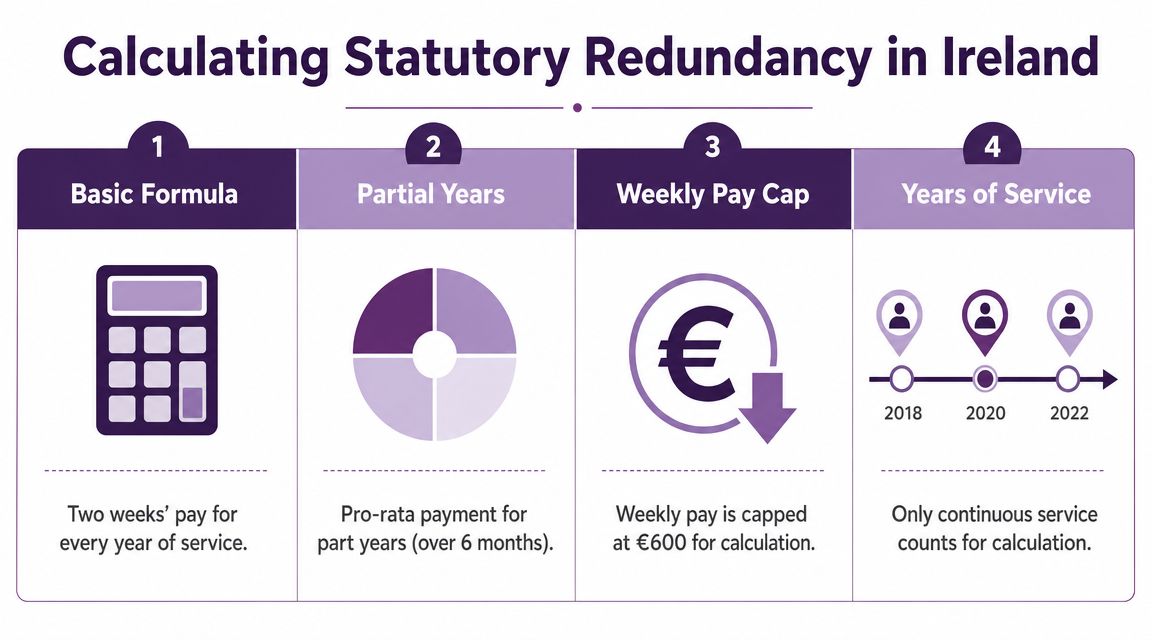
Eligible employees receive two weeks' normal weekly remuneration for every year of service plus one bonus week, and the calculation is capped at €600 per week, according to the Department of Enterprise redundancy payment rules. The same guidance also confirms the statutory payment is tax-free.
The formula in plain English
If the employee qualifies, you calculate the payment using:
- Two weeks' normal weekly pay for each year of service
- Plus one extra bonus week
- Subject to a maximum weekly amount of €600
That weekly cap matters more than many employers realise. If someone earns above the cap, you still calculate statutory redundancy using €600, not their actual weekly pay. If they earn below the cap, you use their actual normal weekly remuneration.
Worked example below the cap
Take a kitchen porter on €550 per week.
Because the weekly pay is below the cap, the statutory calculation uses €550. For each year of service, the employee gets two weeks at €550, and then there is one additional bonus week at €550 at the end of the calculation.
Hospitality employers should stay disciplined. Use the statutory formula as it stands. Don't mix in notice, untaken holidays, service charge issues, or discretionary top-ups and call the whole amount “redundancy”. Keep each payment category separate in your own records and in the employee explanation.
Worked example above the cap
Now take a head chef earning €900 per week.
For statutory redundancy purposes, you do not use €900. The weekly amount is capped at €600, so every part of the statutory formula is based on €600 only. That means an employee on €800 per week is also still calculated using the €600 ceiling, as the Department's guidance makes clear in practical effect.
What “normal weekly remuneration” can trip up in hospitality
Operators can miscalculate here, even when they know the formula.
Hospitality payroll is rarely tidy. Staff may have variable rosters, overtime patterns, changing shift mixes, or earnings that move through the year. You need a defensible view of what the employee's normal weekly remuneration is for statutory purposes, and you should be able to show how you arrived at it from your payroll records.
Common mistakes include:
- Using a random recent week that doesn't reflect normal pay
- Letting a quiet period depress the figure without checking if it's representative
- Blending contractual pay and discretionary elements without a clear rationale
- Assuming high earners receive a higher statutory amount despite the cap
If a manager can't explain the calculation clearly on paper, the payment probably needs checking before it goes out.
Statutory payment versus enhanced packages
Some employers choose to pay more than the legal minimum. That can make commercial or employee-relations sense, especially where you want a clean and respectful exit. But that's an enhanced arrangement, not the statutory baseline.
For the tax side of broader redundancy packages, especially where employers or employees are trying to separate statutory entitlements from other termination sums, a practical explainer on Calculating redundancy pay tax can help frame the distinction. Keep in mind that the statutory redundancy amount itself, as noted above, is tax-free under the Department's guidance.
The safest approach is to document three things clearly: the legal minimum, any additional discretionary amount, and any separate sums such as notice or holidays. When those categories blur, disputes follow.
A Step by Step Guide to the Redundancy Process
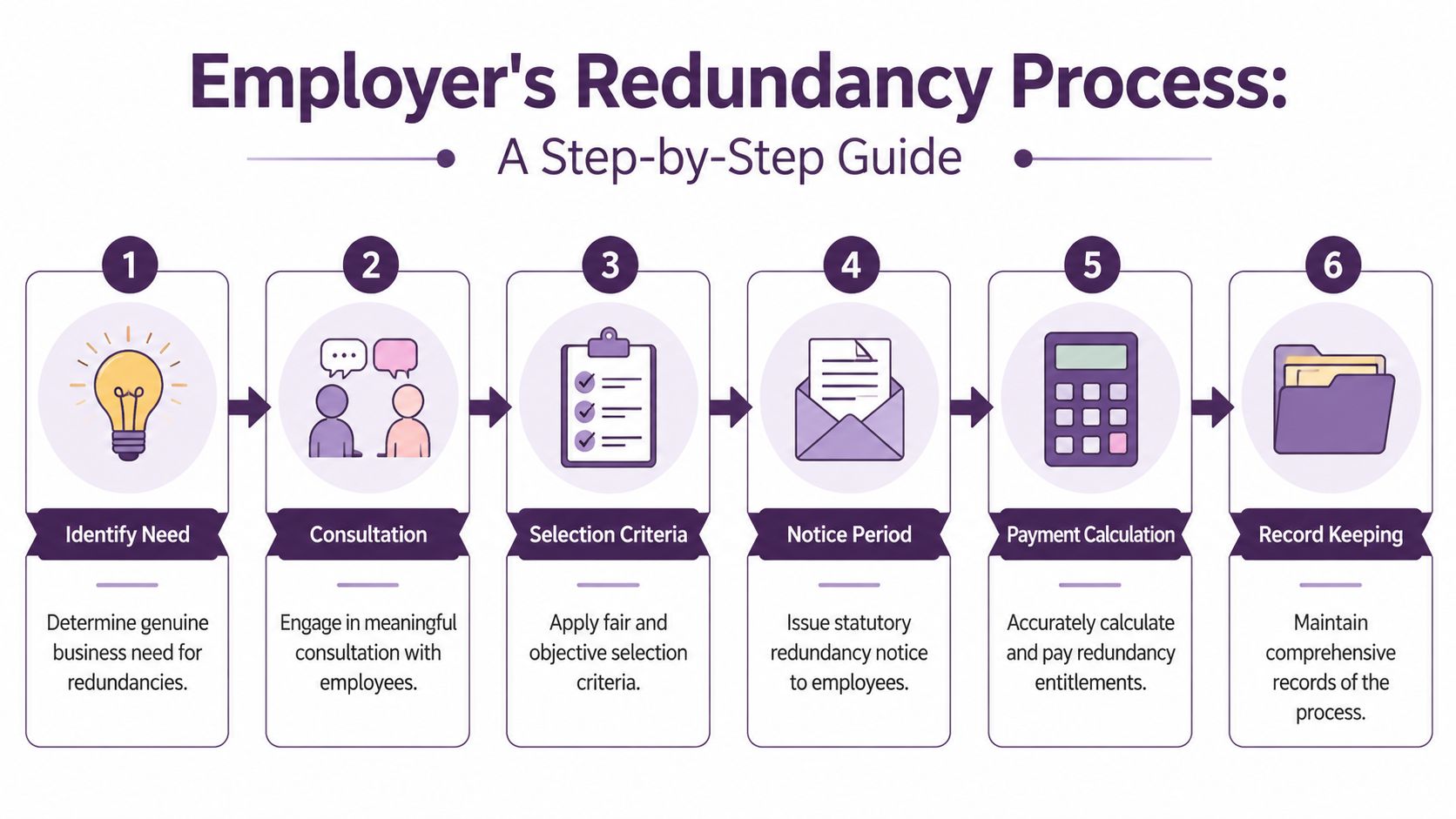
Knowing what statutory redundancy is in Ireland isn't enough. Execution is where employers usually run into difficulty.
In hospitality, the process often unravels because the owner is trying to protect the business, keep service running, and communicate with a team that notices every shift change. You need a process that is fair, documented, and calm.
Step one, define the business reason properly
Write down the actual business reason before you speak to anyone.
Is the role disappearing because a service is ending, the structure is changing, or part of the operation is closing? If your reason can't survive being written in one plain paragraph, it probably isn't ready. Keep documents, financial context, restructure notes, and operational plans aligned.
This also helps you avoid crossing into other legal areas. For example, if what's really happening is a sale, outsourcing arrangement, or handover of an operation, you may need to pause and examine issues like TUPE and transfer of undertakings before calling anything a redundancy.
Step two, identify the correct pool
In hospitality, selection problems usually start here.
If you need one fewer restaurant supervisor, your selection pool may be all restaurant supervisors doing comparable work, not just the person whose face you first thought of. If you need fewer kitchen hours across a section, you need to think carefully about who is doing interchangeable work.
Ask:
- Who does substantially similar work
- Who can rotate into that work
- Whether titles differ but duties overlap
- Whether your structure has changed or only one person is being targeted
A weak pool creates a weak process.
Step three, use fair selection criteria
If more than one employee is in scope, apply criteria that you can explain and evidence.
Good criteria are objective and linked to business need. Skills, qualifications required for the revised structure, documented flexibility across functions, or clearly recorded experience may all be relevant depending on the role. Criteria become risky when they depend on manager preference, informal impressions, or old frustrations.
The fairest criterion is the one you can support with records, not the one that sounds reasonable in conversation.
Step four, consult before deciding
Consultation should be meaningful, not ceremonial.
Tell the employee the business reason, explain why their role may be affected, and give them a genuine chance to respond. In a hospitality setting, that conversation needs privacy and planning. Don't hold it in the office with the service bell going. Don't have it five minutes before a busy shift. Don't make promises you can't keep.
Useful consultation topics include:
- The proposed change: What's changing in the business
- Why this role is affected: The operational reason, not vague language
- Possible alternatives: Different duties, locations, patterns, or vacancies if they exist
- Employee feedback: Questions, challenges, and practical suggestions
Sometimes consultation confirms your original decision. Sometimes it exposes a flaw in the pool or reveals a workable alternative. Both outcomes are useful.
Step five, confirm notice and payment carefully
Once the process is complete, confirm the decision properly and make sure the paperwork matches it.
Your letter should reflect the consultation history, the reason for redundancy, the termination date, and what payments are due. Keep the statutory redundancy calculation separate from any notice payment, holiday pay, or discretionary terms. Give the employee the required documentation and retain copies for your own records.
Step six, keep a full paper trail
This is not busywork. It's protection.
Maintain records of:
- Business rationale
- Selection pool decision
- Criteria used
- Consultation notes
- Letters issued
- Payment calculations
- Final forms and acknowledgements
Hospitality employers often rely too much on informal management. That works until someone challenges the process. At that point, your memory won't carry the case. Your records will.
Hospitality Pitfalls and Your Compliance Partner
Friday afternoon. A wedding party is checking in, two senior staff are off, trade is uneven, and you are looking at payroll that no longer matches demand. In hospitality, redundancy decisions rarely arrive in calm conditions. They land in the middle of service, with variable hours, seasonal peaks, and managers covering jobs in a way that looks practical on the floor but creates legal risk on paper.
A hotel may have front office staff on mixed contracts, a restaurant may rotate chefs across sections, and a pub may cut hours for weeks before deciding a role is no longer sustainable. Those details matter. They often decide whether a redundancy stands up or turns into a WRC problem.

The common traps
The mistakes I see in Irish hospitality are usually operational mistakes with legal consequences.
- Variable hours are treated casually: Weekly pay is estimated instead of calculated from a clear, defensible payroll method.
- Seasonal service is misunderstood: Employers assume a worker who drops off the roster in quieter months has broken service when that is not always the case.
- Layoff history is handled informally: A business relies on short-time or layoff arrangements for too long, then moves to redundancy without checking whether the records and notices support that step.
- Selection is based on preference: In a small venue, it is easy to target the person a manager has lost confidence in rather than identify the role that has genuinely disappeared.
- The job still exists in practice: Duties are split across the remaining team, or a replacement appears a few weeks later under a different title. That is one of the fastest ways to undermine your position.
These problems are common because hospitality businesses run on flexibility. Employment law does not.
Why outside support often makes sense
Owners are often making redundancy decisions while trying to keep rooms filled, shifts covered, and guests happy. That pressure leads to rushed conversations, loose records, and wording that creates avoidable exposure. A good HR adviser brings distance, structure, and the discipline to test whether your rationale matches what is happening in the business.
If you are comparing providers, this roundup of the best HR solutions in Dublin gives a useful sense of the market. For hospitality, I would look for someone who understands fluctuating rosters, payroll built around premiums and variable hours, and the practical difference between a temporary drop in trade and a genuine redundancy situation.
Support is not just about forms. It is about pressure-testing the decision before you put it in writing.
If you are facing a possible redundancy situation in a hotel, restaurant, bar, or multi-site hospitality business, Beacon Recruitment can help you handle it properly. Their HR and compliance support is built for Irish hospitality operators who need clear advice, defensible process, and practical help that fits the pace of a live venue.
Stop Guessing With Difficult Staff Decisions
Turn stressful, informal chats into a clear, compliant, and respectful redundancy process. Talk to our hospitality experts to get practical HR guidance that protects your business and your team.