July 16, 2026
Working Time Act Ireland Breaks Hospitality: WRC Compliance
Stay compliant with 2026 WRC rules. Our guide covers working time act Ireland breaks hospitality, rest, rotas, and pay for hotels & restaurants.

Friday afternoon. A chef has called in sick, a coach group has added covers, the bar manager wants one more late closer, and your duty manager is staring at the rota wondering whether moving one person from breakfast to evening service will solve the problem or create a legal one.
That's how working time issues usually surface in hospitality. Not in a boardroom. On the floor, under pressure, when service comes first and paperwork gets pushed back until later.
For hotels, pubs, restaurants, cafés, and mixed-use venues, the Working Time Act Ireland breaks hospitality question isn't academic. It sits inside payroll, staffing, guest experience, and risk. If your rota looks compliant but the actual hours worked tell a different story, that gap is where trouble starts.
The Rota Puzzle Why Working Time Rules Matter
Managers in hospitality rarely build a rota once and leave it alone. They patch it. Someone swaps a shift. A wedding runs late. A breakfast team member stays on to cover lunch. A bartender closes and then returns early for stock or a function. On paper, each change can look minor. In reality, a week of small decisions can wipe out legal rest periods and break entitlements.

Hospitality has always carried this pressure. A TASC study on hotels and restaurants reported average weekly hours of 42.3 in 1992, and found that more than 40% of workers in hospitality were part-time, compared with 23% in the total workforce in Ireland, as outlined in this hospitality employment analysis. That mix of long hours and heavy part-time use is one reason the sector draws close scrutiny on working time.
Why hospitality gets caught out
The risk usually isn't a manager deciding to ignore the law. It's a business relying on habits that no longer stand up when someone asks for records.
Common pressure points include:
- Split shifts that drift too far: A team member works breakfast, goes home, then comes back for dinner service. If the rest pattern around those shifts isn't managed properly, the problem may only appear after several days of similar scheduling.
- Late finishes followed by early starts: This is one of the fastest ways to break daily rest rules.
- Breaks that exist only on the rota: Writing in a break isn't the same as ensuring the employee received it.
- Managers covering everywhere: Salaried staff are often treated as if normal limits don't apply. That assumption creates risk.
If a WRC inspector or an adjudication process asks what happened, a verbal explanation won't carry much weight without records.
What managers often miss
The law meets hospitality at the point where planning and reality diverge. That matters because service businesses often build rotas around forecast demand, then run the shift around actual demand. The legal exposure sits in the second part.
What works is simple, even if it isn't easy. Build the rota with compliance in mind, then verify actual start times, finish times, and breaks. What does not work is assuming good intentions will cover poor records.
Your Core Obligations Under the Working Time Act
The legal starting point is the Organisation of Working Time Act 1997. For most hospitality employers, the practical question is straightforward: what must you deliver every week, every shift, and every day between shifts?

The core rules are set out in the Workplace Relations Commission guidance on working hours and rest entitlements. That guidance reflects the standard limits many hospitality operators work with every day.
Core rule: An employee should not work more than an average of 48 hours per week, usually averaged over a 4-month reference period for most workers. Exceptions can allow 6 months for seasonal work or continuity of service and 12 months where a Labour Court-approved collective agreement exists.
The non-negotiables on breaks and rest
These are the baseline entitlements that managers need to know without checking a file:
Rest during the day and week: Employees are entitled to 11 consecutive hours' daily rest per 24 hours and 24 consecutive hours' weekly rest per seven days.
Breaks during the shift: Employees are entitled to a 15-minute break after more than 4.5 hours worked and a 30-minute break after more than 6 hours worked, which may include the first break.
Those rules are easy to read and harder to operate in a live venue. A six-hour shift that becomes six and a half because a coach arrives late is no longer a short shift. A supervisor who “grabs food while working” may not have received a proper break at all.
What these rules mean in practice
Managers should translate the Act into rota decisions:
- When assigning closes and opens: Check the gap between finish time and next start time, not just whether the two shifts sit on different calendar dates.
- When approving extended shifts: Look at the break entitlement created by the actual hours worked, not the original plan.
- When covering absence: Don't fix a staffing problem by creating a compliance problem elsewhere.
- When reviewing busy weeks: Use the reference period correctly. One heavy week may be manageable if the average remains compliant, but that only helps if hours are tracked properly.
If you need a plain-English legislative refresher, Beacon's guide to the Organisation of Working Time Act 1997 is a useful operational summary for employers.
Where businesses go wrong with the basics
A lot of venues know the headline rules. Fewer apply them consistently. The usual failures are operational:
- Breaks aren't protected: Staff are told to take one “when it quietens down”.
- Records are thin: Start and finish times may exist, but break records don't.
- Managers assume flexibility solves everything: It doesn't. The law still applies when the week gets messy.
- The rota is treated as proof: It isn't. It's only a plan.
The law is manageable. The danger comes from treating it as background admin instead of a live operating rule.
Common Hospitality Traps That Lead to Fines
The most expensive mistakes in hospitality usually come from assumptions. One of the biggest is this: “We know the standard break rules, so we're covered.” Many venues aren't.
The shop employee rule catches mixed-use venues
There is a specific statutory rule for certain shop employees. Under the relevant Irish Statute Book provision on shop employee working conditions, employees whose hours include 11:30 a.m. to 2:30 p.m. must, after 6 hours' work, be allowed a one-hour break that must commence within that window.
That creates a real trap for hospitality businesses that don't think of themselves as shops.
Examples include:
- Hotel outlets with grab-and-go counters
- Cafés attached to retail areas
- Delis, bakery counters, or food halls
- Venues where front-of-house staff work in a retail-style service setup
If that employee falls into the shop category for these purposes, the ordinary thirty-minute mindset can leave you short of the legal requirement.
A venue can describe itself as hospitality and still have parts of the operation that trigger shop-employee break rules.
Split shifts are not harmless because they are common
Split shifts are standard in hospitality. Breakfast and dinner. Lunch and late bar. Conference turnaround and evening event. The problem isn't the existence of split shifts. The problem is using them without checking the full rest picture.
What does not work:
- Using split shifts repeatedly without checking daily rest
- Letting a team member close one department and reopen another
- Assuming a long unpaid gap in the middle of the day fixes every issue
What tends to work better:
- Setting role-based guardrails so breakfast staff aren't routinely drafted into late service
- Reviewing actual clocked hours instead of relying on the planned rota
- Flagging high-risk patterns such as back-to-back closes and opens
Seasonal pressure creates blind spots
Hospitality businesses often run hot during events, holidays, tourism peaks, and wedding season. Managers then lean on reliable staff, stretch shift lengths, and postpone admin. That's understandable operationally. It's risky legally.
The issue isn't that busy periods are forbidden. The issue is that busy periods expose weak systems. If the team is already using manual timesheets, if supervisors can alter shifts informally, or if break recording is inconsistent, the pressure week is when those flaws become visible.
Retail-style duties matter more than job title
A common error is to classify staff by broad business type instead of by where and how they work. If a person spends their shift in a counter service area that functions like a shop environment, the break analysis may differ from the assumption the venue has always used.
That's why I tell clients to ask operational questions, not branding questions:
- Where does the employee work?
- What duties do they carry out?
- Does their shift run through the mid-day trading window?
- Are you only giving the standard break because “that's what we do for everyone”?
The hidden exposure in working time act Ireland breaks hospitality issues often sits in these edge cases, not the obvious ones.
How to Build an Audit-Proof Rota System
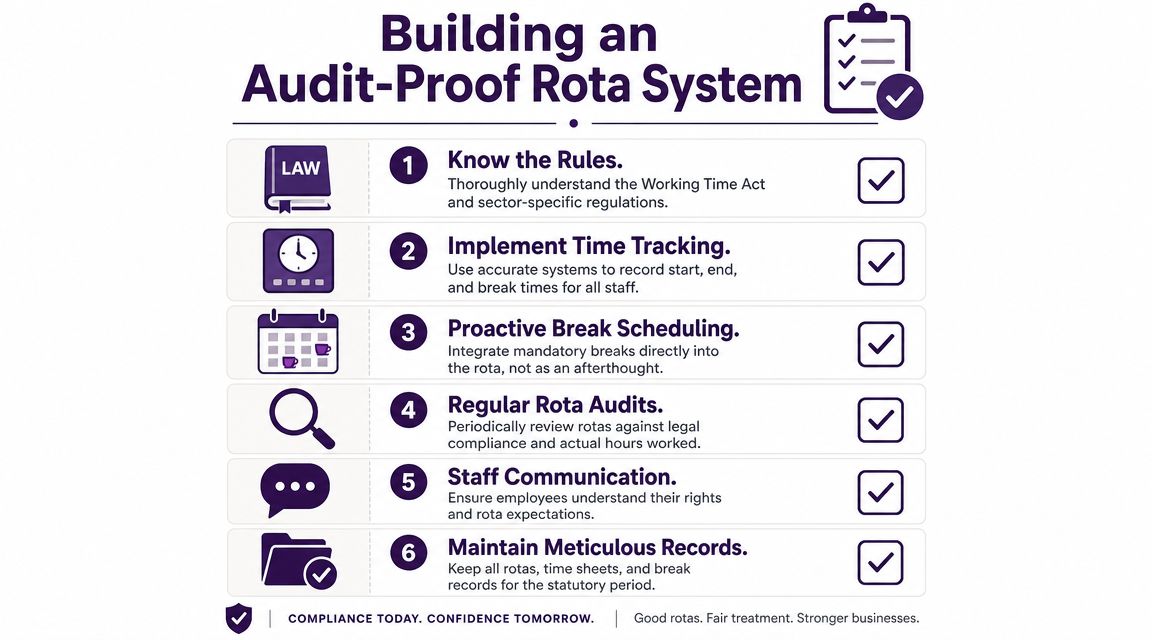
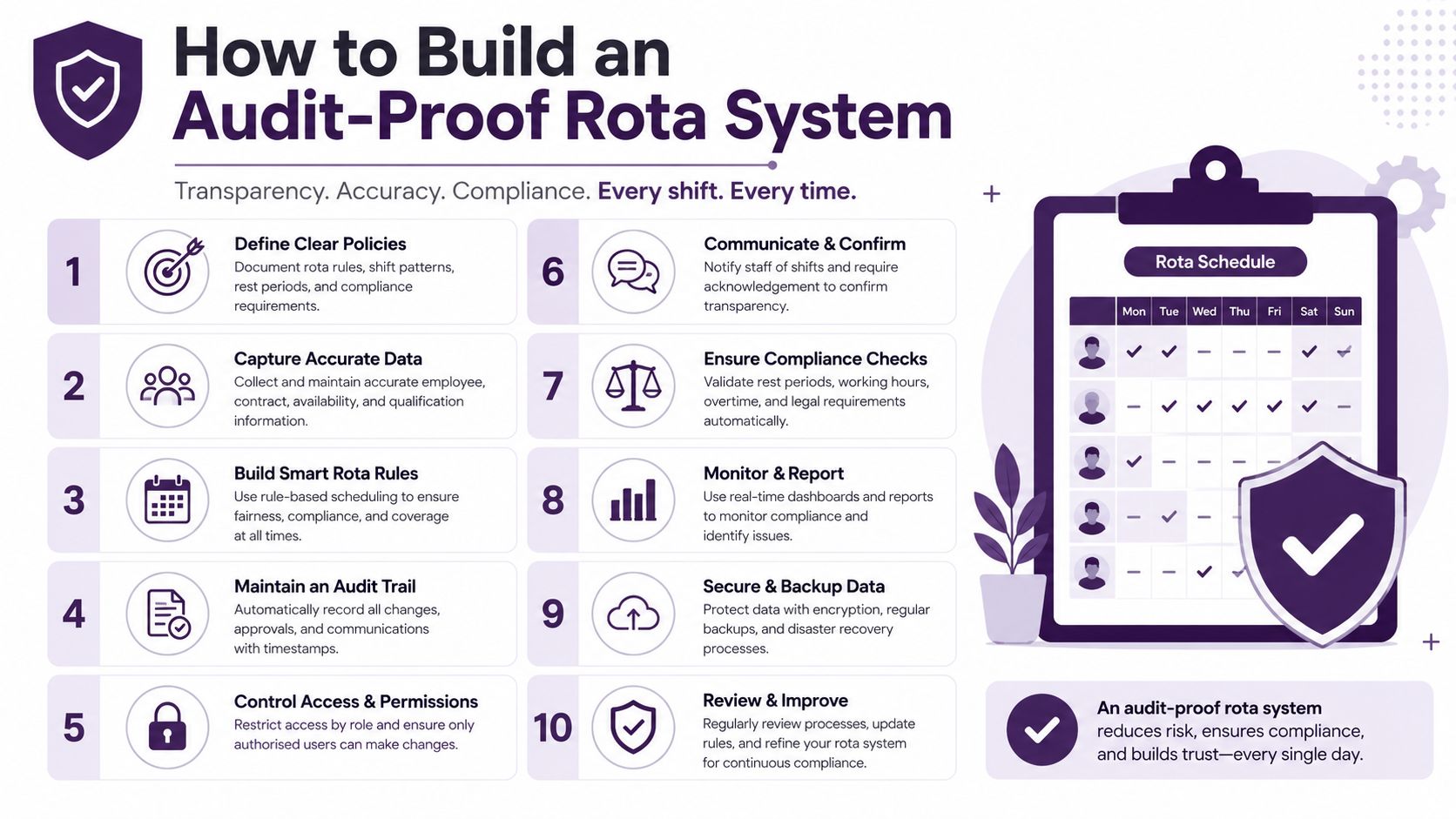
Most compliance problems start before the shift begins. They start in the system behind the rota. If managers can't see rest risks, break entitlements, or actual hours in one place, they're managing blind.
Start with records, not software
You don't need the fanciest tool. You need a system you'll use every day. That can be digital or paper-based, but it must be consistent.
A defensible setup usually includes:
- Planned rota records: Who was scheduled, in which department, and for what hours.
- Actual time records: Start times, finish times, and break times taken.
- Manager sign-off: Someone accountable for checking exceptions, not just collecting them.
- Retention discipline: Records filed in a way that can be produced quickly if requested.
If your current process can't show the difference between the planned shift and the hours really worked, fix that first. For a practical overview of what employers should maintain, Beacon's guide on working time records is a useful checkpoint.
Build compliance into the rota before service starts
Don't leave breaks to chance. Place them into the staffing plan and make cover visible.
A workable rota process looks like this:
- Check the previous shift before assigning the next one. Daily rest issues often appear here first.
- Mark break windows on longer shifts rather than adding a vague note.
- Review mixed-use roles separately, especially café, deli, and retail-style counter staff.
- Approve exceptions centrally so line managers don't solve every staffing problem ad hoc.
- Compare rota to clock data at the end of the week and investigate mismatches.
Operational advice: If a break only exists because a manager intended it to happen, you don't yet have a compliant process.
Train managers on what evidence looks like
Many supervisors know how to run service. Fewer know how to leave an evidence trail. That's the gap.
Train them to answer these questions with documents:
- When did the employee start and finish?
- When was the break taken?
- Was the break uninterrupted?
- If the shift changed, who approved it?
- If a rest issue appeared, what corrective action followed?
Some venues use integrated scheduling and attendance tools. Others use payroll-linked clocking, spreadsheet checks, or external HR support. Beacon Recruitment is one option in the Irish market that supports hospitality employers with HR and compliance systems, including contracts, handbooks, people audits, and WRC-focused processes. The right choice matters less than consistency. A simple system used properly will usually outperform a complex system nobody audits.
The Real Cost of Getting Breaks Wrong
Managers sometimes treat break breaches as low-grade admin issues. They aren't. They sit at the point where employment law, payroll exposure, staff relations, and brand reputation meet.
Small rota decisions can become formal disputes
A missed break on one day may seem manageable. The problem comes when the same pattern repeats, staff talk to each other, and someone decides to challenge it. Then the conversation changes from “we were short-staffed” to “show me the records”.
In that situation, the business is usually tested on three things:
- Whether the entitlement existed
- Whether it was provided
- Whether the employer can prove it
If your answer depends on memory, that's a weak position.
WRC scrutiny is operational as well as legal
An inspection or complaint doesn't only affect the owner or HR file. It pulls managers off the floor, forces a review of rotas and payroll, and exposes how the venue really runs. That's why weak record-keeping hurts twice. First, it makes compliance harder. Then it makes defence harder.
For hospitality operators, the reputational issue is just as serious. Staff watch how a business handles complaints. So do future hires. Venues that build a reputation for chaotic hours or unreliable breaks find recruitment and retention harder, even before any formal outcome lands.
The hidden costs arrive before any decision
The first cost is management time. The second is disruption. The third is the clean-up after someone discovers that one problem was a pattern.
The cheapest time to fix a working time problem is when it first appears on next week's draft rota.
Understanding how the enforcement body operates helps managers take this seriously. Beacon's explainer on the Workplace Relations Commission process gives a practical overview of what employers may face when issues escalate.
The financial and reputational risk attached to working time act Ireland breaks hospitality compliance is why good operators don't wait for a complaint. They audit, tighten, document, and train before someone else forces the issue.
Working Time Act FAQs for Hospitality Managers
Are salaried managers exempt from break rules
Usually, don't assume they are. Salary level or job title doesn't automatically remove working time obligations. If a manager is regularly covering service, opening, closing, or supervising operational shifts, treat their hours and breaks as something that needs active review.
Can an employee choose to skip a break because service is busy
That's a dangerous way to run a shift. In practice, employers need to organise work so legal breaks and rest can happen. A culture where staff “volunteer” to work through breaks often ends badly because the pattern becomes normal and the records rarely show reality.
Do part-time and casual staff have the same break rights
If they meet the working-time thresholds on a given shift, their contract label won't remove the entitlement. In hospitality, part-time and casual arrangements are common, which is exactly why managers need to focus on the hours worked rather than the broad category of worker.
Can I put the break at the end of the shift
That's generally not a safe assumption, especially where a specific break rule requires the break to occur within a defined period. A break should function as a rest during work, not as an early finish disguised as compliance.
Does on-call time count
It depends on control and restriction during that period. If someone is free and not working, the analysis may differ from a situation where they must remain effectively available in a way that limits personal time. These cases need careful review of the actual arrangement, not just the label “on-call”.
What if a shift runs over unexpectedly
Then the entitlement may change with it. A shift that was meant to end before a break threshold can cross into a longer-break requirement once service runs late. Managers need to monitor the live shift, not just the original rota.
How should we deal with mixed hospitality and retail operations
Treat them as a separate compliance check. If you run a café counter, deli, hotel shop, or grab-and-go outlet, review whether some staff may fall under the shop employee break rule. Don't assume one break model covers the entire premises.
Is a rota enough to prove compliance
No. A rota shows what you planned. Time records and break records show what happened. You need both.
What's the best first step if I think our current system is weak
Run a short internal audit. Pick a recent busy week and compare the roster, clock records, break records, and payroll inputs. Look for close-open patterns, missing breaks, and roles in mixed-use areas. That exercise usually shows very quickly whether your system is effective or just familiar.
If your venue needs help tightening rotas, reviewing contracts, or preparing for WRC scrutiny, Beacon Recruitment works with Irish hospitality operators on HR and compliance systems built for real service environments.
Are Your Break Records WRC-Ready?
Don’t let messy rotas, missed breaks, and informal shift changes leave your venue exposed to WRC penalties. Book a Free Consultation with Beacon today to audit your Working Time compliance and protect your business.