August 12, 2026
Business Plan Template for Hospitality in Ireland
Get a hospitality-focused business plan template for Ireland. Step-by-step instructions, financial projections, and tips to win over lenders and investors.
You're probably staring at a half-finished spreadsheet, a corkboard of supplier quotes, and a template you downloaded because someone told you that's what lenders want. The problem is that most business plan templates are built for people opening their first café, not for Irish hospitality owners who already have payroll pressure, seasonal staffing, compliance files, and margin leaks to manage before breakfast.
If you run a hotel, restaurant, pub, or multi-site venue in Ireland, your plan has to do more than describe a concept. It has to show how the business holds together when the bank starts asking about cash, risk, staffing, and regulatory exposure.
Why Most Downloaded Business Plan Templates Fail Irish Hospitality Owners
A Galway hotel manager once told me she spent an entire night filling in a glossy template that looked polished until she reached the part a banker would care about. It covered the usual headings, mission, market, operations, and long-range financials, but it said almost nothing about how her kitchen stayed audit-ready, how she handled WRC paperwork for seasonal staff, or what happens when one key manager is off sick and the floor still has to run.
That is the weakness of generic templates. They are written as if the reader is buying into a dream. Irish lenders and investors are buying into execution, control, and risk management. A template that does not address local lending expectations, regulatory cost bases, and operational dependencies can look complete while still missing the proof that matters most for decision-making. That gap hurts hospitality operators with multiple sites or heavy dependence on a few critical people and suppliers. The standard sections are there, but the evidence is not.
What the generic template leaves out
A startup template usually starts with the product, the target market, and the launch story. That works for a new concept, but it is thin for a trading venue that needs to refinance, restructure, or prepare for sale. In a live hospitality business, the plan has to show how margin is protected, how compliance is maintained, and how the business survives operational shocks.
Practical rule: if your plan cannot survive a lender's first five questions, it is not finished.
One useful way to sanity-check the document is to compare it against a practical opening checklist, like the ultimate launch checklist for new restaurants, then strip out anything that only applies at launch and add the controls your trading site needs. For a closer look at how this kind of work gets translated into profitability language, Beacon's business planning and profitability audits show the right mindset, even if you are writing the plan yourself.
The goal is making the plan harder to ignore, not just longer. Once you understand that, the document stops being a brochure and starts becoming a decision tool.
The Core Sections Every Hospitality Business Plan Must Include
A strong business plan template for Irish hospitality should read like an operating document, not a marketing flyer. Start with the cover sheet. Lenders still want to see exactly whose plan they are reading, then they want the document to move in the same order you would use in a serious meeting with a buyer, bank, or investor.
The front matter that gets skimmed but still matters
Your cover sheet should include the business name, address, telephone number, contact details for owners or executives, the plan date, the preparer's name, and a document copy number, as standard written-plan guidance recommends TowneBank's business planning guide. Add a table of contents if the document runs beyond a few pages. It is basic, but a lender notices when a file is clean, complete, and easy to follow.
The Executive Summary comes next, but write it last. Purdue's sample template says it should be no more than two pages and should include headings for Vision or Mission Statement, Company Summary, Products or Services, Market Assessment, Strategic Implementation, and Expected Outcomes Purdue sample business plan. That is the part most owners rush, and it shows.
Use the body to build the logic, section by section:
- Company Overview: explain ownership, trading history, site count, and the problem you are solving in plain English.
- Market Assessment: show who the customer is, who the local competitors are, and why your position is defensible.
- Products and Services: list the revenue streams clearly, food, beverage, rooms, events, catering, or accommodation extras.
- Marketing and Sales Strategy: describe how bookings, walk-ins, repeat trade, and referrals come in.
- Operations Plan: spell out service flow, stock control, opening hours, roster planning, and supplier reliance.
- Management Team: show who runs service, finance, people, and compliance.
- Financial Plan: set out P&L, cash flow, funding request if relevant, and the assumptions underneath.
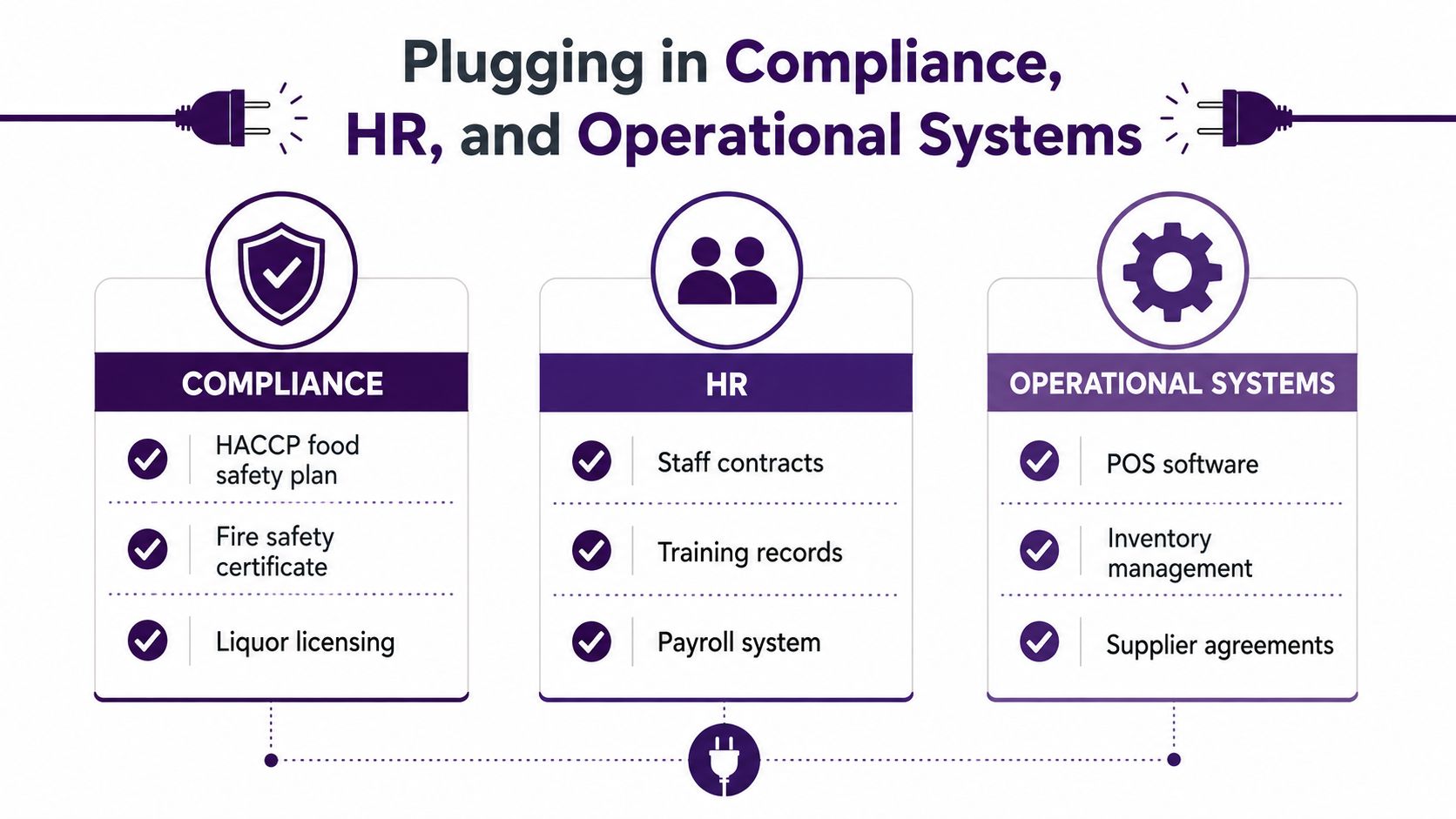
Irish hospitality plans need three blocks that generic templates usually miss, regulatory and compliance overview, people and HR systems, and operational dependencies. Put them in the main body, not in an appendix that nobody reads. That is where you bring in HACCP, WRC compliance, supplier concentration, and multi-site dependency risk. If you want a practical reference point, the restaurant compliance checklist for Ireland is the kind of material that helps owners turn legal duties into an operating section a lender can test.
Queensland government business-plan guidance also stresses market research, a detailed marketing plan, operations/day-to-day functions, hiring and personnel procedures, insurance, risk analysis, and SWOT analysis Queensland Government business plan guidance. That is the shape you want. It gives the document a spine, and it stops the plan from drifting into vague sales talk.
If you are drafting a live trading venue, start with the evidence. For compliance-heavy or multi-site situations, a plan built with consulting support, such as new venue launch and opening consulting, tends to produce the right operational depth because it forces the owner to think in systems, not slogans.
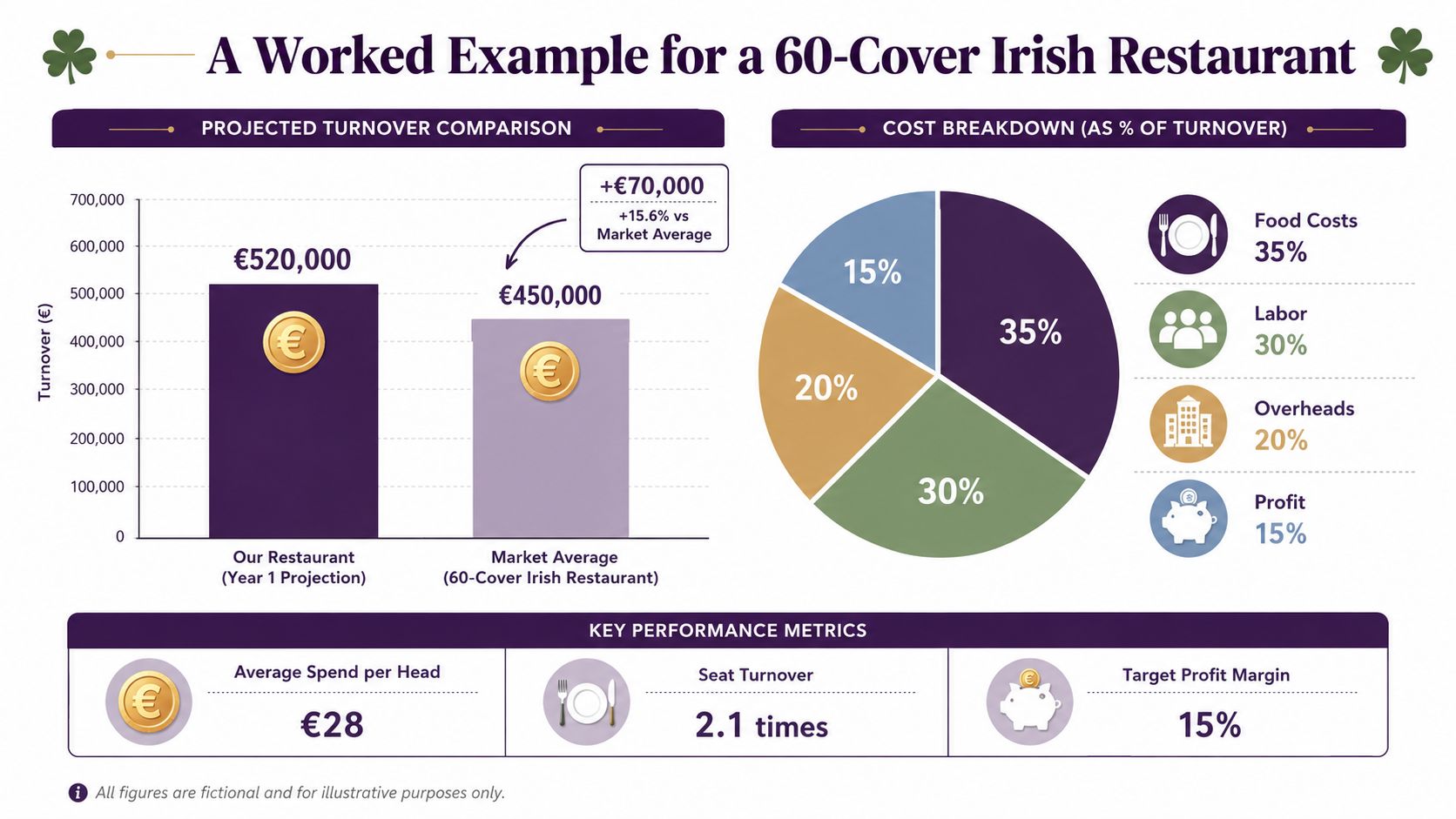
A Worked Example for a 60-Cover Irish Restaurant
A 60-cover restaurant in Co. Clare does not need a glossy origin story. It needs a plan that shows how the room trades, how the costs behave, and how the owner gets from fragile to fundable.
A tight executive summary that a lender can follow
Lead with the trading reality, not the branding language. Say what the business is, where it sits in the market, and why it can hold its line under pressure.
A workable version would say the restaurant serves local and visitor trade, has a clear daytime and evening rhythm, and plans to strengthen cash generation through a second revenue stream in year two. That extra stream could be catering, private dining, or events. Pick one that matches the kitchen and the labour model, not one that sounds clever. For an owner who wants a sharper operating structure, new venue launch and opening consulting is the kind of support that forces the plan into real operational decisions rather than general statements.
Three years of numbers with believable assumptions
Use a three-year projection, but keep the assumptions visible. For a restaurant like this, the narrative should be straightforward.
- Year 1: stabilise trading, clean up stock controls, and prove the dining room can carry itself.
- Year 2: add catering or private-event revenue once the core operation is stable.
- Year 3: improve consistency, reduce waste, and tighten labour scheduling.
The image below should sit beside those projections in the finished document.
What matters is the logic behind each line. Food cost has to be defended by menu engineering and waste control. Labour has to line up with covers and service patterns. Energy needs to be treated as a real trading risk, not a footnote.
A clear rule helps here. The financial model should make the business easy to challenge. That is why a credible forecasting framework, like how to build a credible revenue model, is useful even if your operation is already trading. It forces the owner to connect assumptions instead of dropping in hopeful totals.
What the owner should actually put in the numbers
Use bullets, not a wall of prose.
- Revenue logic: split dine-in, take-away if relevant, events, and any catering arm.
- Cost logic: show food, labour, overheads, and the capex required to keep the kitchen serviceable.
- Growth logic: explain what changes in year two and why the business can support that move.
- Risk logic: name the downside, slower covers, supplier cost pressure, or staffing gaps, and explain the response.
The model should show what happens when things go slightly wrong, not only when trade goes well.
The restaurant example works because every number sits inside an explanation the owner can defend in a room. That is what lenders want. A neat forecast without the operating story gets treated like decoration.
If you are shaping house rules for a venue with rooms, events, or guest stays, 7 expert-approved rule templates are a useful reference point for turning policy into something staff can apply.
Plugging in Compliance, HR, and Operational Systems
This is the point where the document stops looking like a pitch deck. For Irish hospitality, the plan has to show the business can trade legally, staff properly, and keep the operation consistent when pressure rises.
Compliance is the foundation
Start with HACCP and food safety. The plan should explain how food safety is managed day to day, who owns it, and how staff are trained to follow it. If there is a current EHO or inspection rhythm, say so in plain language. The point is to prove the kitchen is controlled, not just busy.
Then deal with employment. A lender does not need a lecture on HR theory, but they do want to see WRC-compliant contracts, a staff handbook, payroll discipline, and evidence that training is tracked. That matters more in hospitality than in many sectors because service quality falls apart quickly when recruitment, inductions, and rosters are loose.
Practical rule: if the plan cannot show who trains staff, who signs contracts, and who owns the safety file, the operation looks fragile.
Insurance and risk belong in the body too. Spell out the current insurance schedule, the main operational risks, and the obvious controls. Then add a SWOT that is honest enough to be useful. Weaknesses should include cover shortages, energy exposure, and seasonal demand swings if those are real. Do not write fake optimism into a risk section. It reads badly.
Attach the proof, not just the promise
The appendices should contain evidence that makes the plan believable:
- HACCP summary: one page that shows the core food safety controls.
- Training matrix: who is trained on what, and when it was last completed.
- Org chart: who reports to whom, especially if one person covers several functions.
- Insurance schedule: the current cover types and renewal timing.
- Supplier map: key suppliers, backup options, and any single-point dependencies.
If you need a practical way to think about standardised operating rules, 7 expert-approved rule templates is a good reminder that clear house rules reduce friction. In hospitality, the same principle applies to staff conduct, food handling, stock discipline, and handover processes.
Operational systems matter because lenders know that a venue with strong systems is less likely to unravel under stress. A business with decent sales but weak controls still looks risky. A business with clean compliance, disciplined HR, and visible operating routines looks fundable.
What Lenders and Investors Actually Read First
Banks and investors do not read a hospitality plan from page one to page fifty. They go straight to the sections that show whether the business can service debt, survive staff turnover, and keep trading if the owner steps away for a week.
The first three minutes decide more than owners realise
A relationship manager is usually scanning for cash flow visibility, debt service capacity, owner dependency, and management depth. If those are unclear, the rest of the document struggles to recover. Weak market sizing will not repair a poor operating story, and forecasts that ignore downside scenarios usually get treated as wishful thinking.
That is why the summary page has to do more work than most owners expect. It should state the trade model, the control points, and the funding purpose in plain language. If the plan mentions insurance only in passing or leaves continuity issues unresolved, the reader assumes the owner has not pressure-tested the business properly.
For Irish hospitality operators, that summary should also make the venue structure easy to read. A lender wants to know whether the plan is supporting a restructure, a refinance, or a sale, and whether the operation depends on one person, one site, or one supplier chain. Multi-site dependencies, key man exposure, and compliance ownership are read as risk markers, not admin detail.
The edits that change the response
Use a sensitivity view that shows what happens if revenue slips. Keep it plain. Show the lender that the plan has been tested against softer trade, higher costs, or a delayed ramp-up. Then add a clear capex schedule so the reader can see where the money goes and why it is needed now rather than later.
A one-page owner continuity note also helps. Spell out who handles trading if the owner is absent, who signs off payroll, who deals with suppliers, and who handles compliance files. That kind of clarity usually reads better than another page of market commentary.
If you are serious about the numbers, use a model that stands up under scrutiny before you ask anyone to fund it. A practical starting point is to build a credible revenue model, because lenders care about how the assumptions hold together, not how polished the spreadsheet looks.
The best plans do not try to sound grand. They sound controlled.
That is the version that gets the meeting. Lenders are not looking for polished optimism. They are looking for a plan that shows the business can take pressure, hold its structure, and keep trading when the hard questions start.
Pitching the Plan Without Sounding Like a Template
A multi-site operations director I know walked into a funding meeting with a clean file and no drama. He did not open with market buzzwords. He led with audit history, staff retention, and margin direction, because he knew the bank was listening for execution risk before growth ambition.
He spent the first few minutes on control. Then he moved to the numbers. That order matters.
What to say in the room
Use short, plain statements:
- Lead with operations: “The business is stable, the controls are in place, and the issue now is strengthening the structure.”
- Move to the commercial logic: “This plan protects margin first, then adds growth where the operation can absorb it.”
- Answer continuity questions cleanly: “If I'm not on site, the management structure still holds.”
Those lines work because they sound like someone who runs a venue, not someone who copied a template. The room will almost certainly ask about security offered, debt service cover, and management succession. Answer those questions directly and move on.
A private investor listens a little differently. They want to know whether the business can scale without losing control. Be ready to point to the summary, the financials, and the compliance framework without wandering through the whole document.
What to leave on the table
Do not try to prove everything. Leave some detail for follow-up. If you overload the first meeting with every policy and every spreadsheet, the message gets blurred. Show the plan, show the discipline, and invite the next conversation.
Keep the pitch focused on the business itself. The room is deciding whether the operation is investable, not whether the folder is thick. If you need outside support on staffing, food safety, HR, or business planning, a full-service operator like Beacon Recruitment can sit in the background as part of the wider support set.
Your 30-Day Plan to Finish the Document
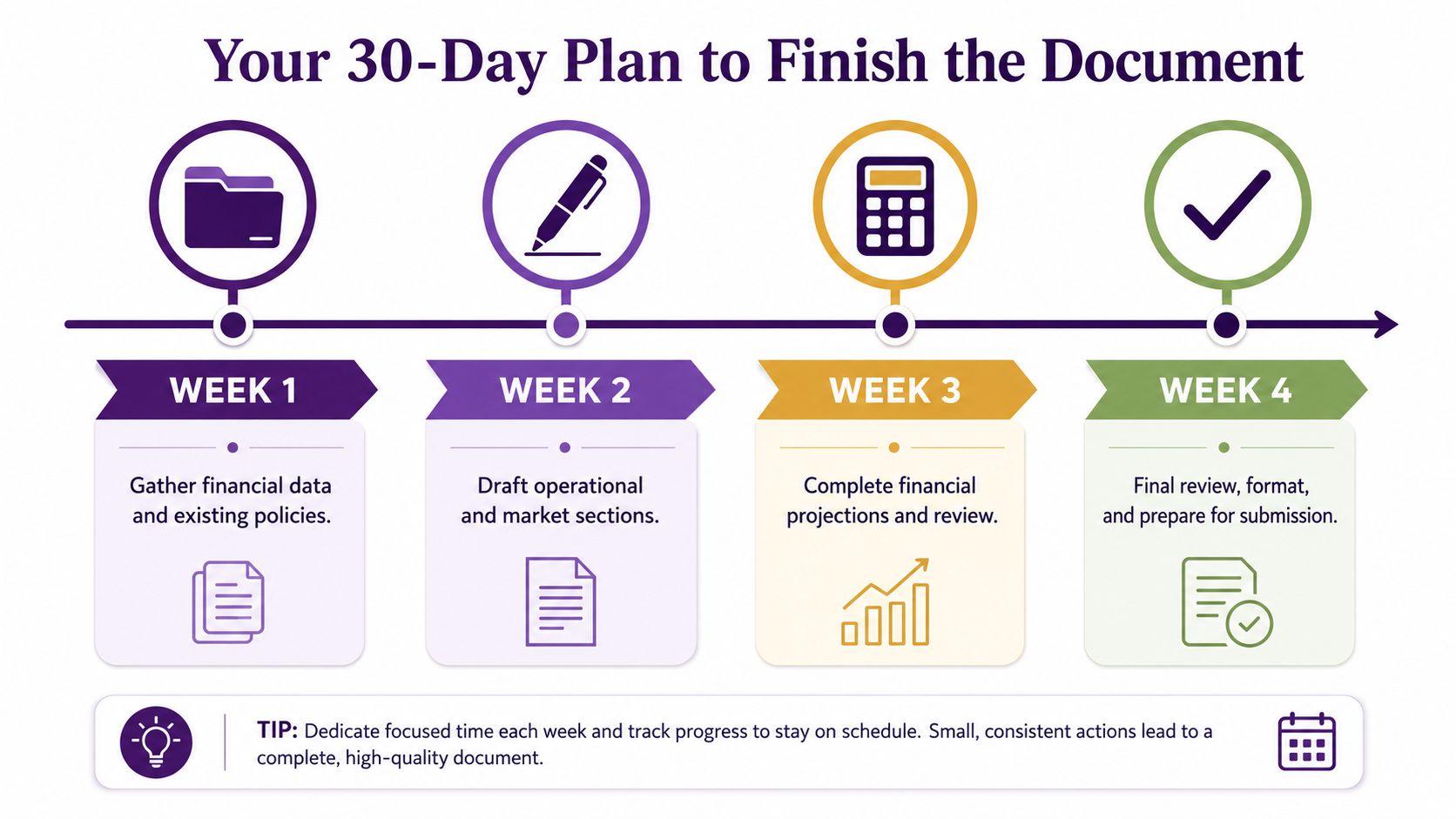
Do this in four weeks and stop waiting for perfect conditions. A finished plan in hand is more useful than a polished draft sitting in someone's inbox.
Week by week
- Week 1: gather financial data, existing policies, lease terms, insurance, and any current compliance files.
- Week 2: draft the operational sections, the market section, and the HR and compliance blocks.
- Week 3: build the financial projections, then test the downside assumptions and capex needs.
- Week 4: write the executive summary last, format the appendix, print the final file, and book lender or investor meetings.
The mistakes that keep showing up
Owners keep making the same errors. They make themselves the single point of failure. They overstate year-one revenue. They ignore energy and insurance pressure until the numbers look soft. They also leave HR and compliance too vague, which is exactly where a lender starts worrying.
Finish the plan this month and use it. A good business plan template should force decisions, not delay them. If you've got a venue to refinance, restructure, or sell, treat the document like a working management tool and not a branding exercise.
If your venue needs a sharper operating plan, Beacon Recruitment works with Irish hospitality owners on food safety, HR compliance, business planning, and profitability audits, so the document reflects how the business runs. Visit Beacon Recruitment if you want support turning a rough draft into something lenders and investors can read without hesitation.
Turn Your Business Plan Into a Tool for Growth
Empower your venue with a structured, lender-ready business plan that highlights your profitability, compliance systems, and operational strength.