July 21, 2026
Confidentiality Agreement Template for Irish Hospitality
Download our free confidentiality agreement template for Irish hospitality. Learn how to customise it for hotels & restaurants, ensuring WRC & GDPR compliance.
You're about to send the menu deck to a consultant. Or share your room-rate strategy with a potential investor. Or let a new head chef review the prep sheets, supplier terms, and margin notes before they start. That's usually the point where hospitality operators realise how much valuable information sits in ordinary documents.
A verbal promise won't protect any of it.
In practice, the risk doesn't start when someone steals a full business plan. It starts earlier. A forwarded email. A WhatsApp screenshot. A recipe file sent to the wrong person. A departing manager taking vendor pricing, rota models, or payroll notes to a competitor. By the time a dispute starts, the damage is often already in motion.
That's why a proper confidentiality agreement template matters. Not a generic download written for another jurisdiction, and not a vague clause copied into a wider contract without thinking through what an Irish hotel, restaurant, or multi-site group needs. In Irish hospitality, the detail matters. GDPR matters. WRC exposure matters. Retention rules matter. The wording around return, deletion, access, and enforcement matters.
Protecting Your Hospitality Business From Day One
A common scenario looks harmless. You're in a meeting with a potential business partner, agency, consultant, supplier, or senior hire. You want to move quickly, so you start sharing the useful bits first. Occupancy patterns. Labour costs. Planned refurb details. A menu concept for summer. The operating weaknesses you need fixed.
That's exactly the wrong moment to leave confidentiality informal.
In Ireland, a confidentiality agreement must be signed before any sensitive information is disclosed to ensure legal protection, according to NetLawman's Irish confidentiality agreement guidance. That point is practical, not academic. If the agreement only appears after the disclosure, you've already weakened your position.
Practical rule: If you'd be annoyed, exposed, or commercially damaged by that information being repeated elsewhere, get the agreement signed first.
Hospitality businesses often underestimate what counts as sensitive information. Owners think of “trade secrets” and imagine a famous recipe. In reality, the more common high-risk material is operational. Wage structures. Accommodation arrangements for international staff. Guest complaint trends. Preferred supplier discounts. Expansion discussions. Draft budgets. Internal investigation notes.
What goes wrong without a signed agreement
A handshake works until interests diverge. Then memory becomes selective.
A consultant may say they were never told the spreadsheet was confidential. A supplier might reuse your launch idea elsewhere. A senior employee could argue that the service standards or kitchen systems they received were just normal know-how. If the paperwork is weak, every argument gets harder.
There's also a wider operational point. Businesses that want tighter controls over confidentiality usually need matching documents across the employment lifecycle. If your contracts are loose, your confidentiality position is loose too. It helps to align the agreement with your wider contract of employment framework, so confidentiality duties aren't floating on their own.
Confidentiality is also a security issue
Legal documents matter, but they're only one layer. If you're sharing sensitive plans before an acquisition discussion, a dispute with a former manager, or a difficult restructure, it also helps to understand how businesses detect corporate espionage threats. Most breaches don't look dramatic. They look routine until someone joins the dots too late.
For Irish hospitality, the safest approach is simple. Identify what you're about to share. Decide who needs it. Put a signed Irish-law agreement in place first. Then disclose only what's necessary.
Why Hospitality Needs a Tailored Confidentiality Agreement
A hotel doesn't hold the same confidential information as a software company. A city-centre restaurant doesn't face the same risks as a multi-site café group. That's why a generic template usually misses the mark. It uses broad language, but broad language often fails when you need precision.
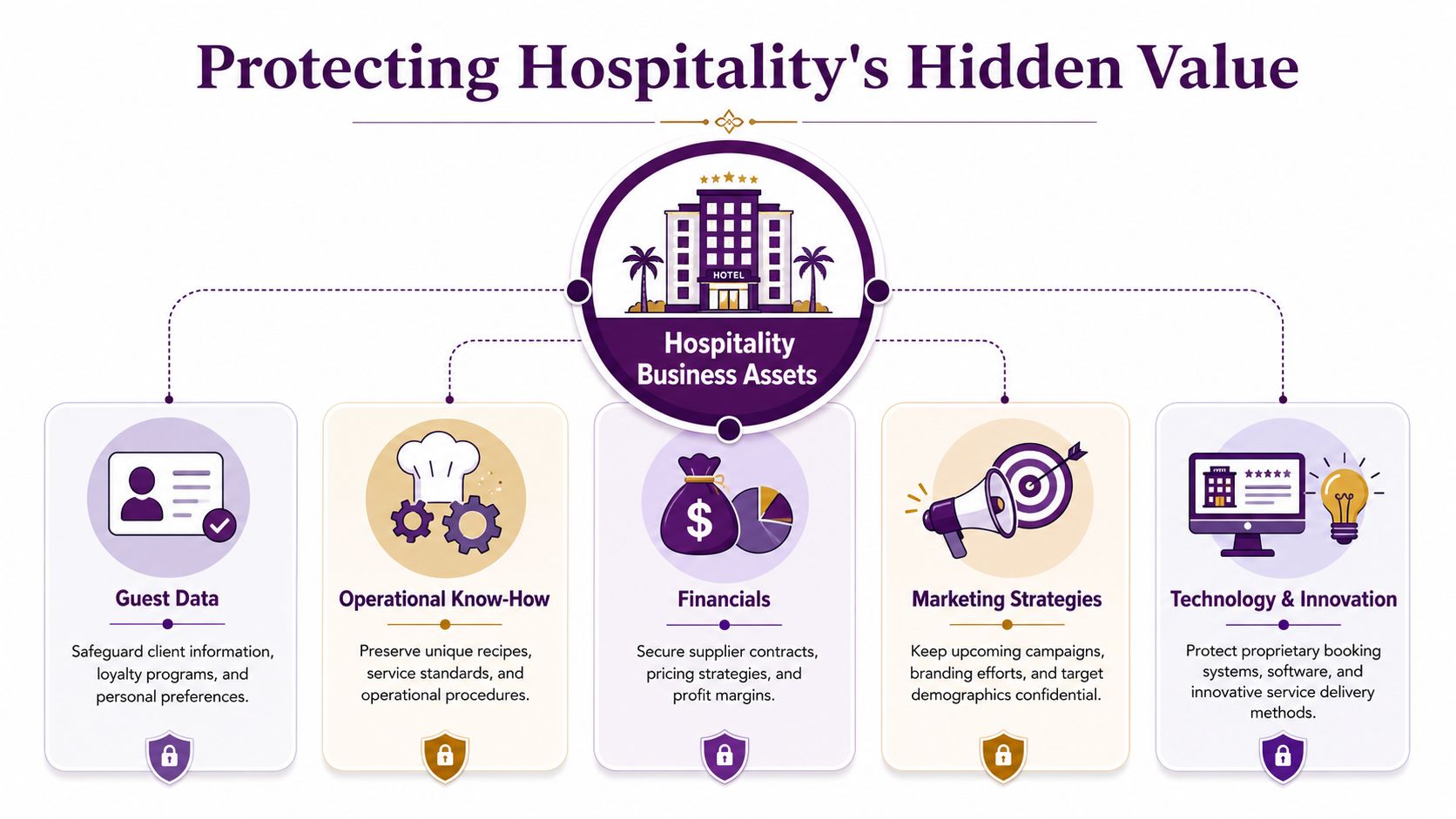
The true value in hospitality is often buried inside daily operations. It isn't always glamorous, but competitors can still use it.
What you're actually trying to protect
A workable confidentiality agreement template for hospitality should cover information such as:
- Guest data: Booking history, loyalty details, special requests, complaint records, VIP preferences, and group business contacts.
- Operational know-how: Prep systems, staffing models, SOPs, opening and closing checklists, training sequences, and service recovery methods.
- Commercial terms: Supplier pricing, rebate arrangements, exclusivity deals, minimum-spend terms, and margin assumptions.
- Financial planning: Forecasts, payroll pressure points, debt discussions, refurbishment budgeting, and expansion plans.
- Marketing and launch material: Seasonal campaign plans, event calendars, partnerships, audience targeting, and unpublished creative assets.
- Technology and systems: Booking workflows, POS configurations, reporting structures, integrations, and internal access controls.
That list changes depending on the venue.
Different venues need different wording
A boutique hotel usually needs stronger wording around guest privacy, events, wedding business, local corporate accounts, and room pricing strategy. If there's a wellness offering or premium membership element, that should be named.
A city-centre restaurant often needs tighter language around recipes, prep methods, supplier terms, rota design, labour deployment, and launch plans. Chef movement between venues creates obvious exposure if the clause is vague.
A multi-site group has a wider risk profile. Area management reports, rollout plans, central purchasing terms, head office reporting packs, and acquisition conversations all need explicit coverage. The agreement should also define which group entities are protected, not just one trading name.
A weak template usually says “all business information is confidential”. A useful one identifies categories the recipient can recognise and the business can enforce.
Who should sign one
Many operators only use confidentiality wording with senior executives. That's too narrow.
In practice, the following people may need a standalone agreement or a strong confidentiality clause in a wider contract:
- Senior managers and department heads who access payroll, pricing, strategy, or investigation material.
- Head chefs and development chefs who handle recipes, product costing, supplier data, and kitchen systems.
- Consultants and freelancers working on HR, finance, marketing, menu development, branding, or turnaround projects.
- Potential investors or buyers receiving pre-transaction information.
- Specialist suppliers or contractors with access to systems, customer data, or future plans.
- Agency partners who receive internal operational information while pitching or delivering work.
A customized confidentiality agreement template doesn't need to be complicated. It needs to be specific enough that everyone knows what's protected, what they can do with it, what they must return, and what survives after the relationship ends.
Your Free Irish Hospitality Confidentiality Template
A restaurant manager shares a staff investigation file with an external HR adviser. A week later, the adviser's work ends and the venue asks for “all information” back under a standard NDA. The problem is obvious. Some records cannot easily be handed over, deleted, or ignored because Irish employment and data protection duties may require controlled retention. That is where generic templates start to break down for hospitality businesses.
A usable confidentiality agreement template for Ireland needs to do two jobs at once. It must protect commercial information such as recipes, pricing, and launch plans. It also has to deal properly with records that may need to be kept for GDPR, WRC, tax, disciplinary, or grievance purposes. If your wording ignores that conflict, the document looks tidy but creates trouble later.
The safest approach is to treat the template as a draft for a specific relationship. Add the legal names of the parties, the venue or group entity involved, the purpose for sharing information, and the categories of information covered. Then check each clause against how your hotel or restaurant works, and where the recipient may hold data after the work ends. If confidentiality sits inside a wider employment contract, the drafting still needs to match the role. For that, it helps to compare it with properly drafted employment contracts for hospitality businesses in Ireland.
The clauses that matter most
Start with the definition of confidential information. If it is too broad, people do not know what they are handling. If it is too narrow, the business leaves gaps.
Definition of Confidential Information
“Confidential Information” should include non-public commercial, operational, financial, technical, personnel, and customer information disclosed by the business in writing, verbally, electronically, or through access to systems, files, devices, or premises.
For hospitality, that definition should be followed by examples the recipient can recognise straight away. Typical examples include:
- Recipes, prep methods, and menu development notes
- Supplier pricing, rebates, and purchasing terms
- Guest lists, booking history, and customer preferences
- Marketing calendars, opening plans, and promotional strategy
- Payroll data, rota models, and staffing costings
- Investigation records, training materials, and internal SOPs
The obligations clause should also read like instructions, not courtroom language.
Obligations of the Recipient
The recipient must use the information only for the stated purpose, limit access to authorised people, protect it from unauthorised disclosure, and avoid copying, storing, or sharing it beyond what the work requires.
That wording helps in real disputes. If a consultant forwards wage data to a colleague who was never approved to receive it, the breach is clear. If a former manager keeps copies of menu costings and supplier lists after joining a competitor, you have a clause you can point to.
A practical obligations clause usually covers four points:
- Use restriction: information can only be used for the agreed role, project, or transaction
- Access control: sharing is limited to approved individuals who need it for that purpose
- Security measures: files must be stored securely, with sensible controls for email, devices, printouts, and cloud access
- No competitive or personal misuse: the recipient cannot use the material for their own benefit or another business
Return, deletion, and lawful retention
This is the clause many free templates get wrong.
A standard “return or destroy everything on request” line is too blunt for Irish hospitality. Some records may need to be retained because of GDPR accountability obligations, payroll and tax requirements, insurance issues, or potential WRC claims. An adviser who has handled grievance notes, CCTV extracts, payroll documents, or disciplinary correspondence may be entitled, or required, to keep limited copies for a defined period. Your template should allow that, but only on strict terms.
A better clause says the recipient must return or securely delete confidential information when the relationship ends, except where retention is required by law, regulation, professional duty, insurance requirements, or documented internal retention rules. Any retained copy must stay confidential, be stored securely, and be used only for that legal retention purpose.
That is the difference between a template that works in Ireland and one that creates an argument the first time a data subject access request, WRC complaint, or Revenue query lands.
Exclusions, duration, and Irish law
The agreement should also state what is not protected. Usual exclusions are information already lawfully known to the recipient, information that becomes public without their fault, and information they must disclose by law. Without those carve-outs, the document becomes harder to apply and easier to challenge.
Set a clear duration for the confidentiality duty. Use a fixed period or an event-based end point. Different categories of information may justify different timeframes. Trade secrets and strategic plans may need longer protection than routine operating documents.
Finally, the agreement should say it is governed by Irish law and disputes will be handled in Ireland. That matters if you have taken wording from a UK or US template, or if a contractor works across jurisdictions. In practice, this clause avoids avoidable confusion at the point you need to enforce the document.
How to Customise the Agreement for Your Venue
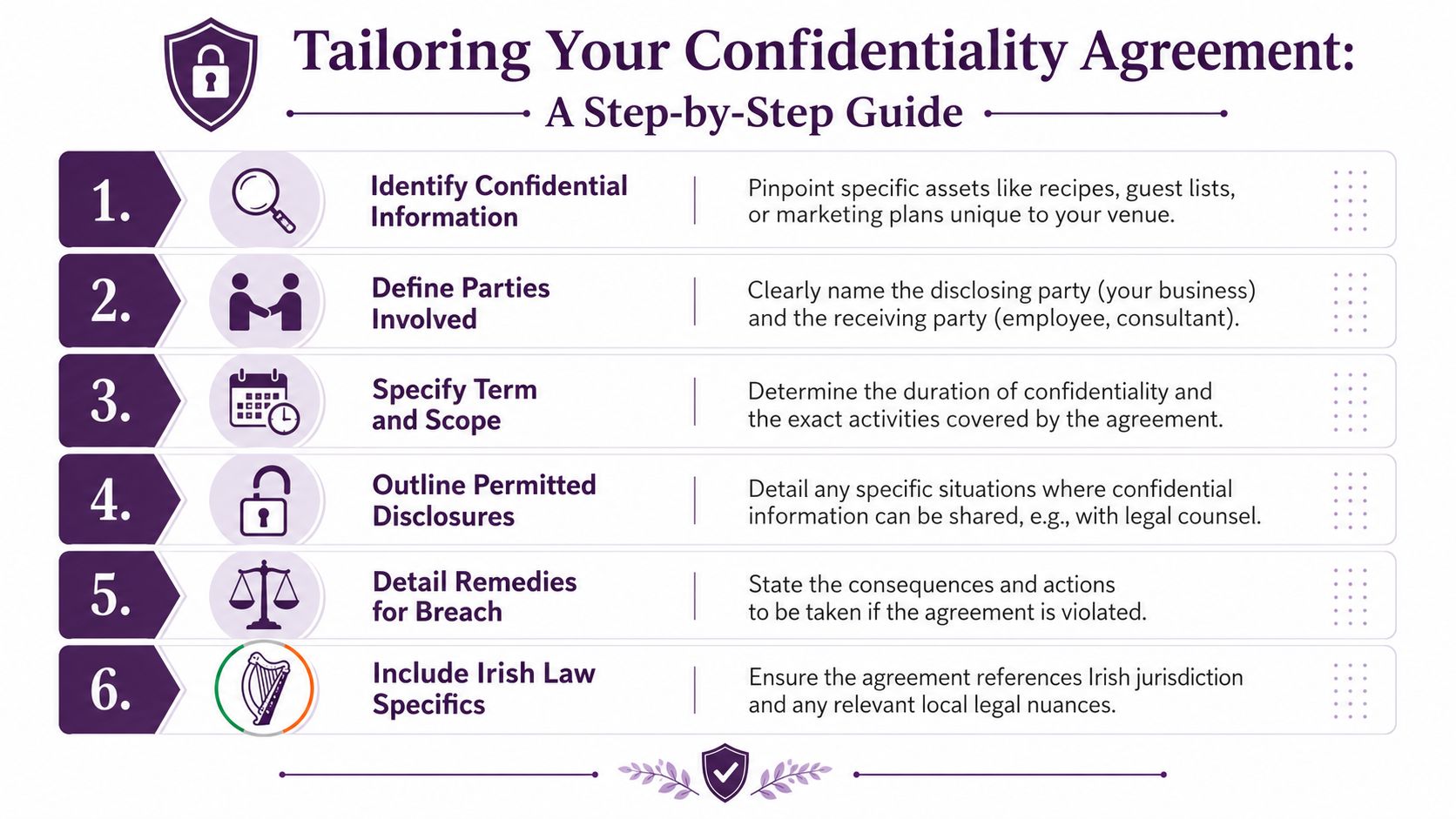
A template is only useful after you adapt it to the role, venue, and type of information being shared. If you skip that step, you get the worst of both worlds. The document looks formal, but it won't match the operational reality of your business.
This matters most in Irish hospitality because generic templates often collide with local compliance duties.
Start with the venue, not the template
Before editing any wording, list the information that needs protection in your setting.
For a hotel, that may include:
- Guest records and rates
- Corporate account terms
- Events and wedding pipelines
- Management reporting packs
For a restaurant:
- Recipe development notes
- Prep systems and training sheets
- Supplier deals
- Launch plans and margin calculations
For a group operation:
- Central purchasing terms
- Expansion planning
- Site performance comparisons
- Internal investigation material
Then identify the recipient. An executive chef, revenue consultant, digital marketing agency, and potential investor should not all receive the same wording.
The Irish retention problem most templates miss
Generic US or international templates frequently break down. They often contain a blunt clause saying that, on termination, the recipient must return or destroy all confidential information immediately. That sounds tidy. In Irish hospitality, it can create a compliance problem.
A critical gap in generic templates is their failure to address Irish GDPR Article 29, which requires hospitality employers to retain specific employee data, such as work permits for WRC or EHO audits, for up to 7 years post-employment. That creates a direct conflict with standard “return-all-information” clauses. A 2025 Irish Hospitality Confederation report found 68% of GMs faced legal ambiguity using generic templates for non-EU staff because of this issue, as noted in this LawDepot-linked reference.
That's the point many operators miss. You can't promise blanket deletion if the business has a legal reason to retain certain records.
Keep the confidentiality obligation strict, but carve out lawful retention. Otherwise, the agreement tells staff to do something the business itself may not be allowed to do.
Sample wording that resolves the conflict
If your template has a return or destruction clause, add wording that preserves statutory retention duties. For example:
Return and Retention Clause
On termination of employment, engagement, or discussions, the recipient must promptly return or securely destroy confidential information in their possession, custody, or control, except where the disclosing party is required to retain specific records under applicable Irish law, regulatory duty, audit requirement, employment law, immigration compliance, data protection obligation, or legitimate business recordkeeping requirement. Any retained information remains subject to the confidentiality obligations in this agreement.
That clause won't solve every issue, but it removes a common contradiction.
If you need role-specific drafting around staff records, permits, onboarding files, or wider contractual compliance, it helps to review the agreement alongside your employment contracts for hospitality rather than treating confidentiality as a standalone document.
Clause changes by role
A few practical examples:
- Head chef agreement: Add express protection for recipes, prep sheets, product specs, supplier costings, menu trials, and kitchen training documents. Be specific about development work created during employment or engagement.
- Marketing consultant agreement: Refer to guest data, CRM exports, campaign calendars, brand assets, ad performance data, and unpublished launch plans. Limit access and require deletion of working files when the project ends, subject to lawful retention.
- Potential investor or buyer: Narrow the use clause so information can only be used to assess the transaction. Ban contact with staff or suppliers unless authorised.
- Senior manager: Include personnel records, investigations, payroll structures, disciplinary material, and commercial strategy.
A short customisation checklist
Use this before issuing the final version:
- Name the parties properly. Use the correct employing entity or trading entity.
- List the information categories. Generic wording alone isn't enough.
- Define the purpose. State why the information is being shared.
- Set the term. Use a clear duration or event.
- Fix the return clause. Preserve Irish legal retention requirements.
- Check who may receive disclosures. Legal advisers and authorised internal personnel may need access.
- Match it to the main contract. No contradictory language between documents.
A confidentiality agreement template becomes useful when it reflects how your venue operates, not how a generic website thinks businesses operate.
Enforcing the Agreement When a Breach Occurs
A chef leaves on bad terms on Friday. By Saturday night, your draft seasonal menu is in a rival venue's WhatsApp group, and screenshots of an internal HR note are circulating among staff. At that point, the agreement matters only if it gives you a clear route to stop the spread, preserve evidence, and act without creating new GDPR or WRC problems.
Start with control, not anger.

The first job is to establish what happened. Identify what information was disclosed, whether it involved commercial material, employee records, guest data, or investigation documents, who received it, and whether the disclosure is still active. Preserve emails, screenshots, audit trails, message logs, access records, and device evidence where you are entitled to do so.
Then act in a disciplined order:
- Send a formal written demand: Identify the agreement, the specific breach, and the steps required immediately.
- Stop further use and disclosure: Require the person or business to cease sharing, copying, uploading, or discussing the information.
- Address return or deletion carefully: Ask for return, deletion, or confirmation of destruction, but do not demand steps that would conflict with lawful retention duties. Generic templates often fail Irish hospitality businesses in this respect. A blanket “return everything” clause can clash with GDPR obligations, payroll retention, investigation records, or material that may be needed for a WRC claim.
- Lock down internal access: Change passwords, suspend permissions, and limit discussion to the managers or advisers dealing with the issue.
- Get legal advice quickly: If the breach is live, delay can weaken any request for urgent court relief.
One practical point matters here. If the leaked material includes employee complaints, disciplinary notes, CCTV extracts, or guest personal data, treat it as both a confidentiality issue and a data protection issue. The wrong response can create a second problem. Hotels and restaurants sometimes rush to recover documents or search devices without checking whether the step is lawful and proportionate.
Online breaches need a parallel response. A former employee may post screenshots on social media. A contractor may upload files to a shared drive. A dispute may spill onto review platforms. In those cases, contractual enforcement, evidence preservation, and takedown action often need to run together. For a practical outline of takedown steps, escalation, evidence preservation, and platform response, the ContentRemoval.com recommendations are useful alongside your legal process.
Court action is sometimes the effective remedy. Damages may matter later, but they rarely solve the immediate problem if supplier pricing, launch plans, or sensitive staff material is already circulating. The priority is usually to stop further use or publication. A well-drafted agreement governed by Irish law puts you in a better position to seek injunctive relief where the facts justify it.
Internal handling also matters. If the person is still employed, confidentiality usually overlaps with suspension, investigation, fair process, and possible disciplinary sanctions. Those steps should line up with your contract, your data handling rules, and your disciplinary and grievance procedures. That reduces the risk of turning one breach into two disputes.
A confidentiality agreement does not prevent every leak. It does give your venue a workable enforcement route if the wording reflects Irish law and the realities of hospitality operations.
Integrating Confidentiality into Your Operations
The strongest confidentiality agreement template in the world won't help if it sits in a folder and nobody uses it consistently. In hospitality, confidentiality works best as an operating habit. It should be part of recruitment, onboarding, supplier setup, consultancy projects, investigations, and exit management.
Businesses that handle this well don't treat confidentiality as a one-off legal task. They build it into the way information moves.
A workable operating routine
Use a simple structure.
- Audit your sensitive information: Identify what would cause commercial, legal, or reputational trouble if it left the business.
- Match roles to risk: Not every employee needs the same level of access or the same wording.
- Sign before disclosure: Apply the agreement before sharing data, plans, files, or systems.
- Control access properly: Limit documents and system permissions to people who need them.
- Review annually: Menus change, systems change, management changes, and so do the risks.
Confidentiality is bigger than one document
Most hospitality operators already understand this in other contexts. Food safety isn't one policy. It's training, records, supervision, checks, and follow-through. Confidentiality works the same way.
That broader mindset is useful outside hospitality too. Some of the same principles appear in guidance on safeguarding law firm information. Different sector, same discipline. Know what's sensitive, restrict access, document obligations, and respond quickly when handling slips.
The agreement is the foundation. The daily controls are what make it credible.
If your business relies on agency staff, consultants, external payroll support, menu developers, or international recruitment pipelines, your exposure points multiply. That doesn't mean you need a massive legal bureaucracy. It means you need documents that fit Irish law, clear onboarding steps, and managers who know when to stop sharing until the paperwork is signed.
If you want practical help tightening confidentiality documents, employment paperwork, and wider compliance systems for your venue, Beacon Recruitment supports Irish hospitality operators with the operational side of HR, compliance, and business structure so sensitive information is protected before it becomes a problem.
Is Your Business Data Exposed to Competitors?
Stop relying on verbal promises and generic templates—book a free consultation with Beacon to build a hospitality-specific, legally binding confidentiality agreement.