July 16, 2026
Customer Service Training Hospitality Ireland: 2026 Plan
Elevate your team with expert customer service training hospitality Ireland. Implement a leading 2026 strategy for unparalleled guest satisfaction.
You've likely seen the pattern already. The food is good, the room is ready, the website did its job, and the booking came in. Then a guest arrives to a flat welcome, waits too long for eye contact, raises a simple issue, and gets a defensive answer from someone who's undertrained and overstretched. By the time that guest leaves a public review, the problem isn't just one interaction. It has wiped value off the work your kitchen, marketing, and management team put in all week.
That's why customer service training in hospitality in Ireland can't sit in the “soft skills” drawer any longer. It has to live inside operations. It has to shape how people are hired, onboarded, coached, corrected, and measured. It also has to connect to the parts of the business owners worry about every day: WRC exposure, food safety consistency, labour shortages, online reputation, repeat trade, and margin.
Busy operators don't need another poster in the staff room telling people to smile. They need a system that holds up on a wet Tuesday lunch shift, during a bank holiday rush, and when half the team is new.
Why Great Service Is No Longer Optional in Irish Hospitality
One badly handled complaint can undo an entire service.
A server forgets to acknowledge a wait. A receptionist gives a scripted apology without solving the problem. A supervisor steps in too late, or worse, backs the wrong staff response in front of the guest. The guest doesn't remember that the room was spotless or that the kitchen recovered well. They remember how your team made them feel when something went wrong.
That's the operational reality behind customer service training hospitality Ireland businesses now need. In a market where guests check reviews before they book and compare venues instantly, inconsistency is expensive. It doesn't matter whether you run a boutique hotel, a busy gastro pub, or a multi-site restaurant group. If your service depends on who happens to be on shift, you don't have a standard. You have luck.
Training demand tells you where the pressure is
The strongest signal from the Irish market is simple. Operators are treating service capability as a business priority, not an optional extra. As hospitality reopened, Ireland saw a 134% increase in training demand for bar skills, barista training, food and culinary preparation, and customer service, according to the SOLAS hospitality skills report. The same report notes that thousands of workers accessed Fáilte Ireland online learning in 2022.
That matters because it shows a change in behaviour. Owners and managers weren't just talking about service standards. They were actively looking for structured training to rebuild consistency.
Service failure is rarely about attitude alone
Most owners first describe a service issue as an attitude problem. Sometimes it is. More often, it's a systems problem wearing an attitude mask.
Common examples include:
- Unclear expectations: Staff don't know the exact greeting standard, handover process, or complaint escalation path.
- Weak onboarding: New hires learn by shadowing whoever is available, which means poor habits get copied.
- No coaching layer: Managers supervise tasks but don't coach guest interaction.
- Peak-period collapse: Standards disappear when the floor gets busy.
Great service isn't “being nice”. It's repeatable behaviour under pressure.
That's the shift. If you want better reviews, fewer escalations, and stronger repeat business, you need to train service the same way you train food safety, opening checks, and cash handling. With standards, practice, accountability, and follow-through.
Laying the Foundation with Clear Training Objectives
“Improve service” is not a training objective. It's a wish.
If you want your programme to stick, define what better service looks like in your operation, for your guests, on your shifts, with your staffing reality. Otherwise, training turns into a one-off talk, everyone nods, and nothing changes by next month.
Start with the business problem
Good objectives begin with friction you can already see. Don't start with generic hospitality language. Start with pain.
Ask yourself:
- Where are guests feeling inconsistency: arrival, ordering, complaint handling, check-out, phone enquiries?
- Which team struggles most: front desk, floor staff, supervisors, reservations, duty managers?
- What keeps repeating: poor handovers, slow table touches, muddled upselling, weak recovery after mistakes?
- What's costing you money or reputation: refunds, review damage, lost repeat bookings, staff conflict?
A practical objective might be to improve complaint handling on evening shifts. Another might be to standardise greetings across a mixed-experience front-of-house team. Another could be to help supervisors correct poor service in real time without creating conflict on the floor.
Write objectives that can be managed
The most useful objectives are operational, not fluffy. They tell people what behaviour matters and how managers will judge progress.
Use this simple filter:
- Specific: Name the service moment.
- Observable: Describe the behaviour.
- Relevant: Tie it to guest experience or business performance.
- Time-bound: Set a review point.
- Owned: Assign a manager, not just “the team”.
For example:
- Reception standard: Every guest is acknowledged promptly on arrival, even during queue build-up.
- Complaint recovery: Staff use a set recovery process before escalating to duty management.
- Service consistency: Team members complete the same farewell routine at the end of each guest interaction.
- Manager coaching: Supervisors give live service feedback during shifts and record recurring issues.
Practical rule: If a manager can't observe it on a shift, it isn't a usable training objective.
Link training to policy and expectation
Service standards fall apart when they sit outside your formal people processes. If your handbook, induction, probation reviews, and disciplinary approach don't reference guest-facing expectations, staff will read service as optional. If you're tightening those foundations, Beacon's guide on how to create a staff handbook in Ireland is a useful operational reference point.
That matters in Ireland because customer service behaviour often overlaps with conduct, communication, fairness, grievance handling, and manager consistency. Those are not separate worlds. They are the same workplace seen from different angles.
Avoid the two most common mistakes
Owners usually go wrong in one of two directions:
- They make the objective too broad: “Deliver amazing guest experience.”
- They make the objective too theoretical: “Build a culture of hospitality excellence.”
Neither helps a shift leader at 7.30 pm when a guest is annoyed and the bar is slammed.
Better to define a handful of essential service standards and train them well. Once those behaviours hold, build from there.
Designing Your Core Hospitality Training Modules
Most service training fails because it's either too generic or too polite. Staff don't need a lecture on kindness. They need to know what to say, what to do, when to escalate, and how to recover a shaky interaction before it becomes a public complaint.
The strongest customer service training hospitality Ireland programmes are built around a small set of operational modules. Each one should map to moments that matter in your business.
Module one: the first and last impression
Many reviews are won or lost at this stage.
Your opening standard should cover greeting, acknowledgement, eye contact, queue management, tone, and body language. In restaurants, that includes how guests are met, seated, and informed about delays. In hotels, it includes arrival flow, check-in phrasing, and how staff manage guests when multitasking.
Your closing standard matters just as much. Train farewell language, final checks, thank-you phrasing, and how to invite return business without sounding robotic.
Module two: complaint handling and service recovery
Many teams are underprepared here. They know they should apologise, but they don't know how to take control of the interaction.
Train a repeatable recovery path:
- Listen fully: Don't interrupt or defend too early.
- Acknowledge impact: The guest wants to feel heard, not managed.
- Take ownership: Even if another department caused the issue.
- Offer the next step: Don't leave the guest hanging.
- Escalate cleanly: Hand over with context, not panic.
Role-play matters here because complaint handling is emotional, not just procedural.
Module three: anticipatory service
Herein, average venues separate from memorable ones.
Teach staff to read cues. A family with children needs a different pace and explanation than a business guest in a hurry. A couple celebrating wants different interaction from a solo traveller checking in late after a long journey. Anticipatory service isn't about being overfamiliar. It's about spotting needs early and reducing guest effort.
Useful learning points include:
- Reading context: Why the guest is there often shapes what matters most.
- Preventing friction: Explain delays, options, and next steps before the guest asks.
- Making relevant suggestions: Recommendations should help the guest, not feel like a sales script.
Module four: clear communication in a multilingual workforce
This module is frequently missed, and in Ireland it matters more than many operators admit.
Modern teams often include people with different first languages, different service backgrounds, and different assumptions about guest interaction. That's not a weakness. It just means training must emphasise clarity. Public guidance often stays broad, but the operational challenge is sharper: labour constraints and diverse teams mean service quality depends on rapid onboarding, communication clarity, and cross-cultural coaching, as discussed in Lingio's hospitality customer service training article.
Train this module around plain language, confirmation habits, tone, and internal communication between departments.
Examples worth building into practice sessions:
- Handover language: short, clear updates between floor, bar, kitchen, and reception
- Guest explanation: how to explain delays, allergens, charges, or house rules clearly
- Cross-cultural coaching: helping staff understand what “warm but professional” looks like in your venue
- Checking understanding: asking colleagues to repeat back key details without embarrassment
If your team can't communicate clearly with each other, they won't communicate well with guests.
Module five: the digital guest
The guest experience doesn't stop at the door. It now includes online reviews, social comments, private messages, and post-stay feedback.
This module should cover:
- How to spot a review-trigger event before the guest leaves
- When managers should intervene before a complaint goes online
- How to respond to criticism professionally and consistently
- How to feed review themes back into training
Don't leave review response solely to marketing or the owner. Frontline teams need to understand how real-life service moments become online reputation.
Choosing Effective Training Delivery Formats
The format matters almost as much as the content. If you deliver training in a way that ignores the pace of hospitality, completion will drop, managers will postpone it, and the team will treat it as separate from real work.
The most effective approach is blended. That means using different formats for different outcomes rather than trying to force everything into one session.
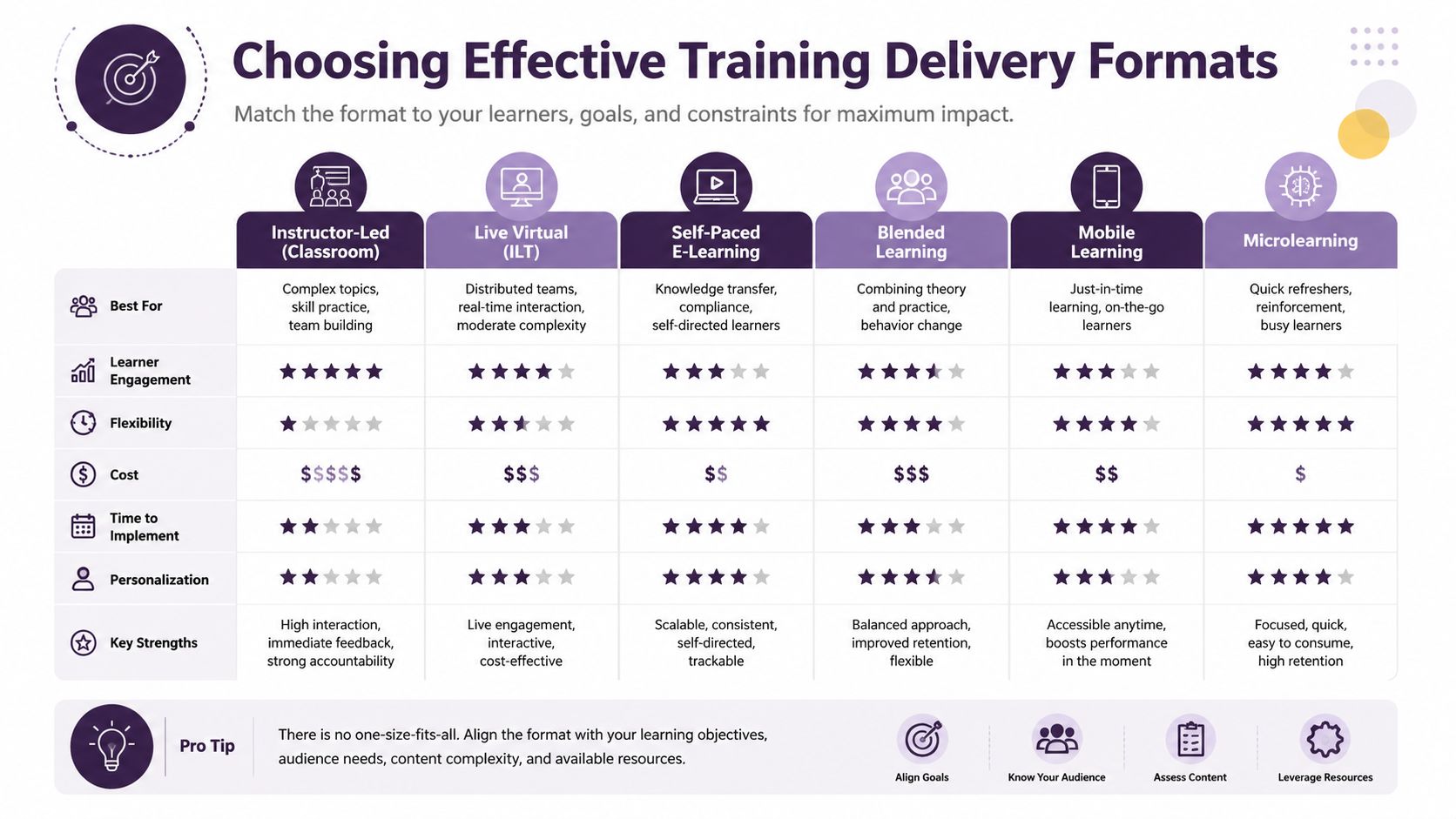
What each format is good for
Here's the practical comparison owners usually need.
- Classroom workshops: Best for introducing standards, discussing real scenarios, and aligning managers. Less useful if used alone, because people understand ideas in the room and forget them on shift.
- E-learning modules: Good for onboarding, policy-linked basics, and refreshers. Weak if you expect them to build live confidence in complaint handling.
- Role-play sessions: Best for difficult conversations, upselling, escalation, and service recovery. Staff often resist at first, but behaviour changes in these sessions.
- On-the-job coaching: The most operationally powerful format. It turns a training principle into a correction in real time.
- Micro-learning: Short refreshers during pre-shift or quieter periods. Useful for keeping standards alive without pulling the team off the floor for long blocks.
Why blended learning works in hospitality
A blended model matches how hospitality teams learn. Foundational knowledge can sit in onboarding or online modules. Behavioural skills need workshops and role-play. Habit change needs manager follow-up on shift.
That fits with the operational guidance used in hospitality training more broadly. Blended programmes built around onboarding, short workshops, e-learning, role-play, mentorship or buddying, and cross-training are especially useful because they turn abstract service standards into behaviours managers can observe and improve.
Keep cost and disruption realistic
Owners often assume structured training means big disruption. It doesn't have to.
A workable training rhythm usually looks like this:
- Induction layer: service basics in onboarding
- Manager-led refreshers: short sessions built into the month
- Live practice: role-play around common complaints and pressure points
- Floor coaching: correction and reinforcement during service
- Review cycle: feedback from guests, managers, and operational checks
If you want external support, the Irish market does give you options. The Restaurant & Hospitality Skillnet, established in 2017 by the Restaurants Association of Ireland, provides partially funded training through in-company, classroom, and online delivery, as outlined on the Restaurant & Hospitality Skillnet training page. For some operators, that makes structured service training more accessible than they assume.
What doesn't work
Three formats tend to disappoint when used on their own:
- The annual training day: forgotten within weeks
- The policy document only: read once, applied badly
- The shadow-and-hope model: new staff copy whoever is nearby, including bad habits
If your service standards are important, they need repetition in more than one format.
Integrating Training into Daily Operations and Compliance
Training only changes results when it enters the daily running of the business. If it lives in a folder, on a slide deck, or inside a once-off workshop, it won't survive contact with a busy shift.
That's where many Irish operators get stuck. Fáilte Ireland has said that only 44% of Irish tourism businesses were actively seeking more guidance on staff training, highlighted in this Fáilte Ireland staff training guidance reference. The actual issue isn't that businesses need more slogans about good service. They need manager-level systems that turn standards into routine behaviour.

Put service into the management rhythm
If service matters, it has to appear in the places where managers already make decisions.
That includes:
- Job descriptions: Spell out service expectations, not just duties.
- Onboarding checklists: Include guest interaction standards alongside operational tasks.
- Probation reviews: Assess communication, complaint handling, and reliability of service behaviours.
- Pre-shift briefings: Focus one service point for the shift, not just covers and reservations.
- Performance reviews: Discuss guest-facing strengths and repeat issues with evidence.
Many businesses achieve improvement. Their success stems not from discovering a secret training trend, but from linking service to accountability.
Train managers to coach, not just supervise
A weak manager can sink a strong training programme.
Managers need to know how to observe a guest interaction, give concise feedback, correct poor behaviour in the moment, and follow up later without creating embarrassment or resentment. They also need to understand when a service issue is a staffing, communication, or roster problem.
A service culture doesn't come from what the owner says once. It comes from what managers allow every day.
This is also where service training connects directly to compliance. A supervisor who can communicate clearly, document accurately, and handle difficult conversations properly is less likely to create avoidable HR trouble. The same communication discipline matters during WRC-sensitive conversations, internal complaints, return-to-work discussions, and disciplinary processes.
Connect service standards to food safety and audit readiness
A lot of owners separate guest service from compliance. On the ground, they overlap constantly.
Think about common moments:
- A staff member explains an allergen process badly.
- A waiter answers a food safety question with guesswork.
- A manager handles a guest complaint about hygiene defensively.
- A team member can't explain a procedure clearly during an inspection or follow-up.
Those are communication failures with compliance consequences. Strong service training helps staff explain what's happening, stay calm under pressure, and escalate correctly. If you want an external lens on whether standards are evident in live guest interactions, mystery shopper programmes for hospitality operators can help reveal where training and daily execution have drifted apart.
Protect time for training
One of the most common reasons training fails is simple. No one protected time for it.
If managers are told training matters but the rota never creates space, the underlying message is that service development comes after everything else. Teams notice that quickly. Reserve the time, keep it short where needed, and build it into the shift pattern instead of hoping quiet periods will appear.
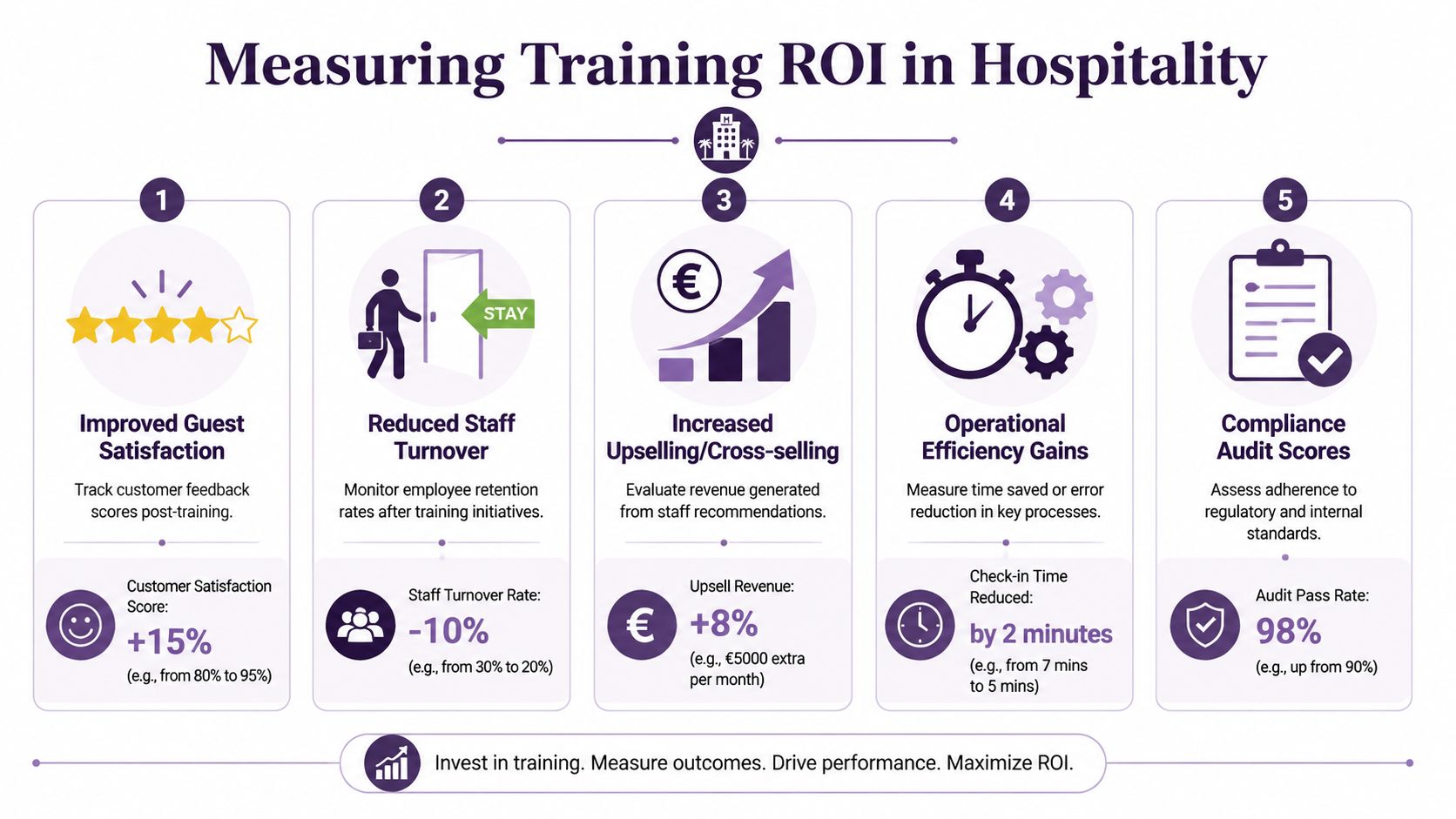
Measuring What Matters to Prove Your Return on Investment
If you can't measure it, you'll eventually stop funding it.
That's what happens with service training in many venues. The team completes a session, managers say it was useful, and then the business goes back to judging success by instinct. That's not enough. Service training needs the same discipline you'd apply to labour, stock, or compliance.
The most practical approach is to treat customer service as a managed system. In hospitality, blended training methods such as workshops, role-play, and e-learning are most effective when tracked through KPIs including guest satisfaction, online review ratings, complaint frequency, repeat-guest rate, and NPS, as discussed in this hospitality training analysis on Hospitality Net.

Track the right signals
Completion rates don't prove impact. They only prove attendance.
Better indicators include:
- Guest satisfaction trends: Use your existing surveys or comment cards consistently.
- Online review patterns: Look for recurring mentions of staff warmth, delays, attitude, or recovery.
- Complaint frequency: Not just severe complaints, but recurring low-grade friction.
- Repeat-guest behaviour: Particularly useful in hotels and local restaurant trade.
- Manager observations: Short, structured notes are far more useful than vague impressions.
If you already use NPS, fold it in. If you don't, don't force it just because it appears advanced. Use the measures your team can realistically collect and act on.
Build a review loop, not a report
The useful question isn't “did the training work?” The useful question is “which service behaviours improved, which didn't, and what do we adjust next?”
A sensible review cycle often includes:
- Pilot a module with a sample group.
- Collect staff feedback on clarity and practicality.
- Check operational movement in the service KPIs you already track.
- Adjust the content before wider rollout.
- Refresh monthly using real examples from guest feedback and manager observations.
That review loop is more valuable than a glossy post-training survey because it ties learning back to live performance.
Treat service training like stock control. Check it, correct it, and don't assume it's fine because no one complained this morning.
Use outside validation when needed
Internal judgement has limits. Managers miss things. Owners get too close to the operation. Teams perform differently when they know they're being watched.
That's where independent assessment can help. A structured customer service audit for hospitality operations gives you a clearer picture of whether standards are visible to guests, not just written in the handbook or repeated in meetings.
You don't need a huge dashboard to prove return. You need a small number of operational indicators, checked consistently, with managers expected to act on what they see.
If your venue needs customer service training that sticks, Beacon Recruitment works with Irish hospitality operators on the wider systems around service delivery, including HR compliance, food safety, mystery shopping, audits, and operational improvement. For owners who are tired of one-off training sessions that fade after a week, that kind of joined-up support is often what turns good intentions into repeatable standards.
Build a Bulletproof Service Culture
Empower your managers to coach staff, handle complaints, and deliver five-star service under pressure. Schedule a Free Consultation with Beacon to upgrade your customer service standards today.