July 16, 2026
Health & Safety Legislation: A Guide for Irish Hospitality
A clear guide to Irish health & safety legislation for hotels & restaurants. Understand your duties under the 2005 Act, avoid penalties, and get audit-ready.
You're halfway through a service, two staff are out sick, the delivery driver is asking where to leave stock, and someone at reception says an inspector has arrived. That moment tells you very quickly whether your safety systems are real or whether they only exist in a folder no one has opened in months.
In hotels and restaurants, health and safety legislation can feel like one more compliance burden piled on top of staffing, food costs, guest complaints, and payroll. But in practice, the venues that treat safety as an operational system usually run better full stop. Floors are cleaner, handovers are clearer, training is tighter, incidents are reported faster, and managers spend less time firefighting.
That's the practical reality of the law in hospitality. It isn't asking you to produce elegant paperwork for its own sake. It's asking whether your team can work a busy shift without getting hurt, whether risks are identified before they become incidents, and whether you can prove that your controls are being used in real life.
Why Health and Safety Law Is Your Business's Best Insurance
An unannounced visit rarely fails because a manager doesn't care. It usually fails because the business is busy, systems are informal, and too much safety knowledge sits in one person's head.
A chef knows the fryer area gets greasy during peak service, but no one has reviewed the cleaning method. A floor supervisor knows the cellar steps are awkward when carrying stock, but manual handling training records are incomplete. A night manager knows there have been difficult guest interactions at closing time, but there's no clear record of how staff are briefed on late-night security risks. That's how small gaps become legal exposure.
What good operators understand
The strongest hospitality businesses don't treat health and safety legislation as a separate project. They build it into how work is done.
- They make hazards visible: Wet floors, sharp equipment, hot surfaces, broken tiles, overloaded storage, chemical decanting, lone working, and fatigue risks are discussed openly.
- They standardise routine tasks: Cleaning a slicer, changing a gas cylinder, moving kegs, taking rubbish out at night, and opening a kitchen after deep clean all have a clear method.
- They document what matters: Training completed, incidents reported, actions closed out, and reviews signed off.
Practical rule: If a control matters after an incident, it matters before an incident. Write it down, train it, and check that it's actually happening.
Why this protects more than compliance
A safety system protects staff first. It also protects guests, operations, and management credibility.
If a bartender slips on a poorly managed spill, the problem isn't just the injury. The shift loses capacity, colleagues rush, service suffers, tempers rise, and management ends up answering questions that should have been prevented by basic controls. The same is true when a housekeeper strains a back lifting linen from a badly designed storage area or when a kitchen porter uses chemicals without proper instruction.
For a busy manager, that's the key point. Good safety management is one of the few things that reduces legal risk and operational chaos at the same time.
The Legal Framework for Irish Hospitality Safety
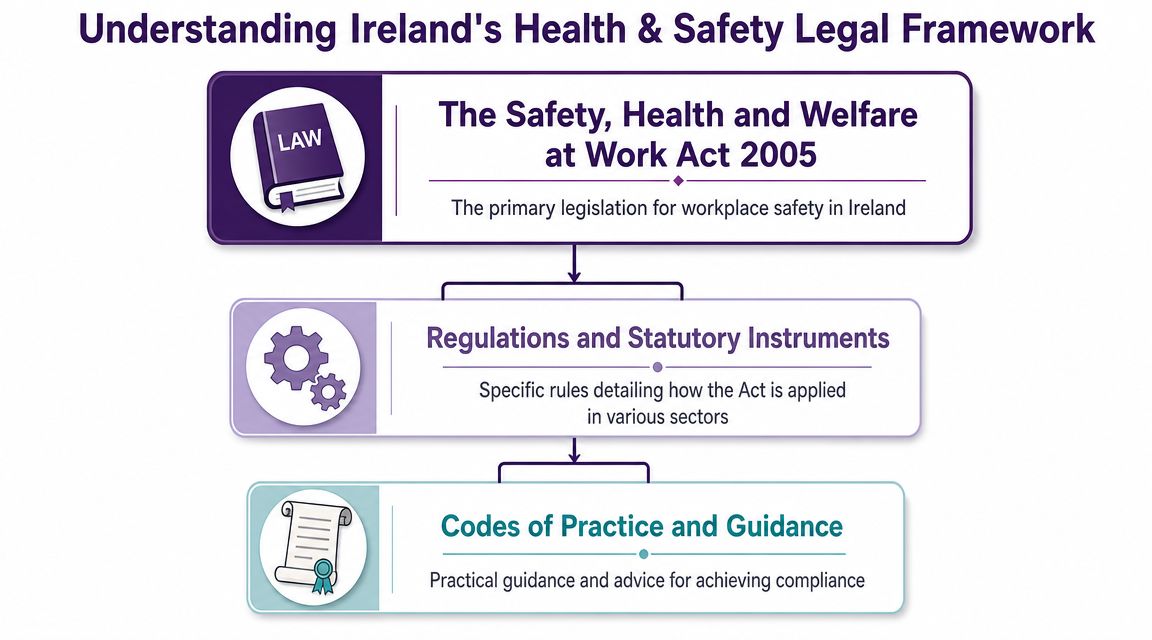
In Ireland, the foundation of workplace safety is the Safety, Health and Welfare at Work Act 2005. It created a broad legal duty on employers to ensure, so far as is reasonably practicable, the safety, health and welfare of all individuals affected by their work, and it is enforced by the Health and Safety Authority under the Irish framework described in this official reference on workplace safety oversight.
That sounds broad because it is broad. In a hospitality setting, it reaches far beyond obvious hazards like a hot grill or a slippery floor. It covers the full working environment, including how work is organised, how risks are assessed, how staff are trained, and how welfare is protected during normal operations and during pressure periods.
What the law means on the floor
If you run a hotel or restaurant, the law doesn't care whether a risk feels ordinary to your team. Normal hospitality tasks can still create serious exposure.
Consider a few ordinary examples:
- Kitchen work: Burns, cuts, manual handling, steam, oil, cleaning chemicals, and cramped movement around service.
- Front of house: Slips on wet entrances, difficult customer behaviour, broken glass, cash handling, and late-night lone working.
- Accommodation and housekeeping: Repetitive strain, awkward lifting, sharps, chemical use, and rushed room turnaround.
- Back of house: Deliveries, stock rotation, cellar access, waste handling, stairs, storage, and maintenance access.
The law expects these risks to be managed as part of day-to-day operations, not after someone gets hurt.
The legal stack matters
The Act is the core. Beneath that sit more detailed rules and guidance that shape how businesses apply the law in practice. Hospitality managers often get caught because they focus on a headline obligation but not on how it translates into procedures, records, and supervision.
That's also why workplace safety can't be separated neatly from other compliance areas. A kitchen that's trying to satisfy both staff safety duties and hygiene obligations needs joined-up systems. For operators balancing those responsibilities, this guide to food hygiene rules under Regulation EC No. 852/2004 is closely related to how safe procedures are built in real kitchens.
The law is broad by design. It gives employers room to manage risk sensibly, but it also leaves nowhere to hide if obvious risks were ignored.
Your Core Duties as a Hospitality Employer
The central duty sounds simple. In practice, it creates a management workload that can't be delegated away casually. The Safety, Health and Welfare at Work Act 2005 requires employers to identify hazards, assess risks, and maintain a written safety statement reflecting the controls in place. That duty must also be reviewed when conditions change, including changes to a menu, equipment, or staffing pattern in a restaurant or hotel, as noted in this technical summary of Irish safety duties.
If your venue added a new combi oven, changed the bar layout, extended late service, or cut experienced staff from a shift pattern, your risk picture changed as well. The paperwork should catch up quickly.
Duty one means controlling the real work
A safe place of work isn't just a clean building. It means the actual environment supports safe behaviour.
That includes things like:
- Floor safety: Non-slip surfaces where needed, prompt spill response, clear walkways, and sensible mat placement at entrances.
- Equipment safety: Guards in place, damaged plugs removed, extraction working, and maintenance faults logged and acted on.
- Storage control: Heavy items stored at sensible height, chemical segregation, safe access to shelves, and no improvised stacking.
A venue can look tidy and still be unsafe. Inspectors and claim handlers both know the difference.
Duty two means creating safe systems
Many businesses weaken because they rely on common sense, shadowing, or “that's how we've always done it”.
That doesn't hold up well when a task is high risk or repeated constantly. A safe system of work is the agreed method for doing the job safely and consistently.
Examples in hospitality include:
- Cleaning a meat slicer or mandoline after service
- Carrying hot liquids from kitchen to pass
- Receiving deliveries through a tight rear entrance
- Handling line cleaning chemicals at the bar
- Emptying bins across a car park late at night
- Dealing with aggressive behaviour at closing time
Duty three means training, supervision, and proof
Training isn't complete because a manager explained something once during induction. Staff need instruction that matches the tasks they do, and managers need to check that practice matches the instruction.
A good test is simple. Could you show:
- who was trained,
- what they were trained on,
- when it happened,
- who delivered it,
- and whether the training was refreshed after a change?
For many venues, the written safety statement is where all of this should connect. If yours is generic, outdated, or disconnected from current operations, it's worth reviewing what an Irish Section 3 safety statement should contain in practice.
If your risk assessment says staff use gloves, but the station has no gloves, the document won't save you. Controls have to exist in the real workplace.
Putting Compliance into Practice
Most managers don't struggle with the idea of safety. They struggle with turning legal duties into routines that survive a busy week. That's where health & safety legislation becomes either useful or useless.
The businesses that stay audit-ready usually do four things well. They assess risk properly, convert that assessment into working procedures, keep records that can withstand scrutiny, and review the system whenever operations shift.

Risk assessments that reflect your venue
A real risk assessment is specific. It names the task, the hazard, who could be harmed, what controls are already in place, and what still needs attention.
In hospitality, vague wording is a common weakness. “Take care with knives” is not useful. “Chefs to use designated cut-resistant glove for mandoline prep and store blade guard in labelled drawer after use” is much stronger because it links the risk to an actual control.
Focus first on the work that causes repeated exposure:
- Slips, trips, and falls: Entrances, wash-up areas, cellar access, stairs, and external bins route.
- Manual handling: Kegs, linen bags, furniture movement, stock deliveries, and refuse.
- Chemical safety: Decanting, storage, use of cleaning products, and access to safety information.
- Hot works and burns: Fryers, boiling liquids, steam ovens, hot plates, and pass areas.
Safety statements that people can use
Your safety statement should be the master document, not a file created once and forgotten. It needs to reflect your current operation, your current risks, and your actual control measures.
A poor safety statement is usually one of three things:
- Copied: It reads like another business's operation.
- Outdated: It describes equipment or layouts you no longer have.
- Detached: Managers can't link it to daily checks, training, or incident follow-up.
A stronger system uses the statement as a management reference point. Supervisors know where it is. Risk assessments support it. New managers can pick it up and understand how the venue is expected to operate safely.
Training records and accident reporting
Training records don't need to be fancy. They do need to be complete. Keep attendance, topic, trainer, and date together. Add refreshers when risks change or standards slip.
Accident reporting should also include near misses. In hospitality, near misses often reveal key pressure points. A tray almost dropped on stairs, a cleaner mixing products incorrectly, or a staff member cornered by an aggressive guest are all warning signs.
Irish safety law also reaches beyond physical hazards. Employers must manage risks to health and welfare, not only visible injury risks, and HSA guidance confirms that psychosocial hazards such as stress and bullying should be identified and assessed. That matters in hospitality because pressure, fatigue, and poor supervision often sit underneath physical incidents, as discussed in this background summary of workplace stress duties.
A team that's exhausted, undertrained, and afraid to speak up is not operating safely, even if the paperwork looks tidy.
For kitchens and hotels trying to align daily safety practice with documented operational controls, specialist food safety consulting for hospitality businesses often becomes relevant because many of the strongest routines overlap across hygiene, training, and safe systems of work.
Who Enforces the Law and What They Look For
Hospitality operators often mix together every inspection under one heading. That creates confusion and, worse, the wrong kind of preparation. Different regulators look at different things.
The main distinction is this: the Health and Safety Authority focuses on workplace safety, while local enforcement and environmental health functions look at other compliance areas such as food hygiene, public health, fire-related matters, and environmental controls.

What an HSA inspection tends to centre on
An HSA inspector is concerned with staff safety and the systems behind it. In a hotel or restaurant, that can include manual handling, slips and falls, training records, chemical controls, machinery use, accident reporting, and whether management can demonstrate oversight.
They are not just checking whether obvious hazards exist. They are looking at whether the business recognises risk in a structured way and manages it consistently.
Questions often cut straight to operational reality:
- Can you produce the safety statement quickly
- Are risk assessments current
- Have staff been trained for the work they do
- What happens after an incident
- Who is responsible for follow-up
If the answer to all of that lives only with one senior manager, the business is exposed.
How that differs from other inspections
A food hygiene inspection will naturally focus on a different set of controls. That's why a venue can be strong in one area and weak in another.
Here's the practical difference:
- HSA focus: Workplace hazards, systems of work, training, welfare, documentation, and employer duties.
- Environmental health or local authority focus: Food safety controls, hygiene standards, public health obligations, and other local compliance matters.
- Fire and emergency oversight: Escape routes, alarms, emergency arrangements, occupancy issues, and related building controls.
That division matters because a manager shouldn't prepare for all inspections with the same folder. The documents overlap, but the questions won't.
The fastest way to lose confidence in an inspection is to hand over the wrong documents first and realise the venue doesn't know who manages what.
The Real-World Consequences of Non-Compliance
Most hospitality operators don't ignore safety on purpose. But the law doesn't judge intent alone. It looks at the risk, the controls, and the evidence.
Ireland's health and safety system is evidence-based, with the HSA tracking injuries, ill-health, and enforcement trends, which means regulators concentrate on known risk areas and expect businesses to show documented compliance during an audit, as outlined in this overview of safety regulation and monitoring.
What failure looks like in practice
Non-compliance usually shows up in one of two ways. Either the venue has weak systems, or it has systems on paper that managers can't prove are being followed.
That can trigger formal action. If there's a serious risk, part of an operation may have to stop until the issue is addressed. Even where matters don't reach that point, corrective notices, follow-up pressure, legal exposure after an incident, and management distraction can drain a business quickly.
The hidden costs often hit longest:
- Operational disruption: Managers get pulled into document gathering, interviews, corrective action, and staff concern.
- Insurance pressure: Poor claims history or weak controls can make cover more painful to manage.
- Recruitment and retention damage: Staff don't stay where injuries, aggression, or chaos feel normal.
- Reputational fallout: Word spreads fast within teams and local labour markets.
Why evidence decides the outcome
In hospitality, plenty of incidents happen during busy, messy, ordinary work. A rushed breakfast setup. A wet lobby during rain. A porter carrying too much because the lift is out. Those situations are understandable. They are not automatic excuses.
The key question after an incident is usually simple. What had the business done to foresee the risk, reduce it, train for it, and review it?
If the answer is vague, legal risk grows fast. If the answer is documented, specific, and credible, the business stands on much firmer ground.
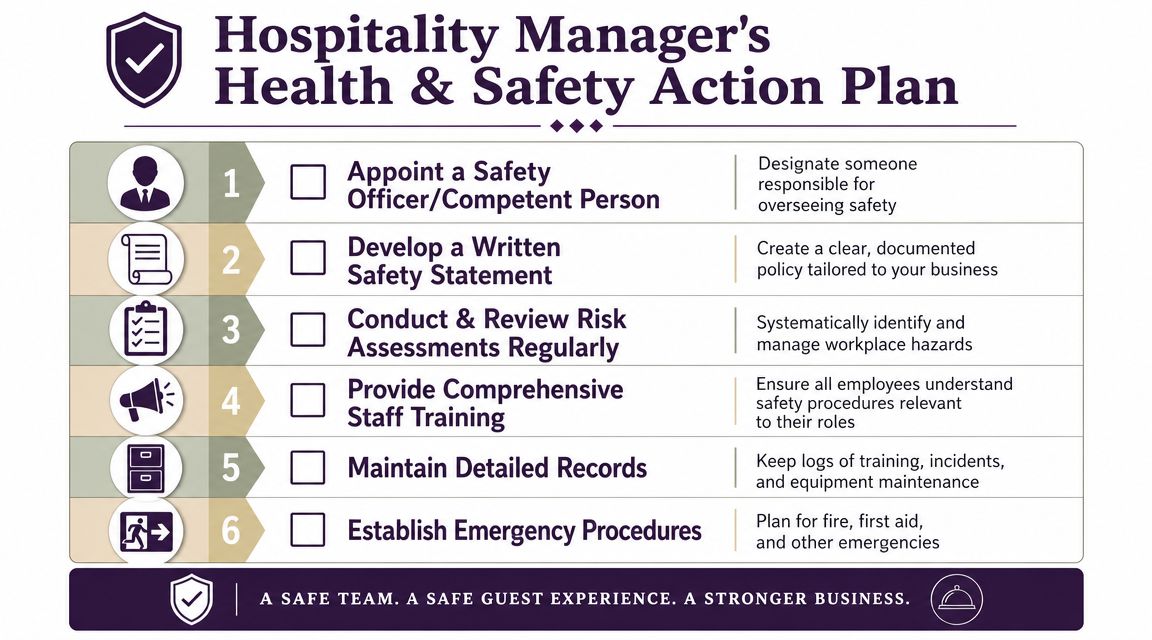
Your Action Plan for Health and Safety Compliance
Most managers don't need another lecture on compliance. They need a short list of actions that can be done without stopping the business. Start there.
Many businesses fail not on the law but on the evidence. With the HSA conducting over 15,000 inspections in 2024, the issue isn't only what the law says. It's what documentation, training records, and management oversight you can prove in an audit, as referenced in this inspection-focused compliance summary.
This week
Do the immediate checks that expose weak spots fast.
- Find your safety statement: Check that it matches the current venue, current team structure, and current work areas.
- Pull the latest risk assessments: Make sure they reflect today's kitchen, bar, housekeeping, maintenance, and public areas.
- Check training files: Confirm that new starters, agency staff, and promoted supervisors have records in place.
- Walk the floor with fresh eyes: Look at entrances, stores, stairs, wash-up, cellar, chemical storage, and staff welfare areas.
This month
Use the next few weeks to tighten ownership and routine.
- Assign clear responsibility. One competent person should coordinate the system, but each department head should own risks in their area.
- Run a short safety meeting. Minute it. Review incidents, near misses, staff concerns, and overdue actions.
- Test your reporting process. Ask supervisors how they log an incident, where forms go, and who closes actions.
- Review pressure points. Late finishes, split shifts, understaffing, aggressive guest interactions, and fatigue should all be discussed openly.
This quarter
Build a cadence that keeps the system alive.
- Review after operational change: New menu, equipment, layout, refurbishment, or staffing changes should trigger a safety review.
- Sample actual practice: Watch tasks being done. Don't rely only on signed forms.
- Refresh high-risk training: Manual handling, chemicals, equipment use, and incident response often drift without reinforcement.
- Check management evidence: Make sure reviews, briefings, and corrective actions are dated and signed.
Good compliance is boring in the best possible way. It means the venue can show who checked what, when they checked it, what they found, and what they did next.
If you're managing multiple sites, standardise the framework but let each venue record its own risks. A copied system is fragile. A site-specific system, reviewed on a schedule and used by managers, is far more defensible.
Beacon Recruitment has grown into more than a hiring partner. For Irish hotels, restaurants, and multi-site operators, we act as an operational support partner across recruitment, food safety, HR compliance, and wider business systems. If your venue needs practical help getting audit-ready, tightening documentation, or building safer day-to-day operations, explore Beacon Recruitment.
Will Your Safety Systems Pass an HSA Inspection?
Don’t let generic safety statements and missing training records leave your business exposed. Book a Free Consultation with Beacon today to audit your health and safety compliance.