July 16, 2026
How to Manage Poor Performance For Ireland Employers
Learn how to manage poor performance Ireland employer legally & effectively. Our 2026 guide covers PIPs, fair procedures, and WRC compliance for your business.
It's a busy Friday. Service is stacked, the rota is fragile, and one team member is missing standards often enough that everyone else has noticed. Orders are going out late, checks are being missed, or the same guest complaints keep landing on your desk. You know you need to act, but you also know one badly handled conversation can create a bigger problem than the original performance issue.
That's the reality for hospitality employers in Ireland. You're balancing guest experience, staffing pressure, margin control, and legal risk at the same time. The worst move is usually the most tempting one. A quick word in the corridor, a vague warning, then a rushed decision when nothing changes.
If you're searching for how to manage poor performance as an employer in Ireland, the answer isn't a harsh disciplinary stance and it isn't endless tolerance. It's a fair, documented, role-specific process that works in an Irish hospitality setting.
Laying the Groundwork Before Problems Arise
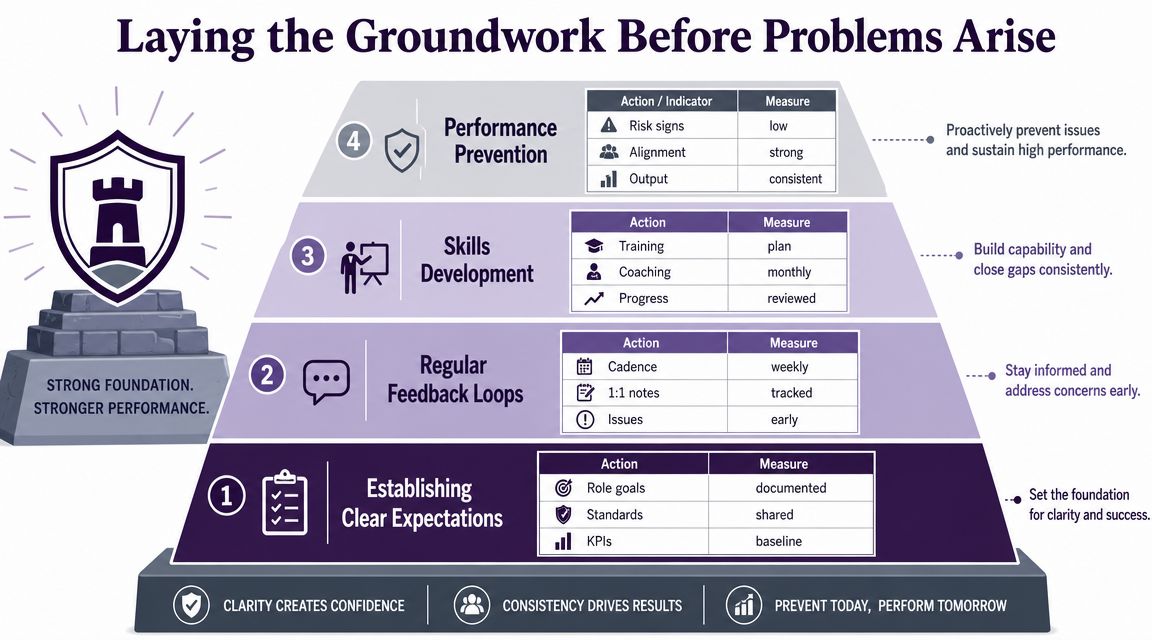
Managing poor performance starts long before anyone ends up in a formal meeting. The process is similar to building a hotel. If the foundation is weak, every crack shows later. In people management, that foundation is clear expectations, consistent supervision, and written standards.
In Ireland, performance management should be handled as a formal, documented process, not an informal complaint chat. Practical Irish guidance recommends clear expectations, regular feedback, and a PIP with specific goals and timelines, while allowing employee representation at formal meetings and keeping full records. The reason is straightforward. If fair procedures are not followed, employers can face unfair dismissal or constructive dismissal claims, as set out in Irish employment guidance on performance management.
Start with role clarity, not personality
Most hospitality businesses don't struggle because managers can't spot poor performance. They struggle because they haven't defined performance well enough to manage it objectively.
A chef can't improve against “be more organised”. A front-of-house supervisor can't respond properly to “your service isn't up to scratch”. Standards need to be tied to the role.
Use documents that already exist in the business and make them usable:
- Employment contracts should match the true role. If the contract says one thing and the daily reality says another, performance discussions get messy.
- Job descriptions should reflect real operational duties, not generic templates.
- Staff handbooks should spell out service standards, attendance expectations, reporting lines, and disciplinary routes.
- Induction checklists should show what training the employee completed.
If you're reviewing those basics, Beacon's guide to the probationary period in Ireland is a useful companion because many performance disputes begin when standards were never clarified properly during onboarding.
Practical rule: If a manager can't point to the written standard, they're not ready for a formal performance conversation.
Build KPIs that fit hospitality work
You don't need a corporate scorecard for every role. You do need concrete measures that a manager can observe and record.
Examples that work in hospitality include:
- Kitchen roles like prep completion, adherence to recipe specs, hygiene compliance, stock rotation accuracy, and waste control.
- Front-of-house roles like order accuracy, guest interaction standards, speed of table reset, and complaint handling.
- Management roles like rota accuracy, completion of cash controls, staff supervision, and consistency of shift briefings.
What matters is not the sophistication of the metric. What matters is whether a manager can say: this was the standard, how performance fell short, and this is how improvement will be measured.
Make feedback routine
If the first time an employee hears there's an issue is at a formal meeting, management has already made life harder for itself. In hospitality, the better approach is short, regular correction close to the work itself. Pre-shift briefings, end-of-shift debriefs, spot coaching on the floor, and documented one-to-ones all reduce the shock factor later.
A fair process feels less adversarial when the employee can see a pattern of support. It also gives the employer better evidence. That matters if the issue escalates.
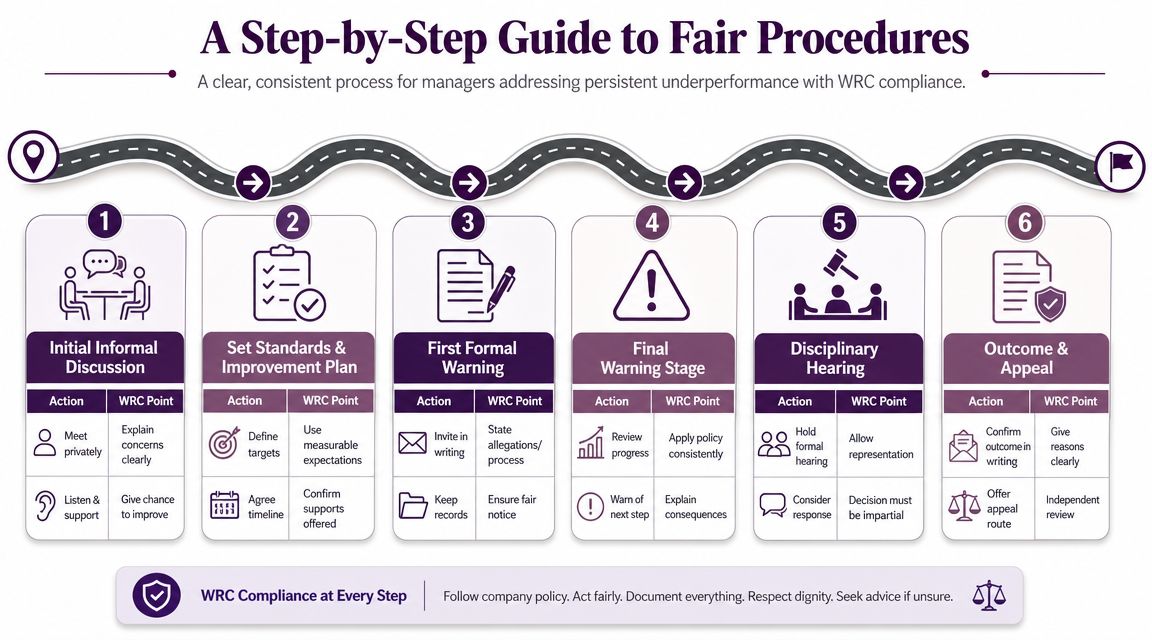
A Step-by-Step Guide to Fair Procedures
When underperformance continues, structure matters. Not because paperwork is the goal, but because a staged process protects the business and gives the employee a real opportunity to improve.
Irish-focused guidance supports a documented, staged approach. The sequence is to identify the specific gap, discuss it informally, agree measurable standards and timelines, then monitor and review. Guidance also recommends at least three review meetings over time before dismissal is considered, with intervals appropriate for the role. It gives the example of around one month for a cashier-type role and longer for senior strategic roles. Each meeting should record the issue, the employee's response, the standard required, how improvement will be measured, support offered, and the consequence if improvement doesn't happen, as outlined in this performance management guidance for employers.
Step one begins with evidence
Before any conversation, gather facts. In hospitality, that usually means records such as shift notes, complaints, wastage sheets, till discrepancies, missed prep lists, lateness records, or supervision notes.
Write down:
- What happened
- When it happened
- Which standard was missed
- What impact it had on service, team workload, or compliance
Keep the language factual. “Three sections were left without table checks” is useful. “Bad attitude on shift” usually isn't.
Step two is the informal conversation
This stage is often skipped, and that's a mistake. The first conversation should be calm, specific, and aimed at understanding what's driving the issue.
The manager should cover:
- The concern clearly with examples
- The expected standard
- The employee's explanation
- Any immediate support needed
- A date for review
This isn't a throwaway chat near the pass. Hold it privately. Make a note afterwards. If the issue improves, good. If it doesn't, you've started a fair record.
Step three is formalising the issue
If the informal stage doesn't bring enough improvement, invite the employee to a formal meeting. Tell them the purpose in advance. If your procedure allows representation, that right should be respected.
At the meeting, cover the same core points, but with more structure:
- The documented concerns
- The standards required
- The support available
- The timeframe for improvement
- What may happen if improvement isn't achieved
For employers who want to compare how structured public-sector procedures are framed, Beacon's article on the HSE disciplinary procedure is useful context on staged process and documentation discipline.
A fair process is easier to defend because it shows patience, clarity, and consistency. A rushed one usually shows frustration.
Step four is building a workable PIP
A Performance Improvement Plan should read like an operational document, not a generic warning letter. In hospitality, weak PIPs tend to fail for one reason. They're too vague.
A sound PIP includes:
- The exact performance gap
Example: incomplete closing checklists, repeated guest complaint escalation, poor station readiness. - The standard required
This needs to be observable and role-linked. - How improvement will be measured
Through manager observations, checklist completion, service audits, attendance records, or similar records already used in the business. - Support provided
Training refreshers, shadowing, coaching, extra supervision, or role clarification. - Review schedule
Book the dates in advance. - Consequences
State clearly what further action may follow if standards are not met.
Step five is review, not drift
A lot of employers create the PIP and then let it sit. That weakens the process. Reviews must happen when promised.
At each review meeting, record:
- What improved
- What didn't
- What the employee said
- Whether support was delivered
- What happens next
If the employee is making progress, say so. If they're not, say that too. Ambiguity helps nobody.
Step six is decision-making
By the final review, the employer should be able to answer a simple question. Has the employee met the required standard, and has the process been fair?
If yes, step them back into normal management with continued oversight. If no, the business may move to warning stages or termination in line with policy and procedure. The point is not to “build a case” from day one. The point is to create a process that would still look reasonable if every note was read later by a third party.
Essential Scripts for Difficult Conversations
Managers often know the process but still freeze on the words. That's normal. In hospitality, these conversations usually happen under pressure, often after a rough shift, and that's exactly when poor phrasing causes unnecessary conflict.
The safest tone is direct, calm, and specific. Underperformance should be treated as a live operational issue, with immediate intervention, regular specific feedback, support such as training or coaching, and a written co-created action plan. Expectations also need to be concrete enough to track against quality, timeliness, service behaviours, or error rates, as set out in best-practice guidance on managing underperformance.
When a server is repeatedly slow with orders
You've noticed that dockets are being delayed and the kitchen is chasing the same person for follow-through.
Try this opening:
“I want to talk about service flow on your section. Over the last few shifts, orders have been going through later than expected, and it's affecting both the kitchen and the guest experience. I want to understand what's getting in the way and agree what needs to change from the next shift.”
That opening works because it does three things. It identifies the issue, states the impact, and invites explanation without sounding accusatory.
If the employee becomes defensive, stay with the facts:
- Bring it back to examples by saying, “I'm focusing on specific shifts and specific delays, not making a general judgement about you.”
- Keep the standard visible by saying, “The expectation is that orders are processed promptly and accurately during service.”
- Move towards action by saying, “Let's agree what support or change is needed so this improves immediately.”
When a chef's prep and consistency are slipping
Kitchen conversations can become blunt very quickly. That usually makes things worse.
A stronger approach is:
“Your station wasn't ready for service on more than one recent shift, and we also had issues with consistency on dishes going out. That's not where the role needs to be. I want to hear your view first, then we'll agree the standard and how we're going to measure improvement.”
This keeps authority without turning it into a row.
When a supervisor's standards are affecting the wider team
Management underperformance carries a bigger operational impact because poor supervision spreads across the shift.
A useful formal phrasing is:
- State the management gap
“This isn't just about your own tasks. The concern is around team control on shift, including follow-up, delegation, and consistency of standards.” - Define the required level
“In this role, the expectation is that service standards are maintained through active supervision, not just reactive problem-solving.” - Set the review tone
“We're going to put clear expectations and review dates around this so there's no ambiguity.”
Don't ask, “Why are you underperforming?” Ask, “What is preventing you from meeting this standard?” The second question gets better answers.
When emotions rise in the room
Some employees go quiet. Some become upset. Some insist they are being singled out.
Managers should avoid arguing. Use short grounding phrases:
- Acknowledge emotion
“I can see this conversation is difficult.” - Reaffirm purpose
“The purpose here is to address the issue fairly and give you a chance to improve.” - Keep process clear
“You'll have an opportunity to respond, and I'll record your comments.”
That kind of language lowers temperature and preserves the record.
Navigating Complex Scenarios and Common Pitfalls
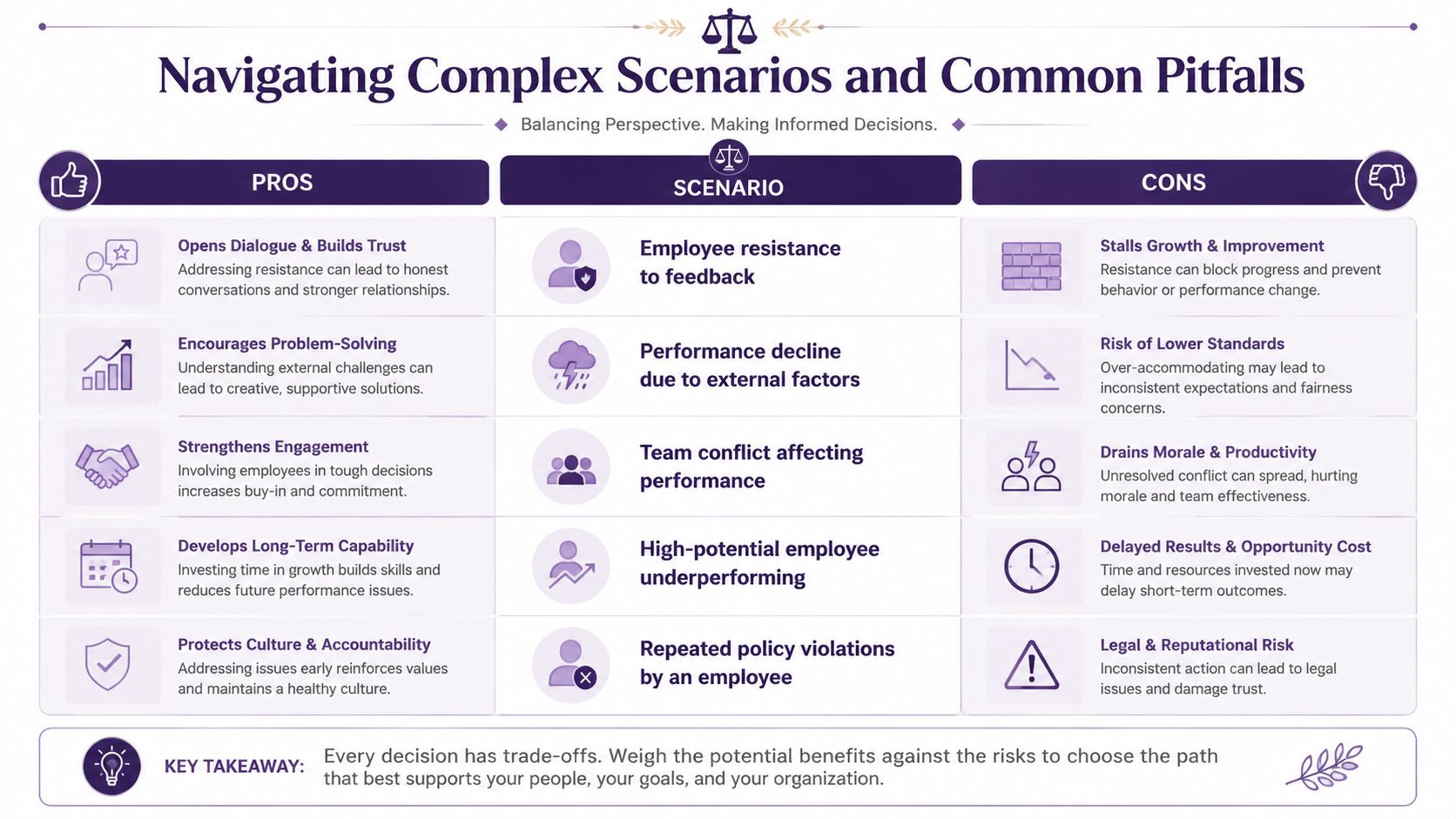
Generic HR advice often assumes a calm office environment, easy access to replacement staff, and neat distinctions between attitude, skill, and wellbeing. That isn't how Irish hospitality works. A restaurant manager may be covering shifts, a hotel may be short on key roles, and a struggling employee may also be tired, stressed, or unwell.
That's why one-size-fits-all performance advice can create risk. The hardest cases are not the obvious ones. They're the cases where poor performance might be a health, stress, or disability issue.
Irish employment commentary highlights this gap clearly. Employers can drift from a standard performance process into an Equality Act risk if they fail to consider reasonable accommodation and medical evidence. That matters in hospitality because long hours, irregular shifts, and burnout can mask underlying health issues. The practical challenge is separating conduct, capability, and disability-related issues before the matter escalates, as discussed in guidance for employers on performance management and risk areas.
When to pause the performance route
A PIP is not always the right next step. Sometimes the employer needs to stop and ask whether the issue is really capability in the usual sense.
Warning signs include:
- A sudden decline in someone who was previously stable
- References to stress, fatigue, medication, or treatment
- Attendance or concentration issues that suggest something wider is happening
- Requests for change linked to health or personal functioning
That doesn't mean performance standards disappear. It means the employer needs to avoid treating a potential health matter as simple non-performance.
A sensible decision frame looks like this:
- Identify the issue factually
- Ask open questions
- Consider whether medical input or accommodation may be relevant
- Decide whether the performance process should continue, pause, or run alongside a capability or health-led review
If dismissal is later considered, the employer's handling of that earlier stage may become highly relevant. Beacon's overview of unfair dismissal in Ireland is useful reading for managers who need to understand how process failures can undermine an otherwise genuine business concern.
The problem with generic PIP timelines
Plenty of online advice pushes standard PIPs with fixed timeframes. That sounds tidy, but hospitality operations rarely behave tidily.
A line chef with repeated station-readiness issues may not need a long review period if the standard is immediate and observable. A senior manager with leadership gaps may need longer because the job involves judgement, delegation, and sustained team control. Multi-site employers also face a practical problem. If replacement cover is scarce, dragging out an ineffective process can damage the wider operation.
The right question isn't, “What's the standard PIP length?” It's, “What timeframe is proportionate for this role, this issue, and this business risk?”
The most common pitfall is false fairness. Employers think they're being fair by giving too much time, too little structure, and unclear review points. In practice, that usually produces drift. Better practice is often a shorter, tighter improvement window with more frequent evidence, clearer support, and an earlier decision if the role isn't the right fit.
Common mistakes that weaken the employer's position
Some errors come up repeatedly:
- Treating poor performance like misconduct when the issue is really capability or support.
- Using subjective language such as “bad fit” or “poor attitude” without examples.
- Ignoring operational context such as training gaps, unclear supervision, or impossible workload.
- Waiting too long until the issue becomes a crisis and tempers are already high.
Hospitality employers need judgement as much as procedure. The process has to be fair, but it also has to work in a live business.
Tools and Templates for Consistent Management
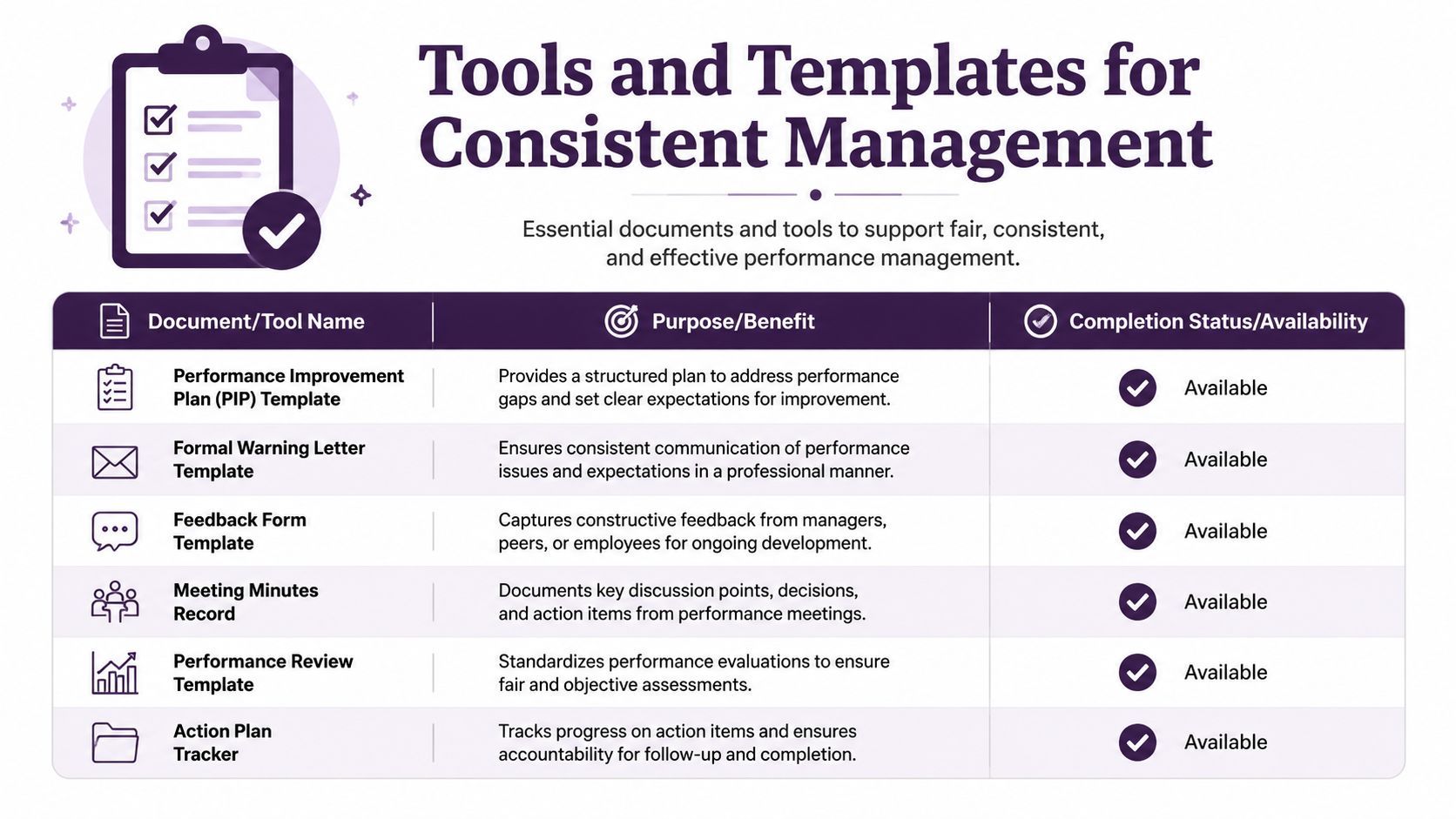
A fair process often breaks down for a simple reason. One hotel keeps clear records, another relies on memory, and a third uses a template copied from a disciplinary case. In hospitality groups, that inconsistency creates risk fast, especially where different sites are dealing with similar issues under the same brand.
Templates give managers a structure they can follow on a busy shift pattern. They also help employers deal with a common Irish hospitality problem. Performance concerns do not sit neatly apart from training gaps, understaffing, language barriers, or employee wellbeing. A workable document set should capture those factors without losing sight of the required standard.
A recurring gap here is practical guidance on timing and structure for Irish hospitality employers. Generic advice often points to PIPs of 4 to 12 weeks, but a more useful approach is to set short, structured improvement periods, clear evidence logs, and defined decision points where the business cannot afford drift, as noted in this employer guide on managing poor performance.
The documents that actually matter
You do not need a large HR platform. You need a small number of documents that managers will consistently use, and use the same way.
- Performance Improvement Plan template
Set out the specific concern, the standard required, how improvement will be measured, what support will be provided, the review dates, and the possible outcome if improvement does not happen. In practice, this document is doing two jobs. It gives the employee a fair opportunity to improve, and it shows later that expectations were clear. - Formal meeting record form
Record the date, attendees, concerns discussed, the employee's response, whether they had representation, actions agreed, and the next review point. In Irish claims, the employee's account often matters as much as the manager's. A proper note shows the discussion was heard, not dictated. - Performance tracking log
Managers should note what happened between meetings, with dates and examples. That keeps the process tied to observed facts such as missed checklists, repeat guest complaints, or failure to complete stock control, rather than broad statements about attitude. - Outcome letter templates
Use separate templates for confirmed improvement, extended review, redeployment discussions where appropriate, and formal progression where standards are still not met. That avoids rushed letters written after a difficult meeting, which is where inconsistency and careless wording usually creep in.
Why consistency protects the business
The primary value of templates is not admin speed. It is consistent decision-making across sites, departments, and managers.
That matters in hospitality because one weak manager can undermine a sound process. If a bar supervisor gets a detailed improvement plan in one venue, but a receptionist in another venue gets only verbal warnings for a similar issue, the employer's position becomes harder to defend. Consistency does not mean treating every role identically. It means using the same fair structure while adjusting the standard, support, and review period to the job.
Where businesses want outside support on those systems, Beacon Recruitment provides employer-facing HR consulting that includes contracts, policies, and process design relevant to performance management in Irish hospitality.
Strong documents do not replace management judgement. They record it clearly and apply it consistently.
From Managing Problems to Building a Performance Culture
Most employers start looking up poor performance because they want to solve one immediate problem. That's understandable. But the stronger long-term move is to stop treating performance management as a route to dismissal and start treating it as part of operational control.
That shift changes everything. Standards become clearer. Managers intervene earlier. Employees know what good looks like. Documentation becomes normal rather than a panic response when things go wrong. In practice, that usually creates a steadier team and fewer high-drama situations.
There's also a wider Irish lesson here. Performance management has moved away from a vague annual appraisal model towards a more continuous structure. Irish research found that almost 60% of Irish-owned organisations had a performance management process in place by 2004, and public-sector incidence reached 85% by 2009, up from 39% in 1999, while 20% of respondents said line managers did not effectively communicate objectives and expectations according to Irish-sector research on performance management development. That history matters because it points to the same practical conclusion hospitality employers still face today. Problems often begin with unclear standards, not unwilling employees.
If you manage poor performance properly, you're not just protecting against claims. You're building a business where expectations are clear, support is real, and decisions are easier to justify. That's better for managers, better for staff, and better for guests.
If you need help building contracts, handbooks, performance processes, or practical HR systems for your venue, Beacon Recruitment works with Irish hospitality employers on the operational side of people management, so managers aren't left trying to improvise fair procedure in the middle of service.
Turn Poor Performance Into Clear Standards
Empower your management team to handle underperformance fairly, consistently, and with confidence. Schedule a Free Consultation with Beacon to upgrade your HR framework today.