July 19, 2026
Labour Market Needs Test Ireland Hospitality Employers
A clear guide for Labour Market Needs Test Ireland hospitality employers. Learn 2026 rules, avoid errors, & secure work permits.
You've got rooms to sell, guests arriving, rotas full of gaps, and a chef or supervisor has just handed in notice at the worst possible time. You've already run ads locally. You've asked your managers to tap their networks. You've stretched the existing team again. Service slips, reviews wobble, and everyone starts making expensive short-term decisions.
That's usually the moment hospitality employers in Ireland start looking seriously at non-EEA hiring.
The problem is that the Labour Market Needs Test isn't just a box on a permit form. It's a compliance process with technical tripwires. One wrong edit to an advert, one mismatch in salary wording, one weak candidate record, and the whole thing can fall apart. If you're searching for practical guidance on the Labour Market Needs Test Ireland hospitality employers need, treat this as an operations manual, not a legal summary.
The Staffing Challenge in Irish Hospitality
A lot of hospitality owners aren't failing to recruit because they're careless. They're failing because the labour market is tight, the work is demanding, and good people have options. A hotel in Clare, a restaurant in Galway, or a busy venue in Dublin can all have the same problem for different reasons. The role is live, the need is real, but the right candidate doesn't appear when you need them.
That pushes employers into survival mode. They over-rely on overtime. They promote too quickly. They move someone strong out of one department to plug a hole in another. It keeps the doors open, but it usually creates a second problem a few weeks later.
The real issue isn't just hiring
Most operators focus on the vacancy in front of them. Fair enough. But the stronger move is to solve two things at once. Fill the role and stop the next one from opening. If you're under pressure on both fronts, practical work on building an engaged workforce matters because retention and recruitment are tied together in hospitality whether people like it or not.
Non-EEA hiring can absolutely be part of the answer. For many venues, it's the difference between stable operations and a constant staffing scramble. But only if you respect the process.
A permit refusal doesn't just delay one hire. It drags management time back into admin, drains confidence, and leaves the rota problem exactly where it started.
Why the LMNT matters so much
The Labour Market Needs Test is the gateway. If you're hiring under a General Employment Permit for hospitality, this is the part that proves you made a real attempt to recruit locally before turning abroad. That's the rule. Complaining about it won't change it.
The smarter approach is to stop treating the LMNT like paperwork and start treating it like a controlled recruitment campaign. The employers who get this right usually aren't luckier. They're more disciplined. They decide the job spec early, keep the advert wording locked, track every applicant properly, and line up the permit file before the ad period even ends.
That's how you take a stressful process and make it predictable.
Understanding the Labour Market Needs Test Purpose
The LMNT exists for a simple reason. The State wants employers to show they looked for suitable Irish and EEA candidates first. This is comparable to searching your own house properly before calling a locksmith. You don't get to skip straight to the outside solution because you're busy.
That's the basic logic behind the system.
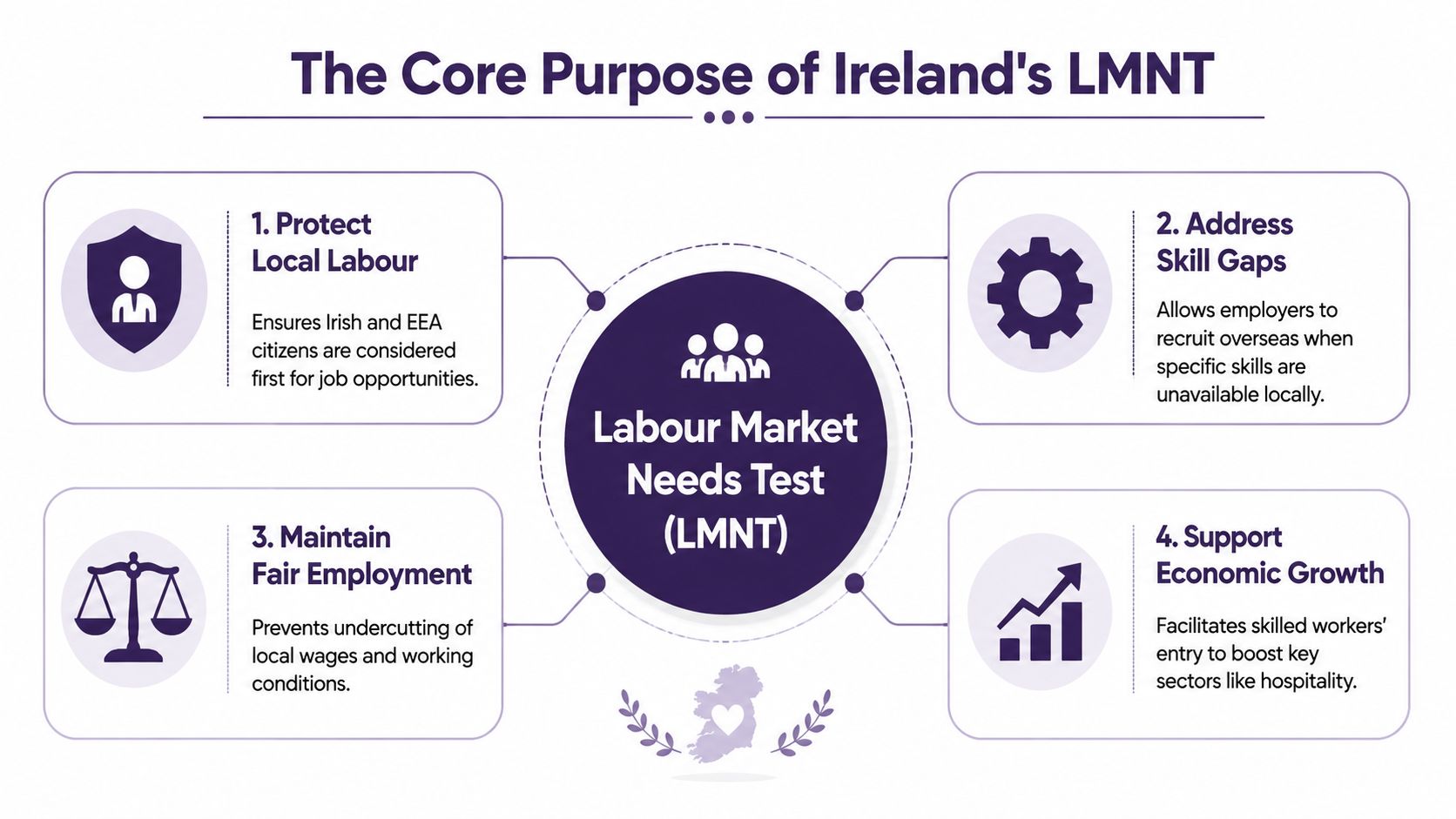
What the government is trying to prove
The LMNT is designed to do four things in practice:
- Protect local access to jobs so Irish and EEA workers are considered first.
- Allow overseas recruitment where genuine gaps exist rather than where it's merely more convenient.
- Hold the line on employment standards so wages and conditions aren't subtly undercut.
- Support sectors that need labour without dropping the requirement for evidence.
That last point matters for hospitality. The system isn't built on the idea that international recruitment is suspicious. It's built on the idea that it has to be documented.
The pressure on the system has grown. The Irish hospitality sector saw employment permits for hospitality roles rise from roughly 500 per year in earlier years to 2,232 in 2022 and then to about 3,358 in 2024, which was about 8 to 9% of all employment permits issued in Ireland that year according to this hospitality permit analysis. When permit use rises like that, scrutiny doesn't get looser. It gets sharper.
What employers usually get wrong about the purpose
A lot of employers think the LMNT is there to catch them out. That mindset leads to sloppy execution because people rush through something they resent.
A better reading is this. The State is asking for proof of search. If you provide clear proof, the process is manageable. If your proof is weak, inconsistent, or patched together after the fact, you're exposed.
Practical rule: The LMNT is not asking whether you wanted to hire locally. It's asking whether you can prove you tried.
That shift in mindset changes how you run the campaign. You stop asking, “How quickly can I get this done?” and start asking, “If someone audits this file later, does the story hold together from start to finish?”
That's the standard to work to.
The Non-Negotiable LMNT Rules for 2026
Hospitality employers lose time on this because they assume there's room for interpretation. There isn't much. The core LMNT rules are rigid, and you're better off accepting that from the outset.
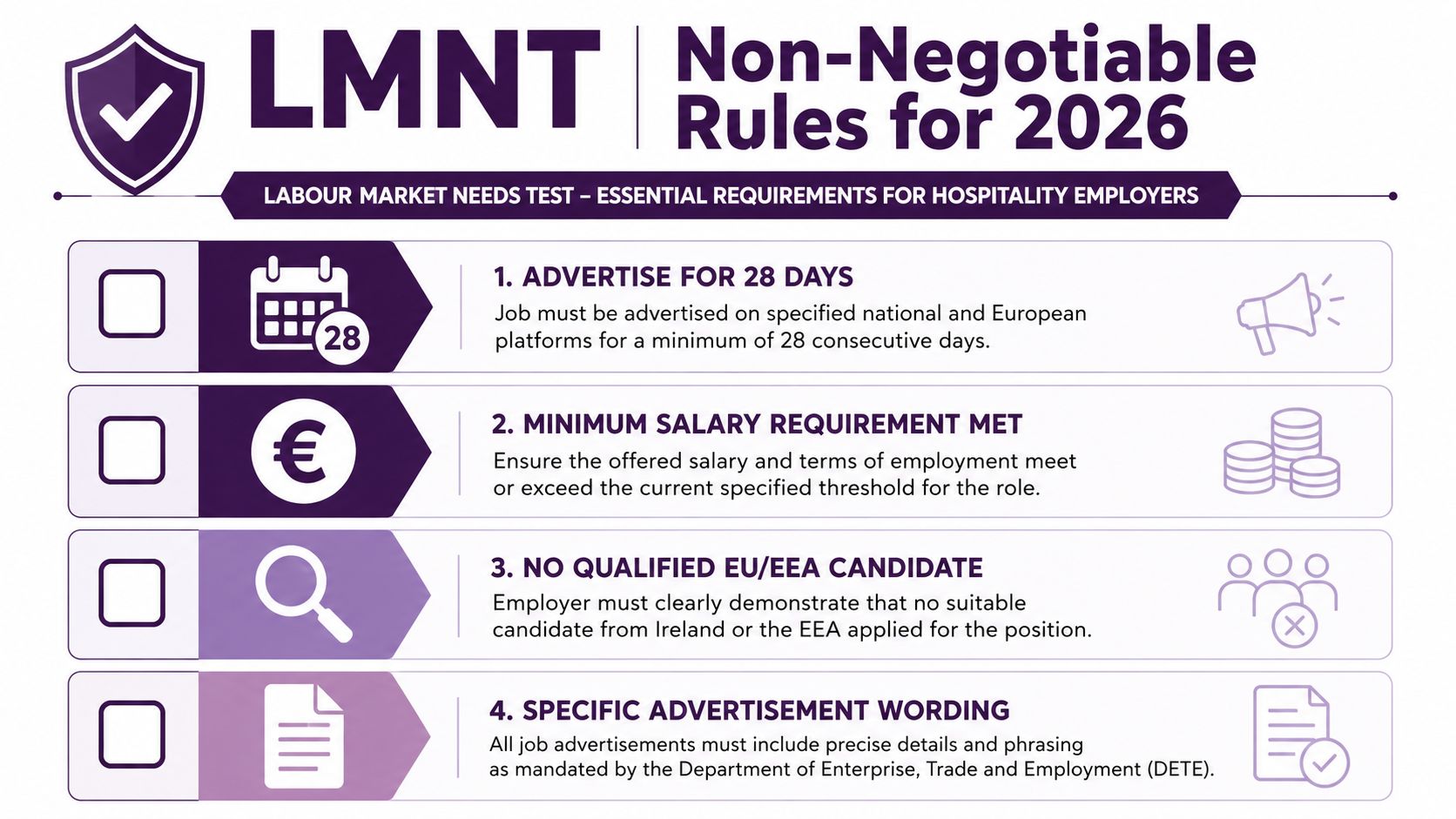
The rulebook you actually need
To hire non-EU hospitality staff in Ireland under a General Employment Permit, the vacancy must be advertised for a minimum of 28 consecutive days on JobsIreland.ie and on one additional online recruitment platform, and the permit application must be submitted within 90 days of the advert's first publication date, as set out in this guide to Ireland hotel employment permits.
That sounds simple. In practice, it means your timing, wording, and file management all have to line up.
Here are the operational rules that matter most:
- The ad duration must be continuous. If your advert drops, pauses, or gets altered in a way that breaks the continuous run, you can end up restarting.
- JobsIreland is mandatory. This isn't optional for a standard hospitality GEP route.
- You need a second online platform as well. Don't assume one posting is enough.
- The application window is strict. If you let the timeline drift beyond the allowed submission period, the advertising exercise may no longer support the permit application.
- The salary threshold must be met. For hospitality GEP roles, employers must offer a minimum salary of €34,000 per annum, effective from January 17, 2024, as noted in the verified data above.
- The 50:50 rule applies. At least 50% of the venue's existing workforce must be EEA citizens before the permit can go through under this route.
What this means for actual venues
A lot of operators think the LMNT is just a pre-permit ad. It's more restrictive than that. It affects when you launch the vacancy, how you count your staff mix, and whether the role is commercially viable at the required salary.
If you're checking wider permit eligibility changes, Beacon's own update on Ireland's employment permit occupations lists and what Irish businesses need to know is a useful companion because permit strategy starts before the advert ever goes live.
A blunt checklist for owners and GMs
Use this before you post anything:
- Confirm the role is suitable for the GEP route.
- Set the final salary now. Not later, not after “seeing the market”.
- Check your workforce mix against the 50:50 rule.
- Choose your second platform before launch.
- Prepare the exact ad copy once.
- Lock the publication dates.
- Diary the submission deadline from the first publication date.
If you're hiring for peak season and you start this late, the law doesn't care that the kitchen is short or the bar is under pressure. The clock still runs the same way.
That's why good operators work backwards from need. If the role has to be filled, the LMNT has to be scheduled like any other critical operation. You wouldn't leave a food safety audit to chance. Don't do it here either.
How to Run a Flawless LMNT Advertisement
Many decent applications die. Not because the role is wrong. Not because the candidate is wrong. Because the advert was handled casually.
The biggest mistake I see is employers treating the two required postings like normal recruitment marketing. They write one version for JobsIreland, then a tidier one for LinkedIn or another board, then tweak a sentence, tighten the salary line, or adjust hours for clarity. That can wreck the application.
The ad text must match exactly
In practice, hospitality employers face a double-advertising requirement where the exact same job text must appear on both JobsIreland and the secondary platform without variation. If the text is edited even once during the 28-day continuous window, the period is invalidated and you have to restart, based on this LMNT technical guide.
That means exact. Not nearly exact. Not “same meaning”. Exact.
If one advert says €34,000 and the other says “competitive” or “from €34,000”, you've created risk. If one says 39 hours and the other says full-time, you've created risk. If one lists accommodation assistance and the other doesn't, you've created risk.
The salary is load-bearing
This is the part many smaller venues get badly wrong.
They advertise at the legal minimum because they want to keep options open. Then they struggle to attract the candidate they want and increase the pay offer later to compete with bigger venues. Commercially, that makes sense. From a permit point of view, it can be fatal.
The advertised wage is not a rough guide. It's load-bearing. Treat it as binding. Decide the actual offer before day one of advertising and hold it there.
Changing the salary after the advert isn't a harmless improvement. It can turn a compliant campaign into a refusal file.
A safer way to build the advert
Before anything goes live, create one master version in a plain document and freeze it. Include the final job title, duties, hours, location, salary, and application method. Then copy that exact version into both platforms.
A practical workflow looks like this:
- Draft once: Build the ad in one master file, not separately inside each platform.
- Cross-check every field: Salary, hours, job title, location, and duties must align.
- Approve internally: Let one person own final sign-off. Too many editors create problems.
- Publish and leave it alone: Don't “improve” wording halfway through because applications are slow.
- Capture evidence: Keep screenshots and publication records from the start.
If you're using LinkedIn as your second platform or part of your broader hiring mix, this practical guide on how to post a job for free on LinkedIn is useful for the mechanics. Just remember that platform convenience never overrides LMNT consistency.
What to stop doing immediately
Hospitality teams under pressure often make the same avoidable errors:
- Editing for clarity mid-campaign. Don't.
- Adjusting pay after weak response. Don't.
- Letting different managers post separate versions. Don't.
- Assuming a small wording difference won't matter. It can.
- Treating the advert as marketing copy. It's compliance evidence first.
The best LMNT advert is usually boring. Clear, complete, static, and defensible. That's what you want.
Managing Applicants and Your Audit Trail
If the advert is the public side of the LMNT, the audit trail is the part that protects you when someone asks, “Show me what happened.”
A surprising number of employers still act as if posting the role is enough. It isn't. You also need a record of what came in, who was considered, and why each applicant did or didn't move forward. That's where weak files fall apart.
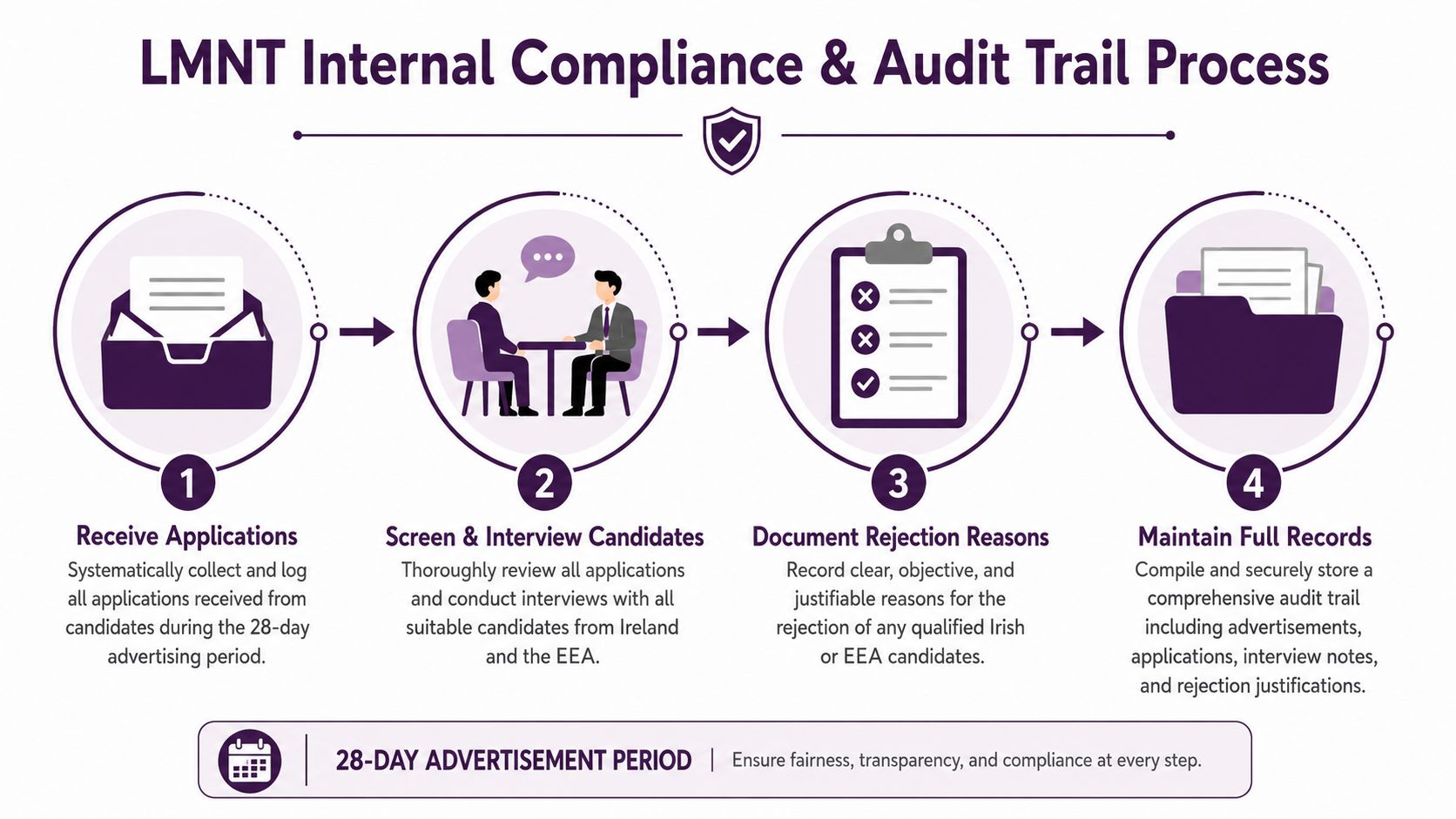
Every applicant needs an outcome
The LMNT evidence requirement includes a formal record of every application received and its outcome in the format DETE specifies. Employers must maintain a documented audit trail of EEA candidates interviewed or rejected to defend against potential WRC audits, as explained in this guide to LMNT evidence and compliance.
That means you need more than an inbox full of CVs.
You need a working record that shows:
- Who applied
- When they applied
- Whether they were EEA or local candidates where relevant to your process
- Whether they were screened
- Whether they were interviewed
- Why they were rejected or progressed
- Who made that decision
What a defensible file looks like
Keep this practical, not fancy. A clean spreadsheet or applicant tracking workflow is enough if it's complete and consistent. If your team needs a better system for handling candidate flow and evaluation, this broader guide to improving talent acquisition gives useful context on how structured hiring tools can support disciplined recruitment.
Your LMNT file should include:
- Copies of both adverts exactly as published
- Publication dates and screenshots
- A candidate log with status updates
- Interview notes where interviews took place
- Objective rejection reasons tied to the role requirements
- Internal reviewer names so decisions aren't anonymous
- Stored correspondence with candidates where relevant
Manager's rule: If you can't explain a rejection clearly in writing, don't expect it to look convincing later.
Vague reasons are dangerous. “Not suitable” is weak. “Lacked the required experience for the advertised duties” is stronger if it's true and supported by the application. You're not writing a courtroom brief, but you are building a file that has to make sense to someone who wasn't in the room.
The 50:50 rule has operational consequences
The 50:50 rule isn't just a legal threshold. It's a planning constraint. In a larger hotel or group setting, one permit application can affect the next. If your workforce mix is already tight, the LMNT can be completed perfectly and still not solve your immediate hiring plan because the venue has reached its non-EEA ceiling.
That's why right-to-work discipline matters across the whole team, not only for the new hire. Beacon's practical overview of right to work checks for Ireland employers is worth reviewing because workforce compliance and permit strategy sit closer together than many operators realise.
The employers who handle this well don't wait for an audit to get organised. They build the paper trail while the campaign is live, not after a refusal lands.
Submitting the General Employment Permit Application
Once the advertising period is properly completed and your candidate file is tidy, move quickly. This stage is administrative, but it still punishes delay.
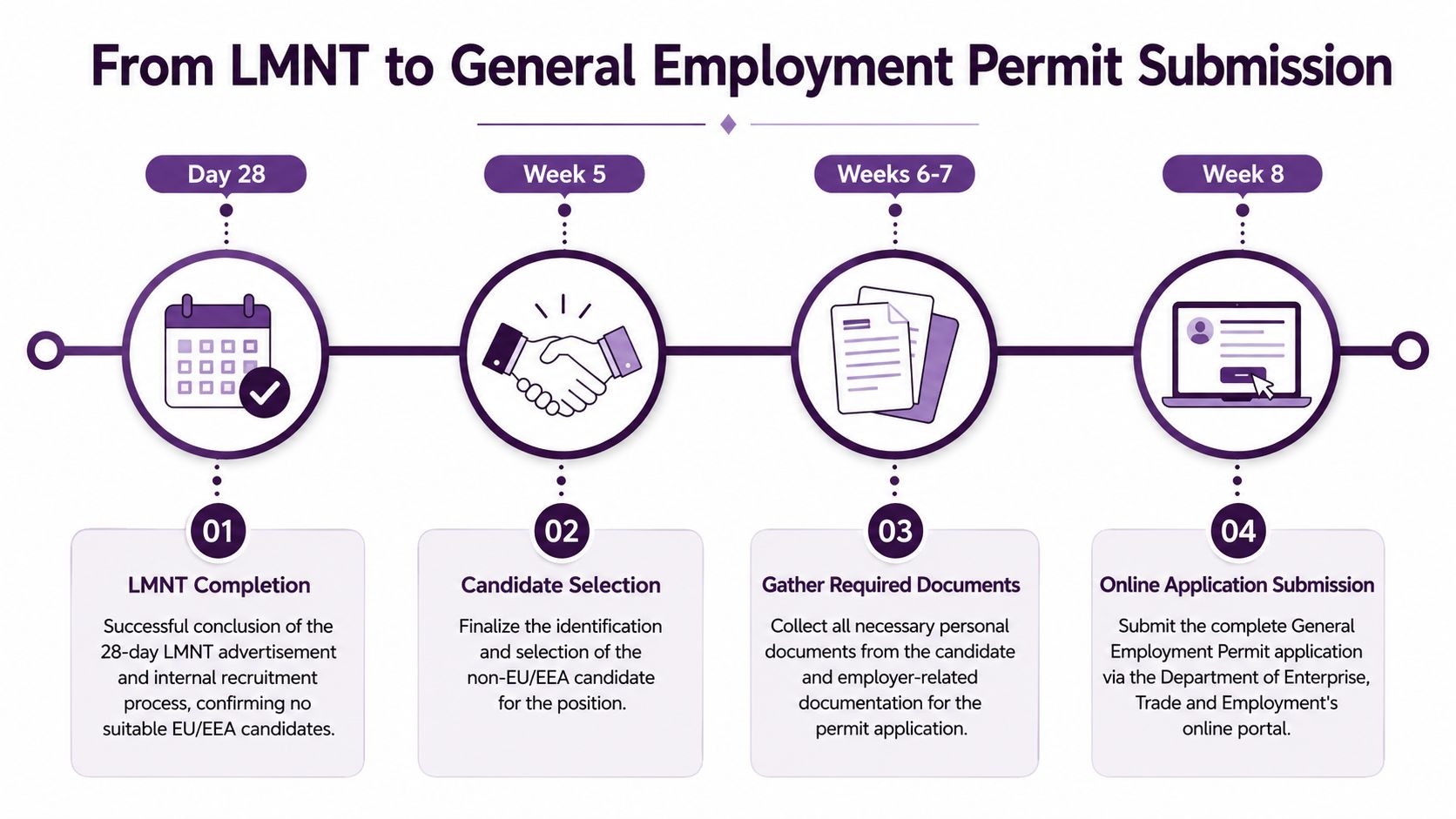
What needs to happen after the ad closes
Your job now is to collate the evidence cleanly and submit within the allowed timeframe. Don't scatter documents across email chains and shared drives. Build one controlled application file with the advert evidence, applicant records, role details, and candidate documentation ready to go.
A practical submission sequence looks like this:
- Verify the LMNT file is complete
- Confirm the selected candidate details
- Check the role terms still match the advert
- Upload and submit the permit application before the deadline expires
If you need a concise reference point on the permit itself, Beacon's general employment permit knowledge base gives a useful overview of the route.
Cost and risk
The application fee for a General Employment Permit is €1,000, with a 90% refund available if the permit is denied, according to the verified hospitality permit data cited earlier in the article's source set.
That refund softens the hit, but it doesn't repay your management time, lost rota stability, or the extra weeks created by a preventable refusal. The primary cost is operational drag. That's why employers should treat submission as the final quality-control stage, not just an upload exercise.
Submit late, submit inconsistently, or submit a file with contradictions, and you're turning a hard-won LMNT into an avoidable problem.
From Compliance Hurdle to Strategic Advantage
The Labour Market Needs Test catches hospitality employers out when they treat it like a job ad. It isn't. It's a controlled compliance process that sits inside your recruitment operation.
The venues that handle it best do three things well. They lock the rules early. They run the advert without fiddling with it. They document every applicant and decision as they go. That's the difference between a process that feels chaotic and one that becomes routine.
For hospitality employers in Ireland, the smart move is to build LMNT discipline into workforce planning, not bolt it on when the kitchen is short and the pressure is already high. If you do that, the Labour Market Needs Test stops being a recurring headache and starts becoming a reliable route into international hiring.
If you need a calm operator to manage the moving parts, Beacon Recruitment works as an operational partner for Irish hospitality employers, handling international recruitment, permit process support, and the wider compliance systems that keep venues stable while owners focus on guests and service.
Are Your LMNT Adverts Exposing You to Permit Refusals?
Don't let a simple wording error, missed deadline, or non-compliant job ad derail your critical international hires—book a free consultation with Beacon to build an audit-proof LMNT process.