July 16, 2026
Sick Leave Entitlements Ireland: Your 2026 Guide
Understand sick leave entitlements Ireland for 2026. Learn statutory sick pay rules, employer obligations, and how to create a compliant policy for your
The text usually lands early. A chef is out. A breakfast supervisor says they've been up all night sick. Front office is already short. In hospitality, the first problem is always operational. Who covers the shift, who calls agency, who reshuffles breaks, and whether service standards will hold.
Then the second problem arrives. What are you required to pay, and what paperwork do you need before payroll touches anything?
That's where many Irish hospitality employers still get caught. Sick leave entitlements in Ireland are no longer just a policy choice in the private sector. They sit inside a legal framework, and if your systems are loose, the risk isn't abstract. It shows up in payroll disputes, inconsistent manager decisions, weak records, and complaints you could have avoided with a tighter process.
The New Rules for Managing Staff Sickness
A typical hospitality absence doesn't arrive neatly. It comes during prep, on changeover, or just before check-in. A sous chef texts at 7am. A duty manager is trying to open the building, brief the team, and decide whether the person off sick needs cover for one shift or several.
In that moment, most owners focus on service first. That makes sense. Guests don't care why the floor is short. But sick leave has become one of those areas where operational pressure can push managers into bad habits. Informal calls, inconsistent pay decisions, and “we'll sort it later” administration tend to create bigger problems after the rush.
The practical shift for employers is simple. You now need a repeatable system, not a case-by-case reaction. In hospitality, that means line managers must know three things immediately:
- Who takes the call: One named manager should receive absence notifications.
- What gets asked: Is the employee fit for work, likely duration, and whether certification will follow.
- What gets recorded: Date, role, shift impact, and what action the business took.
If your current process still depends on texts passed between supervisors, you're leaving too much to chance.
Practical rule: Treat sickness reporting like any other compliance process. If it isn't documented at the point it happens, someone will have to reconstruct it later under pressure.
There's also a wider compliance backdrop for operators reviewing employment obligations this year. If you're already tightening HR documents and payroll rules, it's worth keeping an eye on broader updates such as recent Irish employment regulation changes, because sick leave rarely sits in isolation from contract wording, records, and roster management.
For hospitality employers, the right approach is clear. Build a process that works at 7am on a Saturday, not one that only works when HR is in the office on a Tuesday.
Understanding Statutory Sick Pay Entitlements
The core rules are straightforward once you strip away the legal language. Ireland's statutory scheme sets a minimum floor. If you run a hotel, restaurant, bar, or catering business, you need to know exactly who qualifies, when the entitlement applies, and what the legal limits are.
Who qualifies
Ireland's statutory sick pay regime was created by the Sick Leave Act 2022, which came into force on 1 January 2023 and introduced employer-funded sick pay for the first time at a rate of 3 paid days in 2023. The entitlement increased to 5 days from 1 January 2024 and remains at 5 days per calendar year under current government guidance. The statutory payment is 70% of usual gross earnings, capped at €110 per day, and it applies only to certified leave after an employee has completed 13 weeks' continuous service, as set out in the government's statutory sick leave update.
For hospitality employers, the 13 weeks' continuous service point matters more than many articles admit. High turnover, probation periods, short fixed-term contracts, and seasonal hiring all mean some staff will not yet qualify when they call in sick.
That doesn't mean you can handle absences casually. It means you need to check eligibility before payroll assumes statutory payment is due.
What the entitlement actually means in practice
The statutory scheme is not a general wellness benefit and it's not an open-ended paid absence arrangement. It's a defined legal entitlement with clear conditions.
Use this quick test when an employee reports sick:
- Has the employee completed the required service?
- Is the absence medically certified?
- Has the employee already used some or all of their statutory days this calendar year?
- Does a contract or staff handbook provide something more generous?
If you want a broader compliance reference point alongside your own handbook, Irish statutory leave guidelines are useful for checking how sick leave sits with other leave obligations.
Most mistakes happen because managers answer the wrong question. They ask, “Is this person genuinely sick?” when the payroll question is, “Does this absence meet the statutory conditions?”
What catches hospitality operators out
Two issues come up constantly in hospitality settings.
- Rolling assumptions from old practice: Many businesses still operate as if paid sick leave is discretionary in the private sector.
- Manager inconsistency: One department accepts a cert and processes pay correctly, another handles the same situation informally.
Sick leave entitlements in Ireland are manageable once your managers stop improvising. The law gives you a minimum standard. Your job is to build a policy and payroll process around it.
How to Calculate and Process Sick Pay
Once an employee qualifies, significant effort begins in payroll and administration. Here, hospitality businesses often lose time. Not because the rules are especially complex, but because they're handled by too many people in too many different ways.
Use one process every time.
Start with the paperwork
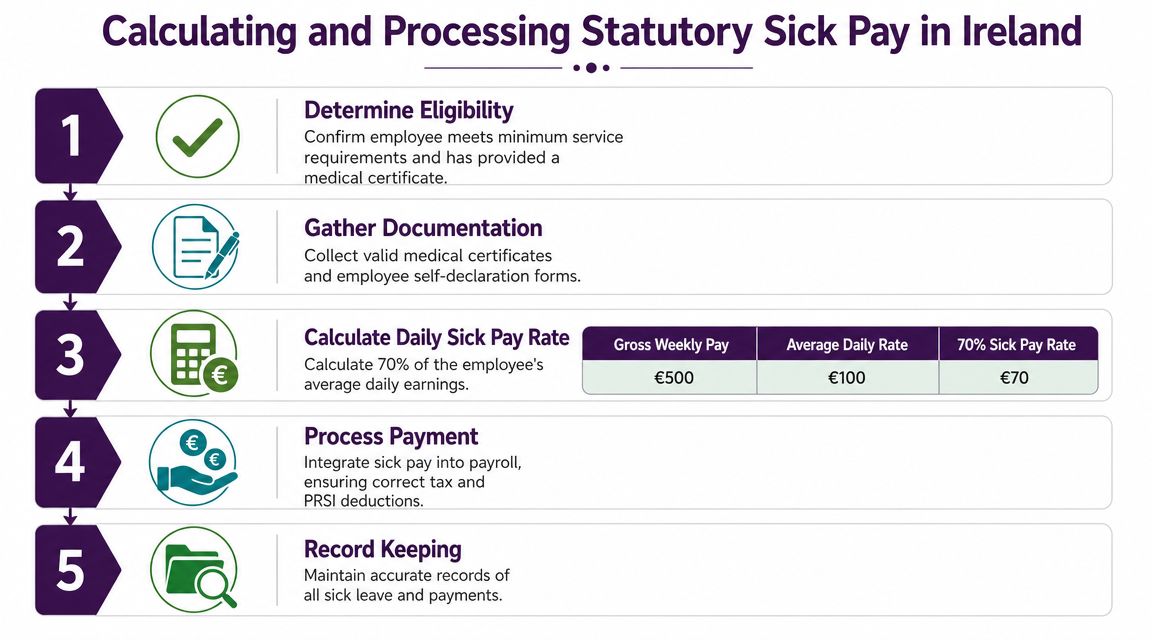
Statutory sick pay applies only to certified leave. In practice, that means no certificate, no statutory payment.
For managers, the cleanest workflow is:
- Receive the absence report: Record when the employee reported unfit for work.
- Request the certificate promptly: Don't leave this hanging until payroll week.
- Match dates carefully: The certificate should support the absence period being processed.
- File it centrally: Don't leave medical certs buried in WhatsApp chats or personal email inboxes.
If the document trail is weak, your payroll position is weak.
Calculate the payment correctly
The statutory payment is based on 70% of usual gross earnings, subject to a daily cap. That means you don't just pay a normal day's wage and call it done.
For practical payroll handling:
- Full-time salaried staff: Work out the employee's usual daily gross earnings, then apply the statutory percentage, subject to the cap.
- Hourly staff: Use their usual gross earnings for the relevant daily rate before applying the statutory percentage and cap.
- Variable roster staff: Be consistent about how you define usual gross earnings. If your method changes from person to person, disputes become much harder to defend.
You don't need a complicated spreadsheet for this. You need one approved method, written down, and used by whoever processes wages.
The safest payroll habit is consistency. A method that's slightly conservative but applied the same way every time is easier to defend than an ad hoc approach that changes by department.
Process and record the payment
Once the amount is confirmed, move it through payroll in a way that can be traced later.
A strong process includes:
- Coding the absence properly in your payroll system.
- Separating statutory sick pay from other absence categories so reports are clean.
- Noting how many statutory days remain for that employee in the current year.
- Keeping the supporting paperwork with the payroll record.
In hospitality groups with multiple sites, I'd also insist on a central checker. One person in HR, finance, or external support should review unusual cases, especially where rotas vary or contractual sick pay may apply.
What doesn't work is leaving this to whichever manager happened to be on duty when the call came in. That approach almost always creates inconsistent decisions.
Statutory versus Contractual Sick Pay Schemes
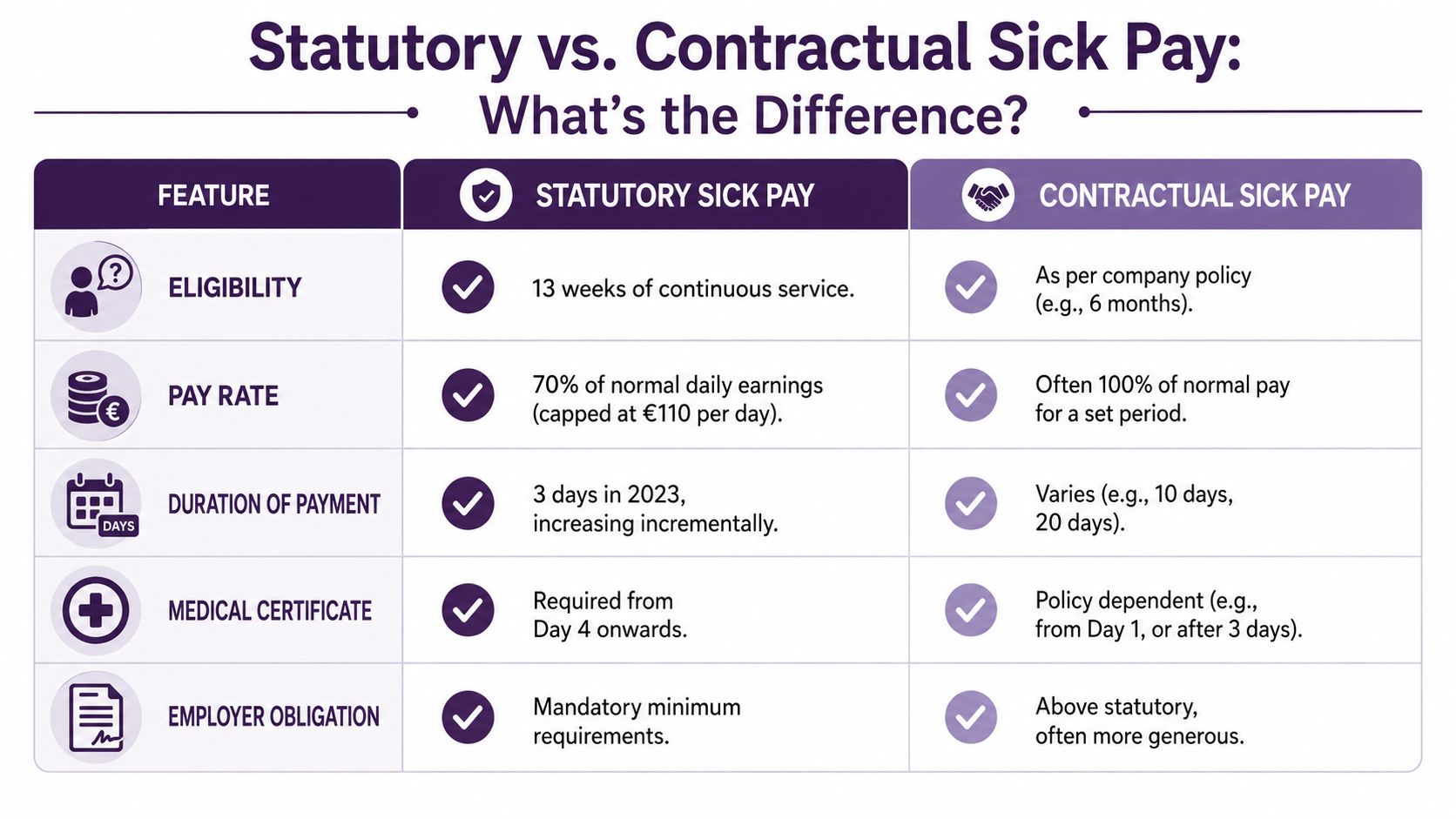
A lot of employers hear “statutory sick pay” and assume the state scheme replaces whatever was in their handbook already. It doesn't. The statutory arrangement is the legal minimum. If your contracts offer better terms, those better terms still matter.
That distinction is critical in hospitality, especially in established businesses that already use custom contracts for management, chefs, or long-serving staff.
The statutory scheme is the floor
The easiest way to think about it is this:
- Statutory sick pay: The minimum legal standard.
- Contractual sick pay: Anything extra you choose to offer through contract, handbook, collective arrangement, or established policy.
If your business gives a more generous sick pay benefit, you cannot disregard it because the law now provides a lower statutory baseline.
That's why every operator should review their contracts against their actual payroll practice. If your documents promise one thing and managers deliver another, you're creating avoidable risk. This is exactly the kind of issue that should be picked up when reviewing the key terms inside an employment contract.
Where the gap becomes obvious
The difference between minimum legal entitlement and broader sectoral schemes can be huge. The HSE provides up to 183 days paid sick leave in a rolling 4-year period, with 92 days on full pay and 91 days on half pay, as outlined in the HSE sick leave scheme.
That matters because many employers still talk about statutory sick pay as if it's the standard across the market. It isn't. It's the floor.
For hospitality, that has two practical implications:
- Retention and recruitment: More generous sick pay can help you hold key people, especially in management and specialist kitchen roles.
- Policy clarity: Mixed promises create trouble fast. If trainees, probationers, managers, and long-service staff all sit on different terms, your paperwork must say so clearly.
What works and what doesn't
What works is a layered approach. State the statutory minimum clearly, then set out any enhanced company terms for the roles or groups that receive them.
What doesn't work is vague language such as “sick pay may be paid at management discretion” if the business has been paying a different pattern in practice. Once a custom becomes established, arguments about discretion get messy.
A good rule is to ask one blunt question. If a line manager and an employee both read the contract separately, would they reach the same answer about sick pay? If not, the wording needs work.
Your Legal Duties and Record Keeping Obligations
Paying sick leave correctly is only half the job. The other half is being able to prove what happened, when it happened, and why you made the decision you made.
That's where many hospitality businesses are exposed. Records live in rota notes, diary entries, screenshots, emails, and payroll comments. It feels manageable until someone challenges a payment, or an inspector asks for a clear trail.
What the law requires operationally
A key structural feature of Ireland's sick leave rules is that entitlement does not carry over into the next year. The Workplace Relations Commission states that leave can be taken on consecutive or non-consecutive days, and employers must keep records for 4 years, as outlined in the WRC guide on sick leave.
That has practical consequences for hospitality employers.
You need to know, for each employee:
- How many statutory sick leave days were taken
- When they were taken
- Whether the days were certified
- What payment was made
- What balance remained in that calendar year
You also need those records to be retrievable. A messy folder structure is nearly as bad as no structure at all.
What an inspection-ready file looks like
A decent compliance file doesn't need to be elaborate. It does need to be complete.
Include:
- Absence notification record: Who reported the absence and when.
- Certificate record: Copy of the medical cert and dates covered.
- Payroll note: How the payment was calculated and processed.
- Leave tracker: Running total of statutory sick leave used in that calendar year.
- Manager notes where relevant: Especially if there was any doubt about eligibility or overlapping contractual terms.
If you're already auditing time and attendance systems, it makes sense to align this with your broader working time records process. In practice, absence management and working time compliance usually fail in the same businesses for the same reason. Too much is left informal.
Good records do more than satisfy an inspector. They stop internal arguments before they grow into formal disputes.
Common mistakes in hospitality businesses
The repeat offenders are predictable.
One is tracking by anniversary date instead of calendar year. Another is forgetting that non-consecutive days still count toward the annual entitlement. A third is holding records at site level only, which becomes a problem when staff move between venues in the same group.
The strongest operators treat sick leave records as a live management tool, not an archive. Managers can see patterns early, payroll can process accurately, and ownership can assess whether absences are becoming a staffing risk.
That approach protects the business. It also creates fairer treatment for staff, because decisions are based on documented facts rather than memory or manager mood.
Budgeting for Sick Leave Costs in Your Hospitality Business
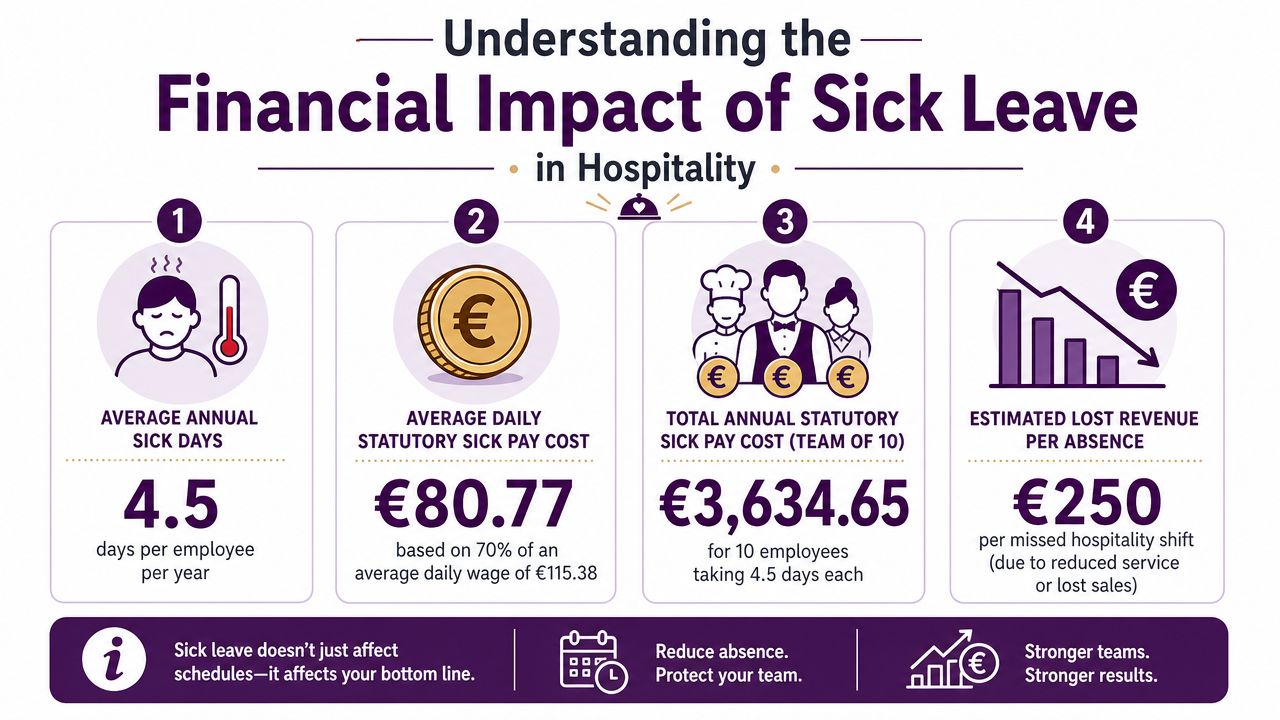
Hospitality owners rarely struggle with the idea of supporting staff who are ill. The pressure comes from timing and margin. An absence doesn't just trigger sick pay. It can also trigger overtime, agency cover, role swapping, slower service, or a manager stepping into operations instead of running the business.
That's why sick leave should sit in budget planning, not only in HR policy.
Focus on exposure, not just entitlement
The most useful budgeting question isn't “What's the rule?” It's “Where are we exposed if several people use it at the same time?”
The planned path to 7 days in 2025 and 10 days in 2026, though currently under review, creates budget uncertainty for employers. The statutory cap of 70% of earnings up to €110 per day means higher-wage staff create a different exposure profile, as noted in Sage's overview of Irish statutory sick pay for employers.
For hospitality, that difference matters. A kitchen porter off sick and an experienced senior chef off sick are both absence events, but they don't create the same operational problem. One may be easier to cover internally. The other may affect food quality, pace, or menu execution immediately.
How to budget sensibly
You don't need a perfect forecasting model. You need a realistic one.
Build your planning around these categories:
- Direct pay cost: The statutory payment itself where it applies.
- Replacement cost: Overtime, relief staff, or pulling salaried managers into service.
- Operational disruption: Reduced output, delayed service, or restricted menu and room turnaround decisions.
- Administrative load: Manager time, payroll handling, and record management.
For multi-site groups, compare absence impact by function, not just by venue. Front office, accommodation, kitchen, bar, and events all absorb absence differently.
In hospitality, the real cost of sickness is often the cover decision, not the sick pay line on its own.
What works in practice
Strong operators usually do three things well.
First, they separate planned labour cost from absence contingency. If sick leave is buried inside one broad wage number, surprises hit harder.
Second, they cross-train key roles where possible. That won't solve every absence, but it reduces panic in smaller teams.
Third, they review contracts and policy before peak periods. Summer trade, Christmas trade, and event-heavy periods expose weak staffing models quickly.
If you need support formalising that side of the process, one option some operators use is Beacon Recruitment's HR compliance service, which covers items like contracts, staff handbooks, and people audits for hospitality employers. The value there isn't hype. It's getting the policy, records, and manager process aligned before a busy season exposes the gaps.
What doesn't work is pretending sick leave is a rare interruption. In hospitality, unplanned absence is part of the operating model. Budget for it like one.
Creating and Implementing Your Sick Leave Policy
A written policy saves arguments, speeds up manager decisions, and makes payroll cleaner. Without one, every sickness call becomes a fresh debate. That's exactly what busy hospitality teams don't need.
A workable policy isn't long. It is clear.
What your policy should say
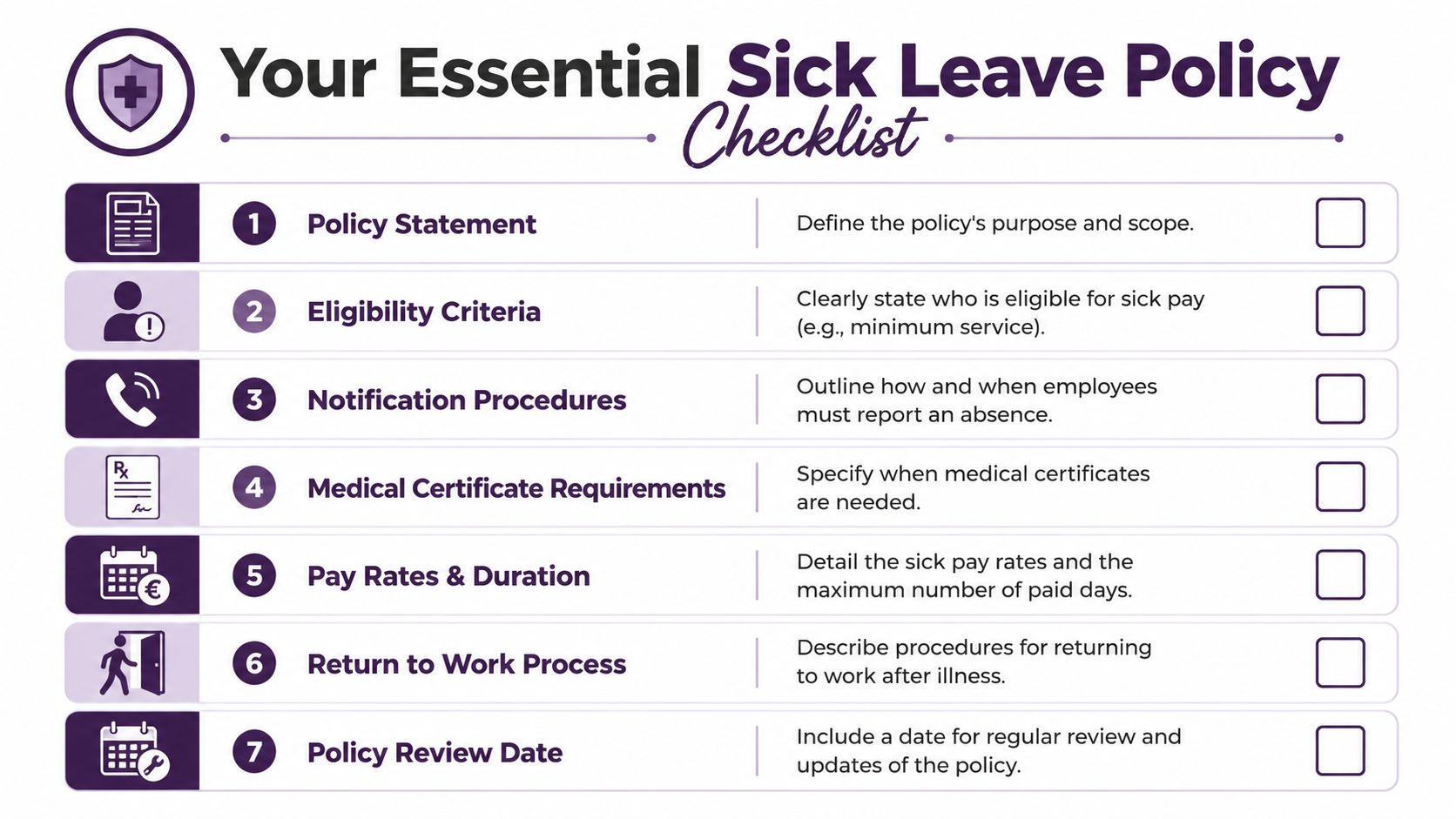
At minimum, include these points in plain language:
- Reporting rules: Who the employee must contact, by what method, and how early before shift start.
- Certification rules: When a medical certificate is required and where it must be sent.
- Payment rules: State whether the business provides statutory sick pay only, or any enhanced contractual scheme.
- Tracking rules: Explain that statutory entitlement is managed within the calendar year.
- Return-to-work expectations: Set out any check-in or handover requirement after absence.
If you want examples of how absence policies are typically structured, HR's guide to absence policies is a useful reference for drafting and review.
Simple wording you can adapt
You don't need legal theatre. You need wording managers and staff can follow.
A practical example:
Employees who are unable to attend work due to illness must notify their manager as soon as possible and in line with the business absence reporting procedure. Where statutory sick pay applies, payment will be processed in accordance with legal requirements and subject to the employee meeting eligibility and certification requirements. Any enhanced sick pay provided by the company will be set out separately in the employee's contract or handbook.
That kind of wording does two jobs. It confirms process, and it avoids promising more than the business intends to provide.
How to make the policy stick
Most policies fail in rollout, not in drafting. Managers don't read them closely, staff hear mixed messages, and payroll ends up correcting mistakes.
Use this implementation checklist:
- Check contracts first: Make sure policy wording matches contractual commitments.
- Train line managers: Especially those handling early-morning absence calls.
- Create one reporting route: Avoid multiple channels for reporting sickness.
- Align payroll codes: So statutory and contractual absences aren't mixed.
- Store records centrally: Don't rely on site-level memory.
- Review after busy periods: Peak season shows where the process breaks.
A policy should remove discretion from routine cases. That's the point. Staff know the rules, managers follow the same steps, and owners aren't dragged into avoidable decisions.
If your business needs help tightening contracts, sick leave procedures, or wider hospitality HR compliance, Beacon Recruitment works with Irish operators on the practical side of employment systems. That includes the documents, record-keeping processes, and manager guidance that help venues stay compliant while keeping operations running.
Are Your Sick Leave Processes Legally Compliant?
Don’t let informal WhatsApp reporting and inconsistent manager decisions lead to WRC claims. Book a Free Consultation with Beacon today to audit your contracts and build a compliant, WRC-ready absence policy.