August 12, 2026
Stock Control System: A Guide for Irish Hospitality
Implement a stock control system that cuts waste and boosts profit. A step-by-step guide for Irish hotels and restaurants on selection, setup, and management.
Every Irish kitchen has had that end-of-shift moment. The prep list is done, the tills are closed, and someone is still standing in the storeroom with a clipboard, trying to work out what's on the shelf, what's missing, and what needs to be ordered before service tomorrow. That's where margins gradually leak, because the gaps rarely show up as one big problem. They show up as over-ordering, waste, missing bottles, short pours, bad recipe costing, and a stocktake that never quite matches the ledger.
A proper stock control system gives you a live view of what's there, where it sits, and what needs replenishment. Beyond this, it turns stock from a night-time chore into an operating discipline that protects gross profit, reduces waste, and keeps venues supplied without tying up cash in dead stock. In Irish hospitality, that matters in hotels, restaurants, pubs, and groups where the difference between a busy week and a profitable week often comes down to what happened in the storeroom.
Moving Beyond Guesswork and Spreadsheets
The old model is familiar. A chef scribbles notes on the back of a delivery docket, the bar manager updates a spreadsheet when there is time, and a stocktake gets done when the team can spare the labour. That approach can suit a very small operation with a limited list of items, and Irish guidance still recognises that a basic stock book can work for small businesses with few lines, while more advanced systems need multiple users and a full inventory test before go-live, according to Infoentrepreneurs' stock control guide. Hospitality rarely stays small or simple for long.
Manual records also make it difficult to tell whether the problem sits in ordering, portioning, waste, or theft. Once the written record drifts away from the actual stock in the cellar, fridge, or bar, the team starts arguing about numbers instead of controlling them. A stock control system turns that into an operating framework for the venue, keeping kitchens, bars, and stores supplied while reducing waste, theft, and ordering errors. It also gives managers cleaner information for margin control, which matters in Irish hotels, restaurants, pub groups, and multi-site operations where one sloppy storeroom can drag down the whole week.
What a good system actually controls
A usable system does more than count stock. It answers four live questions, what inventory exists, where it is located, what condition or status it is in, and when replenishment is needed, which is the right lens for hospitality because stock only helps if it is serviceable and in the right place for the next shift, according to BlueCherry's ERP and stock accuracy overview. A bottle in the cellar, a quarantine tray in the fridge, and a case on the loading bay are not the same thing operationally.
Practical rule: if the team cannot tell you what is on hand before service starts, the system is not controlling stock, it is recording failure after the fact.
The primary value is decision-making. Clean stock data lets the kitchen stop guessing par levels, lets the bar tighten ordering, and lets management spot where gross profit is leaking before the month-end numbers arrive. In practice, that means fewer emergency buys, fewer write-offs, and better control over compliance records and inventory discipline. It also gives operators a stronger basis for service planning and for a Beacon operations review when the storeroom keeps producing the same recurring problems.
That matters even more in venues trying to use data properly, not just collect it. If your team is also weighing how software fits into wider operations, Internal Systems' AI strategy insights are a useful reminder that the tool should support the process, not replace it. Stock control should sit with the people who order, receive, count, and sign off on variances, because that is where the profit leak starts.
Laying the Foundation for Effective Control
A storeroom full of stock does not mean a venue has control. In an Irish hotel, restaurant, or pub group, the pressure usually starts with vague par levels, stock counts that drift from reality, and managers who are forced to make ordering decisions from memory. The first job is to define what the venue wants from a stock control system, whether that is tighter recipe costing, clearer beverage control, better multi-site visibility, or cleaner compliance records.
That operating model has to come first. Once the rules are clear, the system can digitise them and stop relying on handover notes, scattered spreadsheets, or assumptions that only work when the same person is on duty. For hospitality teams, the practical question is simple, which stock decisions need live control, and which ones can stay on a periodic cycle?
Choose features that match how hospitality really works
A hospitality setup needs more than a product list and a count screen. It needs recipe and sub-recipe costing, because stock loss does not only happen at the item level. It happens when raw product is turned into plated dishes, when bottle stock is poured into serves, and when the system cannot trace that movement back to cost.
It also needs purchase order management so ordering follows par levels rather than gut feel, and POS integration so sales data feeds back into consumption figures. If the stock system cannot talk to the till, the venue is still working with two versions of the truth.
The better systems also handle multiple users, multiple prices, and stockturn reporting without making the day-to-day process clumsy for the team. That matters in hospitality, where a system can look impressive on paper and still fail if managers and supervisors avoid using it. Irish guidance on stock control points to minimum stock levels, reorder points, and periodic inventory checks as part of a controlled approach, and that logic still fits the practical realities of service businesses.
A useful decision framework looks like this:
- Small single-site venues: a disciplined spreadsheet or basic stock book can work if the range is limited and one manager owns the numbers.
- Growing restaurants and pubs: software should already support recipes, purchasing, and POS links before manual processes start breaking under pressure.
- Groups and hotels: central reporting, user permissions, and location-based control need to be in place early, because adding governance later is usually messy and slow.
For owners weighing build versus buy decisions in adjacent digital tools, Internal Systems' AI strategy insights is a useful lens for thinking about complexity, ownership, and long-term maintenance. The same logic applies here. If the system saves time in one part of the operation but creates admin somewhere else, it is not solving the right problem.
A targeted operations efficiency review can also show whether the underlying issue is software, process, or team adoption before money goes into the wrong fix. That is often where profit leakage shows up first, especially in venues where the storeroom, kitchen, and bar are not working from the same control system.
Integrating Your System with Kitchen Operations
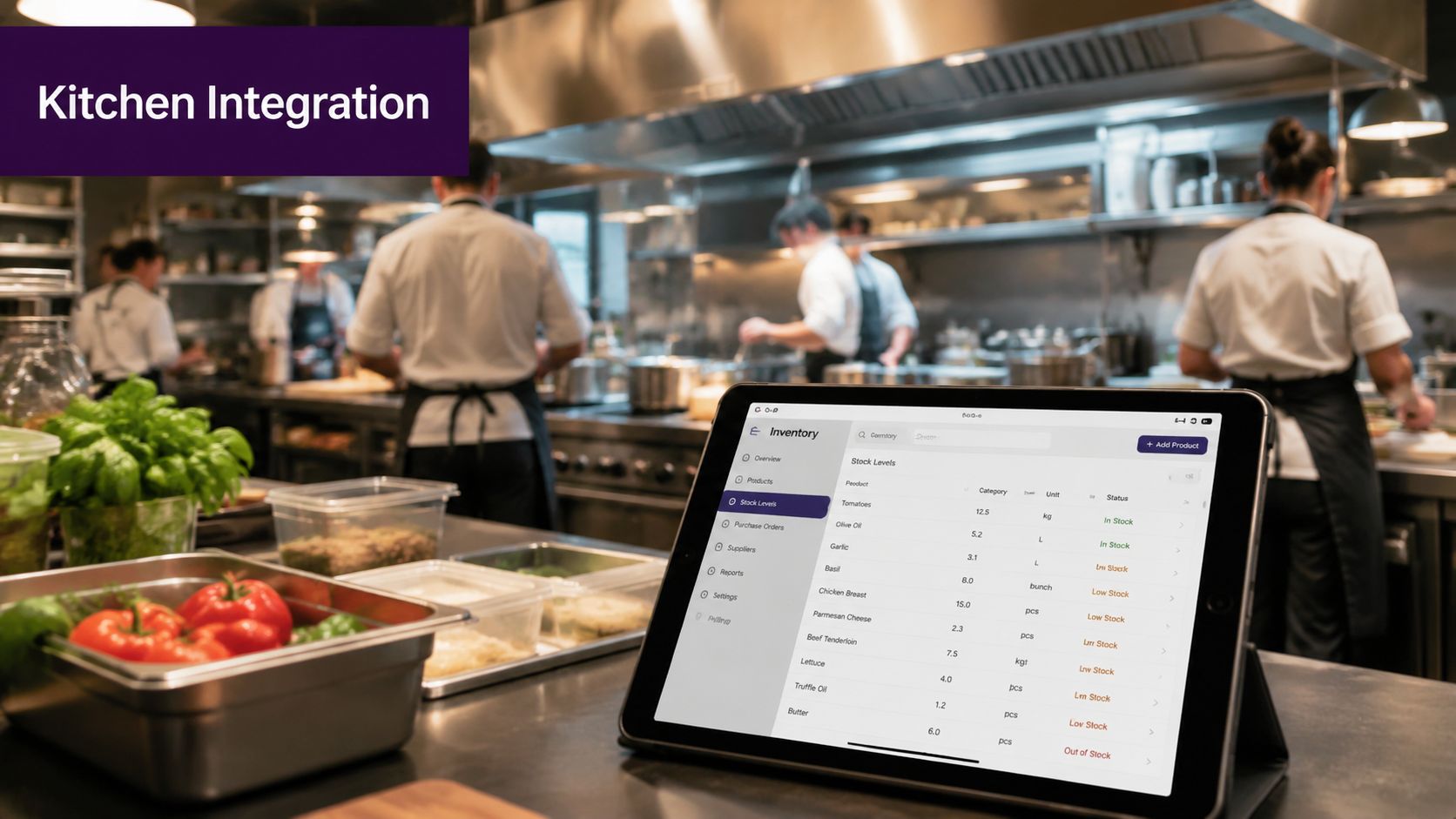
The implementation point that usually fails is data integrity. If the item master is sloppy, the recipe quantities are wrong, or the POS mapping is incomplete, the system will still produce reports, just not reports anyone should trust. That's why item-level traceability matters. For a stock control system to be useful, each item needs to be trackable by fields like SKU, stored location, cost price, and point-of-sale details, which is fundamental for accurate recipe costing, according to Business QLD's stock control guidance.
Build the digital recipe book properly
Every dish, cocktail, and sub-recipe needs a defined bill of materials. That includes sauces, syrups, garnishes, and anything that gets reused across menu items. If a kitchen uses house dressing in three dishes, that dressing must be costed once as a sub-recipe and then consumed correctly across the menu, otherwise margin data turns misleading very quickly.
The same applies to bar stock. A clean setup needs bottle measures, serve sizes, and wastage assumptions handled consistently, not informally. The point is not perfection, it's repeatability. If the team can't enter the same item the same way every time, the figures lose value before the first month-end.
Keep the receiving process disciplined
Receiving is where errors become expensive. Every delivery should be checked against the order, recorded under the correct SKU, and tied to the right location before it enters service stock. If the stock arrives but the metadata never gets captured, the system can't help you with recalls, shortages, or expiry control later.
Operational truth: garbage in doesn't stay in the spreadsheet, it spreads into purchasing, kitchen yields, and gross profit reports.
Hospitality operators should be strict. The receiving clerk shouldn't be guessing product codes, the chef shouldn't be correcting supplier descriptions by memory, and the bar team shouldn't be moving cases between sites without a stock transfer record. In a single venue, poor entry creates noise. Across a group, it creates blind spots.
For operators already wrestling with margins, advice on ecommerce cash flow can be a useful parallel read because the same principle applies, stock accuracy protects cash flow only when inventory movements are captured correctly. In hospitality, that means the system must reflect actual consumption, not wishful thinking.
Designing Smart Ordering and Stocktake Workflows
Once the setup is clean, ordering needs to run as a routine, not a reaction. Set minimum, maximum, safety stock, and optimum reorder levels as part of a stocking policy, as recommended in NetSuite's inventory control guidance. Then link those thresholds to a realistic ordering rhythm. The aim is not to keep every shelf full, it is to keep the right items available without carrying avoidable stock.
Irish hospitality still relies on the basics, re-order levels, regular stock reviews, and stocktakes. A modern system digitises that framework and removes a lot of manual chasing, which is the practical shift Infoentrepreneurs points to in stock control and inventory management. The better question is simple, what does the venue need to order now, based on usage, par levels, and current movement?
Make stocktakes faster, not bigger
Stocktakes should be built for accuracy and repeatability, not theatre. Use zones in the storeroom, assign each area to one person, and put high-value items on a cycle-count schedule instead of waiting for a huge annual catch-up. That keeps variance visible while it is still explainable.
Waste logging has to sit beside the count, not outside it. Spoilage, prep errors, broken packaging, overproduction, and staff meals all need clear routes into the system so the variance report means something. Without that discipline, stock variance becomes a complaint, not a management tool.
A workable workflow is straightforward:
- Count by zone: one person, one area, one list.
- Record immediately: do not rely on memory at the end of the count.
- Flag exceptions: damaged stock, expired stock, and transferred items need separate treatment.
- Reconcile before sign-off: do not let the first count become the final truth.
- Review trends after each stocktake: look for the same item recurring in variance.
For operators managing perishables, how to reduce food waste in a restaurant fits this workflow well, because waste control only works when the team can see where the loss is happening and why it keeps showing up.
If the count takes forever, the process is wrong. Good control should cut friction, not create a monthly punishment exercise.
Defining Roles and Training Your Team for Success
Software doesn't create accountability. People do. A venue can buy the right system and still fail if nobody owns accuracy at site level, if receiving is inconsistent, or if managers treat stock data as someone else's job. That's especially true in multi-site operations, where central control only works when procedures are adopted properly at unit level, a common failure point highlighted in SaleDock's multi-location inventory guidance.
Give each role a clear lane
The Head Chef should own kitchen stock accuracy, because they know the recipe flow, prep usage, and waste patterns better than anyone else on site. The Bar Manager should own beverage counts, pouring discipline, and bottle movements, while the receiving clerk should verify every delivery, match it to the order, and make sure the item lands in the correct location. If those responsibilities blur, no one can fix the error fast enough.
Training should be role-specific and short enough that people remember it under pressure. The receiving team needs to know how to check items into the system, the kitchen team needs to know how to post waste and usage correctly, and managers need to know how to review variance without turning it into a blame exercise. For multi-site groups, a phased rollout works better than a big-bang launch because it lets the business stabilise one venue's workflow before scaling it.
A practical checklist helps:
- Receiving staff: verify codes, quantities, and locations before stock goes live.
- Kitchen leaders: keep recipe quantities current and report waste immediately.
- Bar leaders: count high-value lines regularly and challenge unexplained variance.
- General managers: review reports, enforce sign-off, and keep the process consistent.
A key issue is adoption. If one site shortcuts the process and another follows it properly, group reporting becomes unreliable and managers waste time arguing over data instead of fixing performance. Centralisation only helps when local discipline is genuine.
Using Stock Data to Drive Profitability
A stock control system earns its keep only when the reports change how the venue is run. In an Irish hotel, restaurant, or pub group, that means reading variance patterns, stockturn, and category-level cost of sales, then acting on the root cause before the leak shows up in margin. A perpetual, real-time model makes that easier because managers can monitor stock turns and sales ratios as part of the daily routine rather than waiting for the next count cycle.
Stock is cash tied up in a cold room, a cellar, or a shelf until the team turns it into revenue. If a category moves slowly, the menu may be carrying dead weight that is blocking storage and tying up working capital. If variance keeps appearing in premium spirits, the issue may be over-pouring, breakages, or shrinkage. The report does not fix the problem on its own, but it shows management where the leak is coming from.
Read the numbers like an operator, not an accountant
Costing reports should be part of kitchen meetings, bar reviews, and purchasing conversations. If a supplier price changes, the recipe cost needs to change with it. If a dish sells well but still leaves poor margin, the issue may be the portion, the garnish, or the way the plate is composed. If an item sits too long, it may be taking up space that should be reserved for faster-moving stock.
That is the commercial value of a good stock control system. It links purchasing, preparation, and sales in one view, which is exactly what many venues need when labour is tight and margins are under pressure. In practice, it cuts down on month-end surprises and gives managers better grounding when they challenge a supplier on price changes or pack size shifts.
For a wider profitability lens, the internal business planning and profitability audits resource is useful, because stock data only matters when it feeds pricing, labour, and menu decisions together.
Bottom line: if the stock report does not change an order, a recipe, or a count routine, it is just paperwork with better formatting.
If your storeroom is still driving decisions by guesswork, fix the process before it keeps cutting into margin. Speak with Beacon Recruitment about tightening stock control, reducing operational leakage, and building a practical system that fits how your venue works.
Is Your Storeroom Leaking Gross Profit?
Stop relying on guesswork and messy spreadsheets—book a free consultation with Beacon to build an audit-proof stock control and margin tracking system.