July 19, 2026
Working Time Act Ireland: The Hospitality Compliance Guide
Navigate the Working Time Act Ireland with confidence. Our guide for hospitality owners covers hours, rest breaks, record keeping, and how to avoid WRC fines.
It's 9 pm on a Friday. A chef has called in sick, two floor staff are already near the end of a long week, and a supervisor is asking whether the night porter can stay on. In most venues, that decision gets made under pressure, fast, and with half the facts missing.
That's where the Working Time Act in Ireland stops being a legal topic and becomes an operational one. Every extra hour, missed break, rushed rota change, and poorly documented shift creates risk. Sometimes that risk shows up as payroll friction. Sometimes it lands as a WRC complaint. Sometimes it only becomes visible when an inspector asks for records you can't fully produce.
Hospitality businesses don't need another vague summary of employee rights. They need practical rules that work on a busy floor, in a kitchen under strain, and across seasonal rosters that change weekly.
Your Guide to the Working Time Act in Ireland
Most hospitality managers don't break the law because they're careless. They do it because the business moves quickly, labour is tight, and real life doesn't respect neat rota plans. One sick call can force a string of decisions that look sensible in the moment and risky on paper the next morning.
The Working Time Act in Ireland is the rulebook sitting behind those decisions. It governs how long people can work on average, what rest they must get, what breaks they must receive, and what records an employer must keep. In hospitality, those obligations collide with late finishes, split shifts, function work, early breakfast service, and the constant temptation to “just get through tonight”.
That's why generic compliance advice often fails operators. It tells you the law, but not how breaches happen in a hotel, bar, restaurant, or café. The practical issues are nearly always the same:
- Shift creep: A short extension to cover service becomes a pattern.
- Break fiction: A rota shows a break, but the employee never really got it.
- Patchwork cover: Staff move between roles and sites, but the hours aren't pulled together properly.
- Poor paperwork: The venue can explain what happened, but can't prove it.
Good compliance starts before the rota is published. Hiring decisions matter because understaffed venues create predictable working time pressure. If you're reviewing staffing structure, this piece on making confident talent decisions is useful because it connects recruitment choices with day-to-day operational strain.
The aim isn't to run a venue like a law office. It's to build a system where legal compliance still holds up on your busiest week, not just your quietest one.
Understanding Your Core Obligations
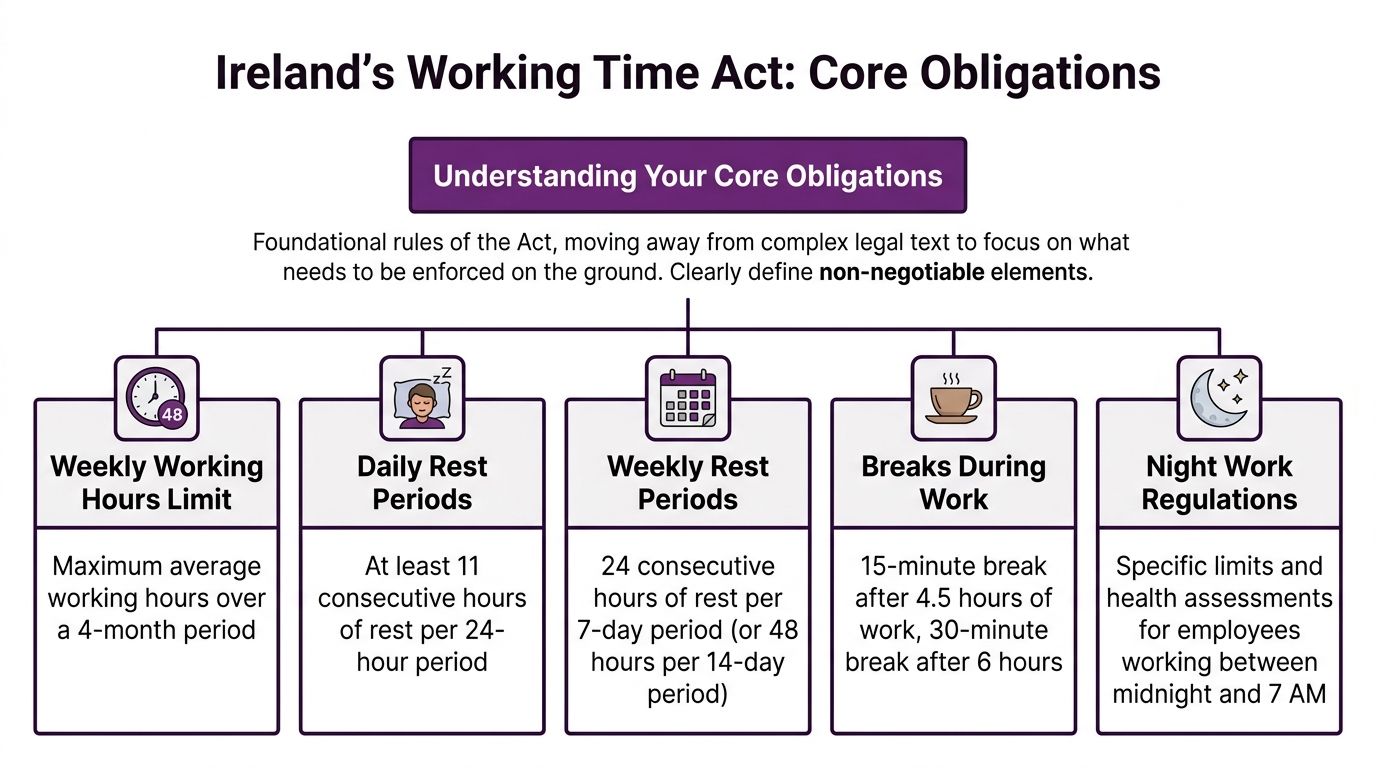
The law becomes manageable once you separate it into a few essential duties. For most hospitality employers, the core issues are working hours, rest, breaks, and night work.
Working hours and averaging periods
Under Ireland's Organisation of Working Time Act 1997, the maximum average working week is 48 hours, calculated over a standard 4-month reference period. That period can extend to 6 months for seasonal work or foreseeable surges, and up to 12 months where a Labour Court approved collective agreement exists, as outlined in this guide on working time, breaks and records in Ireland.
For hospitality, the key word is average. Managers often make one of two mistakes. They either assume a single heavy week is automatically unlawful, or they assume averaging gives them a free pass to overload staff for extended periods. Neither approach is safe.
You need to look at the pattern, not just the crisis week.
Daily rest and weekly rest
Staff must receive 11 consecutive hours of daily rest within each 24-hour period. Weekly rest must be at least 24 consecutive hours in each 7-day period, ideally on a Sunday unless the contract says otherwise. In practice, that means late close followed by early breakfast duty is often where employers slip.
A compliant rota on paper can still fail in practice if managers keep calling people back in.
Practical rule: If a team member finishes late because service overran, don't assess the next shift by the original rota. Assess it by the actual finish time.
In-work breaks
Breaks are often the first thing to disappear when a venue gets busy. They're also one of the easiest things for an employee to challenge later.
The Act requires:
- After more than 4.5 hours worked: a 15-minute break
- After more than 6 hours worked: a 30-minute break, which may include the first 15 minutes
A rota showing a break isn't enough if the person kept serving tables, covered reception, or stayed at the pass.
Night work rules
Night work carries tighter limits. Night workers face an 8-hour average over a 2-month period. Employers also have to manage health protections properly. If you run overnight reception, security, kitchen prep, or late bar operations, this is not a side issue.
Operationally, software assists. A tool such as WorkSignal's compliance platform can help managers spot patterns in hours and breaks before they turn into a formal issue.
If your compliance system depends on a duty manager remembering everything during a slammed service, you don't have a system. You have hope.
Calculating Annual Leave and Holiday Pay
Annual leave disputes usually don't start with bad intent. They start with inconsistent hours, unclear contract terms, and a payroll method nobody can explain clearly to staff.
Under the Organisation of Working Time Act 1997, full-time employees are entitled to at least four working weeks of paid annual leave. Leave can be calculated by 8% of hours worked, one-third of a working week per calendar month worked, or by the 117-hour monthly threshold method, as explained in this guide to the Organisation of Working Time Act 1997.
The three methods in practice
Use the method that applies to the employee's working pattern and gives the proper entitlement.
- 8% of hours worked
- This is often the cleanest method for variable-hour hospitality staff. If someone's hours fluctuate with demand, events, or seasonality, this approach usually gives payroll the clearest calculation base.
- One-third of a working week per calendar month
- This suits more stable patterns where the employee works regular months and their working week is easy to define.
- 117-hour monthly threshold
- Where an employee works at least 117 hours in a calendar month, they may accrue one-third of a working week for that month.
A simple hospitality example
Take a part-time server with changing weekly hours. In a venue with uneven trade, the practical question is this: do you have a stable enough pattern to use a monthly accrual method confidently, or are you better using the 8% approach because it tracks actual hours worked more accurately?
For many operators, the mistake isn't the formula. It's switching methods informally without documenting why. That creates confusion for staff and risk for payroll.
Use one internal rule:
- Variable hours staff: usually manage best under a consistent hours-worked method
- Regular pattern staff: may be easier to manage under a monthly accrual approach
- Mixed role employees: need extra care if hours differ significantly across departments
What tends to go wrong
Annual leave issues in hospitality usually come from poor inputs rather than bad maths.
- Hours aren't recorded properly: Leave calculations become unreliable.
- Managers promise time off casually: Payroll then has to reverse-engineer entitlement.
- Public holiday treatment is inconsistent: Staff compare notes quickly, and complaints follow.
- Part-time staff are handled informally: That's where many avoidable disputes begin.
If you want a practical tool to sense-check entitlement calculations, Beacon's annual leave calculator for Ireland is a useful reference point.
The safest leave calculation is the one you can explain clearly, apply consistently, and support with records.
Hospitality Compliance Traps to Avoid
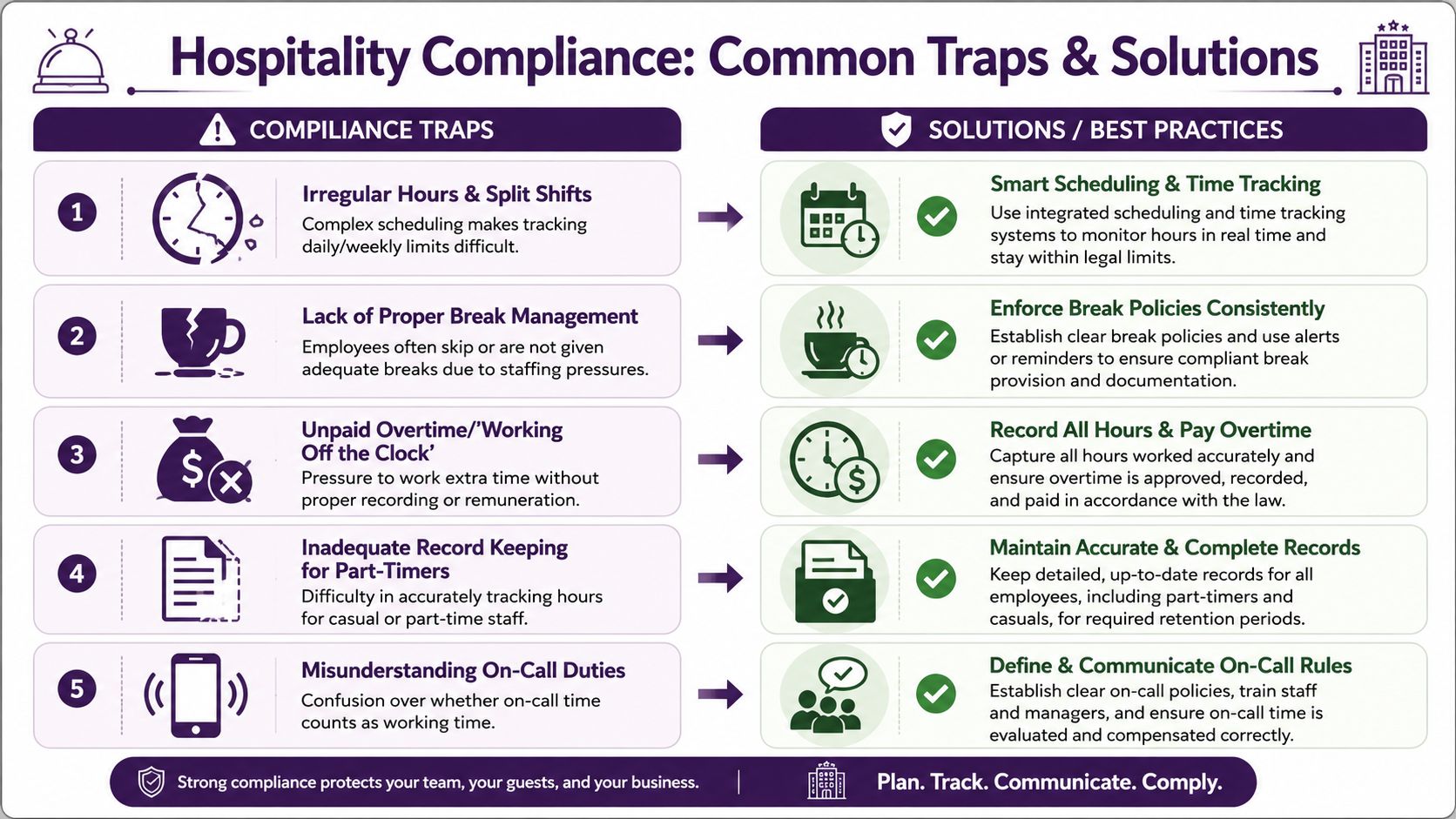
Hospitality has a habit of normalising practices that create legal exposure. A split shift feels normal. Asking someone to stay on “for an hour” feels normal. Reducing hours when business drops feels normal. None of that means it's low risk.
The split-shift myth
One of the most common and dangerous assumptions in hospitality is that split-shift workers are broadly outside the rules. That's where employers get caught.
In 2024, the Irish Workplace Relations Commission reported that 31% of OWTA complaints from hospitality workers involved split-shift scheduling disputes, especially around unpaid break times, according to this analysis of why the Organisation of Working Time Act matters.
The practical problem is simple. Employers treat a long day broken into chunks as if the legal risks disappear because the employee had downtime between periods. But split-shift arrangements still create questions about break eligibility, unpaid time, and what was worked.
That means you should stop asking only, “Is this employee exempt from a particular limit?” Start asking, “What protection still applies, and can I prove we honoured it?”
Banded hours and reduced hours risk
The second trap is less obvious and often more damaging. It sits in the interaction between working time management and banded hours.
The risk appears when a venue cuts someone's hours to respond to quieter trade, menu changes, labour cost pressure, or a manager's informal agreement with the employee. That may seem commercially sensible. It can still create legal difficulty if the employee's historic hours and banding position aren't reviewed carefully.
The main pressure points are:
- Seasonal cutbacks: A post-peak reduction can affect band placement.
- Role redesign: A staff member moves from broad availability to narrower shifts.
- Manager-led deals: Local arrangements are made without HR oversight.
- Poor documentation: There's no clear reason recorded for the change.
A common mistake is treating reduced hours as a rota decision only. In reality, it may have wider contractual and pay implications.
Don't reduce hours first and ask legal questions later. In hospitality, that order causes trouble.
Breaks that never happened
The third trap is operational rather than technical. Managers roster breaks. Staff don't get them. Later, records show compliance that the floor reality contradicts.
That usually happens in:
- Function service
- Busy weekend evenings
- Short-staffed kitchen shifts
- Overlapping check-in and food service periods
If your managers can't show when a break was taken and whether the employee was relieved of duty, you're exposed.
Your Legal Duty for Ironclad Record Keeping
When the WRC inspects, your records do the talking before your explanations ever matter. That's why record-keeping is your first line of defence, not a back-office nuisance.
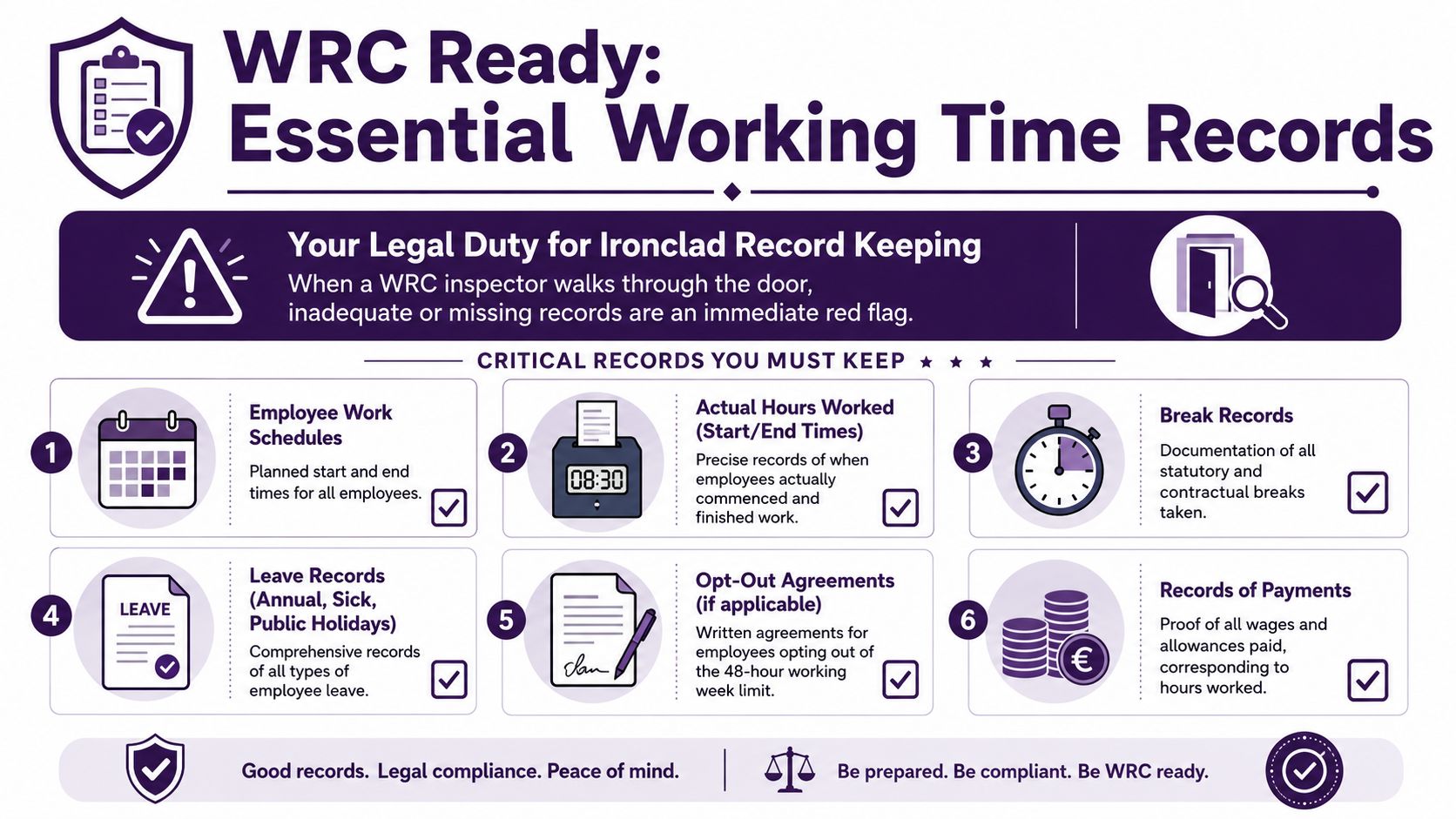
Employers in Ireland must keep detailed records of employees' daily and weekly working hours, leave taken, and start and finish times for at least three years, and failure to do so can lead to significant fines, as noted in this employer guide on work breaks and rest periods law.
What your records should show
If your system can't produce these quickly, it needs attention.
- Planned shifts: What the rota said should happen.
- Actual start and finish times: What really happened on the day.
- Break records: Including statutory breaks taken.
- Leave records: Annual leave, public holidays, and other tracked absences.
- Pay alignment: Hours worked should match what payroll paid.
- Historic retention: Records must be accessible for the required retention period.
A surprising number of venues have some of this data in the rota system, some in payroll, some in WhatsApp messages, and some nowhere at all. That setup falls apart under scrutiny.
What works and what doesn't
What works is a single routine. Staff clock in and out. Managers approve exceptions the same day. Payroll uses the same dataset. Leave is logged centrally. That's defensible.
What doesn't work is reconstructing shifts after the fact from memory, screenshots, or handwritten notes. By the time a complaint appears, memories differ and managers may have moved on.
For a practical benchmark of what a compliant file should include, Beacon's guide to working time records is worth keeping on hand.
Audit mindset: Keep records as if a third party will review them with no context, because one day they might.
A simple WRC-ready checklist
Use this as an internal minimum standard:
- Each employee has one traceable hours record
- Breaks are recorded, not assumed
- Leave balances can be explained
- Changes to scheduled hours are logged
- Managers know who checks records each week
If you fix only one area after reading this guide, fix this one first.
Drafting Compliant Employment Contracts
A lot of working time disputes start because the contract is vague where it should be precise. In hospitality, that usually means loose wording on hours, overtime, breaks, and leave calculation.
A compliant contract won't solve every issue, but it does give you a defensible baseline. It sets expectations before the rota pressure starts and before a manager improvises.
Clauses worth tightening
Your contract should clearly state the employee's normal working pattern and how variation is handled.
The Employee's normal hours of work are those scheduled by the Employer in line with business needs, subject always to applicable working time legislation, rest periods, and break entitlements.
That clause matters because many hospitality contracts refer vaguely to “flexibility” without tying that flexibility back to legal limits.
Overtime also needs clarity.
Any additional hours must be authorised in advance by management. The Employer may require reasonable additional hours where operationally necessary, provided such hours are scheduled and managed in compliance with statutory working time obligations.
That wording helps because unauthorised overtime often becomes a record-keeping and payment dispute later.
Breaks and annual leave wording
Breaks shouldn't be left to custom or local practice.
The Employee is entitled to statutory rest breaks during the working day in accordance with Irish law. Whether any break is paid or unpaid will be as set out in payroll and policy documentation applicable to the role.
Annual leave wording should also identify the method your business uses, especially for variable-hour staff.
Annual leave entitlement will be calculated in accordance with the Organisation of Working Time Act 1997 and the Employer's leave policy, using the method applicable to the Employee's working arrangement.
Night work clauses employers miss
Night work is often under-drafted. That's a mistake if you run overnight operations.
For night workers, the Act requires employers to provide free, periodic medical health assessments and to transfer the employee to suitable day work where a doctor deems night work unsuitable, as set out in the Organisation of Working Time Act 1997 on the Irish Statute Book.
Your contract should reflect that.
Where the Employee is assigned to night work, the Employer may require attendance at periodic medical health assessments provided at no cost to the Employee. Where medical advice indicates that night work is unsuitable, the Employer will consider transfer to suitable day work where available.
Contracts should then line up with your handbook, rota practice, and payroll process. If those documents contradict one another, the contract won't protect you for long.
How to Prepare for a WRC Audit
A WRC inspection rarely feels convenient. The businesses that cope best are the ones that treat compliance as a repeating management process, not a document they finished once.
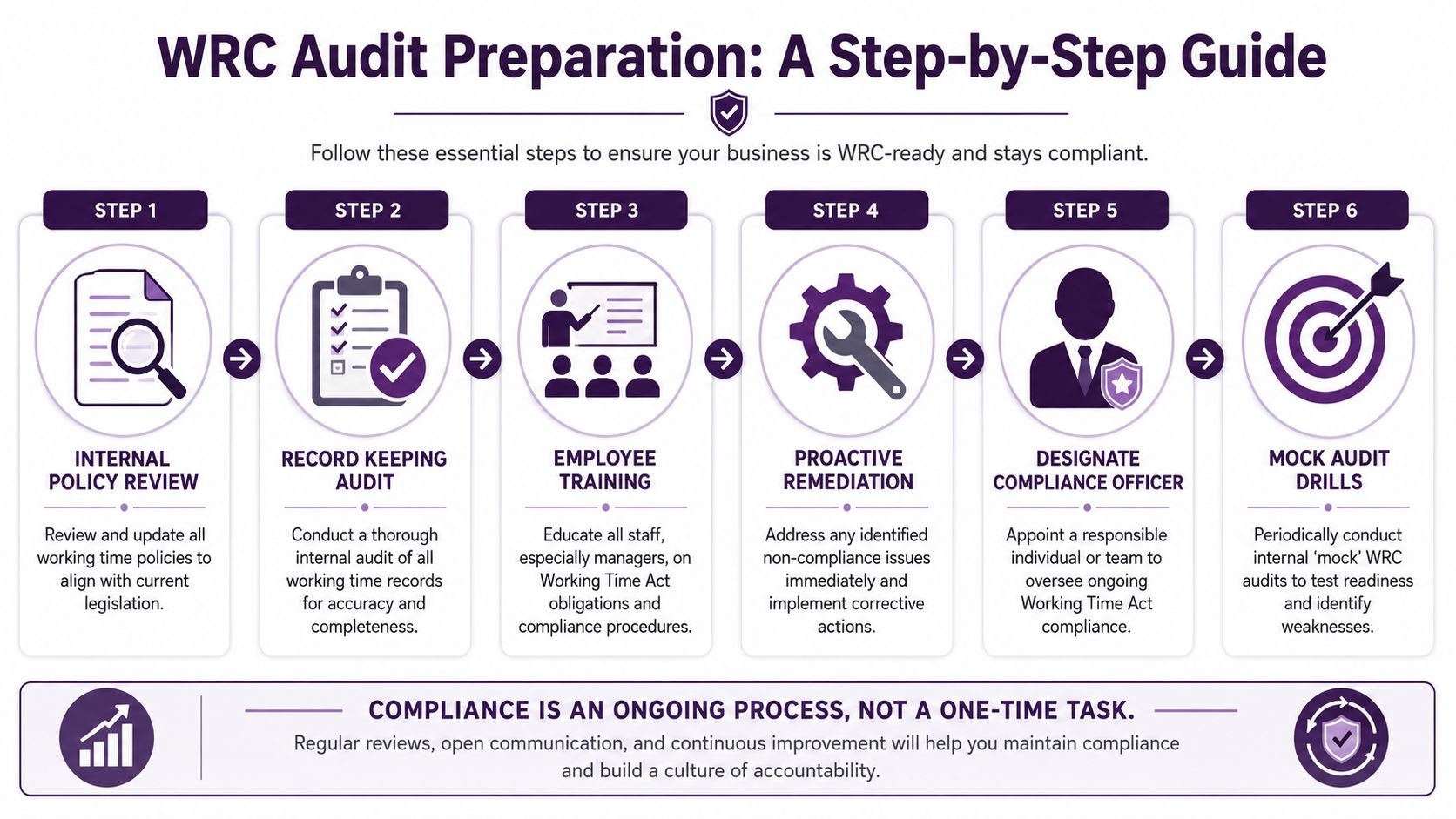
Start with an internal reality check
Before worrying about what an inspector might ask, look at what your business can produce today.
Review:
- Recent rotas against actual hours worked
- Break records for busy service periods
- Leave records for part-time and variable-hour staff
- Contracts for staff on night work or changing hours
- Manager practices across departments or sites
The point isn't to prove perfection. It's to spot where your written process and your real-life process don't match.
Check the documents managers actually use
Many businesses have a decent contract template and a poor operating habit. Others have decent habits but outdated contracts and handbooks.
Bring those together. Your manager on duty should understand the same rules your HR file relies on. If your team needs a plain-English employee-side explainer, this guide to protecting your career is useful because it shows the kinds of clauses staff increasingly pay attention to.
Then test your inspection readiness against a practical list. This WRC inspection checklist for Ireland is a sensible starting point for reviewing whether your files, records, and internal processes are aligned.
Train line managers, not just office staff
Most working time issues don't begin in HR. They begin on the floor, at reception, in the kitchen, or with the manager trying to save a service.
That means line managers need to know:
- When a break must happen
- Why actual finish times matter
- When reduced hours need escalation
- How split shifts create extra risk
- What records must be completed the same day
This is also the point where outside support can make sense. For operators that know the risk is real but don't have time to run a full internal review, Beacon Recruitment provides HR and compliance support that includes contract drafting, handbook development, people audits, and WRC-focused compliance checks.
A WRC-ready business isn't the one with the thickest folder. It's the one where contracts, rosters, records, payroll, and manager behaviour all tell the same story.
If your venue needs a practical review of contracts, records, or rota risk, Beacon Recruitment can help you tighten the operational side of compliance without turning your business into an admin exercise. For hospitality owners and managers, that usually means clearer systems, fewer avoidable disputes, and better readiness if the WRC comes calling.
Is Your Venue Ready for a WRC Working Time Audit?
Stop relying on missing break records and messy shift changes—book a free consultation with Beacon to build an audit-proof working time compliance system.