July 16, 2026
WRC Inspection Checklist Ireland: Essential Guide
Navigate your next audit with confidence. Our WRC inspection checklist Ireland covers records, pay, hours, & common pitfalls for compliance.

Friday lunch service is peaking. The pass is full, a server is looking for a missing allergy docket, two staff are due to clock off, and the duty manager gets a quiet tap on the shoulder. Someone from the Workplace Relations Commission is at reception.
That moment rattles even organised operators.
In hospitality, compliance problems rarely start with bad intent. They start with rushed rotas, a new starter who hasn't signed everything yet, a payroll export that doesn't match the roster, a split shift with no clean break record, or a file saved on the wrong laptop. A WRC inspection brings all of that into focus very quickly. If your records are tidy, the visit is manageable. If they aren't, a normal trading day can turn into a drain on management time and attention.
That Knock on the Door Why WRC Preparedness Matters
The pressure is different in a venue than in an office. Hotels, bars, restaurants and cafés run on movement. Staff swap sections, managers cover floor and admin at the same time, and payroll often has to reconcile hours from several systems. That's exactly why a proper WRC inspection checklist Ireland process matters. It has to work on a live site, not just in a neat HR folder.

The inspection risk is no longer something owners can file under “unlikely”. Reporting on WRC annual figures shows inspections rose from 3,943 in 2022 to 5,156 in 2024, and roughly 77% of visits in 2023 were unannounced. For hospitality, that matters more than it does in many other sectors because inspectors may attend outside normal office hours and during the periods when your admin team is least available.
Why hospitality gets caught out
A venue can look well run and still be exposed. The usual pressure points are operational:
- Rotas change fast. A manager covers absences, adds hours, swaps days and forgets to lock the final version.
- Payroll lags reality. The payroll report says one thing, the clocking system says another, and neither reflects the handwritten adjustment on the supervisor's pad.
- Documents sit in different places. Contracts are with head office, permits are with the owner, leave records are in payroll, and weekend managers can't access any of them.
- Seasonal hiring creates gaps. Short-term staff join quickly, but the paperwork trail often doesn't keep pace.
Practical rule: If your records can't be pulled together quickly by the manager on duty, you're not inspection-ready.
Preparedness isn't just about avoiding a legal headache. It protects service. When a venue scrambles for records, managers leave the floor, department heads get dragged into document searches, and staff become anxious. A clean process keeps the inspection contained.
What readiness looks like in real life
The best operators don't treat compliance as a once-a-year clean-up. They build a simple routine:
- one place for employee records
- one owner for payroll checks
- one method for recording actual hours worked
- one inspection contact on every shift
That's the difference between panic and control when the knock comes.
What WRC Inspectors Actually Scrutinise
Most managers think in terms of documents. Inspectors think in terms of evidence. A contract, a roster, a payslip and a leave record aren't separate admin items. Together, they show whether the business is meeting basic employment law obligations in practice.
One finding should shape where you start. Published analysis of WRC inspection results reports that failure to keep adequate employment records accounts for 62% of all contraventions found. In hospitality, that rings true. The problem usually isn't that a business has never heard of the rules. It's that the records don't prove compliance clearly enough.
Pay is more than the gross figure
Inspectors will look at whether pay records stand up when matched against hours and entitlements.
That means checking things like:
- Payslip accuracy. Staff should be able to see how pay was calculated, not just a final net amount.
- Hourly rates. The rate paid has to match the employee's entitlement.
- Sunday and premium issues. Hospitality rosters often make these messy, especially where roles or shift patterns vary.
- Overtime treatment. If overtime is paid, approved, or time-off-in-lieu is used, the records need to line up.
A payslip that looks neat at first glance can still create problems if it can't be reconciled to the rota or time record.
Working time is where weak systems show
Working time checks often expose the difference between policy and practice.
Inspectors will want to understand:
- start and finish times
- break records
- rest periods
- average weekly hours
- whether the venue can show what happened, not what was scheduled to happen
Handwritten rota changes, WhatsApp swaps and manager memory cause trouble. If the roster says a team member finished at one time but the till close, key log, or clocking record suggest otherwise, the business may struggle to defend the record.
For a broader overview of employer obligations, Beacon's WRC guidance for hospitality employers is a useful reference point alongside your own legal and payroll advice.
Contracts and terms still matter on inspection day
Inspectors aren't only checking current payroll output. They also want to see whether the employment relationship is documented properly from the start.
Focus on:
- written terms for each employee
- job title and role clarity
- start date
- pay basis
- working pattern
- any seasonal or fixed-term arrangements
A common hospitality weakness is assuming returning seasonal staff don't need the same level of paperwork discipline because “they worked with us before”. That assumption causes avoidable gaps.
If a manager has to explain a pay or hours issue verbally because the records don't show it clearly, the business is already on the back foot.
Leave and public holiday records complete the picture
Leave records often get treated as the easy part. They aren't. In practice, they test whether payroll, scheduling and management communication are aligned.
Inspectors may review whether the venue can show:
- annual leave accrued and taken
- public holiday treatment
- consistency between leave records and payslips
- whether managers are tracking leave centrally or site by site
In multi-site operations, leave records are one of the first places inconsistency appears.
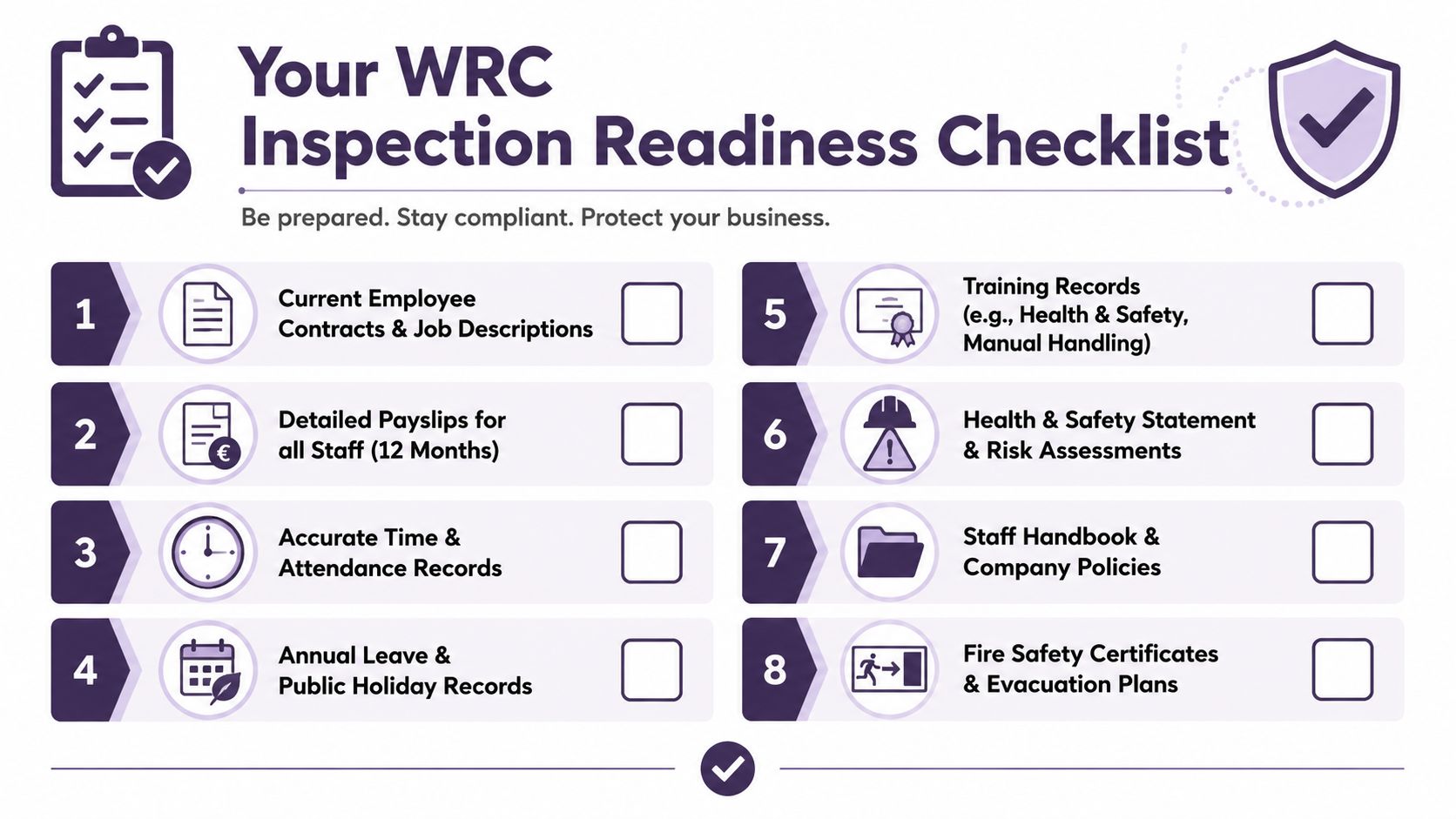
The Ultimate WRC Inspection Checklist for Your Venue
A workable WRC inspection checklist Ireland list has to be built for retrieval speed. The question isn't only “do we have this?”. It's “can the person on duty produce it now, in the right format, without ringing three people?”.
The WRC states that it may request a completed Employee Details Form and a Form of Authority in advance where relevant. The WRC employer inspection guidance also makes clear that employers should be ready to provide records in an appropriate format and cooperate with the process. In practical terms, that means your venue should have an inspection file, not a loose collection of documents.
Core employee records
Start with the basics for every current employee and, where relevant, recent leavers whose records may still be examined.
- Signed contract or written terms
Keep the latest signed version. If terms changed, keep the update trail too. - Employee identity and onboarding details
Store the employee's full name, address, PPS number and start date in one reliable place. - Job title and work location
This matters more than some employers realise, especially where staff work across bar, restaurant, events or accommodation departments. - Termination date where applicable
If someone has left, record that clearly. Unclear end dates create confusion when records are reviewed. - Young worker documentation where relevant
If you employ younger staff, make sure age-related records and controls are easy to find.
Payroll and pay records
Many hospitality businesses get exposed because payroll often relies on information from several sources.
- Detailed payslips
Keep a full record of payslips issued to staff. They should show enough detail to support how pay was calculated. - Gross-to-net payroll reports
Inspectors may want to see the underlying payroll calculation, not just what the employee received. - Hourly pay rates and changes
Record who approved any rate changes and when they took effect. - Overtime, premiums and allowances
If the business pays Sunday premium, service-related payments, board and lodgings adjustments, or role-based allowances, the basis for each should be documented. - Deductions
Make sure deductions are lawful, documented and consistent with what staff were told.
Working time records
This is the file set that often falls apart in real venues because operational managers are busy and systems aren't joined up.
- Actual hours worked
Keep clock-in and clock-out data, or another reliable record of actual attendance. - Rosters and roster changes
Save final worked rosters, not just the first draft circulated to staff. - Break records
If your system assumes breaks were taken automatically, test whether that assumption reflects reality on busy shifts. - Rest period evidence
Look for problem areas such as close-open shifts, split shifts, functions, weddings and late-night trading. - Manager approvals
Keep records of who approved additional hours or deviations from schedule. That helps explain why payroll differs from the original rota.
On-the-ground test: Pick any employee at random and try to match their contract, rota, actual hours, payslip and leave record for the same period. If that takes more than a few minutes, the system needs work.
Leave and public holiday records
Leave problems usually come from informal practices.
- Annual leave accrued and taken
Keep a current running record, not a year-end estimate. - Public holiday treatment
Record how entitlement was handled for each relevant employee. - Manager-approved leave requests
If leave is arranged by text or verbally, save a traceable record.
Right-to-work and permit records
Hospitality relies heavily on international talent. That makes this area especially important.
- Employment permits where required
Keep current copies and track expiry dates carefully. - Evidence where a permit isn't required
Don't rely on assumptions. Keep the relevant status documents on file. - Role alignment
Make sure the role being carried out matches the role connected to the worker's permission to work where that's relevant.
Policy and inspection administration file
These records support the inspection process itself.
- Employee Details Form
Have the information ready so this can be completed quickly if requested. - Form of Authority
Use this where a representative will deal with the WRC on the employer's behalf. - Named inspection contact list
Identify who handles the visit on weekdays, evenings and weekends. - Record access map
Note where each record type sits. Payroll, scheduling, contracts and permits shouldn't be a scavenger hunt.
A venue doesn't need a fancy system to pass this test. It needs a disciplined one.
Understanding the 12-Month Record-Keeping Rule
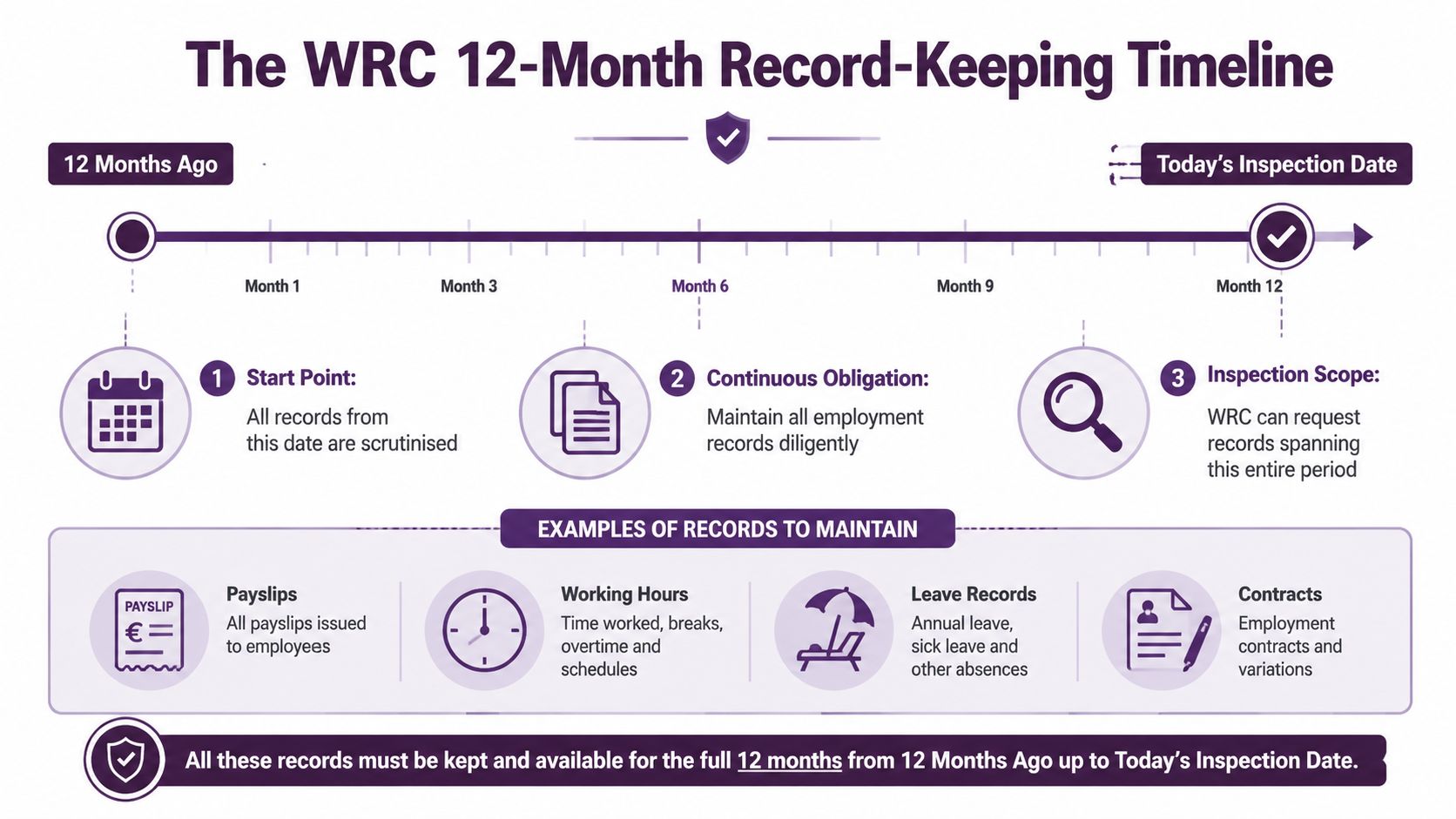
Many employers only think about records in the week before a problem appears. WRC inspections don't work like that. They work more like an audit. The inspector isn't only checking whether you can produce documents today. They're checking whether the business can prove compliance over time.
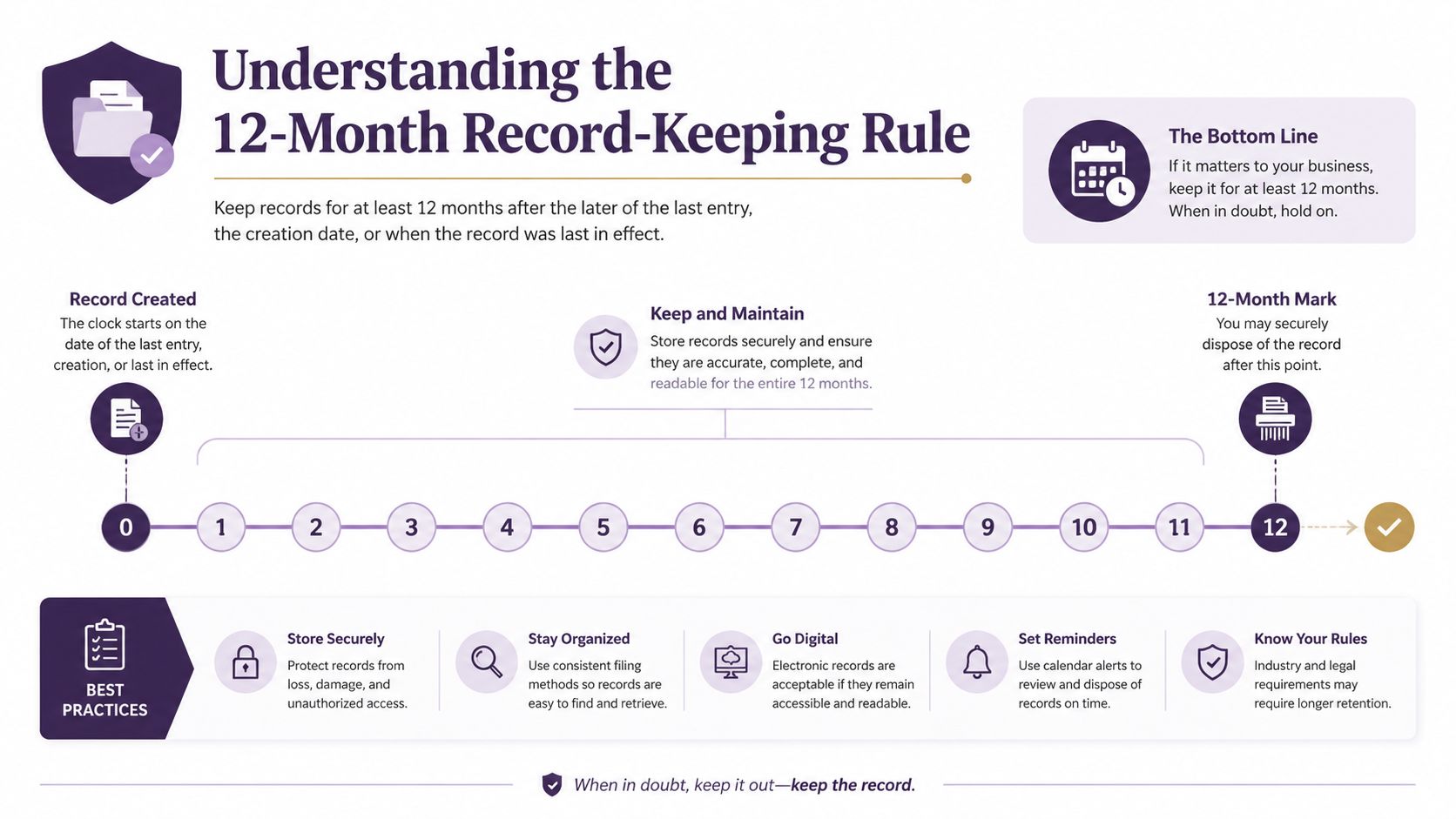
Practitioner guidance on WRC inspections confirms that inspectors commonly review records from the prior 12 months, and if initial checks reveal issues, they can widen the review. That's the detail many hospitality operators underestimate.
Why one missing month can create a bigger problem
If your venue has a gap in rosters, time records or leave files, the issue isn't only that one gap.
It raises a bigger question. Was this a one-off admin failure, or is the whole system unreliable?
That's why a single inconsistency can turn into a much deeper examination. If hours worked in one month don't reconcile to pay, the inspector has reason to test whether the same problem exists elsewhere.
For operators trying to tighten this area, Beacon's guide on working time records in Ireland is useful as a practical companion to your own internal audit.
What good retention looks like
A defensible record-keeping process is usually simple:
- Keep final versions
Don't overwrite old rosters without saving what was worked. - Link systems where possible
Payroll, scheduling and attendance should be comparable without manual guesswork. - Store by employee and by period
If records are only organised by system, retrieval becomes slow and messy. - Check seasonal peaks
Christmas, wedding season, summer trading and event periods are where errors usually creep in.
Businesses get into difficulty when they can describe what happened operationally but can't prove it in records.
The lesson isn't “keep records for an inspection”. It's “run the venue so the records are created properly as part of normal management”.
Common Hospitality Compliance Traps to Avoid
Most compliance failures in hospitality don't look dramatic at the time. They look ordinary. A Sunday shift gets coded wrong. A gratuities arrangement is understood by management but not documented well. A split shift break happens in theory, not in a record anyone can show later.
The Sunday premium mistake
A restaurant has a reliable weekend team. Payroll is processed from the rota template, not the final worked hours. During a busy bank holiday weekend, two staff swap into Sunday shifts, but the rota file isn't updated properly before payroll runs.
Nothing looks obviously wrong until someone compares actual attendance with the pay records.
This happens because managers often treat Sunday premium as a payroll setting when it's really a records issue. If the system doesn't capture who worked, when they worked, and what pay treatment followed, the venue is exposed.
The split shift break that only exists on paper
Hotels and event venues often run split shifts. Breakfast service, downtime, then dinner. On paper, it can look perfectly compliant. In practice, managers call someone back early, ask them to cover a check-in rush, or pull them into prep because a colleague is absent.
The problem isn't only the interruption. It's the lack of a clear record of what happened.
If a business relies on scheduled break assumptions instead of actual records, it may struggle to prove rest periods were provided.
The seasonal staff paperwork drift
This one is common. A returning worker is brought back quickly because they already know the venue, the till system and the team. The manager assumes the old contract is “basically still fine”. A rate changes, hours differ, the department changes, but the paperwork isn't refreshed properly.
That creates confusion across several areas at once:
- contract terms
- payroll basis
- leave records
- role clarity
- permit status where relevant
Seasonal hiring needs more discipline, not less, because speed tends to weaken controls.
Tips and gratuities confusion
Tips and gratuities are a practical pressure point in hospitality because the on-floor explanation and the payroll treatment don't always match.
Common mistakes include:
- No written explanation of how tips, gratuities or service charges are handled
- Inconsistent practice between departments or sites
- Manager-only knowledge where staff know the custom but there's no dependable written record
- Poor separation between wages and discretionary tip-related amounts in internal records
If your venue has any complexity around cash tips, card tips, tronc-style arrangements or service charges, document the process clearly and make sure payroll and managers use the same language.
Staff can tolerate complexity. Inspectors won't tolerate confusion that records should have resolved.
The “we know our staff” trap
Independent operators often rely on familiarity. They know who usually works late, who takes extra shifts, who minds the function room, who covers a sick day. That knowledge is useful for service. It's useless in an inspection if it isn't recorded.
A manager saying “that's just how we do Sundays here” won't repair a weak paper trail. Venues need records that stand on their own, even if the owner is away and the payroll person is off.
Beyond the Checklist Building an Audit-Proof Operation
A checklist helps you prepare. It doesn't run the business for you.
Audit-proof operations come from routines that managers can follow when the site is busy, understaffed or in the middle of a weekend rush. That matters because the WRC's own guidance says announced inspections generally get at least 48 hours' notice, but it also states that unannounced inspections take place, particularly outside normal hours and at weekends. The WRC employer guide to inspections makes that point clearly, and hospitality operators know those are exactly the times when head office support may be hardest to reach.
What to do on the day
When an inspector arrives, the right response is calm and structured.
- Nominate one contact
The duty manager should know who leads the interaction and who provides backup. - Verify and cooperate
Be professional, confirm the inspector's purpose, and avoid defensive improvisation. - Move records through one channel
Don't have three managers emailing, printing and contradicting one another. - Brief staff
If employees are interviewed, tell them to answer truthfully and directly. - Keep notes during the visit
Record what was requested, what was provided and any follow-up items.
What doesn't work
Some reactions make things worse very quickly:
- delaying because “the HR person isn't in”
- producing partial records and promising the rest later without a clear plan
- arguing from memory when documents are missing
- letting local managers invent explanations for payroll differences
- assuming a polished handbook will offset weak records
One practical option for operators who want an external sense-check is a mock inspection or people audit. Beacon Recruitment offers HR and compliance support for hospitality employers, including preparation around WRC-facing records and inspection readiness. That kind of support isn't a substitute for management discipline, but it can help identify weak spots before an inspector does.
For any venue reviewing broader people-process discipline, Beacon's article on disciplinary procedure and process management is also relevant because inspections often expose the same underlying problem. Policies exist, but day-to-day implementation is inconsistent.
Build a system your managers can actually use
The strongest venues usually do three things well:
- they standardise record storage
- they reconcile rota, attendance and payroll regularly
- they train line managers on what matters operationally
That last point is often missed. Compliance can't sit only with HR or ownership. In hospitality, the people creating the records are often supervisors, department heads and duty managers. If they don't understand what needs to be captured, the business will always be fixing problems after the fact.
A good system should work on a wet Tuesday in February and on a packed Saturday night in July. If it only works when the admin team has time, it isn't strong enough.
Running a venue is hard enough without second-guessing whether your contracts, rotas, payroll records and permit files would stand up to inspection. If you want practical support from an operator that understands Irish hospitality, Beacon Recruitment can help you tighten the systems behind the scenes so your managers can focus on service, not scramble for paperwork when the WRC arrives.
Is Your Venue Ready for a WRC Inspection?
Unannounced WRC visits are rising. Don’t wait for a knock on the door to organize your HR records. Book a Free Consultation with Beacon to audit your compliance today.