July 16, 2026
Skilled Worker Visa Ireland: Your 2026 Guide
Guide to the Skilled Worker Visa Ireland for hospitality. Learn 2026 steps, costs & compliance to hire international talent for your hotel or restaurant.
A key chef resigns on a Friday afternoon. Saturday bookings are full. Your sous chef can steady the pass for a few services, but you already know the underlying problem isn't the rota for next week. It's the gap that opens across purchasing, prep standards, menu consistency, team morale, and guest experience the moment a critical role goes vacant.
That's the moment many hospitality operators in Ireland start looking beyond the local market. Not because they want complexity, but because they've run out of realistic options. If you need a head chef, senior chef, specialist pastry hire, or another hard-to-fill role, international recruitment stops being a side conversation and becomes part of your operating plan.
Ireland is already leaning heavily on global talent. In 2025, the country issued over 31,000 employment permits across all sectors, with healthcare alone accounting for more than 7,750 permits, according to Ireland employment permit statistics shared for 2025. Hospitality businesses feel the same pressure even if the headlines focus elsewhere.
A skilled worker visa in Ireland can solve a staffing problem. But if you treat it as paperwork only, you'll create new problems in payroll, compliance, onboarding, and retention. The operators who get this right treat the process like any other serious operational project. They plan the role properly, build the file carefully, manage timelines realistically, and prepare the site before the person arrives.
Your Next Great Hire Might Be an Ocean Away
The usual version starts the same way. A head chef gives notice with no real runway. The kitchen can survive for a week or two on goodwill and long shifts, then standards start slipping. Specials become repetitive. Ordering gets reactive. Training stops. Reviews don't collapse overnight, but the room feels it.

For hotels, the knock-on effect spreads even faster. Breakfast service gets tighter, banqueting becomes risky, and senior managers start covering gaps instead of running the business. For independent restaurants, one departure can put the entire proposition under strain.
That's why international hiring now sits inside the mainstream staffing conversation. The local and EU market should always come first. But when the role is specialised, urgent, or repeatedly hard to fill, looking overseas isn't a last resort. It's often the most practical route to protecting service.
Hospitality recruitment is now an operations issue
A skilled worker visa in Ireland isn't just about getting permission for one person to travel. It affects:
- Service continuity: Can you maintain standards while the hire is in progress?
- Budget control: Can you absorb agency costs, permit fees, and delayed start dates without damaging margin?
- Team stability: Will your existing staff stay engaged while they carry extra load?
- Manager time: Who owns documents, follow-ups, onboarding, and right-to-work checks?
Some operators use digital sourcing tools early in the process to widen the candidate pool and screen faster. If you're evaluating options, this overview of AI powered recruitment tools is useful for understanding where automation helps and where human vetting still matters.
A rushed international hire usually fails long before the visa decision. It fails when the business hasn't defined the role properly, aligned salary, or prepared for the lead time.
The practical shift is simple. Stop viewing visa sponsorship as a one-off admin task. Start viewing it as a managed project with staffing, compliance, and onboarding workstreams running in parallel.
Confirming Your Eligibility for a Skilled Worker Visa
A visa plan can fall apart before you ever reach the application form. In hospitality, that usually happens because the business checks the candidate first and the sponsor position second. The order matters.
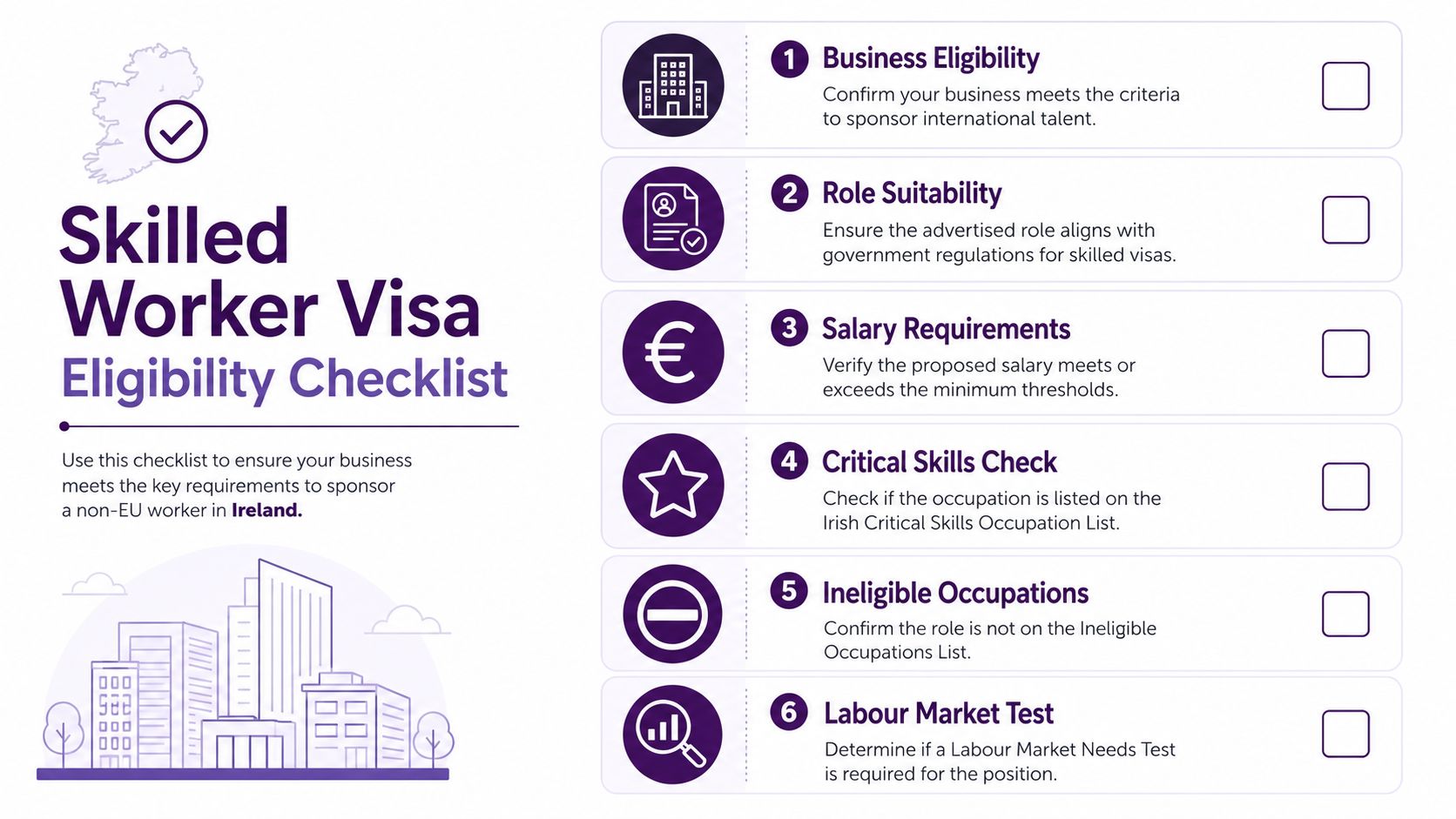
Start with two questions. Can your business sponsor this role under the permit rules? And does the role itself meet the criteria for the permit route you want to use? If either point is weak, the rest of the project becomes expensive admin with no reliable outcome.
Employer eligibility comes first
Hospitality operators are under pressure to fill shifts, protect service, and stop burnout in the existing team. That pressure often pushes managers straight into CV review and interview planning. A significant risk usually sits in the employer file.
A strict rule applies here. At the time of application, at least 50% of employees must be EEA nationals. For hotels, restaurants, and catering businesses with fluctuating staffing levels, that is not a box-ticking detail. It is a live operational test.
We see this catch businesses out during seasonal ramps, after a run of resignations, or when a group assumes the headcount position of one entity can support an application from another. It cannot. The employing entity, the current workforce mix, and the live payroll position all need to line up on the day you apply.
Check these points before you commit budget or start candidate paperwork:
- Workforce mix: verify your current EEA and non-EEA headcount using live employee data, not last quarter's report.
- Correct employing entity: confirm the legal employer on the contract is the same entity making the application.
- Role accuracy: make sure the job title, duties, salary, hours, and site reflect the actual vacancy.
- Timing risk: assess whether upcoming departures, end-of-season exits, or restructuring could push you below the 50% threshold before submission.
If you need a practical explanation of permit criteria, salary levels, and role fit, our guide to the Critical Skills Employment Permit in Ireland sets out the main rules clearly.
Candidate eligibility and role eligibility are separate checks
A strong candidate does not make an ineligible role eligible. Immigration permission is tied to the job on offer, the salary attached to it, and whether that occupation fits the permit route.
For Critical Skills permits, salary and occupation classification do most of the heavy lifting. That is where hospitality employers often run into difficulty. A business may have found an excellent overseas candidate, but if the role is too broad, too junior, or priced below the required level, the case is weak from the outset.
That is why we advise clients to test the role design before they test candidate enthusiasm. It saves time, protects credibility with applicants, and prevents managers from promising start dates they cannot deliver.
What this looks like in hospitality
Hospitality businesses rarely hire in neat immigration categories. They hire to solve service problems. The challenge is that permit rules do not care why the vacancy hurts. They care whether the role qualifies.
A senior culinary position with clear specialist duties and an appropriate salary may support a Critical Skills assessment. Mid-level kitchen roles usually need closer scrutiny and may point to a different permit route. Many front-of-house jobs do not qualify in the way owners expect, especially where duties are generalist or the role sits at junior management level. Specialist beverage, operations, or niche production roles need a case-by-case review against the current occupation lists and salary framework.
The job title alone carries very little weight. Decision-makers look at the substance of the role. If the day-to-day duties do not match the occupation being claimed, changing the wording on the contract will not repair the issue.
The operational question that saves time
The wrong question is, “Can this person get a skilled worker visa in Ireland?”
The useful question is, “Can this exact role, in this exact entity, at this exact salary, support a permit application right now?”
That shift sounds small. In practice, it changes everything. It forces the business to check headcount, salary, entity structure, and role design before managers invest more time in interviews, relocation discussions, and rota planning. For hospitality employers, that is the difference between a controlled hiring project and a scramble that leaves shifts uncovered for months.
Assembling Your Application Blueprint
Most weak applications don't fail because the candidate is unsuitable. They fail because the file is incomplete, inconsistent, or assembled in the wrong order. In kitchens, mise en place prevents chaos during service. Immigration paperwork works the same way.

The smartest move is to build the application pack before anyone touches the online form. That means one shared checklist for the employer and another for the candidate, with every item verified against the final role details.
The employer file
For hospitality businesses, the employer side usually causes the most delays because documents sit across HR, finance, operations, and sometimes external accountants or legal advisers.
Build one clean pack that includes:
- Company identity documents: the correct registered employer details, trading structure, and contact information.
- Role evidence: a clear job description that matches the duties, reporting line, and location.
- Salary confirmation: proof that the package offered aligns with the chosen permit route.
- Employment contract: a final version, not a draft with placeholders or inconsistent dates.
- Advertising and market evidence where required: if your route depends on labour market testing, keep the proof organised from day one.
- Internal approval trail: one named person should own sign-off so the role doesn't keep changing mid-application.
For employers checking whether a role still fits the current occupations framework, this update on Ireland's employment permit occupations lists is worth reviewing before you finalise anything.
The candidate file
Candidates often assume the permit grant is the whole process. It isn't. Their personal documents need to be ready early, especially if qualifications, bank evidence, or passport validity could become an issue.
According to Irish immigration guidance for a Long Stay D employment visa, applicants must submit a signed Summary Application Form, pay the appropriate fee, and provide supporting documents including a passport valid for at least 12 months after arrival, two passport-sized photos not older than 6 months, medical or travel insurance, an employment permit from DETE, a contract of employment, and evidence of qualifications and finances such as bank statements on headed paper from the last six months.
In practical terms, the candidate pack should include:
- Passport readiness: validity, legibility, and consistency with all application details.
- Qualification evidence: degree or training documents relevant to the role.
- Employment history: references and work records that support the CV.
- Financial evidence: documents presented exactly as required, not screenshots or informal statements.
- Personal documents: photographs and forms checked for date validity and signature.
Practical rule: if a document might expire, change, or require translation, deal with it before submission week. Last-minute fixes create most avoidable delays.
What works and what doesn't
What works is one master checklist, one document owner, one final contract, and one shared understanding of the role.
What doesn't work is sending the candidate into the visa stage with missing bank evidence, changing the salary after drafting, or discovering halfway through that the job description doesn't match the permit category. When operators say the process feels stressful, it's usually because the file was built reactively instead of deliberately.
Navigating the Application and Visa Process
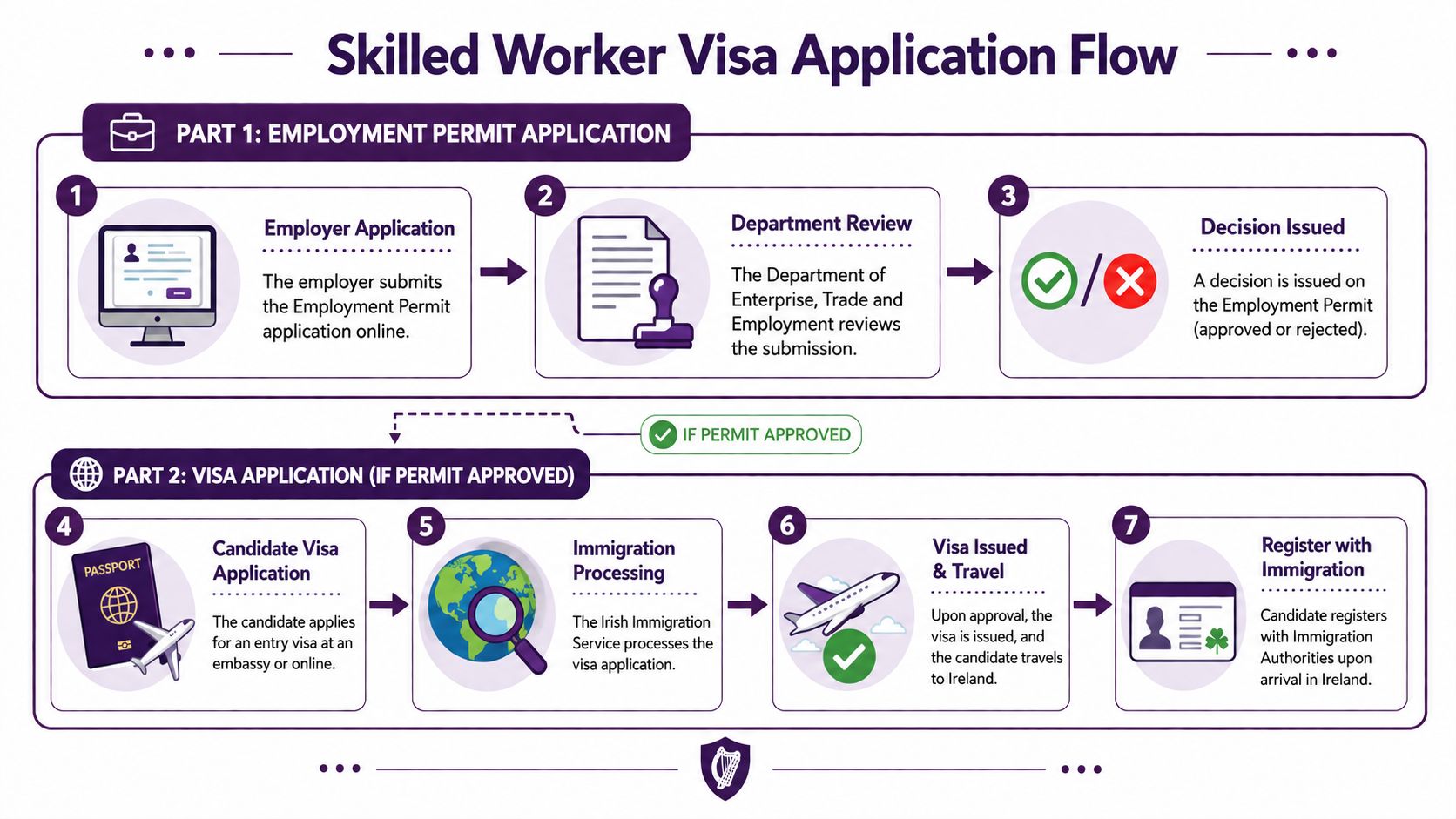
Once the file is ready, the process splits into two linked but separate stages. First comes the employment permit application. Then, if the permit is granted and the candidate needs entry clearance, the visa application follows. A lot of frustration comes from mixing those stages together.
The permit stage with DETE
For a Critical Skills route, the official mechanics matter. According to 2026 guidance on the Ireland Critical Skills Employment Permit, the salary threshold is €40,904 for roles on the Critical Skills Occupation List or €68,911 for other eligible roles. Applications must be submitted at least 12 weeks before the proposed start date via Employment Permits Online, and the processing fee is €1,000, with 90% refunded upon refusal.
That immediately changes how a hospitality operator should plan. If your summer season depends on an April arrival, you cannot start preparing in March and expect the process to bend around service pressure.
A realistic permit-stage timeline usually looks like this:
- Role confirmed: salary, duties, and permit route are locked before submission.
- Application prepared: all employer and candidate documents are checked against the final version of the role.
- Online submission lodged: the permit application goes through the Employment Permits Online system.
- Department review period: During this period, inconsistencies, missing items, and drafting errors cost time.
- Decision issued: approval allows the next stage to begin. Refusal means you review grounds, documents, and eligibility before reapplying.
The visa stage for the candidate
After permit approval, the candidate may still need a Long Stay D visa to travel. This second stage catches employers off guard because they think the permit grant means the person can book a flight immediately.
For some applicants, this stage also has meaningful timing and approval risks. According to guidance on Ireland visa success rates for Nigerian citizens, the CSEP processing time for Indian applicants in 2026 averages 6 to 8 weeks, followed by a further 4 to 8 week Irish employment visa stage, creating a total journey of 10 to 16 weeks after the job offer. The same source states that visa success rates for Nigerian citizens were 44.4%, with 55.6% rejected in H1 2022, and notes that bank statements showing steady income or savings can improve approval prospects.
That doesn't mean every application from every country follows the same pattern. It does mean you should stop promising start dates before the second stage has been assessed properly.
Treat the permit grant as a milestone, not the finish line. Travel permission, document quality, and embassy processing still matter.
How operators should manage the handover
At this point, many files drift. The employer feels their part is done, while the candidate suddenly has to interpret visa instructions, assemble supporting documents, and manage embassy expectations alone.
The handover works better when someone manages it actively:
- Confirm exactly what the candidate must submit: don't assume they'll infer this from government pages.
- Check travel document validity early: passport problems are easier to fix before pressure builds.
- Review personal evidence before filing: especially qualifications, financial papers, and photo requirements.
- Set a soft launch date internally: don't roster the person until travel permission is in hand.
Arrival is still part of the process
Once the worker lands, there's an immigration registration step. According to a summary shared in the Reddit AmerExit discussion on Ireland's Critical Skills pathway, permanent residency is granted after two years on a CSEP, while citizenship eligibility arises after five years of lawful residence, and applicants must register with the local immigration officer or at Burgh Quay in Dublin to obtain an Irish Residence Permit after arrival.
That final administrative step matters operationally because a new hire who has just relocated will still need practical support on the ground. The cleanest skilled worker visa Ireland projects are the ones where the business plans past approval and all the way through arrival week.
Beyond the Visa Employer Compliance and Onboarding
Permit approval is not the finish line for a hotel, restaurant, or catering business. It is the point where the legal file turns into an operating plan.
We see the same mistake repeatedly. A business works hard to secure the permit, then treats arrival as an admin clean-up exercise. In hospitality, that approach creates risk fast. Rotas change, departments borrow staff, seasonal hiring shifts your workforce mix, and a role that looked tidy on paper can drift within weeks if nobody owns the post-arrival process.
The 50% EEA rule is one reason this matters so much. As noted earlier, that test applies at the point of application, but the operational lesson goes further. If your staffing model is volatile, you need live visibility on workforce composition, not a rough assumption based on last quarter's headcount. Groups with multiple sites, agency cover, and frequent casual hiring are especially exposed.
Compliance needs an owner
Immigration compliance works best when one person is accountable for it and operations stay involved.
Your HR file and immigration file should say the same thing. Job title, pay, hours, location, and reporting line need to reflect the basis on which the worker was approved. If a chef is approved for one site and is then moved around the group without proper review, the issue is not theoretical. It can surface during an inspection, an extension application, or an internal audit after the person has already settled in.
Right to work checks also need discipline across the full workforce, not only for permit holders. A rushed process for local hires often creates the same record-keeping weakness that later causes trouble for international staff. These right to work checks in Ireland for employers give a useful baseline for tightening that process.
Then there is rostering. Within this process, hospitality operators get caught. If a property is short-staffed, managers naturally move people to cover service. That may solve tonight's problem and create a compliance one next month. Good control means line managers know which role, site, and terms were approved, and know when to stop and ask before making changes.
A permit can be approved and the project can still fail later if the business loses control of role consistency, records, or workforce planning.
The first month shapes retention
Arrival support is not a soft extra. It affects whether the hire beds in, performs well, and stays.
A strong first 30 days usually includes:
- Day one clarity: who they report to, where they start, what the shift pattern looks like, and who to call if something goes wrong outside working hours.
- Practical admin: support with PPS-related steps, banking, and local registration requirements where relevant.
- Local orientation: transport options, realistic commuting advice, mobile setup, and basic area knowledge.
- Workplace expectations: service style, hygiene standards, escalation routes, and the pace expected in an Irish hospitality setting.
- Team integration: proper introductions, buddy support, and small social gestures that stop the new hire feeling isolated.
- Family planning: if dependants are involved, managers should understand the pressure that relocation puts on the household, not just the employee. Practical guidance on helping families relocate abroad can help employers support retention more realistically.
This is also where experienced support earns its keep. Beacon Recruitment works with hospitality employers on international recruitment, permit administration, and arrival logistics. The value is not just getting papers filed. It is keeping the hire viable after approval, when compliance, onboarding, and day-to-day operations start pulling on the same person at once.
Common Pitfalls and Frequently Asked Questions
A permit application usually goes wrong long before anyone uploads a form. In hospitality, the pressure point is often operational. A chef resigns, occupancy is rising, rota gaps are growing, and the business rushes to secure an overseas hire before checking whether the role, salary, timing, and headcount position support the application.
That is why this stage needs disciplined planning. The permit is one workstream. The rota, payroll setup, housing reality, opening schedule, and the 50% EEA rule can all affect whether the hire is viable in practice.
What not to do
The mistakes we see most often are predictable.
- Do not hire backwards: confirm that the role is permit-eligible before offering it to a candidate.
- Do not commit to unrealistic start dates: permit approval, visa processing where relevant, travel, and onboarding rarely line up as quickly as an understaffed property hopes.
- Do not change the role midway through: altered duties, a reduced salary, or a different site can create problems with the basis of the application.
- Do not split ownership across disconnected teams: the GM, HR lead, finance contact, and whoever holds company documents need one version of the facts.
- Do not treat permit approval as the finish line: approval gets the person into the job legally. It does not solve retention, accommodation pressure, or early-stage integration into the team.
Small inconsistencies cause real delays. A job title that differs across the contract, permit form, and internal approval notes is often enough to trigger questions.
Practical questions operators ask most
Can the employee bring family members
Sometimes yes, but it depends on the permit route and the worker's circumstances. For employers, the practical issue is timing. If family plans are discussed only after approval, the business can run into delayed start dates, housing complications, or a candidate who becomes hesitant for reasons that have nothing to do with the job itself.
In hospitality, that matters more than many owners expect. A strong candidate may accept the role, then slow down once they realise the relocation plan does not work for their partner or children.
What happens after two years
For workers on a Critical Skills route, the longer-term position can become more stable over time. Employers should not leave that conversation until the permission period is nearly up. If the hire is performing well, retention planning should start early, especially in kitchens, management roles, and hard-to-fill specialist positions where replacement costs are high.
What if we want to promote them or move them into a new role
Check the immigration position before announcing the change. A promotion may make perfect business sense and still create permit issues if the new title, duties, location, or pay structure differ materially from what was approved.
This catches operators out regularly. The business sees progression. The permit system sees a change in the basis of permission.
What about the 50% EEA rule
This is one of the most misunderstood points for hospitality employers. In broad terms, the business usually needs to meet the rule that at least half of employees are EEA nationals, subject to the relevant rules and any applicable exceptions. For hotels, restaurants, and catering businesses with fluctuating staffing levels, that can become a live issue during peak season, restructures, or periods of high turnover.
It needs monitoring, not guesswork. We advise clients to review this before recruitment starts, not after an offer has gone out.
The skilled worker visa Ireland process rewards organised operators. Businesses that prepare the role properly, keep documents aligned, and plan for the realities of arrival and retention usually have a much smoother experience.
If you are hiring internationally and want practical support on role eligibility, permit strategy, or the operational planning around onboarding and compliance, Beacon Recruitment works with Irish hospitality businesses on those issues every day. The aim is simple. Get the hire approved, get them started properly, and give them a fair chance of staying.
Build a Reliable International Hiring Pipeline
Empower your business to recruit hard-to-fill roles confidently, compliantly, and with a clear onboarding strategy. Schedule a Free Consultation with Beacon to streamline your international hiring today.