July 19, 2026
Employment and the Law: A Guide for Irish Hospitality
A practical guide to employment and the law for Irish hospitality. Understand contracts, wages, WRC processes, and compliance to protect your business.
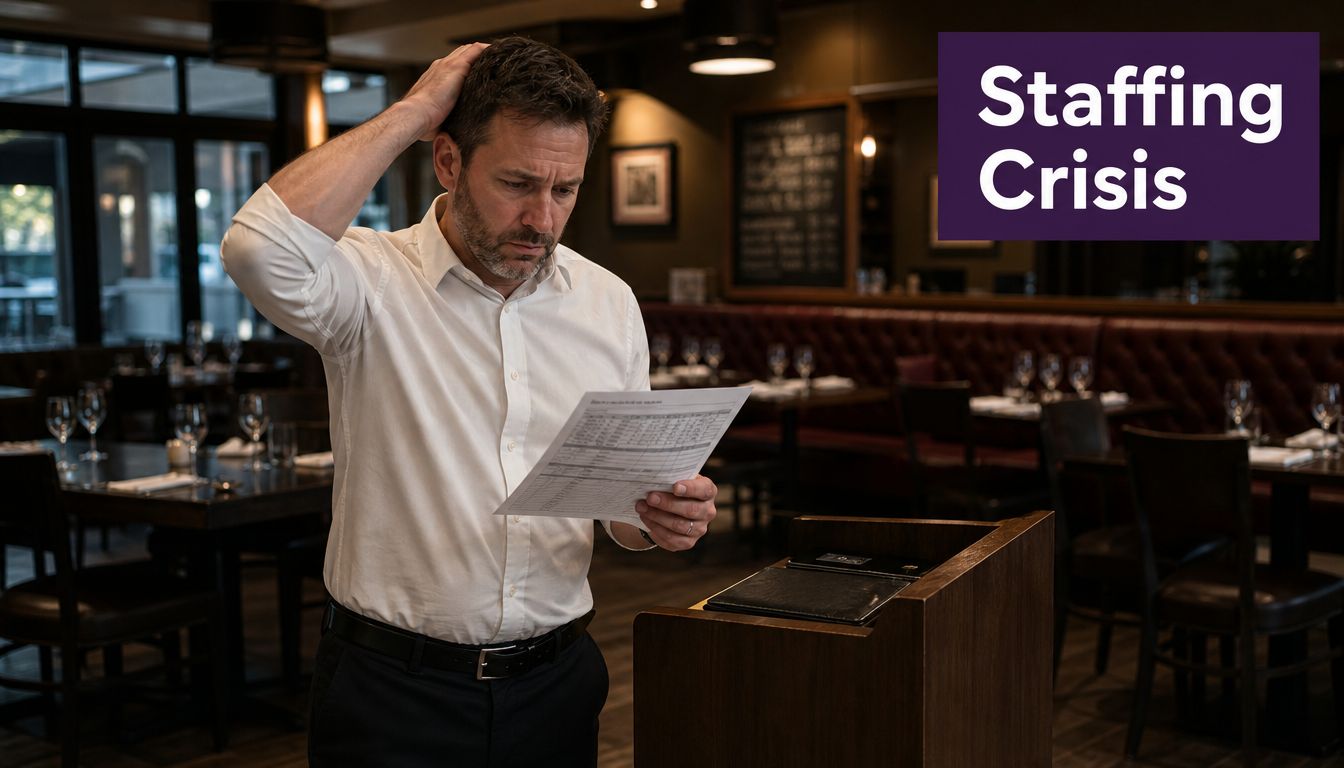
Friday afternoon. A chef has walked out, two floor staff can only work limited shifts next week, a new starter still hasn't signed the proper paperwork, and the rota for the bank holiday is being built on scraps of availability sent over WhatsApp. Service still has to run. Guests won't care that one employee is on probation, another is on variable hours, and a third may not have the right documents on file.
That's where employment and the law stop being an abstract HR topic and become an operational issue. In Irish hospitality, people risk sits right in the middle of service quality, margin control, guest experience, and management time. A busy restaurant, pub, or hotel can absorb a lot of pressure. It rarely absorbs avoidable compliance mistakes well.
Most owners and GMs don't struggle because they don't care. They struggle because the world of hospitality is messy. Rosters change. Students want flexibility. part-time team members pick up extra shifts. non-EU hires bring valuable skills but also extra paperwork. A public-facing business needs consistency, yet staffing is often the least consistent part of the operation.
Your Guide to Irish Hospitality Employment Law
A hospitality manager usually doesn't meet employment law at a desk with a clear hour to think. It lands during service, in the middle of payroll prep, or when someone says, “I never got that in writing,” right before raising a formal complaint.
In hospitality, the legal pressure points are predictable even when the day isn't. High turnover means contracts are constantly being issued. Variable hours make rostering rules harder to manage. Public complaints can quickly become reputational issues. Managers often supervise young staff, seasonal staff, part-time staff, and international hires all at once. Each one brings a different compliance risk.
Where problems usually begin
The trouble rarely starts with a dramatic dismissal. It usually starts with smaller habits that feel harmless at the time:
- Late paperwork: A new starter begins because the venue is short-staffed, and documents follow later.
- Loose verbal agreements: A manager says, “We'll keep it flexible,” but nothing is pinned down clearly.
- Informal rostering: Shifts are offered casually without checking what the contract says.
- Patchy records: Warnings, meeting notes, and pay discussions stay in someone's memory instead of the personnel file.
Those gaps create disputes because hospitality runs fast and memory runs short.
Practical rule: If a manager can't prove what was agreed, it becomes much harder to defend what happened later.
Good employment practice doesn't slow a venue down. It gives management a structure for making quick decisions properly. That matters whether you run an independent café in Clare, a city-centre restaurant, or a hotel group with multiple departments and rotating managers.
Tools can help if they remove admin friction rather than add another layer to it. For teams reviewing contracts, offers, and workflow around hiring, the Legitt AI platform is worth looking at for context on contract management and recruitment process coordination.
What solid compliance looks like in a venue
A well-run employment setup in hospitality is usually visible in ordinary routines:
- Managers roster inside agreed terms
- Contracts are issued on time
- Handbooks are current and accessible
- Performance issues are documented early
- Right-to-work checks happen before pressure takes over
That's the practical core of employment and the law in this sector. It's not about legal jargon. It's about running a stable team when the business is busy and the stakes are public.
Hiring Contracts and Core Terms
A chef walks in for a trial on Friday, the kitchen is short for the weekend, and by Saturday night that trial shift has turned into a hire. That is a familiar hospitality scenario in Ireland. It is also where contract mistakes start.
The law does not make an exception because service is busy. Employers must give a new hire a written statement of core terms within 5 days of starting work, and the wider written terms within 2 months, under the Employment (Miscellaneous Provisions) Act 2018, as explained by the Workplace Relations Commission guidance on terms of employment. In restaurants, bars, cafés, and hotels, that deadline is often missed because managers focus on filling the rota first. The problem is that a rushed start creates avoidable arguments later about pay, hours, duties, probation, and even which site the employee was hired to work in.
In hospitality, paperwork has to match the job. A contract written for an office role will not hold up well in a venue dealing with split shifts, late finishes, guest complaints, cash handling, accommodation turnaround, and staff moving between departments during busy periods.
The two documents that matter
The first document is the written statement of core terms. This statement provides the basics the employee needs from day one, such as employer details, pay, expected hours, and the nature of the job.
The second is the full contract of employment, backed up by a handbook that sets out the rules managers rely on. The contract should identify the legal terms of the relationship. The handbook should deal with the policies and procedures that need to be applied consistently on the floor, in the kitchen, at reception, and across housekeeping. This overview of employment law in Ireland gives useful context on how those documents work together.
The mistake I see most often is overlap without clarity. The contract says one thing about hours, the handbook says something broader, and the rota practice says something else again. That is how small drafting issues turn into WRC complaints.
What to lock down in a hospitality contract
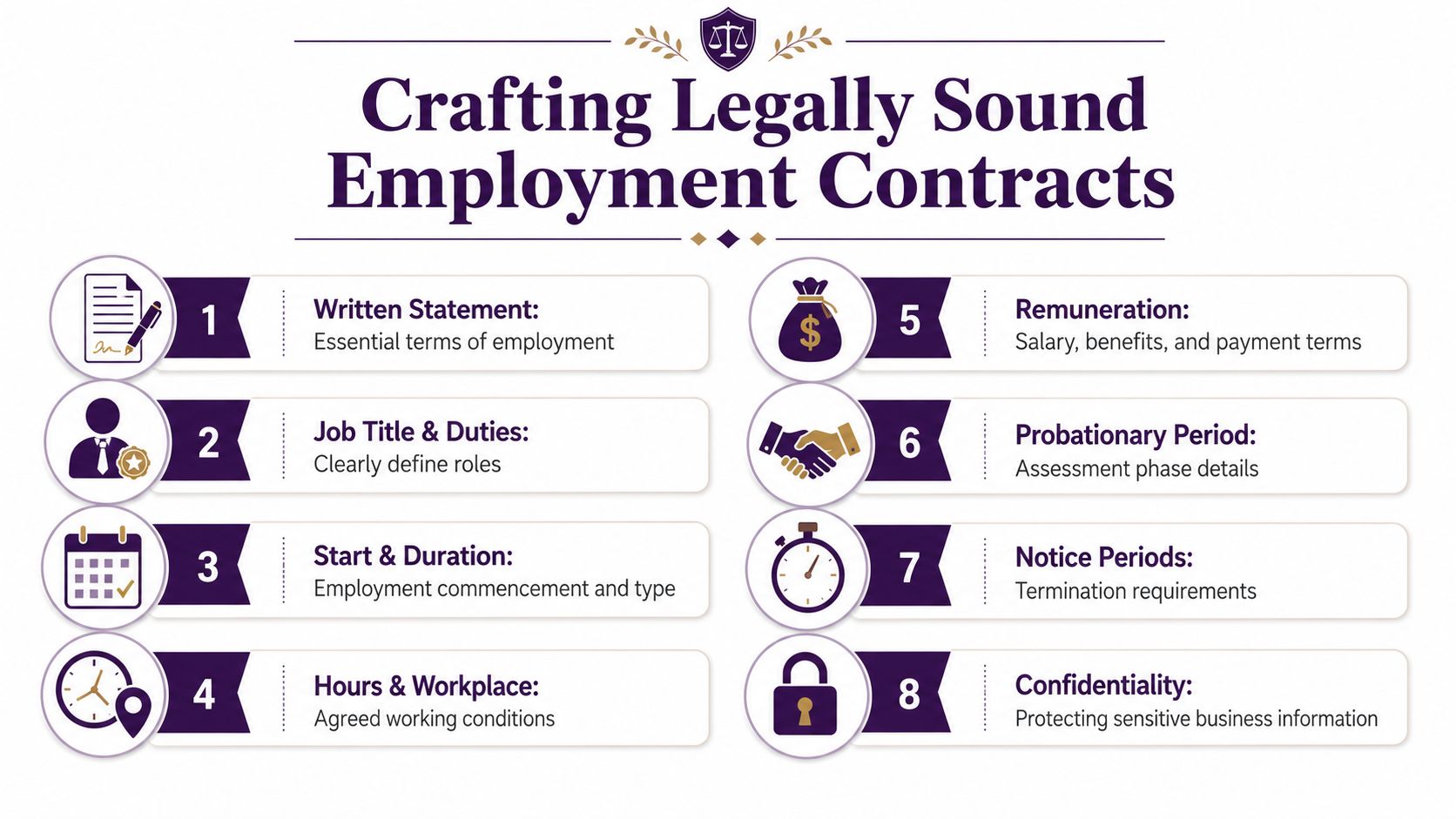
A workable hospitality contract is specific in the places disputes usually start:
- Job title and duties: Avoid vague labels such as “staff member.” State the role clearly, then draft duties widely enough to reflect real operational needs without pretending every employee can be moved anywhere at any time.
- Hours and scheduling: If the role involves variable hours, the wording must say so clearly. Reference hours, expected flexibility, weekend work, and how shifts are assigned matter a lot in this sector.
- Place of work: Multi-site businesses need this clause drafted carefully. If an employee may be asked to work in another hotel, bar, or outlet, say so in a fair and realistic way.
- Pay and deductions: Set out rate of pay, pay date, and any lawful deductions plainly. This matters for all hires, but especially where service charge arrangements, uniforms, or accommodation are part of the working setup.
- Probation: State the length, the standards expected, and the review process. Do not treat probation as automatic or open-ended.
- Notice: Keep notice periods practical. A clause that looks tough on paper but is impossible to operate in a short-staffed venue usually creates more trouble than protection.
- Policies and procedures: Disciplinary, grievance, sick leave, dignity at work, and absence reporting are usually better set out in the handbook, provided the contract refers to them properly.
One extra point matters in this sector. If you employ non-EU workers, the contract should align with the role and terms used for permit purposes. If the permit says one job and the day-to-day reality looks different, you create risk on both the employment side and the immigration side.
A good contract gives a manager something clear to rely on during a busy service, not just a document for the file.
If you are reviewing your documents, this practical guide on a contract of employment for Irish employers is a useful checkpoint against what your venue is asking staff to do.
What fails in practice
The same shortcuts cause the same problems. One generic contract for every role. Verbal promises about hours that never make it into writing. Probation clauses with no review process. Handbooks that are out of date or never issued. Managers hiring quickly because the business needs bodies on the floor, then trying to tidy up the paperwork weeks later.
High turnover makes that tempting. It does not make it safe.
The better approach is simple. Prepare role-specific documents in advance for front of house, back of house, accommodation, reception, and management hires. Get terms out before operational pressure takes over. Then make sure the contract matches how the venue runs. That is what protects the business when a staff member challenges what they were told, what they were paid, or what they were expected to do.
Managing Wages Hours and Leave
It is 4.30pm on a Friday. A coach tour has arrived early, two servers have called in sick, and the manager on duty starts filling gaps on the rota by text. That is exactly how wage and working time problems start in hospitality. The issue is rarely one big decision. It is a series of rushed changes that payroll and leave records fail to catch later.
Pay needs close control from day one. The National Minimum Wage Act 2000 sets the floor, but the primary exposure in a restaurant or hotel usually comes from the details around it. Hours worked have to match hours paid. Breaks have to be managed in practice, not assumed. Leave has to accrue properly for staff whose schedules change every week. In a sector with high turnover and variable hours, those basics can drift quickly if one manager is rostering, another is approving swaps, and payroll is trying to reconstruct the week after service has finished.
Roster discipline matters more than good intentions
Flexible rostering is normal in bars, cafés, hotels, and event venues. Casual rostering is where trouble starts.
Under Ireland's Transparent and Predictable Working Conditions Regulations 2022, employers must give notice of work assignments and keep those assignments within the employee's stated reference hours. In practical terms, that means your written terms, your rota, and what the manager is texting staff on the day should all line up. If they do not, staff may be entitled to refuse the shift, and a complaint can follow.
This catches hospitality businesses out all the time. A contract says one pattern. The rota operates on another. A supervisor asks a team member to stay late, start early, or cover an extra shift outside the agreed framework because the business is under pressure. Operationally, that can feel reasonable. Legally, it still needs to sit within the employee's stated terms.
Where problems usually show up
The same pressure points come up across the sector:
- Variable-hours employees: If weekly shifts rise and fall, the contract needs to reflect that reality and the records need to show how hours were assigned.
- Short-notice cover: Calling someone in because a function ran over, the weather turned, or the terrace suddenly filled up is common. It still needs to be handled within the agreed working pattern.
- Part-time and irregular leave accrual: Annual leave errors are common where staff work different hours each week, especially across front of house, banqueting, and seasonal teams.
- Payroll corrections after the event: Rebuilding time sheets from messages, handwritten notes, or memory is where underpayment and holiday pay mistakes creep in.
A stable process matters more than manager goodwill. Use one rota system, one approval route for changes, and one payroll deadline. If shifts are swapped or extended, record who approved it and when. If your team struggles with leave for part-time or irregular workers, this annual leave calculator for Ireland is a useful sense-check before errors build into a WRC issue.
Zero-hour arrangements need careful handling
Some hospitality employers still treat zero-hour style arrangements as an easy answer to uncertain demand. They are not.
Irish working time law gives protections in this area, and businesses should be careful about promising flexibility while expecting regular availability. In practice, if a venue needs someone to be consistently available for weekend service, breakfast shifts, or wedding work, it is usually safer to define the arrangement clearly and roster within those terms than to rely on vague casual status.
This matters even more where you employ students, seasonal staff, and non-EU workers. Those groups are often the least likely to challenge a poor system early, but they can still bring claims later if records do not support what they were paid, when they worked, or how leave was calculated.
In hospitality, the rota is not just an operations tool. It is part of your legal record.
The businesses that stay out of trouble usually do three things well. They check rates before payroll closes. They keep live records of hours, breaks, and leave. They make one person accountable for spotting mismatches between the contract, the rota, and the payslip. That approach saves time, reduces arguments at busy periods, and gives GMs and owners something far more useful than good intentions. It gives them proof.
Navigating Disciplinary and Dismissal Procedures
Most unfair dismissal risk in hospitality doesn't come from one shocking incident. It comes from impatience, inconsistent managers, and poor records. A business gets frustrated with lateness, attitude, till discrepancies, guest complaints, or weak performance, then rushes to a sanction before a fair process has been followed.
The first distinction to get right is conduct versus capability. Conduct is about behaviour. Capability is about whether the employee can do the job to the required standard. Those issues can overlap, but they shouldn't be managed as if they're the same thing.
Conduct and capability need different responses
A server who's rude to guests presents a conduct issue. A commis chef who's trying but can't keep pace on section presents a capability issue. A receptionist with repeated lateness may raise conduct concerns. A supervisor who can't complete core admin tasks may need capability management, training, or closer review.
Confusing the two creates weak outcomes. Managers often say someone is “not working out” without identifying why. That vagueness makes it hard to fix the issue and even harder to defend a dismissal.
A fair process in practice
Hospitality businesses need a disciplinary process that line managers can use during a busy week. In practical terms, that usually means:
- Raise the issue early
An informal conversation can solve a lot. State the concern clearly, explain the expected standard, and note the conversation. - Investigate before deciding
If the matter is serious, gather facts first. Check the rota, CCTV if applicable and lawful, witness accounts, till records, or complaint details. Don't jump straight to sanction. - Invite the employee to a formal meeting
Put the issue in writing. Set out the concern and give the employee a fair chance to respond. - Hear both sides properly
Let the employee explain. In hospitality, there's often context a rushed manager didn't know at the time. - Issue the outcome in writing
If a warning is justified, record what happened, what improvement is required, and what may happen next if the issue continues. - Allow an appeal
If possible, use a different manager to hear it.
Natural justice matters. The employee must know the allegation, have a chance to answer it, and be judged fairly.
Write notes as if someone outside the business may read them later, because they might.
Documentation is your real protection
A venue can have a reasonable concern and still lose a case if the process was poor. That's why documentation matters more than managerial certainty.
Keep these records together:
- Meeting notes
- Warning letters
- Evidence reviewed
- Training provided
- Improvement targets
- Appeal outcome
Dismissal should never be the first tidy solution to an untidy management problem. In hospitality, underperformance often improves when expectations are clearer, supervision is stronger, and records are consistent. When dismissal is necessary, a fair sequence is what protects the business.
When Things Go Wrong The WRC Process
For many hospitality employers, the Workplace Relations Commission feels bigger and more mysterious than it is. In practice, it's a formal process, not a sudden ambush. The worst response is panic. The better response is to get organised quickly.
The WRC sits at the centre of Irish employment dispute resolution because the Workplace Relations Act 2015, enacted on October 1st, 2015, consolidated functions previously carried out by bodies including the Labour Relations Commission, Rights Commissioner Service, and Equality Tribunal into the WRC, as set out in the official page on workplace relations legislation.
What an employer should do first
When a complaint arrives, resist the urge to answer it emotionally. Start with the file.
Pull together the contract, handbook acknowledgment, rota records, payroll details, correspondence, meeting notes, warnings, and any resignation or dismissal letters. In hospitality businesses, the employer often has fragments stored in email, WhatsApp, a scheduling app, and a paper file. Bring them into one sequence.
Then identify the actual issue. Is this about wages, hours, notice, dismissal, discrimination, or terms of employment? Managers sometimes defend the wrong point because they haven't isolated the legal complaint from the workplace frustration around it.
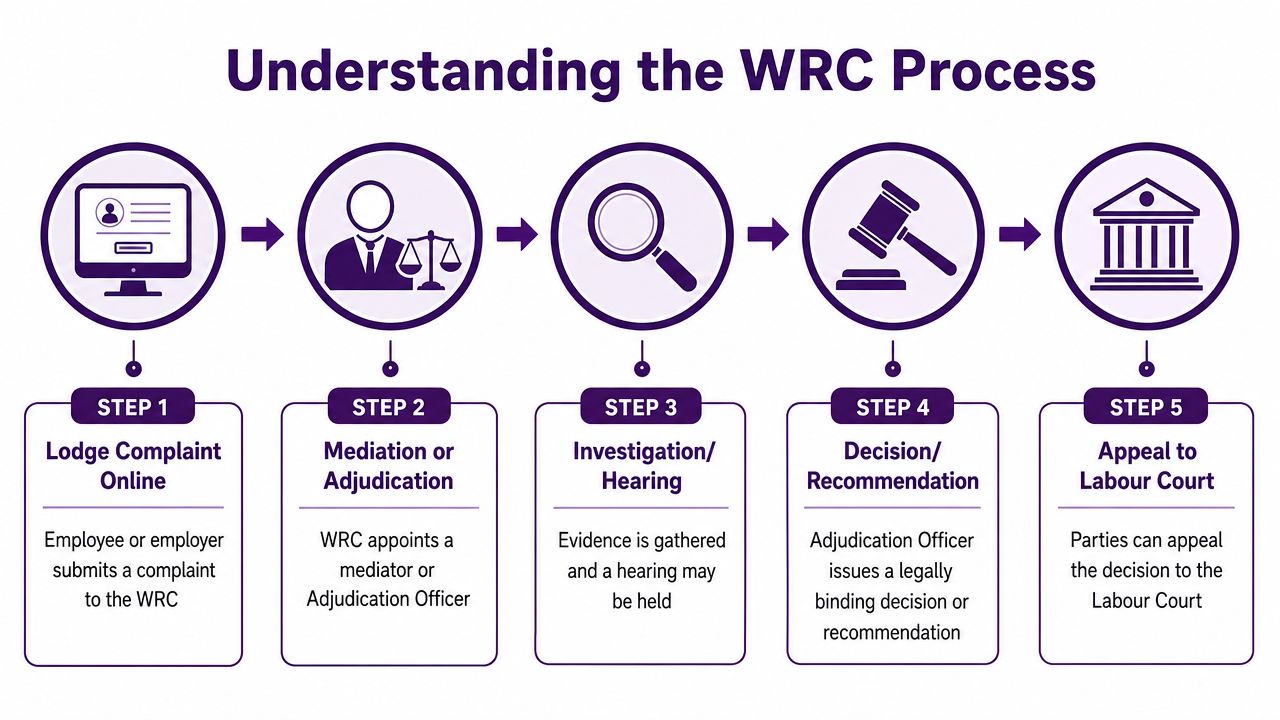
The usual path through the process
Most employers will recognise this sequence:
- Complaint received: The business learns an employee or former employee has lodged a claim.
- Mediation or adjudication route: Some matters may be suitable for mediation. Others proceed to hearing.
- Preparation stage: Documents are assembled, chronology is built, and witness positions are clarified.
- Hearing: The employer explains what happened and produces supporting records.
- Decision: An adjudication outcome is issued, with appeal options after that.
A case is rarely won by indignation. It's won by coherent records, credible witnesses, and a process that looks fair on paper because it was fair in real life.
Why the WRC matters operationally
The WRC's significance isn't just administrative. In a judgment published on December 4th, 2018, the Court of Justice of the European Union held that the WRC has authority to dis-apply national legislation that conflicts with EU law, as discussed in this note on Case C‑378/17 and the WRC's obligation to give effect to EU law.
That matters because hospitality employers can't assume a narrow domestic reading will always protect them. Employment and the law in Ireland sit inside a wider legal framework, and the WRC has real authority within it.
International Hires and Immigration Rules
Hospitality in Ireland depends heavily on international talent, especially where local recruitment can't fill specialist or hard-to-staff roles. For many venues, non-EU hiring isn't an exception anymore. It's part of the staffing model.
That changes the employer's role. Once a business hires from outside the local labour pool, it isn't only making a job offer. It's stepping into a process that touches immigration status, permit conditions, onboarding timing, and document control.
What employers often underestimate
The practical challenge isn't just finding the right chef, manager, or specialist worker. It's aligning employment terms with immigration compliance from the start.
A few areas need close attention:
- Job title accuracy: Titles and duties should be consistent across the offer, contract, and immigration paperwork.
- Start dates: Don't build a rota around assumptions before the person is cleared to work.
- Document retention: Keep clear copies of permission-related documents and review dates.
- Manager awareness: Duty managers and HR staff need to know who has been cleared, on what basis, and when checks are due again.
A lot of avoidable trouble starts when operational teams think immigration compliance sits only with the owner or external adviser. It doesn't. The venue has to run the employment relationship correctly once the person arrives.
Right-to-work checks can't be casual
Busy businesses sometimes check documents in a rush on the first day and move on. That's not enough. Right-to-work checks need a consistent method, clear record keeping, and follow-up where permission is time-limited.
This practical guide to right to work checks in Ireland for employers is a useful reference point for building a repeatable internal process rather than relying on memory.
There's also a planning issue that hospitality employers don't always spot. International workers may ask broader mobility and visa questions that sit outside the immediate job offer. Where staff are comparing routes, a practical explainer on mastering digital nomad visa applications can help them understand how different visa frameworks operate internationally, even though an Irish hospitality role will need its own separate and correct permission pathway.
The safest approach is simple. No one starts, trains, or shadows until the business has completed the right checks and filed them properly.
That discipline protects the employee as much as the employer. It also protects the manager who'd otherwise be asked to make legal calls from behind a reception desk or pass counter.
Your Hospitality Compliance Checklist
Friday evening is building, two people have called in sick, and a supervisor is covering the floor while trying to approve hours in the back office. That is exactly when compliance slips. In hospitality, the weak spots are rarely dramatic at first. They show up as unsigned terms, patchy leave records, inconsistent rotas, or a missing visa follow-up for a non-EU hire. Then a WRC claim, inspection, or staff complaint turns an admin gap into a management problem.
A useful checklist keeps those risks visible. Good operators in restaurants, hotels, bars, and cafés review employment compliance the same way they review food safety, cash control, and stock loss. On a regular basis, with clear ownership.
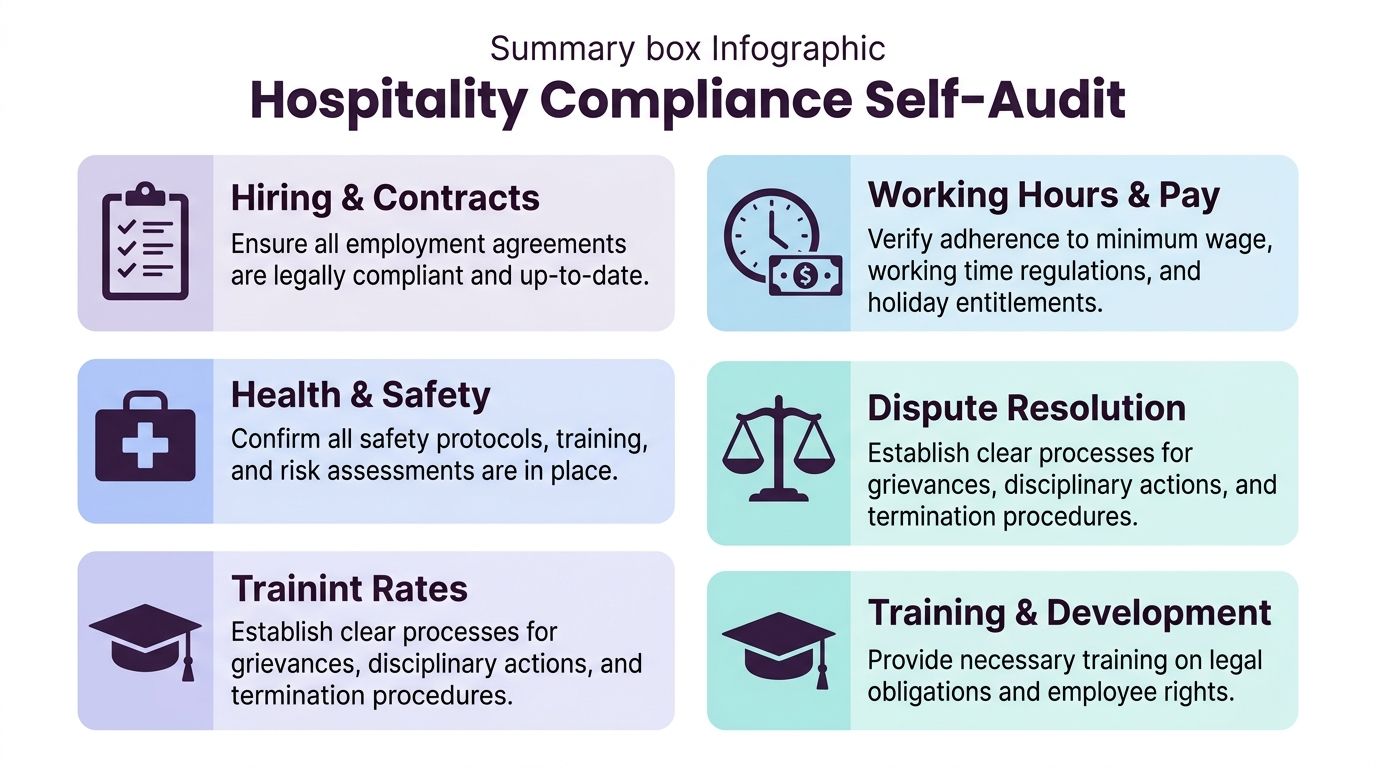
Use this as a working check, not a filing exercise.
Hiring and onboarding checks
- Do new starters receive their core written terms within the legal timeframe?
- Does every employee file contain a signed contract and acknowledgment of key policies?
- Are job titles, duties, and pay terms consistent across the offer, contract, and internal records?
- Are right-to-work checks completed and stored before the employee starts work?
Daily management checks
- Do your rota practices match the terms you've issued to staff?
- Can managers show how annual leave is tracked for part-time and irregular-hours employees?
- Are wage rates reviewed when legal minimums change?
- Do line managers know when an issue is conduct, capability, or grievance, rather than treating everything as “performance”?
End of employment checks
- Do managers document informal coaching, formal warnings, and investigations properly?
- Can the business produce a clean timeline if a dismissal is challenged?
- Is there an appeal route that works in reality, even in a small management team?
Hospitality businesses feel pressure fastest where turnover is high and management time is short. A file that looks mostly complete is not much use if key dates are missing, records are spread between payroll and site managers, or no one can explain why one team member got different terms from another doing the same job. The practical test is simple. Could the GM or owner put the paperwork and decision trail in front of an inspector or adjudicator without scrambling?
There is also a recruitment point to fix now, before it becomes urgent. Irish hospitality employers must prepare for the EU Pay Transparency Directive, due by June 2026. It will require pay ranges in job ads and ban questions about salary history, as outlined in this update on employment law developments in Ireland in 2026.
Add these checks to your process:
- Do your job ads use clear pay ranges?
- Have you removed salary history questions from recruitment practice?
- Can you explain how pay is set for similar roles across the business?
Compliance drifts. It drifts through copied templates, rushed promotions into management, old payroll settings, and habits picked up during a busy season. The fix is not complicated, but it does require discipline. Review the basics, assign responsibility, and correct weak points before they become expensive.
If your checklist has too many “not sure” answers, Beacon Recruitment can help you turn them into clear, workable systems. Their hospitality-focused support covers contracts, handbooks, people audits, compliance processes, and the operational realities that make HR harder in restaurants, hotels, bars, and cafés.
Is Your Venue Exposed to a WRC Claim?
Stop relying on verbal agreements and messy rotas—book a free consultation with Beacon to build audit-proof contracts and HR systems.