August 4, 2026
Health and Safety Compliance: An Irish Hospitality Playbook
A step-by-step guide to health and safety compliance for Irish hospitality. Learn to manage EHO/WRC audits, create policies, and train staff effectively.
Friday lunch is in full swing. A delivery driver is blocking the back door, a chef is shouting for an allergen check, a new floor staff member has called in sick, and someone says there's an inspector at reception. In hospitality, that's the kind of moment that turns a normal service into panic.
Most owners and general managers know the feeling. It isn't just fear of getting caught out. It's the sick realisation that the business may be running on habit, goodwill, and memory instead of a system that stands up when someone independent starts asking questions.
That's where proper health and safety compliance stops being a paperwork exercise and becomes operational control. If your venue is audit-ready, an inspection is still inconvenient, but it's no longer a crisis. Your team knows where records are. Your managers know what to say. Your procedures match what occurs on the floor.
The Knock at the Door Every Owner Dreads
An unannounced visit rarely arrives at a convenient time. It lands when the kitchen is stretched, when rooms are turning over, when a supervisor is off, or when you've just had three staff changes in a week. That's why inspections feel so personal in hospitality. They expose the difference between a venue that looks organised and one that is organised.
I've seen venues with spotless front-of-house presentation come unstuck in minutes because nobody could produce training records, explain an incident log, or answer a basic allergen question with confidence. I've also seen ordinary, busy operations handle inspections calmly because they had a routine. Not fancy systems. Just disciplined ones.
The stakes are not imaginary. In Ireland, the HSA carried out 10,713 inspections and investigations in 2023, and those actions led to 19 prosecutions that generated nearly €1.4 million in fines, according to this HSA annual report overview. That figure comes from multiple sectors, but the message is the same for hospitality operators. Regulators inspect. They enforce. Non-compliance costs money.
Practical rule: If your systems only work when your best manager is on shift, they don't work.
The right response isn't to live in fear of EHO, HSA, or WRC scrutiny. It's to build a playbook for the whole operation. Physical safety. Food safety. People processes. Documentation. Follow-through.
That playbook also does something owners often overlook. It improves the business. Cleaner handovers, fewer avoidable incidents, clearer staff accountability, stronger induction, better maintenance discipline, and less firefighting. Compliance done properly protects margin because it reduces chaos.
A venue that runs safely usually runs better. That's the point.
Understanding Your Legal Obligations in Ireland
Irish hospitality businesses get into trouble when they treat legal obligations as separate boxes handled by different people. The law doesn't care how you divide responsibility internally. It cares whether the business can show that hazards have been identified, risks have been managed, and staff are working within safe systems.
Under the Safety, Health and Welfare at Work Act 2005, employers in Ireland must maintain a written risk assessment and a safety statement, and workplace injury records must be kept for a minimum of 10 years, as outlined in this overview of workplace safety standards in Ireland. In practical terms, that means your venue needs more than good intentions. It needs written evidence.
What the documents actually mean
A risk assessment is where you identify hazards, decide who could be harmed, and put controls in place. In a hotel, restaurant, café, or bar, that includes obvious risks like slips, hot surfaces, sharp blades, cleaning chemicals, and manual handling. It also covers less obvious operational issues, such as lone working, late-night conflict, or rushed cellar deliveries.
A safety statement is the bigger operating document. It sets out how your business manages safety overall. It should reflect your real workplace, not a generic template downloaded years ago and forgotten in a drawer.
Use these two tests:
- Reality test: Does the document describe how your venue works on a Tuesday night when you're short-staffed?
- Inspection test: Could a manager pull it out immediately and explain how it applies to kitchen, bar, housekeeping, maintenance, and front-of-house?
- Update test: Has it been reviewed after staffing changes, refurbishments, menu changes, equipment changes, or a serious near miss?
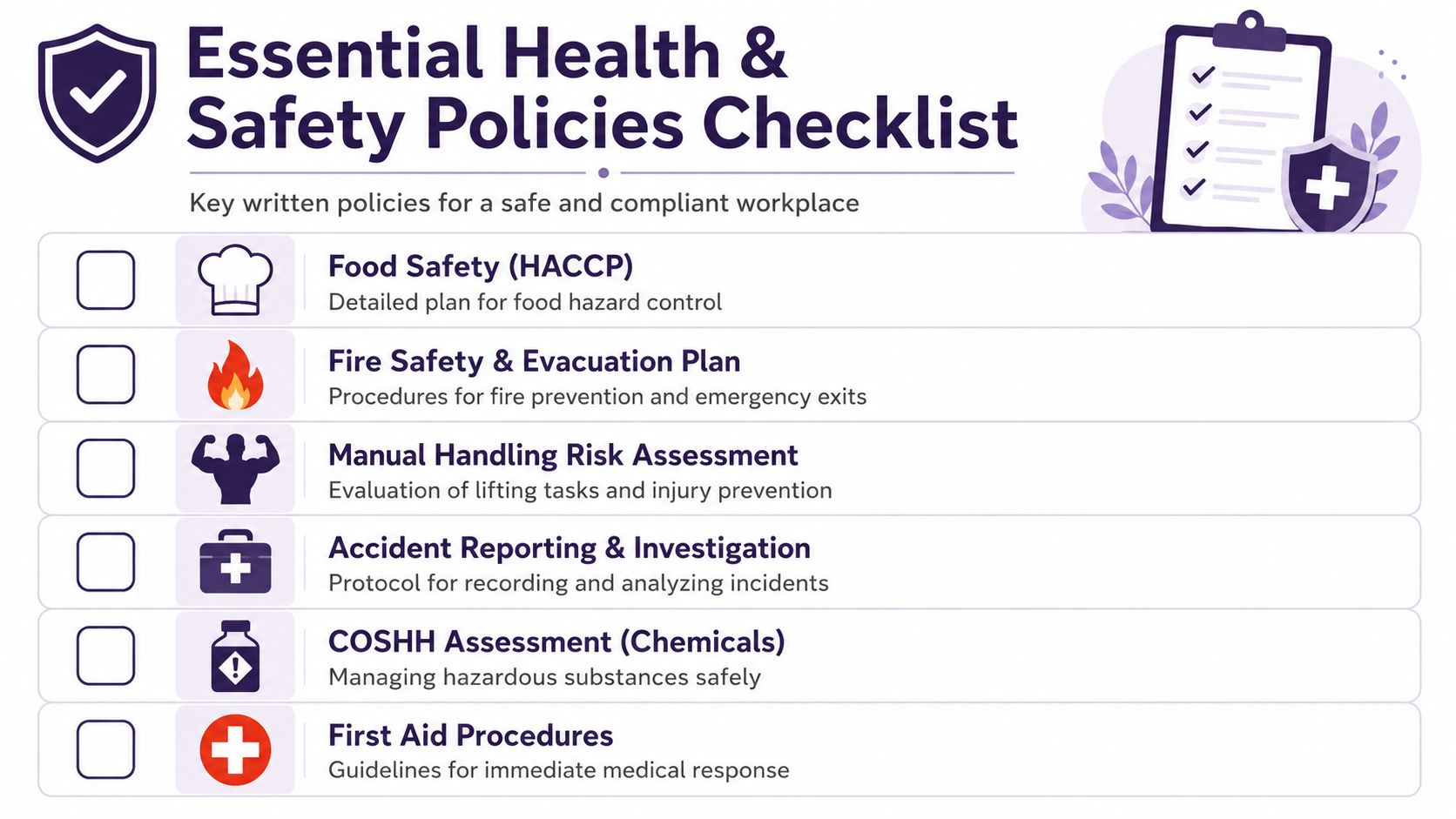
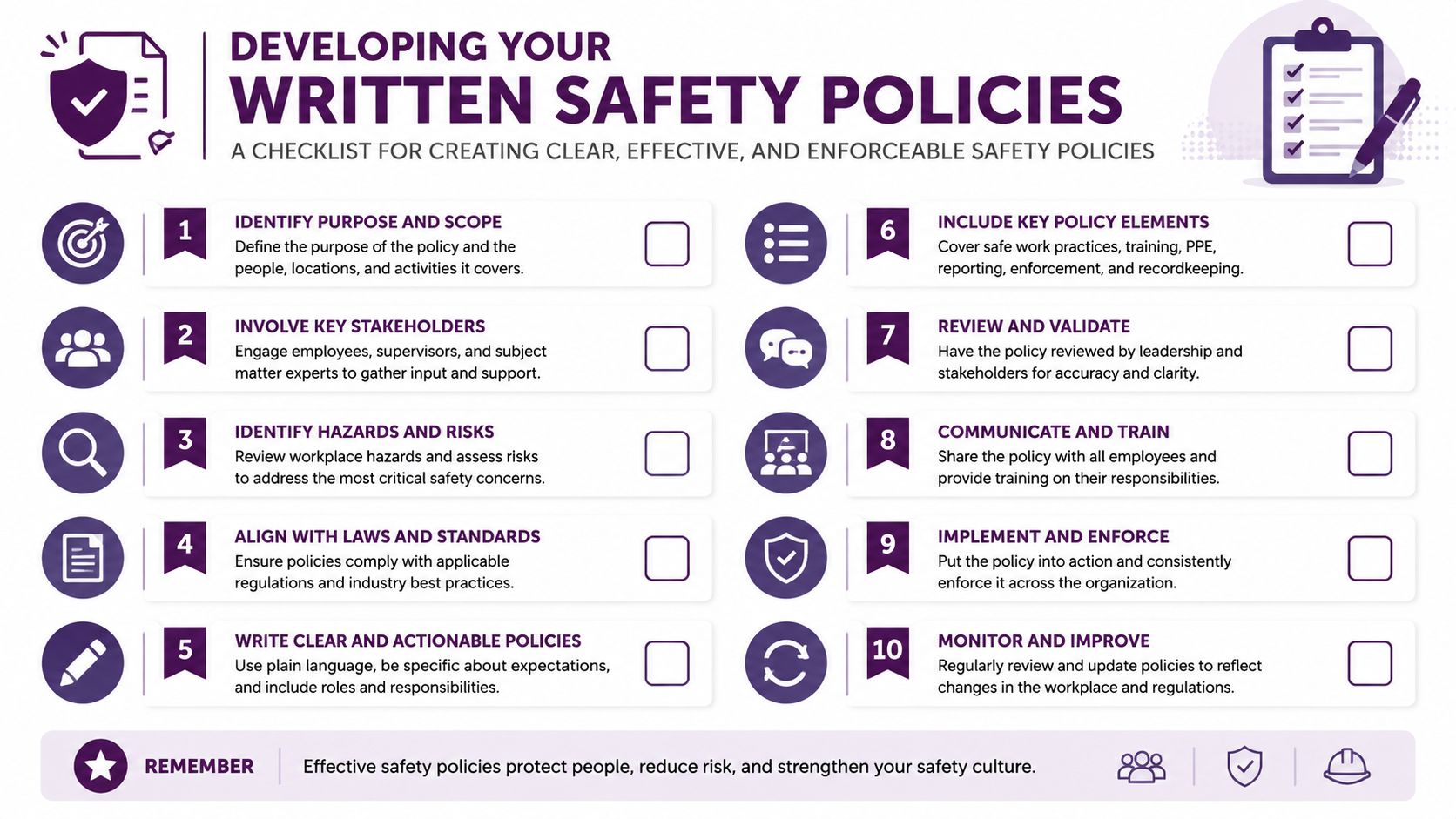
A simple visual checklist helps keep the core policies visible:
Who regulates what
Operators often muddle the roles of the different bodies. That confusion slows down responses when an issue arises.
- HSA: Oversees workplace health, safety, and welfare. Think staff safety, systems of work, accident reporting, manual handling, and wider duty of care.
- FSAI and EHOs: Focus on food safety standards, hygiene, traceability, allergen control, and whether food practices match your written HACCP system.
- WRC: Deals with workplace rights and plays a key role in enforcement and dispute resolution around workplace standards, including issues tied to safety, dignity, harassment, and compliance procedures.
If you want a plain-English overview of the wider legal framework, this guide to health and safety legislation in Ireland is a useful starting point. For operators managing larger buildings or mixed-use sites, this actionable guide for facility managers is also worth reading because it connects policy with day-to-day site control.
Your paperwork should help a manager make a good decision during service. If it only exists for an inspector, it's already too weak.
Conducting a Practical Risk Assessment
A proper risk assessment in hospitality should be done on the floor, not only at a desk. The desk version tends to be tidy, broad, and useless. The practical version notices the wet corner near the pot wash area, the awkward keg lift in the cellar, the blocked fire exit during a delivery, and the chef who skips steps because prep is running late.
The process doesn't need to be complicated. It needs to be honest.
A five-step method that works in real venues
- Identify the hazard
Walk the site at operating speed. Look at kitchen, bar, store rooms, staff entrance, delivery routes, stairs, toilets, plant areas, and any guest-facing spaces where staff work under pressure. - Decide who could be harmed
Don't only think about employees. Include agency staff, cleaners, delivery drivers, contractors, guests, and younger or newly hired workers who may not spot risk quickly. - Assess the risk in context
A knife is always a hazard, but the risk changes depending on training, pace, supervision, and layout. A dry storeroom step may be manageable in theory and dangerous in practice if lighting is poor and staff are rushing. - Put controls in place
Fix what you can physically. Add signage where useful. Change workflow where needed. Train people. Remove unnecessary complexity. The best control is usually the one staff can follow during a busy shift. - Review and revise
Risk assessments go stale quickly in hospitality. New menu, new chemicals, new equipment, new opening hours, or new staff mix all change the risk picture.
A kitchen example
Take a common issue. Water and grease collect near a pass during peak service.
You can't solve that with a laminated sign alone. A meaningful control package might include revised cleaning intervals, a mat suited to the area, clearer floor checks during service, footwear standards, and a shift lead who owns the response. If a control relies on “someone should probably keep an eye on it”, it won't hold.
For cleaning and contamination points, a separate hygiene-focused lens is often useful. This practical guide to infection control steps gives a sensible example of how to think through exposure routes and cleaning discipline.
The blind spot most venues still miss
Most risk assessments in hospitality are still heavily physical. They cover burns, slips, cuts, chemicals, and lifting. They often ignore psychosocial risks such as stress, burnout, harassment, and pressure-driven conflict. That's a mistake.
As noted in this discussion of psychosocial risks in Irish workplaces, many Irish guides still overlook these hazards even though worker well-being is now treated as part of health under Irish law.
That matters in practical terms because poor rostering, constant understaffing, unmanaged conflict, and aggressive management styles all create risk. They drive mistakes, increase absence pressure, and undermine every physical safety system you thought was in place.
Ask questions such as:
- Workload pressure: Are staff regularly skipping breaks or working in a state of visible overload?
- Behavioural risk: Is there a process for reporting bullying, harassment, or repeated verbal aggression?
- Role clarity: Do supervisors know what authority they have when conflict escalates?
- Support after incidents: What happens after a serious guest complaint, abuse incident, or workplace injury?
If your risk assessment only lists objects and surfaces, it's incomplete.
Developing Your Written Safety Policies
Most venues don't need more policies. They need fewer, better ones that staff can use. The right written policies create consistency. The wrong ones sit in a shared folder, untouched until inspection day.
The core set for most Irish hospitality operations comes down to four documents done properly: Food Safety, Fire Safety, COSHH, and Manual Handling. Each one should match the reality of the site.
Food safety and HACCP
Many operators think they're covered because they have a HACCP folder. That's not enough. The file matters, but inspectors also look at whether the team lives it.
For Irish food businesses, food safety culture matters as much as the documents themselves. One of the clearest operational weak points is the Allergen Matrix. It must list the 14 legal allergens, and staff need to be able to use it instantly. Failure here is identified as a primary cause of Closure Orders during unannounced EHO inspections in this article on food safety culture and EHO inspections in Ireland.
Your food safety policy should include:
- Menu and ingredient control: A live process for updating recipes, supplier changes, and allergen information before items reach service.
- Allergen access: One agreed location for the current Allergen Matrix, with managers and floor staff trained to use it without hesitation.
- Traceability process: A clear method for recording where food came from and where it went.
- Temperature and storage rules: Fridge, freezer, hot holding, delivery, and stock rotation checks that are completed.
- Corrective actions: What staff do when temperatures drift, labels are missing, or a product can't be verified.
Fire safety
Fire policy shouldn't be built around the annual drill alone. It should be built around response under pressure.
Include:
- Evacuation routes: Routes that reflect furniture layouts, seasonal changes, and storage realities.
- Alarm response: Who checks, who calls, who leads guests, and who sweeps designated areas.
- High-risk zones: Kitchens, linen storage, plant rooms, bottle stores, and waste areas.
- Contractor controls: Rules for maintenance work that could create ignition risk.
- Shift responsibility: Named roles for managers, supervisors, and night staff.
A fire policy fails the moment nobody on duty is sure who takes charge.
COSHH and chemical control
In hospitality, chemical risk often slips because products are familiar. Familiar doesn't mean harmless. A descaler, sanitiser, or degreaser used wrongly can injure staff, contaminate food areas, or create an exposure problem quickly.
A workable COSHH policy should cover:
- Product register: What chemicals are on site and where they're used.
- Storage discipline: Segregation, labelled containers, and secure access where needed.
- Dilution and use instructions: Especially for concentrates and decanted products.
- PPE expectations: What's needed, where it's stored, and how supervisors enforce use.
- Spill and exposure response: Immediate actions, first aid route, and reporting.
Manual handling
A generic manual handling statement won't protect a venue that still asks staff to improvise with kegs, linen sacks, stock cages, and furniture moves.
Build your policy around the tasks that cause strain:
- Cellar and stock deliveries: Route checks, team lifts, timing, and equipment use.
- Housekeeping loads: Linen handling, trolley loading, and room turnaround pace.
- Furniture movement: Function room resets, terrace setups, and storage access.
- Training by task: Not just a classroom explanation, but site-specific instruction where the load is lifted.
- Escalation rule: Permission for staff to stop and ask for help without being judged as slow.
Good policies reduce variation. That's what makes them valuable.
Training Your Team for a Culture of Safety
Bad training is easy to spot. A manager gathers staff for ten rushed minutes before service, points at a form, gets signatures, and calls it done. Everyone hears the words. Almost nobody changes behaviour.
Good training looks different. It is short enough to hold attention, specific enough to matter, and repeated often enough to stick. In hospitality, the standard that matters is not whether training happened once. It's whether staff can act correctly when the pressure is on.
What bad training gets wrong
Tick-box training usually fails in three places:
- It's too generic: Front-of-house, kitchen, housekeeping, and maintenance all get the same message even though their risks are different.
- It's too abstract: Staff hear policy language but never see how it applies to a cellar step, a guest allergen query, or a chemical refill station.
- It has no follow-through: Nobody checks behaviour a week later, so the old habits return.
That kind of training creates false confidence. The folder is signed. The risk is still there.
What a stronger safety culture looks like
A better approach treats training as operational coaching. New starters need induction that shows them the site, the hazards, the reporting chain, and the mandatory requirements. Established staff need refreshers tied to actual problems that have occurred in the building. Supervisors need extra training because they set the tone every shift.
Use real examples from your venue:
- Near misses: A tray dropped on stairs, a cleaning bottle left unlabelled, a guest nearly served the wrong allergen information.
- Recent changes: New menu item, new dish machine chemical, altered closing procedure, changed delivery route.
- Role-specific scenarios: Fire response for night staff, conflict handling for bar managers, lifting practice for cellar teams.
Staff remember the training that solves yesterday's problem, not the training that recites a manual.
The manager's role
Culture comes from what managers tolerate. If a supervisor ignores blocked exits, shrugs at missing labels, or mocks someone for raising a concern, the whole system weakens. If that same supervisor thanks staff for speaking up, fixes issues quickly, and uses incidents as coaching moments, safety becomes part of how the venue operates.
A few habits make a big difference:
- Ask questions in plain language: “Show me where the allergen file is” works better than “Are you familiar with the procedure?”
- Train in the actual setting: Cellar, pass, plant room, chemical cupboard, and staff corridor.
- Keep refreshers tight: Small, repeated sessions are more effective than occasional information dumps.
- Reward reporting: A near miss reported early is useful. A near miss hidden is expensive.
The strongest teams don't see health and safety compliance as a separate project. They see it as part of professional standards.
Monitoring Audits and Keeping Records
Compliance slips imperceptibly. That's the dangerous part. A temperature sheet gets skipped because the morning was hectic. An incident is discussed but never logged. A training session happens, but attendance isn't recorded. By the time an inspector asks for evidence, management knows the work was partly done but can't prove it.
That's why monitoring matters. Not because venues need more bureaucracy, but because standards decay unless someone checks them routinely.
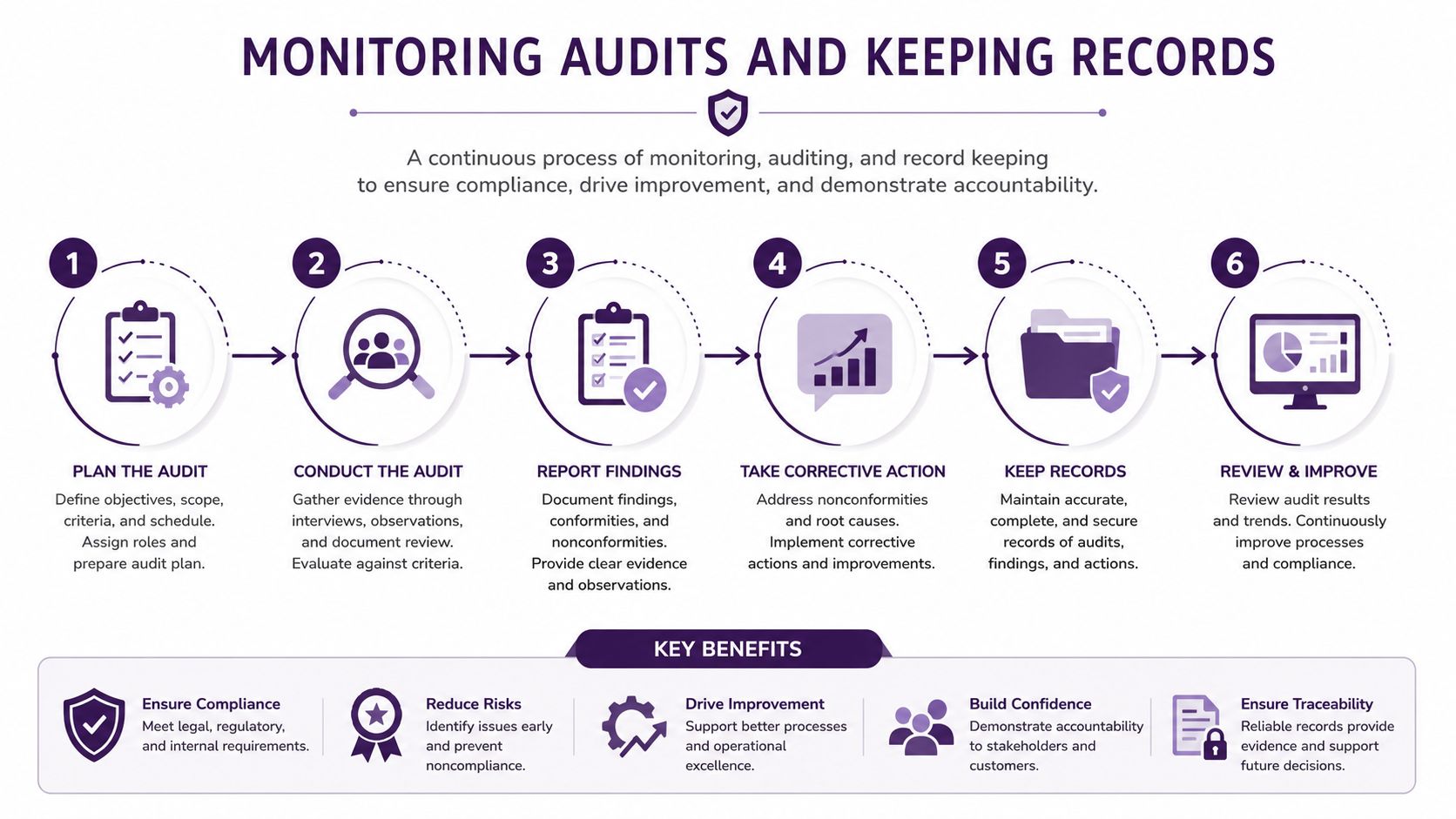
Use the four-phase cycle
A simple cycle works well in hospitality: Plan, Check, Measure, Act. According to this guide on health and safety audits, that means setting policy and assigning a competent person, checking documentation, measuring performance against legal requirements, and acting on findings by updating risk assessments. The same source notes that the HSA achieved a 92% conviction rate in prosecutions.
That should sharpen every operator's thinking. If an issue reaches prosecution stage, the odds are not in your favour.
What a mock audit should look like
A mock audit should feel like a real interruption, not a polite office exercise. Walk the venue as an inspector would. Ask for documents without warning. Check whether the version produced is current. Talk to staff, not only senior managers.
Review areas such as:
- Document control: Safety statement, risk assessments, HACCP records, cleaning schedules, allergen information, incident logs, training records.
- Physical standards: Housekeeping, exit routes, storage, chemical control, maintenance condition, signage, first aid access.
- Behavioural evidence: Can staff explain what to do, not just point to a file?
- Corrective action tracking: Are problems assigned, dated, and closed out?
If you need an example of how technical checks feed into safety records, your electrical installation report is a good example of the kind of maintenance evidence that should be easy to retrieve when a building safety question arises.
Records that actually matter
Keep the records that prove your system is alive. In hospitality, that usually means:
- Training logs: Dates, attendees, topics, and who delivered the session.
- Incident records: What happened, who was involved, immediate actions, investigation notes, and follow-up.
- Maintenance records: Planned maintenance, defects found, repairs completed, contractor visits.
- Food safety checks: Temperature logs, cleaning verification, delivery checks, allergen updates.
- Risk assessment reviews: Evidence that documents changed when operations changed.
If it isn't written down, most inspectors will treat it as if it didn't happen.
There's also a strong operational case for doing a periodic outside review. A fresh pair of eyes sees blind spots internal teams normalise. For operators who want help stress-testing their systems before an inspection, this overview of EHO audit support and compliance shows what an external audit support model typically involves.
The point of monitoring is not to catch people out. It's to stop small failures becoming official ones.
Your Ongoing Health and Safety Maintenance Schedule
The best compliance systems are built into routine. Not annual panic. Not pre-inspection clean-ups. Routine. When health and safety compliance becomes part of the weekly operating rhythm, it stops feeling heavy and starts feeling normal.
That means assigning tasks by frequency and owner. Daily work should stay simple. Weekly work should tighten standards. Monthly work should surface patterns. Annual work should reset the whole system.
Daily and weekly rhythm
Daily priorities should focus on live operational controls:
- Check critical safety points: Exits clear, floors safe, chemicals stored correctly, first aid supplies accessible.
- Complete food safety checks: Fridge and freezer records, delivery checks, cleaning sign-off, allergen information availability.
- Log incidents and near misses: On the day, while details are fresh.
- Spot-check staff practice: Not formal policing. Just active supervision.
Weekly work should be slightly broader:
- Hold a short team briefing: Pick one real issue from the past week and address it directly.
- Review open actions: Outstanding repairs, missing records, training gaps, recurring housekeeping failures.
- Walk the site with fresh eyes: Use a manager from another department if possible.
- Test readiness: Ask a staff member to show a key document or explain a core procedure.
Monthly and annual discipline
Monthly tasks are where management steps back and looks for patterns:
- Review incident trends: Are the same issues repeating in the same area or on the same shift?
- Audit paperwork quality: Not just whether forms exist, but whether they're complete and credible.
- Check higher-risk services: Fire systems, extraction, electrical items, plant, contractor work, and any specialist equipment.
- Revisit people risk: Stress points, conflict hotspots, staffing pressure, and supervision quality.
Annual work is more strategic:
- Review the full safety statement and risk assessments
- Refresh policy documents
- Update training plans by role
- Test whether your current systems still fit the business you're now running
For operators who want a broader operations checklist to complement this schedule, this restaurant compliance checklist for Ireland is a useful companion.
Health and safety compliance is never finished. That's the good news as much as the hard news. It doesn't depend on one perfect week. It depends on repeatable habits, honest reviews, and managers who fix problems while they're still small.
If you want an operational partner that understands the practicalities of Irish hospitality, Beacon Recruitment supports venues with practical systems across food safety, HR compliance, and wider operations. Their work is built for owners and managers who need more than advice. They need structure that holds up under inspection and during service.
Is Your Venue Ready for an Unannounced HSA or EHO Audit?
Stop relying on missing risk assessments and untrained supervisors—book a free consultation with Beacon to build an audit-proof safety system.