August 4, 2026
Hiring Your First International Worker Ireland Checklist
Use our hiring your first international worker Ireland checklist to navigate permits, LMNT, costs, & insurance for hospitality in 2026.
It's Friday afternoon, occupancy is strong, functions are booked, and your kitchen team is already stretched. You've advertised for a chef or senior kitchen hand locally, but the right candidate still hasn't appeared. At that point, hiring from abroad can feel like the obvious fix. It can also feel like walking into paperwork you haven't dealt with before.
For many hospitality managers, the primary pressure isn't just filling the role. It's avoiding the knock-on effect of being short-staffed for months. Service slows, supervisors work doubles, standards slip, and guest complaints start landing on your desk. That's why a solid hiring your first international worker Ireland checklist matters. It keeps the process organised before the staffing gap becomes an operational problem.
The practical challenge is timing. International hiring in Ireland isn't just about finding a candidate. It's about lining up advertising, permit steps, visa lead times, and onboarding so your new hire arrives when you need them. If your team will also be managing interviews across cultures, this short guide on Translate AI insights on global negotiations is a useful extra read for handling communication more clearly during interviews and offer discussions.
Introduction to Your First International Hire
Your first international hire usually starts with a straightforward business reality. You have a genuine vacancy, the role affects service delivery, and the local market hasn't solved it. In hospitality, that might mean a chef de partie role staying open too long, a specialist cuisine position proving difficult to fill, or a front-of-house leadership role needing experience you haven't found yet.
The mistake many employers make is treating the immigration process like a final admin step after recruitment. It isn't. The immigration pathway shapes your hiring timeline from day one. If you wait until you've chosen a candidate before planning the legal route, you can lose valuable weeks.
Operational truth: International hiring works best when recruitment and immigration admin run in parallel, not one after the other.
That's especially important in hotels, restaurants, and care-linked hospitality settings where rotas are built weeks ahead. If you know a role will become critical during a busy period, you need the legal process moving before the pressure peaks.
Keep this checklist mindset from the start:
- Define the exact vacancy: Write down the exact title, duties, salary, and why the role matters operationally.
- Check whether local recruitment has been exhausted: You'll need evidence that the role couldn't be filled locally for many permit routes.
- Build the timeline backwards: Start from the date you need the person on site, then work back through advertising, permit application, visa processing, travel, and induction.
- Assign one owner internally: In most businesses, delays happen because nobody owns the paperwork from start to finish.
Understanding LMNT and Permit Options
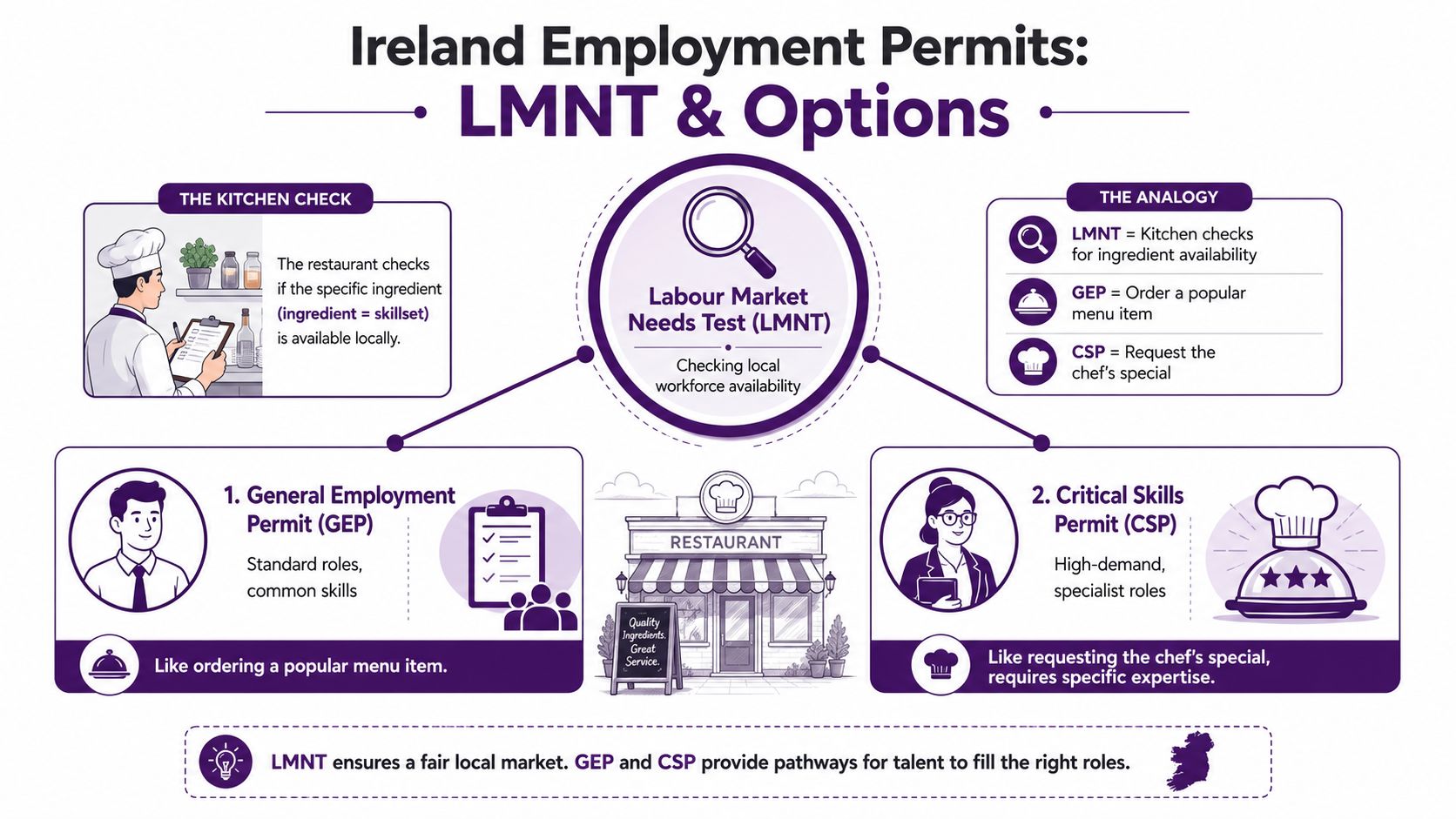
LMNT sits near the start of the process for many first-time international hires, but it affects the finish line too. For a General Employment Permit, the Labour Market Needs Test asks you to prove that you advertised the role properly and gave the local labour market a fair chance to fill it. If you run a hotel or restaurant, it helps to treat LMNT like opening a booking window before a peak weekend. The timing matters as much as the action itself.
Why LMNT exists
LMNT works like a documented local search. The State wants evidence that the role was first offered to candidates in Ireland and the wider EEA before a non-EEA worker is hired under a permit route that requires the test.
That is why the advertising stage carries so much weight. Your adverts are not only there to attract applicants. They become part of the proof behind the permit application.
A strong candidate does not fix a weak LMNT record. If the ad ran in the wrong place, for the wrong length of time, or with details that do not match the later permit application, the case can stall or fail.
The two main permit routes
For many employers, the first decision is whether the role fits a General Employment Permit or a Critical Skills Employment Permit.
- General Employment Permit: Often used for roles that do not fall under critical skills categories. This is the route many hospitality employers meet first, and LMNT is commonly part of that process.
- Critical Skills Employment Permit: Designed for roles the State treats as higher-skill or hard-to-fill. In the right case, it can involve fewer hurdles than a General Employment Permit.
For managers, the practical question is simple. Does this role sit in a permit category that requires LMNT, and does the salary and job description support that route? If the answer is unclear, fix that before advertising. The permit type, ad wording, salary, and contract all need to line up.
The timing mistake that creates staffing gaps
Many GMs lose time by treating LMNT as something to start after they have chosen their preferred candidate. That sequencing creates a quiet delay in the middle of the recruitment plan.
Here is the difference in practice:
Bad timeline
- Interview candidates first
- Choose your preferred overseas hire
- Start LMNT advertising after selection
- Wait for the ad period to finish
- Submit the permit application
- Fill rota gaps with overtime or agency cover
Good timeline
- Confirm the role details and likely permit route first
- Start LMNT advertising while sourcing and interviewing
- Shortlist candidates during the ad period
- Move to permit application as soon as LMNT evidence is ready
- Reduce the gap between offer, permit approval, visa steps, and arrival
That overlap is where operations improve. In hospitality, a delay of a few weeks can mean managers rewriting rotas, paying premium agency rates, or asking an already tired team to cover another busy stretch. Running LMNT during live recruitment shortens that dead space.
A simple example helps. If you know your senior kitchen role must be filled before the Christmas run, starting candidate interviews in September but leaving LMNT until October pushes the legal process back by weeks. Starting the ad process at the same time as sourcing gives you a better chance of having permit paperwork ready as soon as you choose the candidate.
The lesson is practical, not legalistic. Choose the permit route early. Match the advert to that route. Start LMNT on day one of recruitment if the role requires it. That is how you protect the rota, not just the application.
Setting Up Your Business Legally
Before you advertise anything, your business paperwork needs to be clean. The permit process doesn't only assess the role and candidate. It also checks whether the employer is a legitimate, active, compliant business.

Employers hiring non-EEA workers must submit proof of active trading, valid registration numbers, tax clearance, and evidence of monthly statutory returns within the last three months to validate legitimacy, as outlined by Oyster's overview of Ireland work visa requirements.
What to gather before you post the role
Treat this like a pre-opening checklist. If one piece is missing, everything behind it can stall.
- Registration details: Have the company's registration or licence details ready and make sure they match current business records.
- Tax position: Confirm tax clearance or compliance evidence is available and current.
- Trading evidence: Be ready to show the business is actively operating, not just registered on paper.
- Statutory returns: Pull evidence of monthly statutory returns from the last three months, or the accepted equivalent proof where relevant.
For operators who want to tighten their wider people processes before starting, this HR compliance checklist for Ireland employers is a sensible companion read.
Where hospitality businesses often get caught
One common issue is assuming the accountant or payroll provider has everything ready for permit purposes. They may have the records, but not in the form you need on short notice. Another is discovering too late that company details don't line up cleanly across Revenue, registration, and internal HR files.
A smaller independent venue can also trip over document ownership. The GM thinks finance has it. Finance thinks the external adviser has it. Nobody has the final pack ready when the permit application needs to move.
Manager's rule: Build a single digital folder for immigration documents before recruitment begins. Don't wait until you're trying to hit a submission deadline.
Why this legal prep matters operationally
Good legal prep shortens decision-making later. When you identify a strong overseas candidate, you want your business documents ready to go, not buried in old email threads. In a hotel or restaurant group, that can be the difference between moving decisively and losing momentum while the rota gets tighter.
Advertising for Your Labour Market Needs Test
This is the stage where timing discipline matters most. Unless exempt, roles must be advertised 28 days on JobsIreland or EURES, 3 days in a national newspaper, and 14 days on an Irish job board to satisfy the Labour Market Needs Test, according to Irish immigration guidance on coming to work in Ireland.
LMNT advertising channels and durations
ChannelDurationJobsIreland or EURES28 daysNational newspaper3 daysIrish online job board14 days
If you want a practical companion resource focused specifically on evidence and execution, this Labour Market Needs Test guide is useful.
How to run the ads without creating delays
Don't think of these three ads as separate admin tasks. Treat them as one coordinated campaign with one start plan, one evidence folder, and one named owner. The ad copy should be consistent across channels so the role description, title, and pay details don't create confusion later.
A good hospitality example is a chef role where the newspaper ad uses one title, the job board another, and the contract a third. That sort of mismatch creates questions nobody wants during permit review.
Use this simple approach:
- Set one launch date: Start the required channels in a coordinated way so you can track completion clearly.
- Save evidence immediately: Keep screenshots, booking confirmations, ad copies, and publication dates in one folder.
- Source candidates in parallel: While the ads are running, interview and assess potential international candidates rather than waiting for the ads to finish.
- Check exemption status carefully: Some roles may not need the same LMNT route, but don't assume that without confirming it against the permit category.
The smoothest international hires start candidate conversations while the advertising clock is already running.
Navigating Employment Permit Applications
A lot of first-time employers assume the hard part ends when the LMNT ads finish. In practice, this is the stage where small inconsistencies turn into staffing delays. For a hotel or restaurant GM, the permit application works like a service handover. If the booking details, rota, and room status do not match, the shift starts badly. The same applies here. Your ad, contract, salary, start date, and company details all need to match from the start.
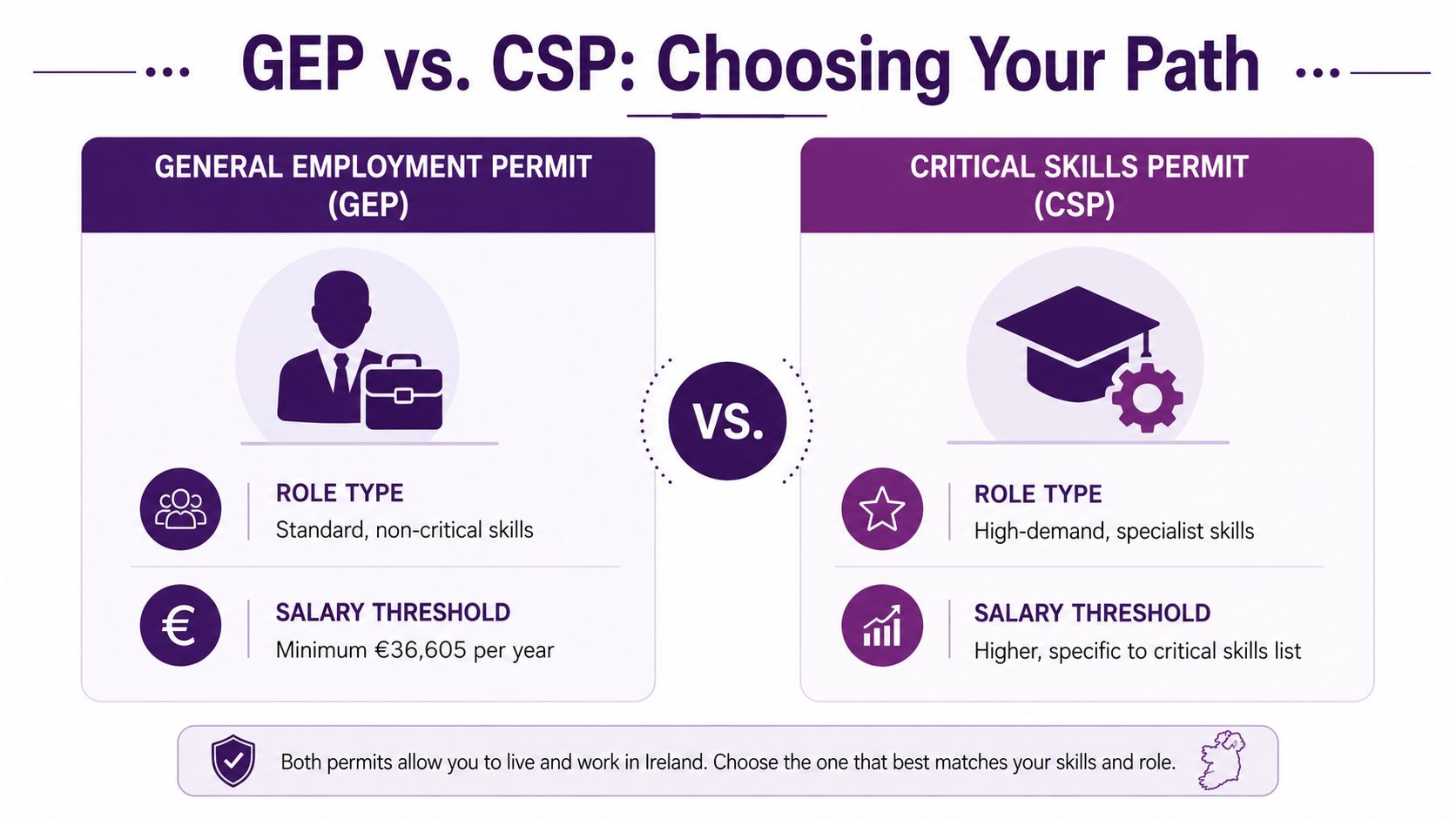
For a General Employment Permit, employers face a €1,000 application fee and must show that at least 50% of the workforce are EEA nationals, as set out in Recruitroo's employer checklist for a first international hire in Ireland. If the salary level, role type, or workforce ratio does not fit the permit route, the application can be refused.
Salary thresholds that decide your route
Salary is one of the first filters, not a detail to tidy up later. According to the Department of Enterprise employment permits FAQs 2024, a General Employment Permit requires a minimum annual salary of €36,605, while a Critical Skills Employment Permit requires a minimum annual salary of €40,904 for degree holders.
That point often causes confusion. Managers sometimes choose the candidate, agree a start date, and only then check whether the pay fits the permit. The safer order is the reverse. Confirm the permit category first, then issue the offer on the right terms.
The checks that prevent rework
A first permit application usually stalls for one of four reasons:
- Role mismatch: The job title or duties differ across the ad, contract, and application.
- Salary mismatch: The pay in the offer does not meet the threshold for the chosen permit.
- Workforce ratio issue: The business does not meet the EEA workforce requirement for a General Employment Permit.
- Timing drift: The application is submitted too close to the intended start date.
Timing deserves more attention than it usually gets. If your LMNT ads finish late, the permit submission moves late. If the permit submission moves late, visa timing and arrival planning move late as well. That is how a vacancy you expected to fill for high season can still be open when trade picks up.
A practical sequence for GMs and owners
Use the permit stage as a control point, not just an admin task.
- Match the role to the permit route. Check the job against GEP or Critical Skills rules before finalising the contract.
- Confirm the salary on the correct route. The number in the offer letter should already fit the permit category.
- Review your workforce ratio early. For GEP roles, check the 50/50 position before paying fees or promising dates.
- Build one submission pack. Gather employer records, candidate documents, and role documents together so details stay consistent.
- Set dates backwards from the target start date. Work back from the month you need the person on site, not from the day you happen to finish the paperwork.
- Clear payment approval before submission. Accounts delays can cost you days you do not have.
Practical rule: The permit application should tell one clear story. Same role, same salary, same dates, same employer details across every document.
Why operations teams should map permit timing early
The strongest first-time hiring plans line up LMNT advertising, permit submission, and expected visa timing on one timeline. That gives you a more realistic view of when the employee can start work.
In hospitality, that matters because labour gaps are operational, not theoretical. If your chef hire arrives six weeks later than planned, the pressure lands on your head chef, your rota, and your service standards. Early alignment reduces that risk. It also gives you time to adjust agency cover, onboarding dates, and opening schedules before the gap becomes expensive.
Planning Visa Processing and Onboarding
A hotel GM finally gets the permit approval email on Tuesday afternoon and assumes the staffing gap is solved. Friday's rota says otherwise. The employee may still need visa clearance, travel plans, and a realistic arrival date before they can stand on the floor, start in the kitchen, or join housekeeping.
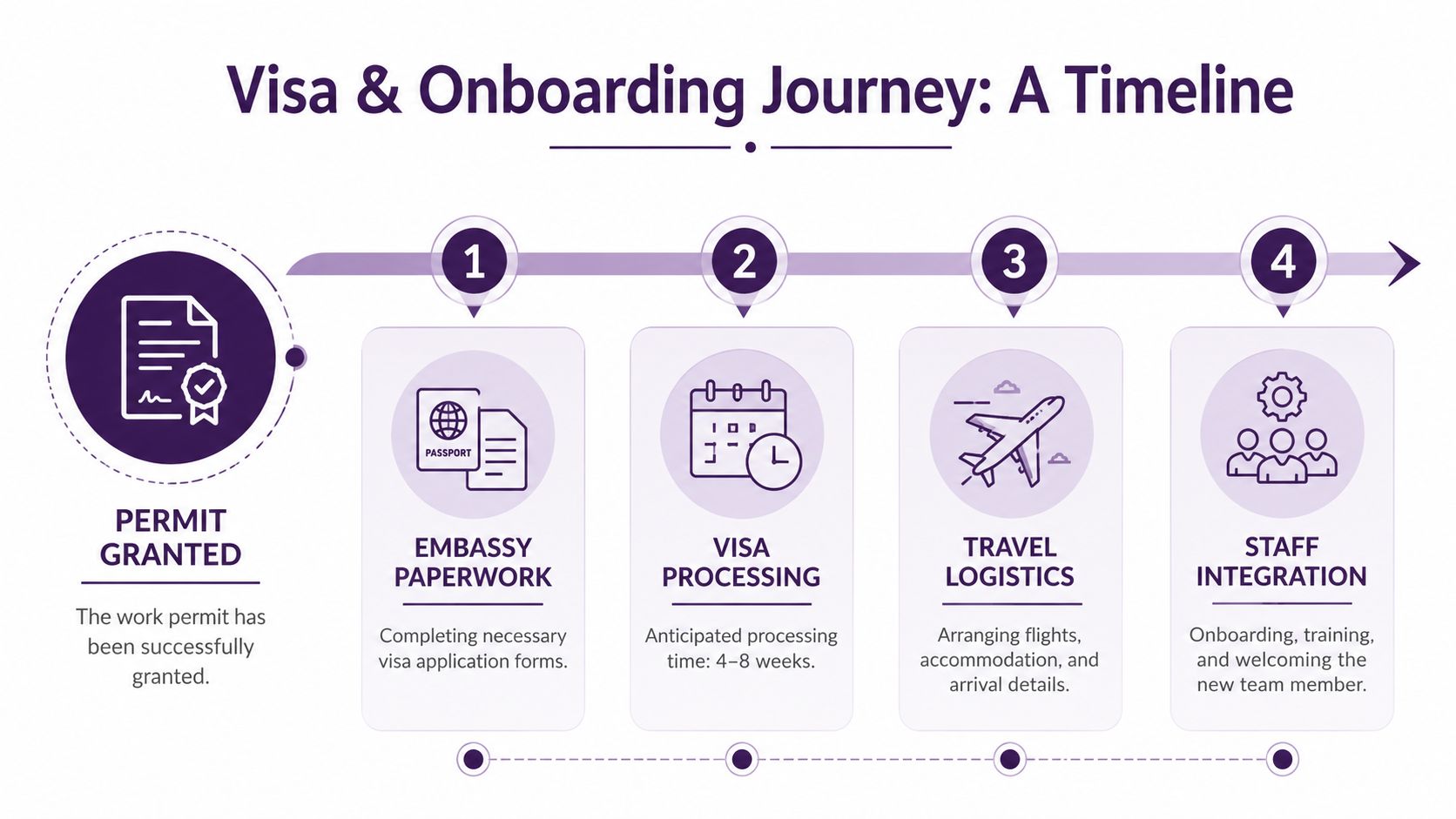
Permit approval is the midpoint of the process, not the point where labour pressure disappears. For hospitality employers, the practical question is simple: when will this person be ready to work, and what cover do we need until then?
That is why the timeline should be built as one chain, not three separate tasks. Your LMNT advertising dates affect when you can file. The permit stage affects when the visa stage can begin. The visa stage affects flights, accommodation, induction, and the first rota they can safely join. Employers who line these up early usually avoid the last-minute panic of paying agency rates for shifts they thought were already covered. For a broader overview of routes and practical employer considerations, see this skilled worker visa Ireland guide.
What needs planning after permit approval
The employee may need to complete visa or embassy steps before travel. That part can feel outside your control, but the operational side is not. You can still set dates, assign owners, and prepare the site so the person walks into a planned first week rather than a scramble.
Focus on four areas:
- Arrival date versus start date: Keep these separate. Someone who lands on Sunday may not be ready for a full shift on Monday if they still need local admin, rest, or orientation.
- Accommodation for the first period: Temporary housing buys breathing room. It helps the employee settle and reduces the risk of a delayed start caused by last-minute housing problems.
- Structured induction: Book the first days in advance. Include right-to-work checks, payroll setup, site tour, department training, food safety, and who they report to on each shift.
- Settling-in support: Simple guidance on transport, shops, banking, phone setup, and local routines helps the new hire become productive faster.
Build your rota with a buffer
Hospitality teams often make the same planning mistake. They count the role as filled once the permit is approved, then schedule the employee into a busy weekend before visa steps and travel are finished.
A better approach is to treat the employee's first workable shift as a later milestone than their permit approval date. That buffer works like holding a few spare rooms during a high-occupancy week. You hope not to need the slack, but it protects the operation when one part of the process runs late.
If the person arrives earlier than expected, you gain training time. If they arrive later, you have protected service, your supervisors are not firefighting the rota, and your existing team is less likely to burn out covering extra shifts.
Plan the first week like an opening-week schedule. Assign each handoff, from airport arrival to first supervised shift, before the employee travels.
Checklist for Your Immigration Broker
If you're using a broker, solicitor, or recruitment partner, don't assume “in progress” means everything is under control. Ask direct questions and ask them early.
Use this working checklist in calls or update emails:
- Advertising proof: Can you send me the saved evidence for each required ad placement and confirm the dates are correct?
- Permit route: Which permit route are we using, and why is that the correct legal fit for this role?
- Salary check: Has the offered salary been tested against the correct permit threshold?
- Workforce ratio: Have you checked whether our current workforce composition supports a General Employment Permit application?
- Employer documents: Do you have all active trading, registration, tax, and statutory return documents needed for submission?
- Application timing: What is the target submission date, and does it leave enough time before the planned start date?
- Fee status: Has the payment approval for the application fee been cleared internally?
- Candidate paperwork: Is the passport copy, CV, and any supporting candidate documentation complete and consistent with the application?
- Visa follow-up: Once the permit is approved, who owns the visa stage and how will progress be tracked?
- Arrival plan: Who is responsible for travel, accommodation, airport collection, and first-day induction?
A good broker should answer these clearly. If the answers are vague, the process probably is too.
Conclusion and Next Steps
Your first international hire in Ireland is manageable when you treat it like an operations project rather than a last-minute recruitment fix. The strongest results come from early preparation, clean documentation, and one joined-up timeline that links advertising, permit work, visa processing, and onboarding.
Start with the vacancy you need to fill. Get your business paperwork in order. Run the LMNT correctly where required. Match the role to the right permit and salary level. Then leave enough runway for visa processing and a calm arrival.
If you're building your own hiring your first international worker Ireland checklist, keep it simple:
- Gather employer documents first
- Schedule LMNT advertising early
- Prepare the permit application carefully
- Track visa progress actively
- Plan induction before travel is booked
A rushed international hire usually becomes an expensive staffing gap. A planned one gives your team breathing room and gives your new employee a fair start.
If you want hands-on support from a team that understands both international hiring and day-to-day hospitality operations, Beacon Recruitment is a strong place to start. They work with Irish hospitality businesses on international recruitment, HR compliance, food safety, and wider operational support, which is especially useful when your staffing challenge is only one part of a bigger operational picture.
Is Your First International Hire Legally Secure?
Don't let LMNT mistakes, wrong permit routes, or messy paperwork delay your critical hires—book a free consultation with Beacon to build an audit-proof hiring plan.