August 4, 2026
Independent Contractor vs. Employee in Irish Hospitality
Understand the difference between an independent contractor vs employee in Irish hospitality. Get clear guidelines for 2026 to ensure compliance and avoid

A busy Friday is coming, bookings are strong, and you need a seasoned chef for the summer push. Or you need a bar specialist to rebuild the drinks menu before wedding season starts. The quickest fix often looks obvious. Bring them in as a freelancer, agree a rate, skip the payroll admin, and get on with service.
That shortcut is where many hospitality businesses get exposed. In Ireland, calling someone a consultant, contractor, or freelancer doesn't settle anything. What matters is how the relationship works in real life. If the arrangement looks like employment, the label on the invoice won't save it.
The High-Stakes Decision in Irish Hospitality
Hospitality managers make classification decisions in the middle of operational pressure. A head chef resigns with little notice. A hotel needs an events specialist for peak season. A restaurant group wants a “freelance” social media lead but also expects weekly meetings, a company email, and day-to-day direction from management.
On paper, these engagements can look flexible. In practice, they often drift quickly into employee territory.

The problem is simple. Hospitality businesses don't run in neat legal boxes. People step in where needed. Managers adjust rotas at short notice. Owners want consistency, brand control, and accountability. Those are normal business pressures, but they also create the exact facts that can point towards employment rather than genuine self-employment.
Where managers get caught
A common pattern looks like this:
- Urgent hiring need: A venue needs cover fast and engages someone informally.
- Operational control increases: The person gets fixed shifts, reporting lines, and service standards just like the rest of the team.
- Admin stays informal: They still submit invoices, so everyone assumes the arrangement is safe.
- The legal risk builds: The reality of the role no longer matches the label.
In hospitality, the biggest classification mistakes usually don't start with bad intent. They start with speed.
There's another layer for Irish employers. Multi-lingual teams are common in hotels, kitchens, and front-of-house operations. If you're reviewing contracts, handbooks, or onboarding material for staff from different backgrounds, a plain-language guide to Ireland's official languages can help managers communicate more clearly and avoid confusion around workplace documentation.
Why this matters more than owners think
Misclassification isn't a paperwork issue. It affects payroll, PRSI, statutory rights, and exposure under employment law. In hospitality, where staffing models are often patched together around seasonality and margins, a loose arrangement can become an expensive one very fast.
The practical lesson is blunt. If someone works like part of your team, on your rota, under your control, using your systems, you should pause before treating them as an independent contractor.
Understanding the Two Fundamental Contract Types
Irish law starts with a basic split. An employee works under a contract of service. An independent contractor works under a contract for services. That distinction isn't legal trivia. It determines rights, taxes, and the employer's obligations.
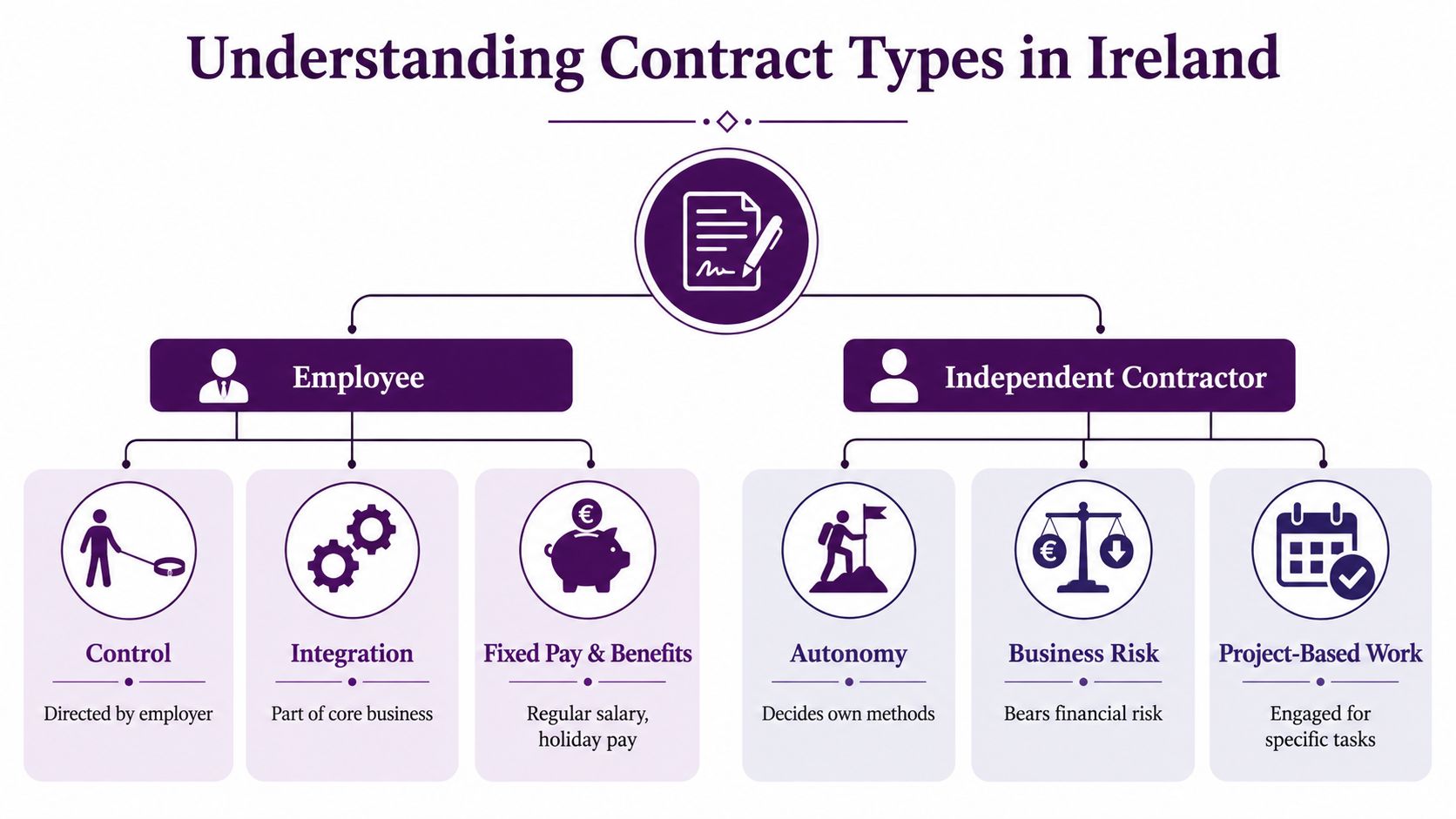
A useful external primer on contractor vs employee classification can help managers compare the broad concepts, but Irish hospitality operators need to apply the Irish legal framework carefully in day-to-day practice.
The early comparison managers need
IssueEmployeeIndependent contractorLegal relationshipContract of serviceContract for servicesBusiness setupWorks as part of employer's organisationOperates as a separate businessStatutory rightsEntitled to protections such as the national minimum wage, paid annual leave, statutory sick pay, and unfair dismissal protectionGenerally excluded from those employee statutory protectionsTax handlingEmployer deducts tax through PAYE, including Income Tax and USCContractor manages tax through Revenue self-assessmentPRSIClass A PRSI, with contributions tied to the employment relationshipClass S PRSI paid by the contractorBenefit positionBroader social welfare cover linked to employee statusMore limited benefit coverage
That summary reflects the legal distinction set out in Irish guidance on contractor and employee status in Ireland.
What a contract of service really means
A contract of service creates an employer-employee relationship. In practical hospitality terms, this usually means the business hires the person into its structure. It decides where they work, how they work, and often when they work. The role is part of the operation, not just a bought-in result.
That's why employment rights attach so strongly to this category. Once someone is an employee, the business isn't just paying for labour. It is taking on legal duties.
If you need a refresher on the paperwork side, a solid contract of employment guide is useful alongside the status analysis.
What a contract for services looks like in reality
A contract for services is different. The business is buying a service from a separate enterprise. The contractor remains responsible for their own tax affairs through self-assessment. They're also generally outside the bundle of statutory protections that apply to employees.
Working rule: If you're buying an outcome from someone's business, that leans towards contractor status. If you're plugging a person into your operation, that leans towards employment.
In hospitality, genuine contracts for services do exist. A menu consultant engaged for a defined project is one example. A specialist photographer hired for a hotel campaign is another. The mistake comes when businesses use contractor language for roles that function like ordinary jobs.
How Irish Law Determines Employment Status
The most important principle in the independent contractor vs employee question is this. Irish law looks at substance over form. A written contract matters, but it doesn't override facts on the ground.
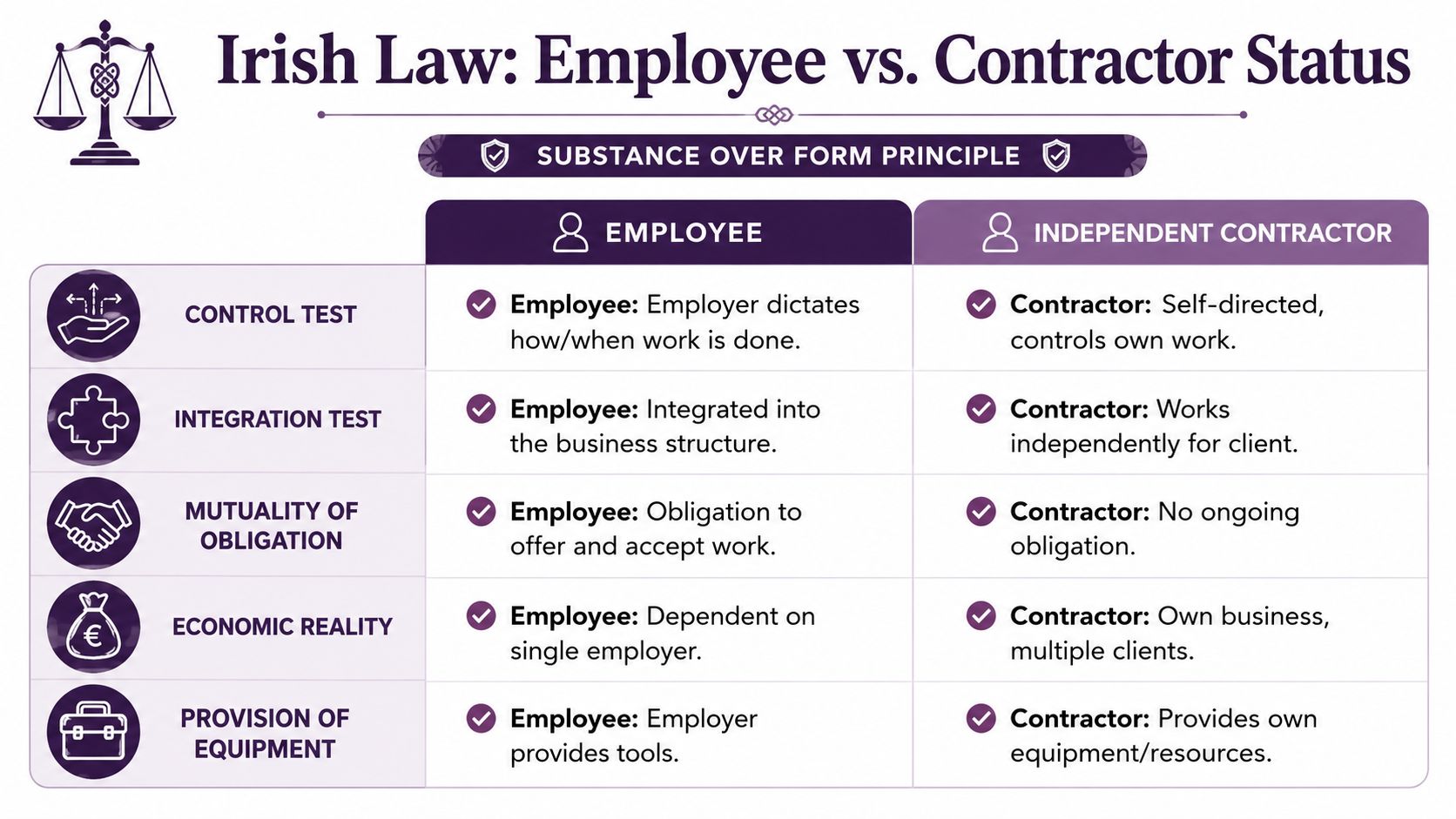
Irish courts and Revenue use a composite approach. The modern dominant consideration is whether the person is in business on their own account. The legal indicators set out in Irish analysis of employee versus contractor status include substitution rights, who provides equipment and materials, whether payment is for a fixed job or a wage, and whether the person can work for multiple businesses. The same guidance notes that Revenue updated its guidelines in May 2024 and warned organisations to review existing arrangements against the Code.
The question isn't what the contract calls the person. The question is how the work is actually done.
For hospitality employers managing teams and standards, it's also worth keeping an eye on broader classification thinking in other markets. UK-focused IR35 guidance for contractors isn't Irish law, but it can sharpen your understanding of how control and business independence are analysed in practice.
Control in daily operations
Control is often the first red flag in hotels and restaurants. If the business directs how, when, and where the work is done, that points towards employee status.
A contractor usually decides their own method. A business can set the deliverable and the standard expected, but it shouldn't be running the person as if they were on staff. In a kitchen, that difference can blur quickly. Telling a consultant chef the brief for a menu redesign is one thing. Slotting that person into line service on a fixed rota under the executive chef is another.
Substitution and the right to send someone else
One of the clearest indicators of genuine contractor status is substitution. The Irish guidance is unusually helpful here. An unconditional right to appoint a substitute is consistently inconsistent with a contract of employment.
That point matters because many hospitality businesses say someone is self-employed, but still insist that only that individual can perform the shifts. Once you remove any real substitution right, the arrangement starts looking much more like employment.
Equipment, materials, and financial risk
Who supplies the tools of the work still matters. A genuine contractor commonly provides their own equipment and materials. An employee typically supplies labour while the business provides the workplace tools.
In hospitality, this factor has limits because venues naturally provide the kitchen, bar, POS systems, reservation tools, and branded environment. That's why this test should never be used alone. But if the person brings no equipment, takes no pricing risk, and turns up for set hours, the employee argument gets stronger.
Payment structure and multiple clients
Payment for a fixed price job leans more naturally towards contractor status. A fixed wage or a regular hourly rate can point the other way, especially where the individual works mainly for one business and has little commercial independence.
A contractor can usually hire others or provide services to several clients at the same time. That's harder to square with a role where the venue expects exclusive availability, fixed attendance, and close supervision.
If you're reviewing your own management practices more broadly, this overview of employers' rights in Ireland is a helpful companion piece. It's easier to classify workers properly when managers understand the limits of control they should and shouldn't exercise.
The Critical Impact on Payroll Tax and PRSI
Legal theory turns into cash exposure.
If the worker is an employee, the business must operate PAYE and deduct tax at source. That includes Income Tax and USC, and employee status also brings Class A PRSI into the picture within the employment relationship, as outlined in the earlier Irish guidance on status and tax treatment.
If the worker is a genuine contractor, the business usually pays against invoice and the contractor handles tax through Revenue's self-assessment system. That sounds simpler, and sometimes it is. But it only works if the classification is right.
The financial difference in practice
Here's the trade-off for hospitality operators:
- Employee route: You carry payroll administration, statutory compliance, and employer obligations from the start.
- Contractor route: You reduce internal admin, but only if the person is operating on their own account.
- Misclassified route: You get the burden of both. Informal flexibility up front, then exposure later.
Grant Thornton Ireland's framework puts the focus on the factual matrix rather than the written contract, and links that analysis to the tax reality that contractors pay independently while employees are taxed through wages. It also highlights the importance of the enterprise test, asking whether the person can profit from their own enterprise or risk financial loss, as set out in Grant Thornton Ireland's employment status guidance.
Practical warning: If your “contractor” doesn't really run a business, payroll risk usually sits with you, not with them.
What works and what doesn't
What works is a clean distinction. If you need someone embedded in the operation, place them on the correct employment footing and run payroll properly. If you need a specialist service from an external operator, structure it as a genuine project or outsourced service.
What doesn't work is the middle ground hospitality owners often try to create. An invoiced worker on a rota. A “freelancer” managed through the same attendance rules as staff. A consultant who has no realistic chance of profit, no chance of loss, and no independent client base.
That grey zone is where compliance problems tend to live.
Hospitality Red Flags and Real-World Scenarios
The legal tests become much easier when you put them beside recognisable hospitality roles. Most misclassification problems aren't hidden. They show up in ordinary management habits.
Irish analysis of worker classification points to five recurring factors: mutuality of obligation, substitution, enterprise test, integration, and control. It also notes a practical distinction around substitution and the ability to reject non-compliant work from contractors, and identifies mutuality of obligation as the most defensible factor in many cases, as explained in this review of worker classification in Ireland.
Scenario one: the “freelance” kitchen porter
A hotel brings in a kitchen porter for the season. They wear the venue uniform, use hotel equipment, follow the head chef's instructions, and work a fixed rota every week.
This arrangement raises immediate concerns:
- Control: Management decides the shifts and directs the work.
- Integration: The person is part of the kitchen operation.
- Mutuality of obligation: The hotel expects them to turn up for work offered, and the work is treated as part of the staffing plan.
That doesn't look like an external business supplying a service. It looks like employment.
Scenario two: the consultant marketing manager
A restaurant group hires a “consultant” to improve trade. The person gets a company email address, attends management meetings, reports weekly to the owner, and is expected to be available on set days.
This one often catches owners by surprise. Marketing can feel project-based, but the facts matter. If the person is closely integrated, managed internally, and not free to structure the work as an outside business, the contractor label becomes weak.
If someone looks like part of your management team to everyone inside the business, that usually tells you something important about status.
Scenario three: the events DJ on an hourly rate
A wedding venue engages the same DJ regularly. The venue pays an hourly rate, requires personal attendance, and won't allow any substitute. The venue also expects availability for a series of recurring dates.
This creates pressure on several fronts. The lack of an unconditional substitute points away from contractor status. The hourly pay model and repeat dependence also weaken the argument that the DJ is delivering an independent service.
A simple red-flag filter for managers
Watch closely when any so-called contractor is:
- On your rota: Fixed weekly scheduling is often a sign of employment.
- Using your identity: Company email, name badge, and internal reporting line suggest integration.
- Limited to your business: If they can't work freely elsewhere, independence becomes harder to prove.
- Paid for time, not result: Hourly or weekly pay often fits labour supply more than an outside business service.
The strongest contractor relationships in hospitality are usually narrow, specialist, and outcome-based. The weakest are the ones that fill ordinary staffing gaps under another name.
A Practical Classification Checklist for Managers
Managers need a quick first-pass filter before a contract is drafted or a shift is offered. This won't replace legal advice, but it will catch the arrangements most likely to go wrong.
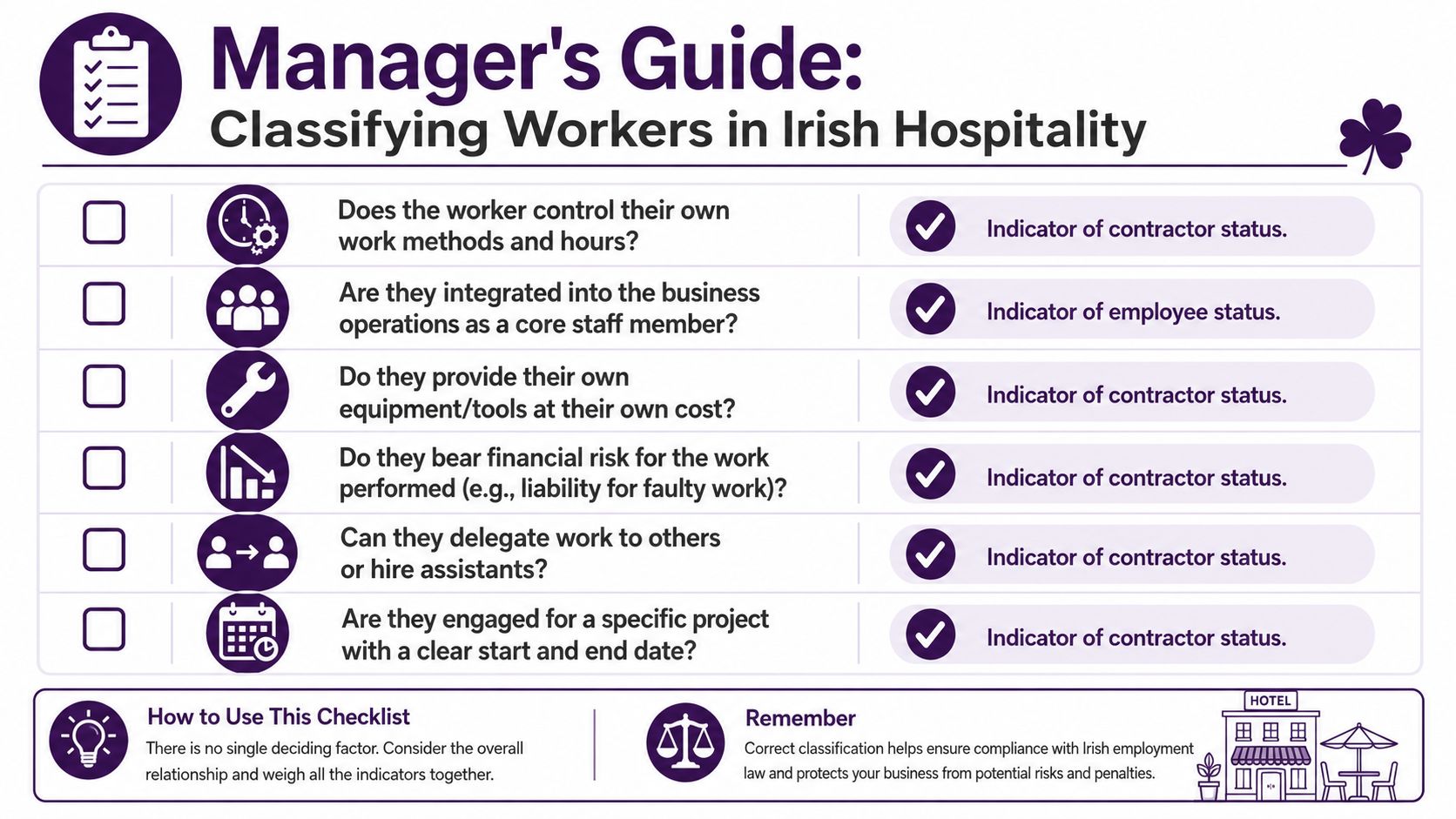
Ask these questions before engagement
- Who controls the work? If you decide the person's hours, methods, reporting line, and day-to-day tasks, the arrangement leans towards employee status.
- What exactly are you buying? A defined project with a start and end point is easier to defend as contractor work than open-ended labour.
- Can they send a substitute? If the answer is no, or only with your tight approval for practical reasons, be careful.
- Do they provide anything beyond labour? Specialist tools, materials, assistants, or a wider service package can support contractor status.
- Do they carry business risk? A contractor should have some exposure to profit or loss from how the work is organised.
- Are they integrated into the venue? Uniforms, internal email, management meetings, and inclusion in the rota all push towards employment.
- Can they work for others? A genuine independent contractor usually remains free to serve multiple clients.
- How are they paid? A fee for a completed job is easier to defend than payment for attendance by the hour.
When the checklist points both ways
Some hospitality roles are mixed. A specialist chef may be engaged to redesign menus, train the team, and review supplier quality for a limited period. That can lean contractor if the brief is defined and the person operates independently. The same individual can drift into employee territory the moment they start covering service every weekend under management direction.
A written contract should confirm the reality. It shouldn't try to disguise it.
If you want a broader management tool for people-risk reviews, this HR compliance checklist for Ireland employers is a useful operational reference.
Take Control of Your Compliance with Expert Guidance
The independent contractor vs employee decision often gets treated as an admin choice. In reality, it's an operational risk decision with payroll, employment law, and management consequences attached.
That's why guesswork is dangerous. In Ireland, calling someone an independent contractor has no legal force on its own. Status is decided by a substance over form analysis that looks at the reality of the relationship through factors such as mutuality of obligation, substitution, enterprise, integration, and control, as outlined in this Irish review of employment status.
What careful operators do now
Strong operators don't wait for a complaint or inspection. They review the people already working under informal labels. They check who is on invoices but managed like staff. They look at rotas, reporting lines, equipment, and whether the person really has an independent business.
That audit matters in hospitality because arrangements evolve fast. A genuine short-term specialist can become part of the permanent operation without anyone formally noticing the legal shift.
Where outside help adds value
The hard part isn't finding the legal buzzwords. It's applying them properly to a live venue where business needs change weekly. Owners and GMs usually need practical help with three things:
- Status reviews: Looking at real working arrangements, not just contract wording.
- Contract drafting: Matching documentation to the actual model being used.
- Manager discipline: Training line managers not to treat contractors like employees if the business wants the contractor model to hold.
The safest approach is proactive. Review your current freelancers, consultants, and seasonal specialists now. If they're really part of the team, correct the setup before the issue corrects itself at the worst possible time.
If you want a confidential review of your current worker arrangements, Beacon Recruitment can help. Their HR & Compliance team works with Irish hospitality operators to audit existing contractor relationships, tighten contracts, and build practical systems that stand up to real-world scrutiny, so owners and managers can focus on service instead of employment risk.
Stop Managing Informal Contractor Arrangements
Let our experts clean up your contractor agreements and employee contracts so you can hire specialist help without the compliance headache.