August 4, 2026
Ireland Work Permit Processing Time 2026: Get Your Visa
Understand Ireland work permit processing time 2026. Get insights into application timelines, required documents, & tips for a smooth, quick visa process.

A lot of hospitality operators are in the same spot right now. Summer planning is on one screen, rota gaps are on another, and someone has just told you a chef you expected in a few weeks may not be legally on site for months. The spreadsheets all look busy, but none of them answer the one question that matters: when can this person start?
That's the trap with Ireland work permit processing time 2026. Most operators look at permit timelines in isolation. Real staffing pressure shows up earlier. It shows up in missed opening dates, agency overspend, tired supervisors covering shifts, and guest experience slipping because the kitchen or floor team never reached planned headcount.
For hospitality, permit timing isn't just an immigration issue. It's an operations analytics issue. If you don't track the full journey from vacancy to productive first shift, you're not planning staffing. You're guessing.
Why Reporting and Analytics Matter
A hotel general manager in this situation usually has four versions of the truth. HR has a hiring tracker. Finance has labour cost sheets. Operations has rota risk by department. The external recruiter has a permit update by candidate. None of them line up neatly, so every leadership meeting becomes a debate about whose spreadsheet is current.
That's where reporting discipline matters. Not glossy dashboards for the sake of it. A single operational view that shows vacancy status, permit stage, visa stage, target start date, contingency cover, and revenue impact by department.
The biggest mistake I see is treating the permit decision as the whole timeline. It isn't. The critical oversight in most coverage of Ireland work permit processing time 2026 is failing to separate permit processing from the total operational lead time, including the 28-day Labour Market Needs Test and the 6-to-8-week visa adjudication lag for visa-required candidates, as outlined by Recruitroo's Ireland permit timeline analysis.
What the manager actually needs to see
A useful hospitality reporting pack answers questions like these:
- Which roles are revenue-critical: Head chef, sous chef, duty manager, accommodation supervisor, bar lead.
- Which vacancies are legally blocked: Candidates waiting on LMNT completion, EPOS submission, permit issuance, or embassy visa outcome.
- Where temporary cover is costing you: Overtime, split shifts, reduced opening hours, menu simplification, or delayed room inventory release.
- Which promised start dates are fantasy: Any date not built from the full compliance path.
Practical rule: If your staffing report doesn't include pre-submission delays, it's not a staffing report. It's a permit log.
Many operators already understand sales reporting but haven't applied the same discipline to workforce planning. If you want a simple primer on how structured reporting turns noisy data into decision-ready insight, Oviond's guide on what is marketing reporting is useful because the same reporting logic applies here. Define the question, standardise the inputs, then automate visibility.
Why this matters on the floor
When permit timing is tracked properly, managers stop making avoidable commitments. They stop promising opening dates around people who can't legally start. They stop over-ordering uniforms and accommodation. They stop building rotas around names instead of confirmed arrivals.
That's the practical value of analytics in hospitality. It protects revenue, compliance, and guest experience at the same time.
Defining Objectives and Essential KPIs
Good staffing analytics starts with a blunt question. What are you trying to control? In hospitality, the answer usually isn't “immigration efficiency” on its own. It's faster onboarding, fewer rota shocks, steadier labour cost, and less service disruption.
For General Employment Permit hiring in hospitality, the baseline has to reflect reality. In 2026, a GEP route requires a 28-day Labour Market Needs Test on Jobs Ireland and EURES, creating a 4–6 week lead time before DETE begins processing, and that leads to a total 3–4 month timeline for non-visa candidates, according to VisaJobs' hospitality-specific permit guide.

Start with business objectives, not data fields
If your venue goal is “fill kitchen vacancies”, that's too loose. A better objective is: reduce the delay between offer acceptance and productive first shift, while keeping the permit file compliant and labour cost predictable.
That gives you KPIs with operational meaning.
- Permit-to-start lead time: The metric that matters most for workforce planning.
- Vacancy days by department: Shows where delay creates service pressure.
- Offer acceptance to document-complete status: Finds admin drag before formal submission.
- Rota gap exposure: Flags the shifts still uncovered while a hire is in process.
- Agency or overtime dependency by vacancy: Ties permit delays to direct operating pain.
- Candidate dropout by process stage: Shows whether silence, delay, or confusion is costing you hires.
Pick KPIs that force action
Not every metric deserves dashboard space. Use a short scorecard that prompts a management response.
A practical approach is:
- One timing KPI for the end-to-end hiring path.
- One compliance KPI for file readiness and submission quality.
- One labour KPI showing the staffing cost of delay.
- One service KPI showing operational impact by outlet or department.
That's also where risk thinking helps. Security and compliance teams often use threshold-based indicators to escalate issues before they become incidents. The same logic works for hospitality staffing. AuditReady's piece on risk indicator guidance for security leaders is a helpful model for setting trigger points, owners, and response rules around permit bottlenecks.
A simple KPI stack for hospitality
Use different KPIs for different audiences.
- GM view: Vacancy risk, start-date confidence, labour cost exposure.
- HR view: document readiness, LMNT completion, submission backlog.
- Operations view: rota pressure, training slot planning, outlet readiness.
- Finance view: temporary cover cost versus planned payroll.
For teams comparing permit pathways and role fit, this overview of the Skilled Worker Visa Ireland process is a useful companion because it helps frame the staffing decision before you lock your KPI targets.
Track fewer numbers, but make each one expensive to ignore.
Mapping Data Sources and Infrastructure
Most hospitality teams don't have a data problem. They have a fragmentation problem. Key staffing information sits across payroll, ATS notes, email threads, shared drives, permit forms, and rota tools. That's why the same candidate can appear as “starting soon” in one file and “awaiting documents” in another.
The infrastructure doesn't need to be exotic. It does need to be mapped. Start with a data inventory and force every source into one of three buckets: operational, compliance, or financial.

The minimum source map
For hospitality permit tracking, I'd map these sources first:
- ATS or recruitment tracker: Candidate stage, role, site, recruiter notes.
- HR folder or document repository: Passport copies, contracts, qualifications, signed forms.
- EPOS 2.0 workflow data: Submission date, application status, queries, decisions.
- LMNT evidence archive: Ad dates, screenshots, channel record, completion proof.
- Rota system: Unfilled shifts, overtime cover, role pressure by week.
- Payroll or finance system: Agency spend, overtime, salary alignment, cost centre exposure.
The key mechanical rule in 2026 is easy to miss. Ireland launched EPOS version 2.0, and employers must advertise for 28 continuous days on Jobs Ireland, EURES, and national media before DETE processing begins, as set out in this EPOS 2.0 and LMNT overview. If that evidence chain is weak, your dashboard may look tidy while the application is going nowhere.
Build the pipeline around decision points
Don't just ingest data. Map the moments when leadership needs to decide something.
A useful structure is:
- Decision point one: Can we proceed with international hiring for this role?
- Decision point two: Is LMNT running correctly and completely?
- Decision point three: Is the file submission-ready?
- Decision point four: Do we need temporary cover because the projected start date has slipped?
- Decision point five: Is onboarding infrastructure ready once approval lands?
That structure changes the data model. You stop collecting “interesting updates” and start collecting fields that affect action.
Reliability beats sophistication
A shared Google Sheet updated daily is better than an elegant BI build nobody trusts. If you do automate, keep ownership clear. One person should own the candidate master record. Another should own compliance evidence. Finance should not be editing immigration status. Operations should not be rewriting salary fields.
If your broader workforce planning also has exposure to residency admin delays after arrival, this update on IRP renewal delays in Ireland and what employers need to know is worth factoring into the same operating view.
A permit dashboard fails when nobody can answer which field is authoritative.
Designing Dashboards and Visualisations
A useful dashboard for Ireland work permit processing time 2026 should help a hotel GM decide whether to open more rooms, keep a reduced menu, approve overtime, or delay a launch. If it can't support one of those choices, it belongs in an archive, not on the front page.
The visual design should start with hierarchy. Put the staffing risk at the top, not the admin detail. Executives need the answer first. Coordinators can drill down later.

What belongs on page one
Use a first screen with five objects only:
- Open roles by venue or department
- Projected start dates by candidate
- Applications at risk or stalled
- Temporary cover cost pressure
- Upcoming service exposure
That gives you a management view. Underneath that, add drilldowns by role, nationality requirement, permit type, and site.
For permit timing itself, benchmark cards matter. In 2026, Critical Skills Employment Permits are processing in 3–5 weeks while standard General Employment Permits average 5–6 weeks, based on VisaJobs' July 2026 processing benchmark update. That's exactly why real-time alerting belongs in the dashboard. If your assumptions are old, every staffing projection built on them is wrong.
Match chart type to the decision
I'd use these patterns:
- Timeline bars: Best for each candidate's stage path from offer to start.
- Heatmaps: Best for rota pressure by department and week.
- Exception lists: Best for missing documents, salary mismatch, or stalled actions.
- Trend lines: Best for seeing whether permit cycle time is shortening or drifting.
- Traffic-light cards: Best for start-date confidence, but only if the rules are explicit.
Avoid pie charts. They look neat and answer almost nothing in this context.
Filters that hospitality teams actually use
Many dashboards die because the filters reflect system architecture, not operator behaviour. Managers think in these slices:
- site
- role
- urgency
- permit type
- candidate readiness
- start month
Build those first. Leave technical filters for the second layer.
If a dashboard needs explanation every time you open it, the design is doing too much and saying too little.
One more point. Colour has to carry meaning consistently. If amber means “awaiting embassy action” on one page, it can't mean “contract not signed” on another. Standardised visual language matters more than decorative polish.
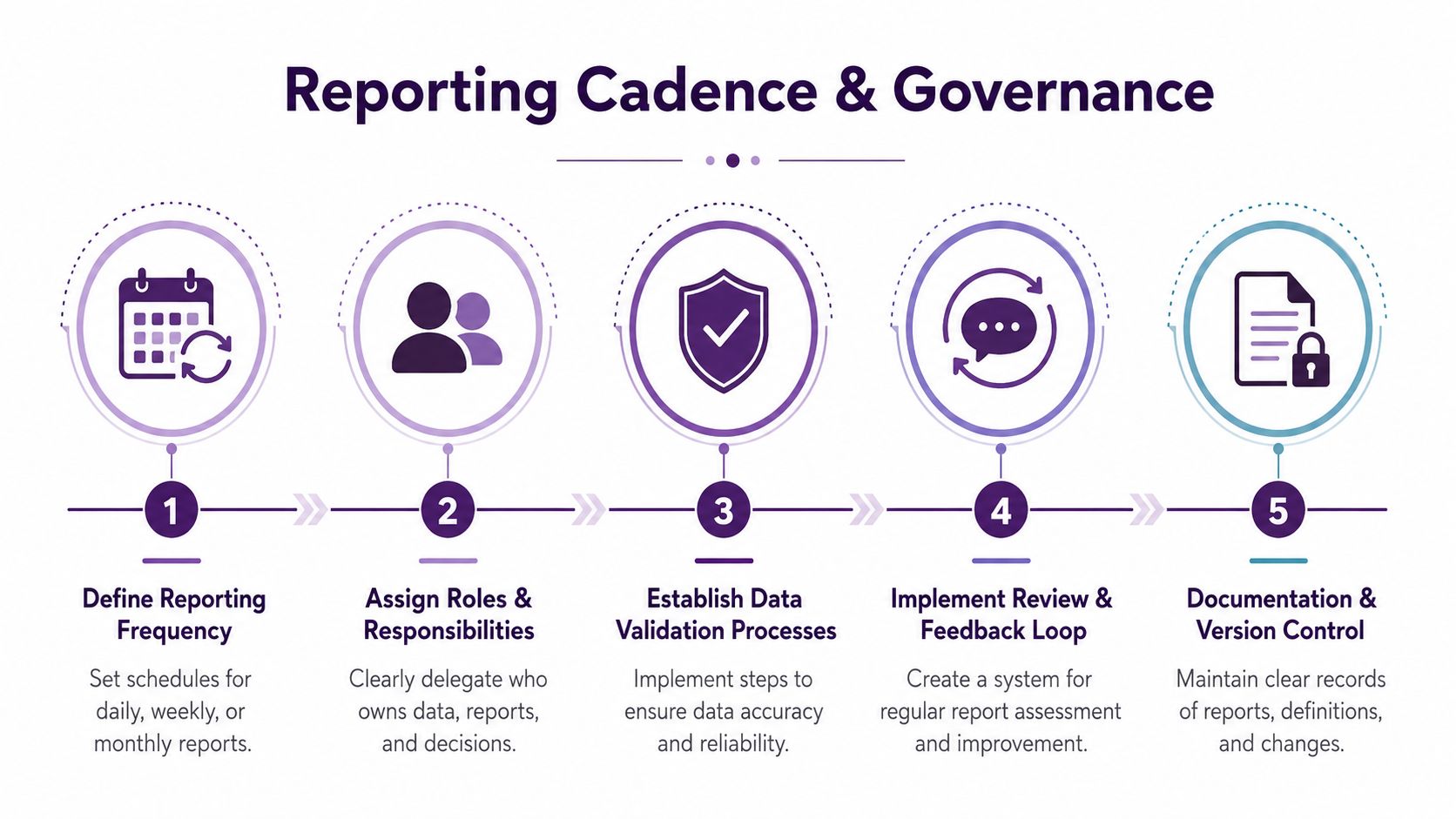
Setting Reporting Cadence and Governance
Most permit reporting problems don't come from missing software. They come from weak cadence and vague ownership. A report exists, but nobody knows who updated it, when it was validated, or whether the salary on the contract still matches the permit requirement.
That gets dangerous quickly in 2026 because salary thresholds changed. Effective 1 March 2026, the minimum annual remuneration threshold for General Employment Permits increased to €36,605 and for Critical Skills permits to €68,911, according to VisaHQ's summary of the March 2026 threshold changes. Governance rules should flag mismatches before submission, not after refusal.
A cadence that fits hospitality reality
Hospitality doesn't run on monthly reporting alone. Permit analytics should follow the operating rhythm of the venue.
A practical cadence looks like this:
- Daily check-in: Exceptions only. Missing documents, expiring tasks, candidate movement, urgent rota exposure.
- Weekly operating review: Open roles, projected starts, delayed files, cover costs, outlet risk.
- Monthly leadership pack: Trend view, structural bottlenecks, supplier or recruiter performance, compliance quality.
Daily reports should be short. Weekly reports should drive action. Monthly reports should change process.
Governance rules worth documenting
You don't need a thick policy manual. You do need a few rules nobody can improvise around.
- Single source ownership: One named owner for each core field.
- Definition control: “Submission-ready” must mean the same thing every time.
- Version discipline: Shared drives with final_v2_final are not governance.
- Salary validation: Contract, application, and internal approval must match.
- Evidence retention: LMNT and supporting documents should be stored where audit retrieval is easy.
Roles and escalation
One of the cleanest models is a three-layer ownership structure:
- Coordinator owns data entry and document completeness
- Manager owns validation and timeline confidence
- Leadership owns operational response when delays affect service
That separation matters. The person updating a field shouldn't also be the only person deciding whether a risk is acceptable.
Good governance makes a staffing forecast boring. That's the point.
When reporting cadence and governance are sound, meetings get shorter. People stop debating whether the data is accurate and start deciding what to do about it.
Quick Wins and Consulting Support
You don't need a major transformation to improve permit visibility this quarter. Most venues can get value from three fast fixes.
First, create a candidate stage tracker with mandatory fields only. Role, site, permit route, current stage, next action, owner, expected start, and operational fallback. If a field doesn't change a decision, leave it out.
Second, add an exception view. Don't bury risk in rows of green statuses. Surface the files with missing documents, inconsistent salary details, weak LMNT evidence, or uncertain start dates.
Third, tie the hiring tracker to the rota. Once managers can see which missing person affects which service period, permit data stops feeling administrative and starts driving real labour decisions.
For operators dealing specifically with kitchens, floor teams, and seasonal pressure, this guide to hospitality employment permits in Ireland 2026 is a practical reference point.
External support makes sense when your team is spending too much time reconciling data, not enough time acting on it. That support can be as light as dashboard setup and governance rules, or as involved as redesigning the full staffing and compliance workflow. The right benchmark is simple: if permit reporting still depends on one person's inbox, you've outgrown the current setup.
Conclusion and Next Steps
The operators who handle Ireland work permit processing time 2026 best aren't the ones with the most spreadsheets. They're the ones who turn permit data into staffing decisions early enough to matter.
Start by tightening the basics. Define a small KPI set. Map the source systems. Decide which record is authoritative. Build one dashboard for management decisions and one working view for coordinators. Then lock in cadence, ownership, and validation rules.
A sensible rollout over the next few weeks looks like this:
- Weeks 1 to 2: define KPIs, owners, and field definitions
- Weeks 3 to 5: map data sources and clean the candidate master tracker
- Weeks 6 to 8: build dashboard views and exception alerts
- Weeks 9 to 12: formalise governance, review quality, and adjust based on live use
The key shift is mental. Don't treat permit timing as an isolated compliance update. Treat it as part of your operating model. Once you do that, hiring plans become more realistic, labour decisions get sharper, and service risk stops arriving as a surprise.
If your venue needs help turning permit tracking, HR compliance, and hospitality operations into one workable system, Beacon Recruitment can help. Their team supports Irish hospitality operators with international recruitment, compliance-led process design, and broader operational consulting that makes staffing decisions easier to manage in actual operations.
Is Poor Permit Tracking Costing You Service Shifts?
Stop guessing on work permit start dates and let Beacon build a compliant, data-driven hiring tracker for your venue.