July 21, 2026
Level 2 HACCP: Your Guide to EHO & WRC Audit-Proofing
Pass your next EHO audit with confidence. This guide explains Level 2 HACCP for Irish hospitality, who needs it, and how it ensures compliance with FSAI & WRC.

It's 11 a.m., lunch prep is half-finished, a commis chef is asking about allergen labelling, reception is chasing you for a last-minute group booking, and someone from front of house has called in sick. Then the message lands.
The EHO is here.
If you run a hotel, restaurant, café, or catering operation in Ireland, you already know what happens next. Everyone suddenly starts looking for records nobody checked yesterday. The temperature sheet has gaps. A supervisor says the HACCP folder is “in the office somewhere”. A new hire says they did food safety training before, but nobody can produce proof. That's how good businesses fail inspections.
Most audit problems aren't caused by one dramatic food safety disaster. They're caused by ordinary sloppiness, weak systems, and managers who thought a generic certificate was enough. It usually isn't. Level 2 HACCP is where basic awareness turns into operational control, and if your key people don't have it, you're running on luck.
The Knock at the Door Every Manager Dreads
A manager in Ireland rarely gets caught out because they've never heard of HACCP. They get caught out because they treated it like paperwork instead of a live operating system.
The scene is always familiar. The kitchen is busy. Deliveries are stacked in the wrong area. Someone says the probe thermometer was working yesterday. The chef on duty knows how service runs, but can't clearly explain the venue's critical control points. Then the inspector starts asking for evidence, not intentions.

Why the panic starts before the questions do
An unannounced EHO visit exposes the gap between what management thinks is happening and what staff are doing. If your team only knows the basics, they can follow instructions when watched. They can't defend the system when challenged.
That's the core value of Level 2 HACCP. It gives the people on the floor and in the kitchen enough understanding to explain hazards, controls, limits, monitoring, and corrective action without guessing. It turns “we usually do it this way” into “this is our control, this is our record, and this is what we do when it goes wrong.”
A venue doesn't fail an audit because the inspector is difficult. It fails because the operation can't prove control under pressure.
The difference between stress and readiness
Managers who pass audits consistently do a few things differently:
- They train the right people: Not just junior food handlers, but supervisors, chefs, duty managers, and anyone expected to monitor standards.
- They keep records usable: Not buried in a drawer, not half-completed, not written up after the fact.
- They rehearse the system: Staff know where records are, what the CCPs are, and what answer to give when an inspector asks “show me”.
- They treat food safety as a management job: Not a side task dumped on whoever is least busy.
If your current system depends on one person “who knows where everything is”, you don't have a system. You have a liability.
What Is Level 2 HACCP Actually
Too many operators think all HACCP training is the same. It isn't.
Level 1 HACCP is the rules of the road. Wash hands. Avoid cross-contamination. Keep food at safe temperatures. That's necessary for everyone handling food.
Level 2 HACCP is maintaining the car and managing the route. It teaches people how the safety system is built, where it fails, and how to control it properly. In Ireland, that matters because the HACCP framework is legally mandated under EU Regulation (EC) No 852/2004 and enforced by the FSAI, requiring all food businesses to implement a plan based on seven specific principles. FSAI requirements also mean HACCP records must be kept for a minimum of two years and be immediately available for EHO audits, as outlined in the HACCP principles and application guidelines.

The seven principles in plain English
Here's what Level 2 HACCP teaches your team to do:
- Hazard analysis
Identify what could make food unsafe. That includes biological, chemical, and physical hazards. - Critical control points
Decide where control is essential. Cooking, chilling, reheating, and storage are common examples. - Critical limits
Set clear boundaries that must be met. If the limit isn't met, the food or process isn't safe. - Monitoring
Check the control point properly and consistently. Not occasionally. Not when someone remembers. - Corrective actions
Define what staff must do when something goes wrong. Guesswork is not a corrective action. - Verification
Review whether the whole system works in practice. - Documentation and records
Keep proof. No records means no defence.
Why Level 2 matters more than a generic food safety talk
A proper Level 2 course teaches supervisory thinking. Staff stop seeing food safety as a list of chores and start seeing cause and effect. If the fridge rises above the safe range, what product is affected, who isolates it, what record gets updated, and who signs off the correction?
That's the difference between a compliant kitchen and a kitchen that hopes nobody asks questions.
For managers tightening standards across the operation, it also helps to look beyond the training certificate itself and review practical guidance on complying with food safety regulations in day-to-day service environments. If your HACCP plan itself needs work first, this guide on what a HACCP plan is and why every Irish food business needs one is worth reading before you send anyone on a course.
What You Will Learn in a Level 2 Course
A real Level 2 HACCP course doesn't stop at “keep hot food hot and cold food cold”. If that's all your team learned, they haven't been trained properly.
In Ireland, a Level 2 qualification requires competency across all seven principles, and 68% of non-compliant EHO inspections in the Irish hospitality sector stem from inadequate hazard evaluation. The pass benchmark is also specific. Candidates must answer at least 9 out of 15 questions correctly to pass. That standard exists for a reason. Managers who can't think through hazards logically can't run a defensible food safety system.
Hazard analysis is where most weak operators collapse
Most failed sites don't struggle because they've never heard the term CCP. They struggle because they do poor hazard analysis at the start.
A Level 2 course teaches staff to break the food journey into stages and ask hard questions:
- Delivery stage: What arrives chilled, frozen, damaged, or incorrectly labelled?
- Storage stage: What can be contaminated, time-abused, or mixed with allergens?
- Preparation stage: Where can staff, tools, or surfaces transfer risk?
- Service stage: What sits too long, gets reheated badly, or leaves no traceable record?
That's practical thinking, not theory. A chef who can identify a biological hazard but misses a physical contamination risk from damaged packaging hasn't done the job fully.
Practical rule: If your hazard analysis is generic enough to fit any kitchen, it's too weak for your kitchen.
The operational skills that actually matter
A solid Level 2 course builds competence in the areas that decide whether a plan survives an audit:
- Identifying the true CCPs: Not every step is critical. The course teaches staff to distinguish important controls from genuine make-or-break points.
- Setting valid critical limits: Limits can't be made up because they sound sensible. They have to be defined clearly enough that staff know when a breach has happened.
- Creating monitoring procedures: Who checks, when they check, what tool they use, and where it gets recorded.
- Defining corrective action: If food drifts outside control, the next step must be immediate and written down.
- Building verification habits: Someone must review whether records are complete and whether the plan still matches reality.
Why this makes someone valuable
A Level 2-trained supervisor isn't just safer to roster. They're easier to trust. They can run a shift, train junior staff correctly, answer inspector questions, and spot weaknesses before they become enforcement issues.
That's the actual outcome. Not a certificate on a wall. A person who can think like a control point instead of a passenger.
Who Needs This Training and Why It Is Non-Negotiable
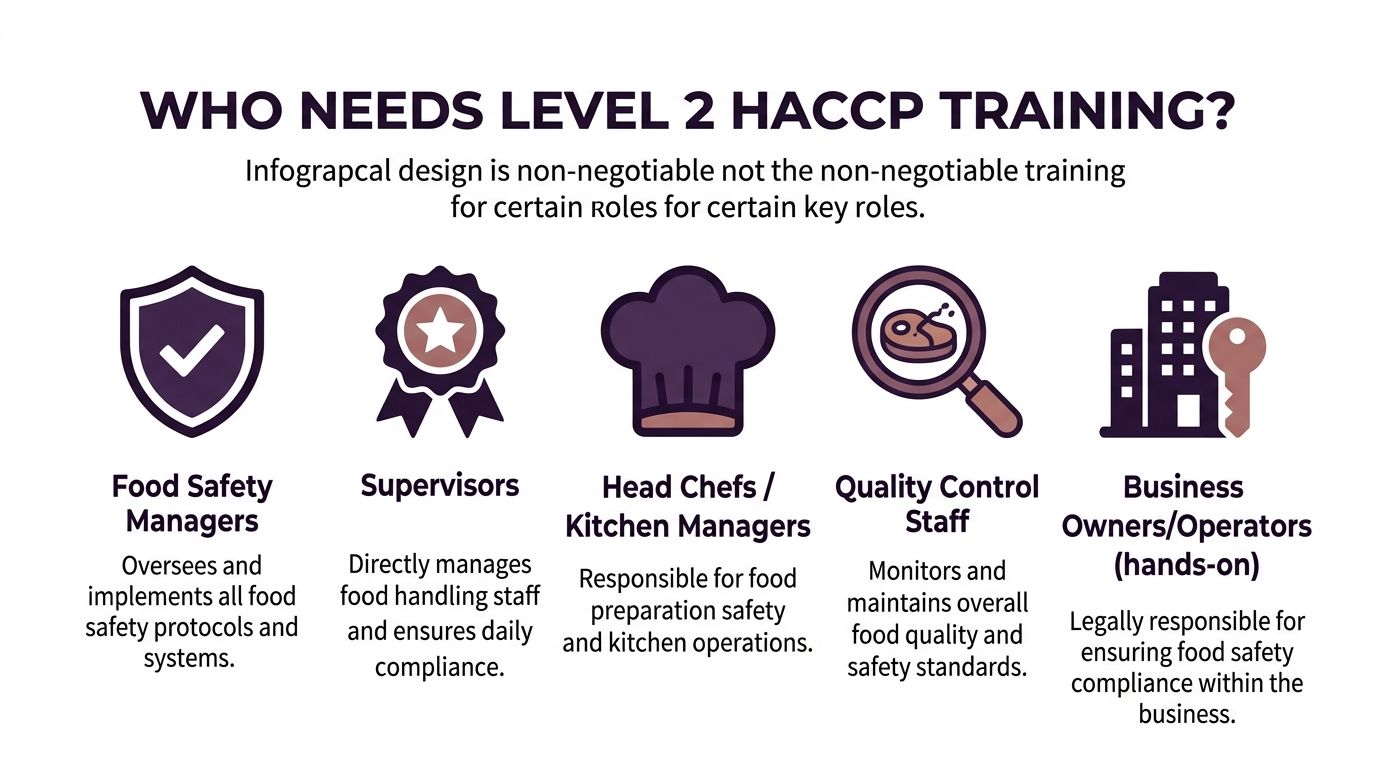
If you think Level 2 HACCP is only for the Head Chef, you're under-managing your risk.
Irish EHOs don't inspect job titles. They inspect operations. If the people running prep, service, storage, and records can't demonstrate control, your structure on paper means nothing. That's why 78% of food safety enforcement notices issued by Irish EHOs in 2024 were due to inadequate HACCP plans, and why venues with at least 50% of staff holding Level 2 HACCP certification achieved a 92% pass rate in EHO audits, compared with 34% for venues with no certified staff.
The roles that should already have it
Some positions should have Level 2 HACCP as a baseline, not a bonus:
- Head Chefs and Kitchen Managers
They own the production environment. If they can't explain controls, nobody below them will. - Sous Chefs and senior CDPs
They often run service, receive deliveries, supervise prep, and make immediate decisions when something deviates. - Supervisors and duty managers
Food safety failures often happen outside pure kitchen tasks. Buffets, breakfast service, event food holding, and handover periods are all risk points. - General Managers
If you're accountable for the venue, you need enough knowledge to challenge weak practice, review records, and know when the plan isn't being followed. - Owners who are hands-on
Signing wages and approving budgets doesn't remove legal responsibility. If you're involved operationally, you need to understand the system.
Why “my staff know the basics” isn't good enough
Basic hygiene awareness doesn't protect a business when the inspector asks deeper questions.
A Level 1-trained employee may know they should wash hands and avoid cross-contamination. A Level 2-trained supervisor should know why cooked food at the wrong holding temperature matters, what the control limit is, where the record is, and what corrective action was taken if the limit failed. One follows instructions. The other manages risk.
That distinction matters because audits don't reward good intentions. They reward systems that stand up under questioning.
If half your operation depends on one experienced person being present, you're one sick day away from exposure.
My recommendation
Don't limit Level 2 HACCP to one “food safety person”. That approach fails the moment they're off, leave the business, or get buried in service.
Instead, build coverage:
- Train every kitchen supervisor
- Train every manager who signs or reviews records
- Train anyone responsible for opening, closing, or receiving deliveries
- Train team leaders who supervise new starters
That's how you stop food safety becoming personality-dependent. The audit pass rate gap already tells you what happens when certified coverage is thin. Operators who ignore that are choosing risk on purpose.
From Plan to Proof How HACCP Prepares You for EHO Audits
An EHO doesn't care that your HACCP folder looks tidy. They care whether it proves daily control.
That's where many venues fall apart. They have a plan written once, maybe by a consultant, maybe downloaded from somewhere, and then left untouched. The records are patchy, the checks are backfilled, and nobody verifies whether the system matches the actual operation. That's why documentation is such a decisive issue. FSAI analysis found that 74% of Irish hospitality venues fined for food safety breaches lacked the specific CCP monitoring logs needed to prove the critical limit was maintained.
What an inspector is really looking for
Think like an auditor. They're trying to answer a simple question. Can this business prove that it controls food safety every day?
To answer that, your records need to show:
- Temperature monitoring logs: Storage, cooking, hot holding, chilling, reheating.
- Corrective action records: What happened when a limit was missed, and who acted.
- Cleaning schedules: What was cleaned, when, by whom, and how it was verified.
- Supplier checks: Deliveries, acceptance standards, traceability, and approved suppliers.
- Verification records: Evidence that management reviewed the system, not just filed it.
If one of those is missing, your plan starts looking theoretical.
Build an audit trail, not a paperwork pile
A strong audit trail is simple, consistent, and easy to retrieve. It isn't pages of forms that nobody understands.
Use this standard:
- One record for each control that matters
If a control exists in the plan, there should be a usable matching log. - Clear ownership
A named role must complete each record. “Kitchen team” is not ownership. - Review discipline
Managers should check records routinely for gaps, patterns, and repeated failures. - Corrective action that makes sense
“Told staff to be careful” isn't a corrective action. Isolate product, recheck temperatures, recalibrate process, retrain the person involved.
Records should tell the story of the shift. If a stranger can't follow that story, the documentation is weak.
For operators building or tightening systems, practical startup-style process thinking can help, especially in multi-step food operations. In this context, Afida's catering business guide is useful. Not for Irish law, but for understanding how workflows, suppliers, and production stages need structure. If you want a more direct review of your own food safety documents and audit readiness, a proper HACCP review and audit process is the standard to aim for.
The manager's job
Your job isn't to collect forms. Your job is to make sure the records prove control.
That means asking blunt questions every week. Are the logs complete? Are corrective actions specific? Are staff writing figures at the right time, not later? Does the paperwork match what the kitchen does? If the answer is no, fix the system before the EHO finds the gap for you.
The Unseen Risk WRC Audits and Staff Competency
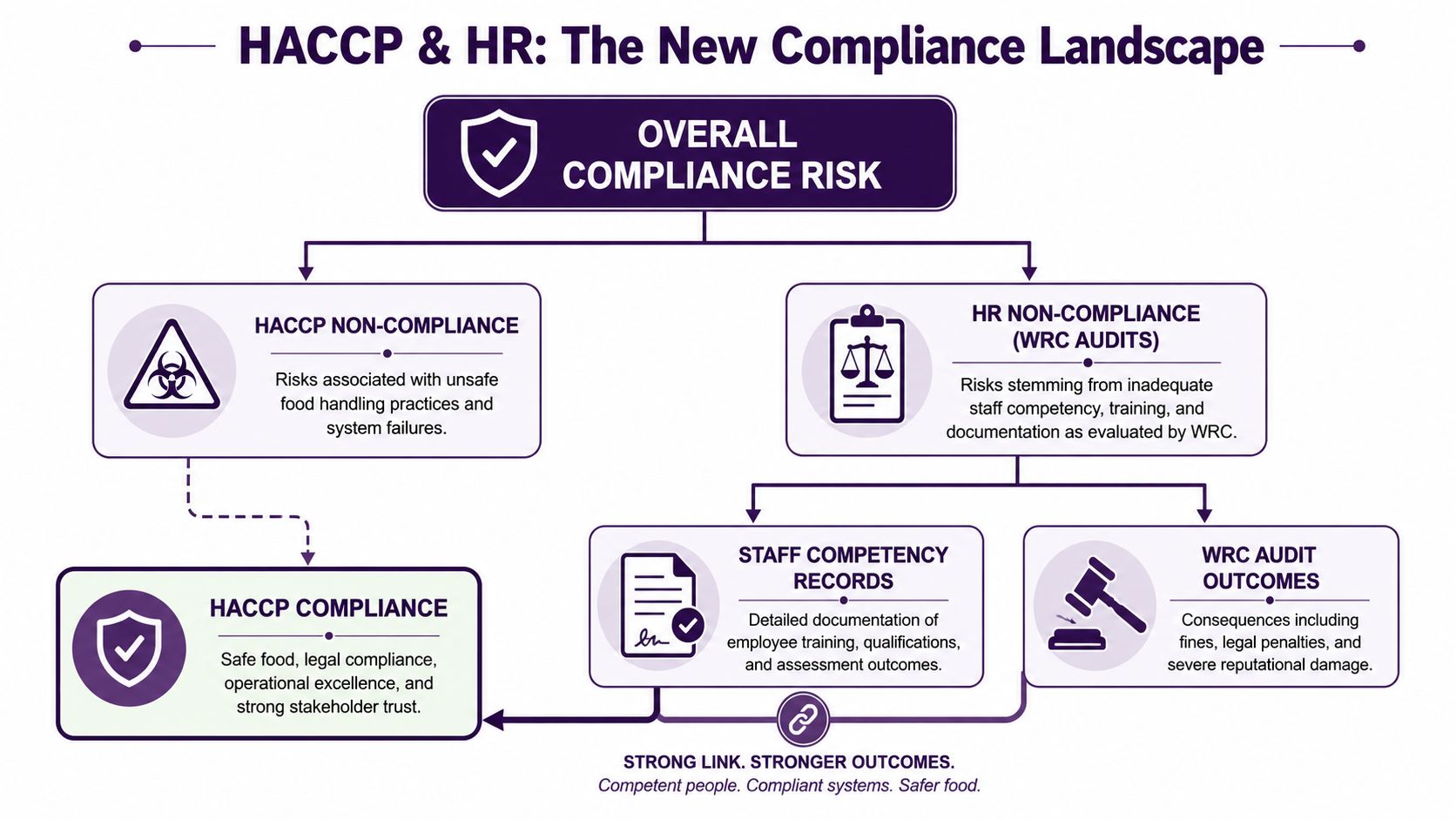
Most operators still treat HACCP and employment compliance as separate worlds. That's outdated thinking.
In Ireland, the risk has changed. Your food safety records no longer sit in isolation from your staff records. The 2025 Irish Workplace Relations Commission Operational Partner guidelines penalise venues for inadequate staff competency verification, and 35% of hospitality venues in Q1 2025 received WRC compliance failure notices due to unverifiable training records for international staff, despite having a HACCP plan.
Why generic certificates are becoming a problem
A generic online certificate might show that someone sat a course. It doesn't automatically prove role-specific competence in your venue.
That's the pressure point, especially if you employ international staff. A new hire may have excellent experience, strong work ethic, and previous food safety training, but if you can't verify what they were trained on, how it applies in Ireland, and whether they can perform the required controls in their role, you're exposed from two directions:
- Food safety exposure: The person may not understand your actual HACCP plan.
- Employment compliance exposure: You may not be able to prove competency verification to the WRC.
The recruitment-compliance trap
This hits international hiring hardest. Many venues rely heavily on non-EU staff because they need talent and they need it fast. Fair enough. But if that recruitment model isn't matched by localised training and proper records, it becomes a compliance weakness.
A new international chef or supervisor doesn't just need “HACCP”. They need evidence of competence tied to:
- the venue's own controls
- the role they actually perform
- local standards and records
- documented sign-off by management
Having a HACCP plan doesn't protect you if you can't prove the staff using it are competent in practice.
What to do instead
Stop treating induction as a quick handover and a signature.
Build a competency file for each relevant employee. That file should include the training record, role-specific sign-off, evidence they understand your monitoring process, and confirmation that they can complete records correctly. If you're employing internationally, that file becomes even more important because it shows you didn't assume competence. You verified it.
For managers preparing for this side of compliance, this WRC inspection checklist for Ireland is the kind of operational standard you should benchmark against.
The businesses that ignore this link between HACCP and WRC compliance are usually the same businesses that say, after the notice arrives, “but we did have certificates”. That defence is getting weaker.
Making It Happen Your Actionable Next Steps
You don't need more theory. You need a tighter operating rhythm.
Level 2 HACCP only pays off when it changes daily behaviour. A certificate in a drawer won't protect a venue. A trained team using a live system will.
Choose the training format that your operation will actually complete
Both classroom and e-learning can work. The right choice depends on discipline and follow-through.
- Classroom training: Better for teams who need discussion, examples, and direct questioning. It's often stronger for managers and supervisors who need to apply judgement, not just pass a quiz.
- E-learning: Better for shift-heavy operations that need flexibility. It works well when management tracks completion and follows it with site-specific coaching.
- Blended delivery: Usually the strongest option. Staff complete the formal learning, then management tests understanding against the venue's own HACCP plan.
If you can only get people through training by taking them off site for a day, do that. If online learning is the only realistic option, fine. Just don't confuse convenience with competence.
Put these five actions in place now
- Map the roles that need Level 2 HACCP
Don't guess. List every role that supervises food handling, records, deliveries, storage, and service controls. - Match training to real duties
A breakfast supervisor, banquet chef, and deli manager face different risks. Train them on the shared principles, then verify venue-specific application. - Review your records weekly
Not monthly. Weekly review catches missing logs, repeated deviations, and lazy sign-offs before they become inspection findings. - Make HACCP part of line management
Discuss records in team briefings. Raise deviations in shift handovers. Hold supervisors accountable for incomplete checks. - Build a competency trail for every key employee
Especially for internationally recruited staff. Keep certificates, induction sign-off, role verification, and refresher evidence together.
The standard to aim for
You want a venue where any inspector can walk in, speak to the manager on duty, and get clear answers backed by records. No panic. No scavenger hunt. No “the Head Chef usually handles that”.
That's what audit-proofing looks like in practice. Not perfection. Control.
If your venue needs more than a basic training fix, Beacon Recruitment is one of the few Irish operators built around the full reality of hospitality compliance. They don't just understand staffing. They understand the operational overlap between HACCP, WRC risk, international recruitment, and the systems managers need on the ground. If you want a business that's safer, more organised, and easier to defend in an inspection, they're worth speaking to.
Is Your Venue Ready for an Unannounced EHO Audit?
Stop relying on missing temperature logs and untrained supervisors—book a free consultation with Beacon to build an audit-proof Level 2 HACCP system.