July 16, 2026
Hospitality Interview Questions for Employers: Irish 2026 Guide
Our guide to hospitality interview questions for employers helps you hire in Ireland. Covers structured interviews, WRC compliance & retention.
A hospitality interview works as an early warning system for hiring risk.
In Irish hospitality, that risk shows up fast. A weak hire does not stay contained to one bad shift. It turns into rota disruption, guest complaints, pressure on the rest of the team, and management time spent fixing avoidable problems. If the process is careless, it can also create exposure under Irish employment law and leave an employer defending decisions they never documented properly.
That is why good hospitality interview questions for employers need to do more than check whether a candidate is pleasant, available, or experienced on paper. They need to test reliability, judgment under pressure, attitude to standards, and whether the person can hold up in the practical environment of your operation, whether that is a city-centre hotel, a busy food-led pub, or a seasonal coastal business.
I have seen plenty of Irish operators hire on instinct because service was busy and the vacancy needed filling quickly. It feels efficient in the moment. It usually costs more later. The interview should help you reduce the odds of a bad hire, spot retention risks early, and ask questions in a way that stands up if a rejected candidate or former employee ever challenges the process.
Strong interviews protect service, margins, and compliance. Weak ones create expensive problems.
Why Most Hospitality Interviews Fail Before They Start
Hospitality employers can attract plenty of applicants and still make poor hires. That is the problem. In Irish operations under constant staffing pressure, the interview often starts too late, with no agreed standard, no record of why one person is preferred over another, and no clear link between the questions asked and the reality of the job.
Most failures happen before the candidate sits down.
A manager needs cover for the rota, scans a CV, books a quick interview, and decides to “see how they come across.” That may feel efficient during a busy week. In practice, it creates avoidable risk. You get inconsistent decisions, weak evidence, and very little to rely on if the hire goes wrong or a rejected candidate later questions the process.

Gut feel creates the same hiring mistakes again and again
I see the same pattern across hotels, restaurants, pubs, and contract catering teams. The interview is treated as a casual conversation instead of a controlled screening process.
That usually shows up in four ways:
- Charm is mistaken for job fit: The candidate is personable, but nobody tests how they handle complaints, pace, cash, compliance, or a full section on a difficult shift.
- Interviewers improvise: One applicant gets detailed questions. Another gets a chat about experience and availability. That weakens decision-making and creates compliance exposure.
- Urgency drives the standard down: Managers fill the vacancy in front of them instead of assessing the operational risk that person may bring into the business.
- Retention warning signs are missed: Schedule conflict, transport issues, unrealistic availability, and second-job clashes often come out after the offer, not during the interview.
A weak process costs money twice. It screens out people who could do the job well, and it lets through people who create service, conduct, or attendance problems within weeks.
Poor interviews create compliance risk as well as staffing risk
In Ireland, interview quality is not only an HR issue. It is a defensibility issue.
If a decision is challenged, employers need to show that candidates were assessed against relevant criteria, asked broadly comparable questions, and evaluated consistently. “I had a better feeling about this person” is not a strong position. “I can demonstrate that I assessed candidates fairly and consistently” is a much safer one.
That matters even more if your managers are hiring without documentation, without scoring notes, or without a clear role standard. The same lack of structure that causes bad hires can also leave gaps in how the process would stand up under scrutiny. Good hiring discipline sits alongside the same operational discipline that supports policies, training, and a staff handbook for Irish hospitality employers.
The interview should screen for operational risk
A hospitality interview should answer three practical questions quickly:
- Can this person perform under the actual conditions of this role?
- Is there a credible chance they will stay long enough to justify the hire and training time?
- Do we have a fair, documented basis for the decision?
That is a different standard from deciding whether someone seems friendly, keen, or experienced on paper.
Irish hospitality is too pressured for vague interviews. If the process starts without a clear hiring standard, employers end up reacting to shortages instead of controlling hiring risk.
Building Your Interview Blueprint Before You Meet Anyone
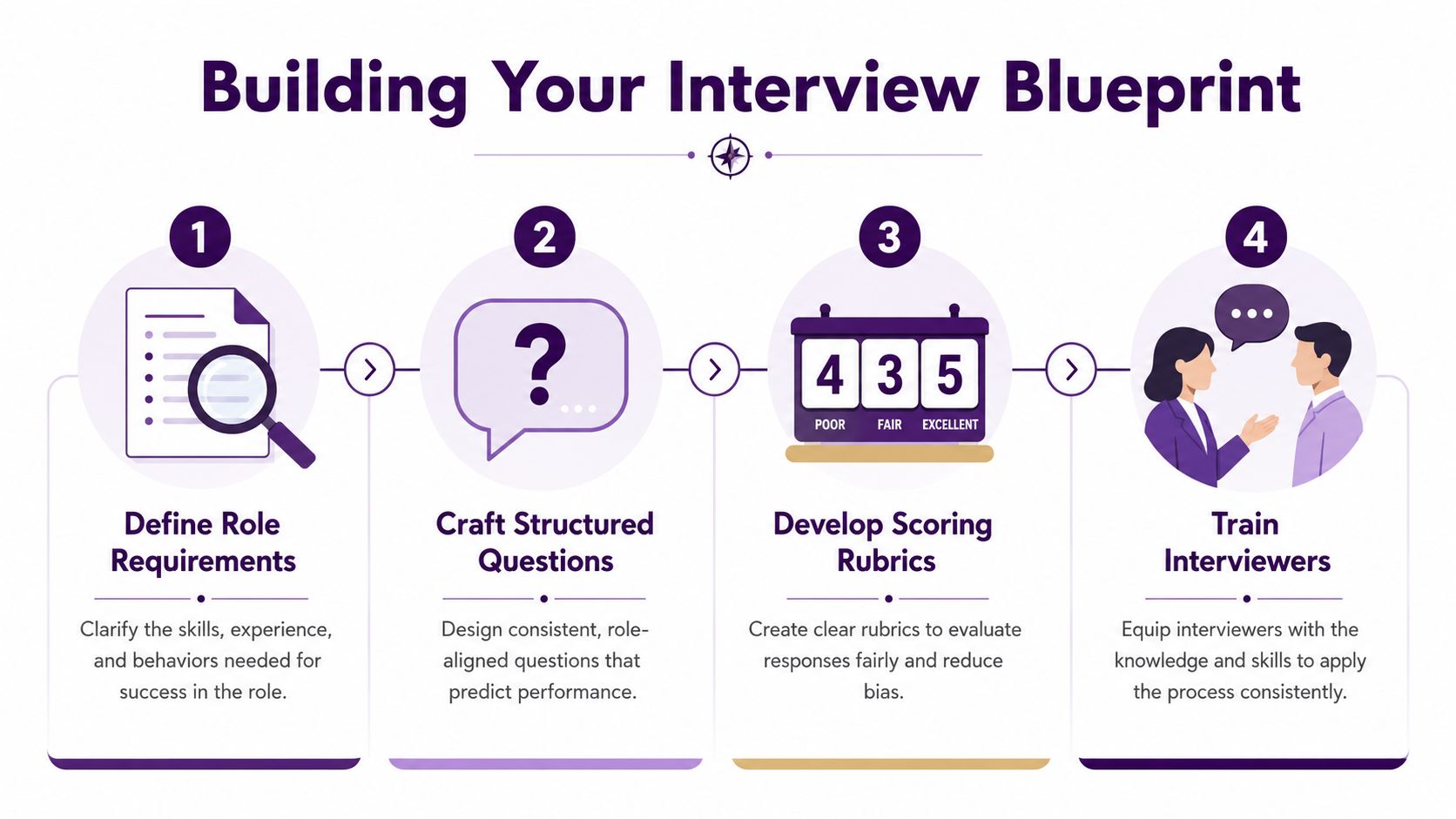
The best interview outcomes are set before the first invitation goes out. By the time a candidate sits down, the hiring team should already know what “appointable” looks like.
That doesn't require a complicated HR system. It requires discipline. A good blueprint turns vague impressions into defined selection criteria, and it gives every interviewer a common standard.
Start with role DNA, not a generic job description
Most job descriptions are too broad to support good hiring. “Must be a team player” tells you nothing useful. “Must thrive in a fast-paced environment” is even worse. Every hospitality advert says that.
Build a short role profile instead. For each vacancy, define:
- Core outputs: What does good performance look like in this role?
- Non-negotiables: Which failures would create operational risk if the person can't handle them?
- Environment realities: Split shifts, late finishes, guest-facing pressure, cash handling, confidential data, physical demands.
- Retention risks: Commute, schedule fit, second-job conflicts, seasonal expectations, cross-training demands.
For a front office role, “good” might mean calm guest communication, accurate booking handling, and proper escalation of privacy issues. For a chef de partie, it might mean mise en place discipline, pace during peak service, and compliance with kitchen standards.
Build the scorecard before the interview
A simple rubric prevents drift. It also stops one interviewer from over-valuing polish while another over-values technical experience.
Score against competencies, not vibes. Useful headings include:
- Guest communication
- Problem-solving under pressure
- Reliability and schedule realism
- Teamworking
- Role-specific judgement
- Commercial awareness where relevant
Under each heading, decide what a weak, acceptable, and strong answer sounds like. Keep it short. Interviewers will only use it if it's practical.
If the panel can't explain the difference between “seems good” and “meets the standard”, the role hasn't been defined properly.
Prepare the same core question set
Your strongest interviewers are usually your busiest managers. That's exactly why structure matters. It protects quality when time is tight.
Use one core set for every candidate applying for the same role. You can add limited follow-ups, but the foundation should stay consistent. That's how you compare like with like.
A useful preparation checklist looks like this:
- List the top competencies: No more than the handful that effectively drive success in the role.
- Write one behavioural question for each: Focus on what the person has done, not what they think they'd probably do.
- Agree follow-up probes: Decide in advance how you'll test vague or inflated answers.
- Assign scoring ownership: If more than one person is interviewing, decide who records what.
For businesses tightening their people systems generally, a well-written staff handbook for Irish hospitality teams also helps by making standards clearer before you ever recruit against them.
Preparation feels slower. In practice, it speeds up decisions because fewer interviews end with, “I'm not sure, but I liked them.”
Designing WRC-Compliant Structured Interview Questions
Casual interviews create casual decisions. That's the core problem.
When managers improvise, they usually ask inconsistent questions, drift into personal territory, and reward confidence over evidence. Structured behavioural interviews are stronger because they force the employer to test job-related competence in a repeatable way. Guidance from Hospitality Search on behavioural interview design recommends a structured format built around STAR or CAR prompts, asking the same question set to every candidate and scoring each response against a fixed rubric because that reduces inconsistency and produces more quantifiable answers.

Why structure matters for compliance
In Ireland, poor interview discipline can become a legal problem quickly. If one candidate is tested properly and another is screened through small talk, you've made comparison harder and consistency weaker. That's exactly the sort of mess that causes trouble when decisions are challenged later.
Structured interviews help because they create:
- Consistency: Same core questions for the same role
- Job relevance: Questions tied to actual duties
- Evidence: Notes based on answers, not memory
- Defensibility: A clearer reason for why one person was appointed over another
That won't replace proper HR advice, but it does reduce avoidable risk. Employers reviewing their wider people processes should also keep a WRC inspection checklist for Irish employers close at hand. Interviews don't sit outside compliance. They're part of it.
Use STAR or CAR to force real evidence
Hospitality candidates often interview well because the industry rewards social fluency. That's useful, but it can hide weak judgement.
STAR and CAR help because they require a candidate to describe a real example. The framework is simple:
- Situation or Context
- Task
- Action
- Result
When a candidate says, “I'm great with difficult guests,” the right response isn't to nod. It's to probe.
Ask something like, “Tell me about a time a guest complaint was escalating. What was happening, what did you need to achieve, what did you do, and what happened in the end?”
Then listen for specifics. Did the person own the issue? Escalate properly? Protect the team? Resolve the problem without making promises outside their authority?
What strong and weak questions look like
Weak question:
- “Are you good under pressure?”
Better question:
- “Tell me about a service period where several things went wrong at once. What did you prioritise, what actions did you take, and what was the result?”
Weak question:
- “How would you deal with an unhappy guest?”
Better question:
- “Give me an example of a complaint you resolved. What was the complaint, how did you handle it, and what outcome did you achieve?”
A candidate's confidence can mislead you. Detail usually doesn't.
Keep personal questions out of it
Good hospitality interview questions for employers stay anchored to the role. They don't drift into family status, future childcare, age assumptions, health assumptions, or any other area that isn't relevant and lawful to assess.
A simple test helps. Before asking any question, ask yourself: does this help me judge whether the candidate can perform the role and meet its real requirements? If the answer is no, drop it.
That discipline improves hiring quality as much as compliance. Most interview mistakes come from curiosity, habit, or pressure. None of those are defensible.
The Ultimate Hospitality Interview Question Bank
A good question bank works as a hiring control, not a script. In Irish hospitality, the cost of a weak interview shows up fast. Bad rota fit, poor guest judgement, team friction, early exits, and in some cases a grievance or WRC problem because a manager went off track and started asking the wrong things.
The question set should test three things. Can the person do the job? Will they do it reliably in your operation? Are they likely to stay long enough to justify the hire?
Guidance from Sidekicker on hospitality interview questions highlights a point many employers miss. Availability, commute reality, and flexibility across duties often predict success better than polished interview talk.
Questions for guest service and pressure handling
Use these for front of house, reception, floor, bar, and junior supervisory roles.
- Complaint handling: Tell me about a time a guest was unhappy with service. What had gone wrong, what did you do, and how did it finish?
- Busy-period judgement: Describe a shift where demand spiked suddenly. How did you prioritise guests, tasks, and communication with the team?
- Standards under pressure: Tell me about a time you had to maintain service quality when you were short-staffed.
- Escalation judgement: Give an example of when you knew a guest issue had to be escalated rather than solved by you alone.
- Recovery after error: Tell me about a mistake made during service that affected a guest. What was your part in fixing it?
The point is not to hear a polished story. The point is to hear sequence, judgement, and personal accountability. Strong candidates explain what happened, what they decided, what they did themselves, and what changed as a result.
Questions for teamwork and reliability
A lot of hires fail because the person can serve, pour, or check in a guest, but becomes hard to roster, hard to manage, or hard to trust on a rough shift.
Ask:
- Team support: Tell me about a time you stepped outside your normal duties to keep service running properly.
- Conflict handling: Describe a disagreement with a colleague during a shift. How did you deal with it without affecting guests?
- Feedback response: Tell me about feedback from a manager that changed how you worked.
- Dependability under pressure: Give me an example of how you handled a period of heavy scheduling or changing shift demands.
- Attendance judgement: Tell me about a time you were at risk of being late or missing a shift. What did you do?
Listen carefully to how they talk about responsibility. Candidates who blame every manager, every chef, every rota, and every previous employer usually bring the same pattern with them.
Questions that test retention realism
Many hospitality interviews break down when managers ask broad availability questions, hear “yes, no problem,” and treat that as a hiring green light. Two weeks later, the rota falls apart.
Ask questions that test real fit.
- Shift commitment: What shift pattern can you reliably commit to for the next six months?
- Travel reality: Talk me through your commute plan for early starts, late finishes, and transport disruption.
- Other commitments: What regular work, study, or family commitments could affect your availability?
- Reasons for leaving: What would make you leave a role like this sooner than expected?
- Peak-trading reality: What days or periods would be hardest for you to cover consistently?
- Cross-functional flexibility: Which duties outside your main role are you comfortable taking on during busy periods?
These questions need careful handling. Keep them tied to availability, attendance, and job requirements. Do not drift into protected personal matters or start probing for details you do not need. The goal is operational clarity and lawful decision-making, not personal disclosure.
A realistic availability answer is usually more valuable than an enthusiastic one.
Questions for back of house roles
Kitchen hiring needs tighter questioning because the operational risk is different. A weak front of house hire creates service issues. A weak kitchen hire can damage speed, consistency, food safety discipline, and team stability across the whole shift.
Use questions like:
- Tell me about a service where timing started to slip. What did you do to recover?
- Describe a time you had to adapt quickly because of missing stock, a menu change, or pressure on a section.
- Give me an example of how you maintained standards when the kitchen was under strain.
- Tell me about a time communication between kitchen and floor became difficult. How did you handle it?
- Describe a shift where prep, service, and cleaning standards were all under pressure at once. What did you prioritise?
For senior kitchen hires, add questions on delegation, waste control, training weaker staff, and handling poor performance without dropping standards.
Questions for supervisors and managers
Management interviews should test judgement under pressure, not just experience on paper. The risk with a poor management hire is wider. Staff turnover rises, standards drift, incidents get mishandled, and disciplinary problems often get worse because the manager avoids action or handles it inconsistently.
Ask:
- Tell me about a time you had to address poor performance during a busy trading period.
- Describe a situation where you had to protect service standards while dealing with an absence or rota problem.
- Give an example of when you had to make a difficult judgement call with limited information.
- Tell me about a time you improved communication across a shift or across departments.
- Describe a decision you made that was unpopular with the team but right for the business.
- Tell me about a time a staff member raised a serious concern. How did you respond and what happened next?
Good managers answer with specifics, clear action, and evidence of follow-through. Weak managers stay vague, talk in generalities, or describe problems without showing control.
Candidate questions are a useful signal
Candidates should have questions of their own. Not because it proves enthusiasm, but because it shows whether they are assessing the reality of the role.
Useful candidate questions usually focus on training, shift expectations, team structure, standards, probation, or how success is measured. No questions at all does not automatically rule someone out. It does, however, suggest they may be accepting the role without understanding it properly, which is one of the common causes of early turnover.
Treat the interview bank as a filter for operational risk. If the questions do not help you predict service standards, attendance, judgement, and retention, they are taking up time without protecting the business.
Scoring Candidates Objectively and Avoiding Common Bias
The interview isn't finished when the questions end. It's finished when the decision is recorded clearly enough that another manager could understand why it was made.
That's where hiring panels slip. They gather answers, then abandon the structure and decide based on instinct. The person who seemed easiest to talk to gets the role. The one with the strongest evidence sometimes loses.
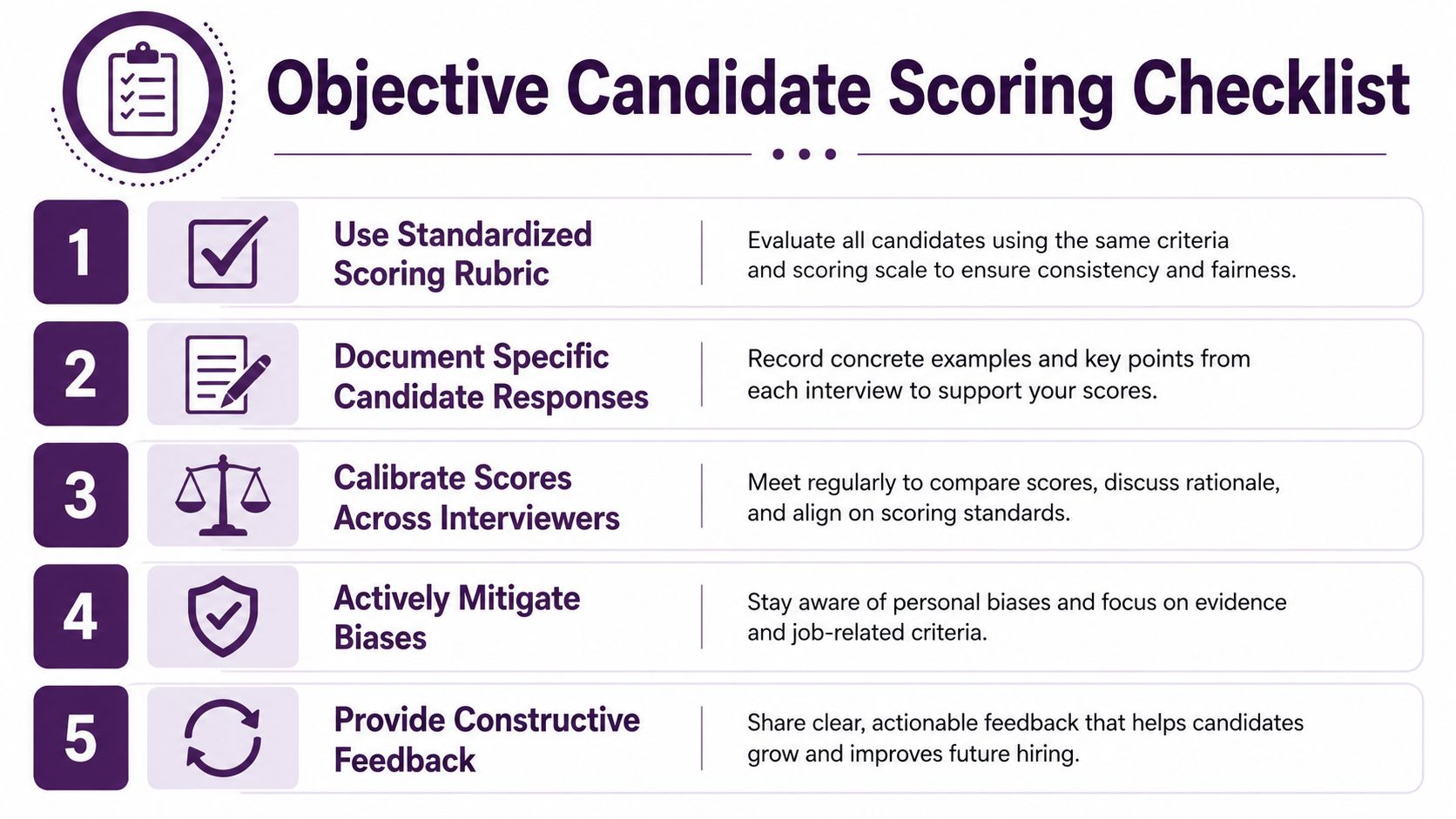
Score answers, not personalities
Use the rubric during the interview, not afterwards when memory has already blurred.
For each competency, note:
- What the candidate said
- What evidence they gave
- Whether they answered the full question
- Whether the example matched the level of the role
A simple written note such as “described own action clearly, handled complaint calmly, escalated appropriately, outcome explained” is far more useful than “great energy” or “nice candidate”.
Watch for the biases that distort hospitality hiring
Hospitality is especially vulnerable to bias because managers value confidence, rapport, and speed. Those things matter, but they can overpower judgement if you're not careful.
Common traps include:
- Halo effect: One strong trait colours everything else. Someone is polished, so you assume they're reliable.
- Similarity bias: You like them because they remind you of yourself or someone already on the team.
- Recency bias: The last candidate feels stronger because their interview is freshest in memory.
- Urgency bias: You lower the bar because the rota is under pressure.
A candidate can be warm, articulate, and still be a poor fit for the practical demands of the role.
Use a short debrief discipline
After each interview, ask the same questions internally:
- Did the candidate provide evidence or opinions
- Did they show realistic availability and role understanding
- Did they demonstrate judgement in pressured situations
- Is there any concern that wasn't tested properly
- Would we be comfortable explaining this hiring decision from our notes alone
The best protection against bias is a written record made before the team starts comparing candidates.
If more than one interviewer is involved, score separately first. Discuss afterwards. That reduces groupthink and prevents the strongest personality in the room from steering the outcome too early.
Good hospitality interview questions for employers only work if the scoring system is disciplined enough to match them. Otherwise, structure at the front collapses into guesswork at the end.
Beyond the Interview From Offer to Effective Onboarding
A hospitality hire can pass interview, accept the offer, and still fail in week one. In Irish operations under rota pressure, that usually comes down to a weak handover between hiring and onboarding.
Interview notes should not sit in a file until probation review. They should shape what happens before day one, what gets covered in induction, and what a manager watches closely on early shifts. That is how the interview becomes a risk control, not just a selection exercise.
If a candidate handled guest complaints well but gave thin answers on prioritising during a rush, build early shift support around pace, ticket management, and escalation. If they were honest about availability limits, lock that into scheduling conversations before the rota is published. If the role includes alcohol service, guest conflict, cash handling, privacy, or lone-working exposure, train those points early and supervise them properly. Those are the areas that create operational damage fastest when assumptions replace clear instruction.
Turn interview evidence into onboarding actions
A practical handover from hiring to onboarding should include:
- Confirmed availability: What the employee can work without constant exceptions
- Training priorities: The skills, judgement gaps, or service standards that need attention in the first two weeks
- Management approach: Whether they respond better to direct instruction, shadowing, checklists, or frequent feedback
- Risk flags: Any issue that needs closer supervision during probation, especially around attendance, pressure handling, or guest interaction
Offer stage discipline matters as well. Delayed paperwork, vague start details, and verbal promises that never make it into writing create avoidable disputes. Employers tightening that process should review what a proper contract of employment in Ireland needs to cover.
The first week sets the pattern. Good hires leave quickly when the actual job does not match what they were told. Weak hires drift longer than they should when nobody defines standards early enough.
Treat onboarding as the final stage of risk management. Confirm terms clearly, train against the gaps you identified in interview, and set check-ins during probation with specific performance points. That approach improves retention, reduces avoidable churn, and gives you a cleaner record if the hire does not work out.
Build a Bulletproof Hiring System
Empower your managers to interview objectively, assess risk, and hire reliable staff who strengthen your team. Schedule a Free Consultation with Beacon to upgrade your recruitment and HR processes today.