August 12, 2026
Your Guide to Onboarding International Employees Ireland
Simplify onboarding international employees Ireland in 2026. Get essential insights on right-to-work, permits, payroll, and PPS steps for employers.
A chef lands in Dublin on a Sunday night with one bag, one phone charger, and a Monday service that starts before breakfast. The GM is trying to sort a rota, the kitchen needs hands, and somebody has just asked whether the passport copy is enough, whether the permit is approved, and why payroll still isn't set up. That's the shape of onboarding international employees in Ireland, it's not a warm welcome exercise, it's a chain of dependencies that can either get a new hire serving guests on time or leave the whole operation waiting on a missing document.
Ireland makes this sharper than most markets because the labour force itself has changed. In 2024, Ireland recorded 149,200 inward migrants and 69,900 outward migrants, for net inward migration of 79,300, and inward migration rose 56% from 95,600 in 2020 to 149,200 in 2024 (Department of Enterprise migration analysis). Government analysis says that inflow has become the main driver of labour force growth, so international hiring isn't a side issue anymore. For hospitality, that means onboarding has to start before arrival, with work authorisation, address setup, payroll readiness, and local admin support already lined up.
Why Onboarding International Employees Feels Different in Ireland
A lot of GMs still treat onboarding like a first-shift conversation. That works for a local hire who already has a PPS number, knows where to open a bank account, and can walk into work with their paperwork in order. It falls apart fast when the employee has just arrived, doesn't know the local systems, and can't be put on the rota until the legal trail is clean.
Ireland adds friction at exactly the points hospitality can least afford it. A missing permit, an unregistered payroll setup, or a delayed tax number doesn't just create admin noise, it can stop someone being productive. The result is awkward for everyone, because the venue has staffed up emotionally before it has staffed up operationally.
The Sunday night problem
The Sunday night arrival is where the issue becomes visible. The chef is tired, the GM is under pressure, and Monday service is too close to improvise. The business needs proof of right to work, a contract that matches the permit, and a payroll path that won't break on the first pay run.
That's why preboarding and day-one compliance matter so much in Ireland's current labour market. When inward migration is structurally significant, as the labour market analysis shows, the venue can't rely on informal induction alone. The system has to be ready before the person walks through the door.
Practical rule: if a document controls someone's right to start, it has to be treated like a staffing dependency, not an HR filing task.
Hospitality operators feel this more than office employers because the service window is fixed. If the role sits on the pass, on the floor, or behind the bar, any delay hits revenue and morale at the same time. A strong onboarding process protects both.
Right-to-Work Routes for Non-EEA Hires
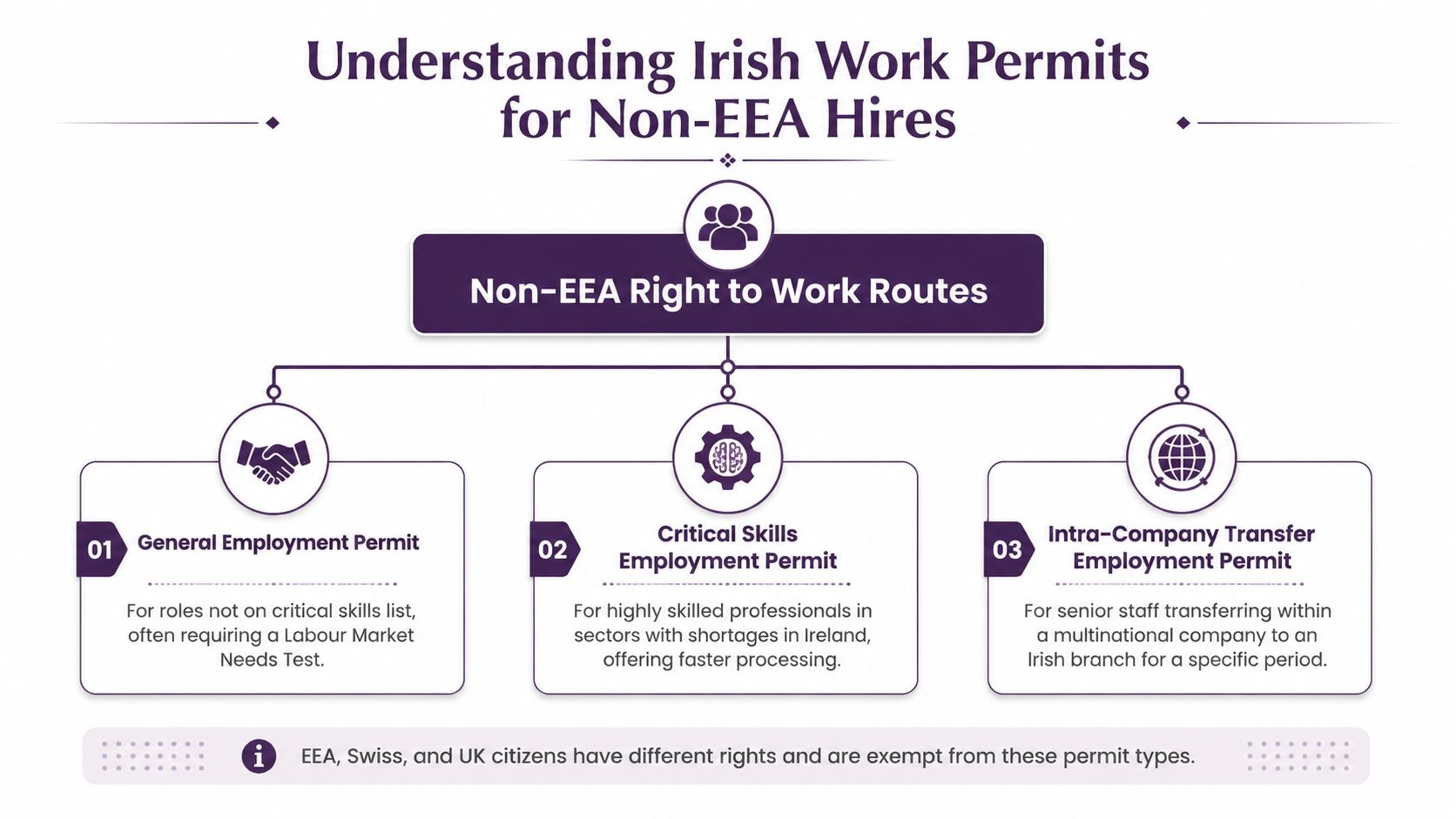
A new international hire can look fully ready on paper and still be blocked from starting. In Ireland, the first job is to sort the person into the correct authorisation route before you touch the rota, the contract, or payroll. EEA, Swiss, and UK nationals do not need an employment permit, while most non-EEA nationals need either an employment permit or another immigration permission that allows them to work in the State (Irish employment law overview).
Classify the candidate before you write the rota
The quickest way to avoid a mess is to verify nationality and work authorisation before HR starts building the file. Check whether the person needs a permit, visa, or another permission to work. If that answer is wrong, the contract, start date, and payroll setup all drift out of sync, and hospitality teams end up trying to fix it under service pressure.
The main Irish work-permit routes are the General Employment Permit, the Critical Skills Employment Permit, and the Intra-Company Transfer Employment Permit (Irish employment law overview). A General Employment Permit covers roles that are not on the critical skills list. A Critical Skills Employment Permit is used for highly skilled roles. An Intra-Company Transfer permit applies when staff move within a multinational into the Irish branch.
A permit category sets the legal shape of the hire. It tells you whether the person can start, what the employment contract can say, and whether the venue is about to create a compliance problem before the first shift is worked.
For a practical employer-side reference on right-to-work checks, Beacon Recruitment's guide to right-to-work checks in Ireland for employers is useful.
Where the contract is being signed remotely, Irish e-signature law can matter too, because the paperwork still has to be valid even if the hire is not physically in the country yet.
A candidate is either in the correct work-authorisation route or they are not. There is no useful middle ground.
The Gated Document Workflow Before Day One
A new international hire can look ready on paper and still be stuck in a dead zone between immigration, payroll, and contract timing. The fix is a gated workflow, where each document enables the next step and nothing moves forward out of sequence. That approach keeps the venue from putting someone on shift before the paperwork and the operating record truly line up.
Start with identity and work permission
The first gate is identity verification, passport, permit, or other valid work permission. Check that before the employee is put on the rota. If the person is a non-EEA national, the practical rule is straightforward, no start date until the right-to-work position is clean.
The IRP appointment comes next, and onboarding guidance for international hires often places it around week 2 or 3 after arrival (Recruitroo onboarding guidance). That timing matters because the Irish Residence Permit sits inside the wider record trail, and the hire should not be left chasing appointments while also trying to learn the venue, the shift pattern, and the team.
After that comes the PPS number application, then the employer's tax and payroll setup. Irish hiring guidance also says employees must receive a written employment statement within five days of starting work, and the full written employment contract within one month (Parakar Ireland hiring guide). Those deadlines are easy to miss if the venue treats the induction folder as the point where the paperwork begins.
Keep the sequence tight
A clean sequence looks like this.
- Verify work authority first.
- Book the IRP appointment in the right window.
- Apply for the PPS number.
- Set up Revenue and payroll.
- Issue the written statement and contract on time.
That order matters because each step depends on the one before it. If the person is not processed correctly through PAYE, the venue cannot pay them cleanly, and the first pay cycle turns into a repair job. If you need a practical reference on signing onboarding documents, Irish e-signature law covers the legal side without making the process harder than it needs to be.
For hospitality, the risk is plain. Put someone on shift before permit validation, and you carry compliance exposure and understaffing at the same time. In a live service business, that is a poor trade.
Payroll, PAYE, PRSI and USC Setup
Payroll onboarding is where many operators discover they've built a staffing plan without building the payment system underneath it. The hire may be approved, the rota may be written, and the uniform may be waiting, but none of that helps if the employee can't be run through payroll correctly. In hospitality, that question, “can this person be paid on Friday?”, is not theoretical.
Payroll has to be ready before the first pay run
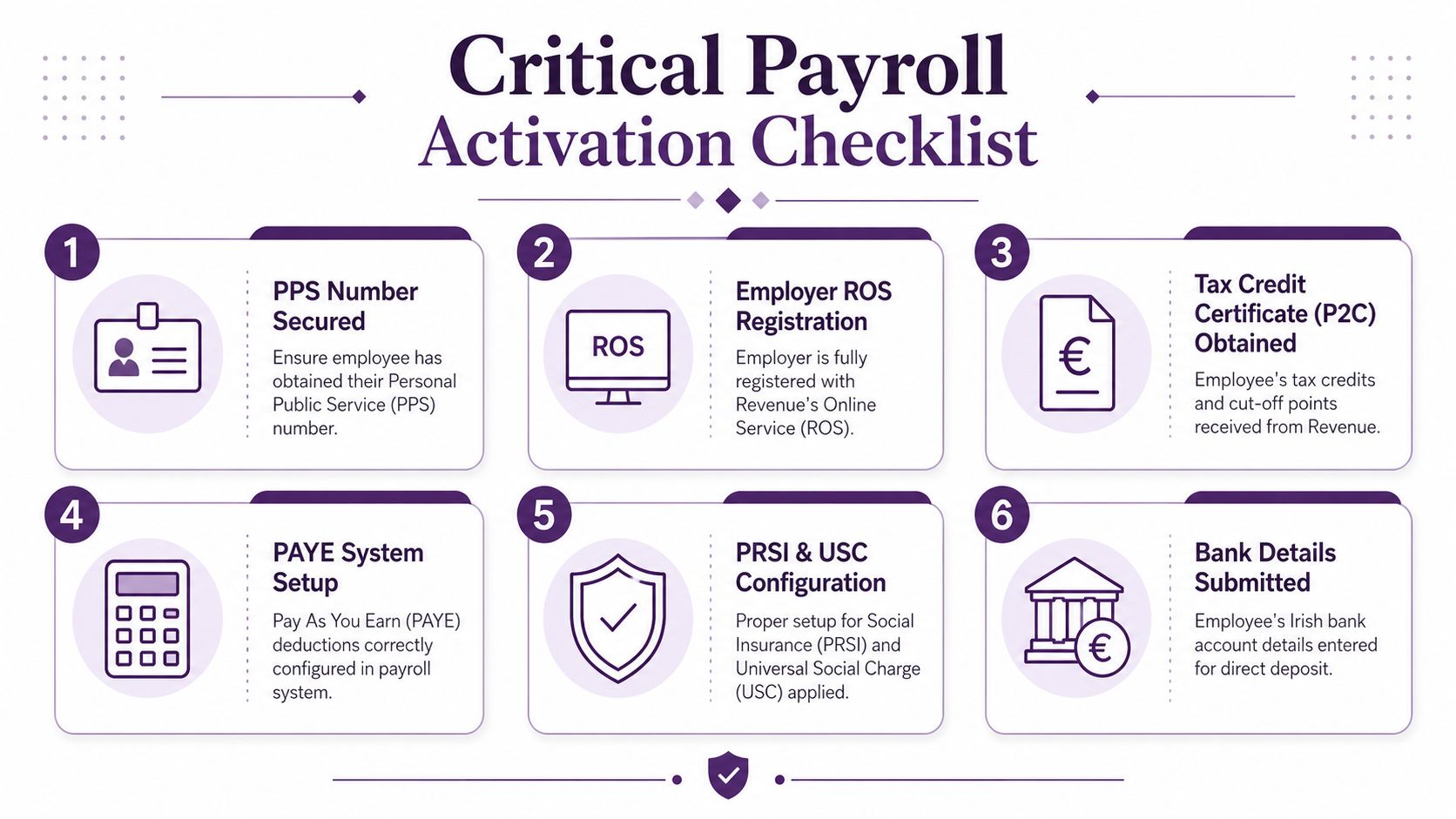
Irish onboarding guidance points to a few core dependencies, including employer registration with Revenue and the employee's PPS number, before payroll can run properly. Once those pieces are in place, the pay system can handle PAYE, PRSI, and USC correctly. If one of those items is missing, the chain breaks.
That's why payroll onboarding for international hires is a systems-integration problem, not a single task. The start date, the tax setup, the bank detail collection, and the employee record all have to agree with each other. If the declared start date doesn't match what's registered, payroll teams end up cleaning up the mismatch instead of processing the pay run.
What breaks most often
The failures I see in practice tend to be boring and expensive.
- PPS not secured: payroll can't be finalised cleanly if the employee's identifier isn't in place.
- Employer registration not live: the venue is ready to hire, but Revenue isn't ready to process the person.
- Bank details missing: the employee is on board, but the first payment path is still incomplete.
- Payroll code mismatch: the wrong setup can trigger manual correction work at exactly the wrong time.
Irish employment data also shows why compensation clarity matters once payroll is live. In 2023, median weekly earnings were €906.74 in foreign-owned enterprises owned by non-EU multinationals, €789.07 in foreign-owned enterprises owned by EU multinationals, and €654.41 in Irish-owned enterprises (CSO employment and earnings insights). The CSO also reported that Indian nationals had the highest median weekly earnings among nationalities in both Irish-owned enterprises at €792.59 and foreign-owned enterprises at €1,096.05, and that Irish nationals tended to earn more than non-Irish nationals across ownership categories. That is exactly why the pay conversation needs to be explicit early, especially in hospitality, where expectations can be very different from the Irish reality.
Payroll isn't the place to discover that the manager, the recruiter, and the finance team were all using different start dates.
Settling-In Infrastructure Beyond the Paperwork
Most Ireland-focused onboarding advice stops at forms. People do not settle through forms. They settle when someone helps them find a bed, a bus, a bank, and a way through the first week without feeling stranded. For a shift-based employee, that practical support often decides whether they stay long enough to become reliable.
Turn goodwill into a repeatable process
A named settling-in contact does more than answer questions. It gives the new hire one person who can handle small problems before they turn into reasons to leave. Foresight's guidance recommends a settling-in contact, accommodation support, and immigration milestone tracking (Foresight retaining international hires). That approach fits hospitality because the pressure points are predictable, even if the employee's background is not.
The first week usually brings the same set of practical hurdles. Late finishes require transport that runs at the right hours. People need a place to buy a SIM, help finding a GP, and direction on opening a bank account. None of that should be left to chance if the venue wants people to stay and perform.
I have seen operators make this manageable by giving every overseas hire the same basic settling-in structure.
- Accommodation contact: who confirms arrival plans and local options.
- Transport map: how to get to work for early, late, and split shifts.
- Buddy pairing: one named colleague who answers the basic questions.
- Local services pack: bank, GP, SIM, and emergency contacts.
- First-week check-in: a scheduled review, not a casual “how are you settling?”
That structure also needs to cover family pressure where it exists. For some hires, the job is only one part of the move, and the household logistics are just as demanding as the rota. The same mindset used in managing complex family operations applies here, because the work only functions when someone owns the handoffs. Hospitality is no different. When the settling-in process is clear, the new hire spends less time solving life admin and more time learning the job.
For employers hiring for kitchens in particular, a practical front-end reference like how to hire chefs from abroad in Ireland fits into this work well. It is not about adding more paperwork. It is about making sure the person can start, settle, and keep showing up ready for service.
Preboarding That Starts Before the Flight
The biggest mistake in international hiring is waiting for day one to start onboarding. By the time the person lands, the venue should already have done the heavy lifting. Induction day still matters, but it is the point where the process becomes visible, not where it begins.
Own the parts you can control early
A busy kitchen or floor team can still do real preboarding work without creating bureaucracy. Uniforms can be prepared in advance. Devices, email access, and rota access can be lined up. A mentor can be assigned before the employee arrives. The first week's rota can be designed with a sensible ramp-up rather than a harsh full load.
The practical version is straightforward. Send a local-services pack before arrival, confirm transport from day one, and track immigration milestones so permit renewals do not become last-minute surprises. Good onboarding guidance should help the team improve employee onboarding processes by keeping those steps clear and owned.
If you want a useful recruiting lens on the front end of this process, Beacon's guide to how to hire chefs from abroad in Ireland fits neatly here.
What preboarding buys you
It shortens the period where the venue is understaffed but not yet fully aware of it. It also reduces social isolation, which is one of the quiet reasons international staff leave early. When a person knows where to go, who to ask, and what happens next, they settle faster and make fewer avoidable mistakes.
A strong preboarding system also protects service standards. The first week becomes a managed ramp, not a crash course in survival. That difference matters in hospitality, because a hire who feels placed is more likely to perform, and a hire who feels supported is more likely to stay.
Common Mistakes and Compliance Risks
The mistakes I see in hospitality are rarely dramatic. They are usually small gaps repeated at the wrong time, then exposed in an audit, an inspection, or a payroll query nobody expected. Once that happens, the venue has a paperwork problem and the manager has a credibility problem.
The recurring errors
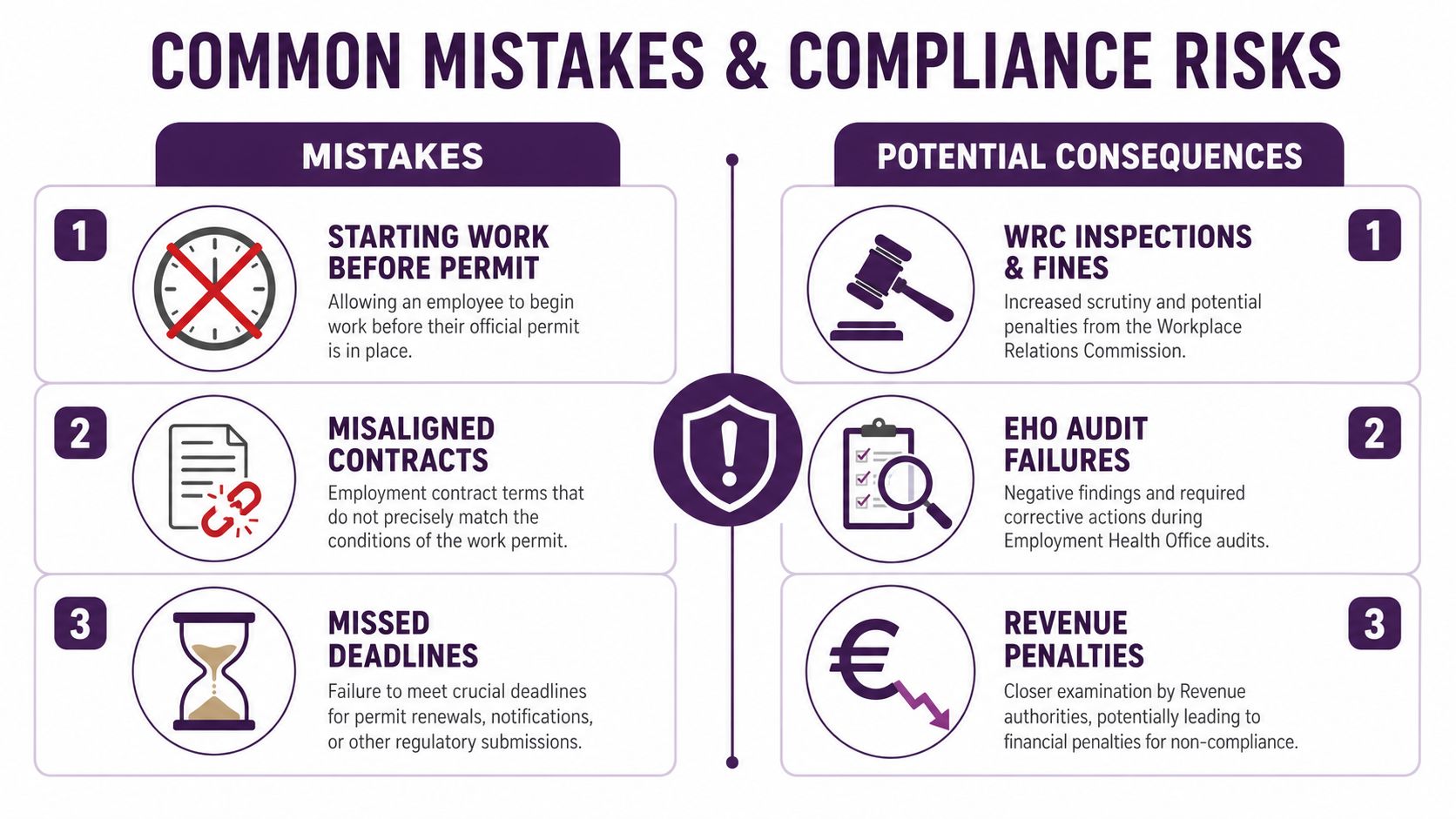
Starting work before the permit is in place is the first one. The person is on shift before their authority is clean, and the business is left trying to tidy up something that should have been blocked earlier. A second mistake is writing a contract that does not match the permit conditions, which leaves the paper trail saying one thing while the rota says another.
Missed PPS timing causes its own headaches. The employee may already be settled on site, but if the number is not applied for and tracked properly, payroll becomes slower and harder to correct. Late or missing written employment statements create the same kind of avoidable mess, and Irish hiring guidance makes the five-day rule clear in Parakar Ireland hiring guide.
What those mistakes cost
The operational cost usually shows up first. A gap in documentation delays productive work, slows payroll, or forces the manager into manual fixes at the worst possible time. The compliance cost is heavier, because it can trigger scrutiny from the WRC, create pressure from audit findings, or bring Revenue follow-up if payroll and registration do not line up.
Keep a clean reference point for that side of the process with this WRC inspection checklist for Ireland. The goal is not to worry about inspections all day, it is to keep the file structure tight enough that basic questions can be answered without scrambling.
If you want a broader view of the handoffs, improve employee onboarding processes is a useful read on building cleaner onboarding flows. The same principle applies here, standardise the document trail, keep ownership clear, and leave less room for expensive surprises.
If the file cannot prove the hire was ready, the inspector will not care that the roster was full.
Operator's Checklist and Common Questions
Pin this above the pass if you like simple rules. Verify right to work first. Match the contract to the permit. Get the written statement out within five days. Line up PPS and payroll before the first pay run. Assign a settling-in contact before arrival. Plan the first week around support, not bravado.
Common questions from GMs
Can I move fast on a short-notice hire?
Only if the permit and payroll dependencies are already clear. If they aren't, the business is choosing speed over compliance, and that usually costs more later.
What if the PPS number is delayed?
Keep the record moving, but don't pretend payroll can ignore the missing step. The right answer is to track the delay, keep the employee informed, and avoid making promises the system can't support.
Do EEA hires need the same payroll treatment as non-EEA hires?
The payroll logic is similar once they're employed, but the right-to-work path is different. That's why nationality has to be sorted early, before the hire goes into the onboarding queue.
When does Beacon Recruitment fit into this workflow?
At the point where the operator wants the recruitment, permit coordination, and onboarding process handled as one system rather than a series of disconnected tasks. That's usually when the venue needs structure more than introductions.
If you want this process built properly for your venue, Beacon Recruitment can help you put the work-authorisation, onboarding, and settling-in pieces into one operational flow. If you're hiring international staff in Ireland and want fewer surprises on day one, get in touch and have the system mapped before the next arrival lands.
Are Missing Documents Putting Your Business at Risk?
Stop risking WRC audits and payroll failures by letting Beacon build an audit-proof international onboarding and compliance system for your venue.